 FlashBoards Learn
- Learn
- Storytelling
- Catharsis
Storytelling · Film language
Catharsis
Also called: emotional release
Catharsis is the emotional release an audience feels when a story's built-up tension finally breaks, through tears, relief or laughter. It usually arrives at or right after the climax, and it is what makes an ending feel earned: the viewer walks out lighter, not just informed of the outcome.
- What it does
- Turns the pressure a story has built into a release the audience feels physically: tears, a laugh, a long exhale.
- Use it when
- The character has carried something unresolved the whole film and the audience has carried it with them.
- Watch out
- Release without buildup reads as sentimental; music and slow motion cannot fake a catharsis the story has not earned.
- Try this prompt
Close-up of a gray-haired man in his sixties crying with relief into his adult son's shoulder in a dim kitchen at night, 50mm, warm practical light, film still.
What is catharsis in film?
The word comes from Aristotle's Poetics, where tragedy arouses pity and fear and brings about the katharsis of those emotions. For storytellers the idea is simple: an audience made to feel something intensely needs a moment to let it go.
In film, catharsis is a response in the viewer, not an event on screen. The climax is the story's decisive peak; catharsis is what the audience feels when that peak resolves: grief, relief, joy or laughter. The shared ingredient is pressure. The longer a story holds something back, the stronger the release.
How does a cathartic ending work?
Catharsis needs three things, all planted early:
- A held-back emotion. The character refuses to cry, forgive or admit the truth, and the audience waits for the wall to break.
- Sustained pressure. Near misses, where the character almost lets go, raise the stakes.
- A clear break. One moment where the wall comes down, played long enough for the audience to go through it too.
Classical tragedy reaches catharsis through the fall of a tragic hero, often at the moment of anagnorisis, when the character finally sees the truth. Modern films more often release relief or joy. Either way, catharsis is a payoff, and it only works if it was set up.
Catharsis examples in film
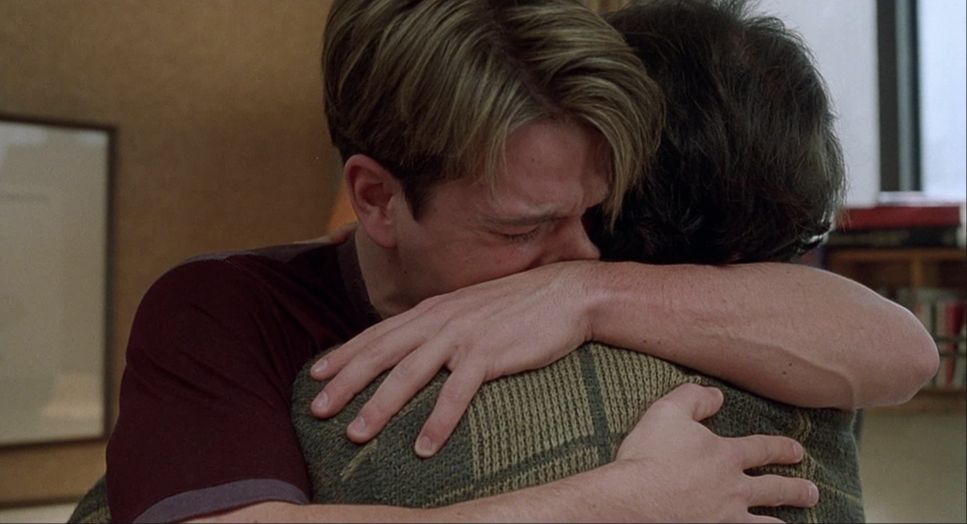
Good Will Hunting (1997) builds its catharsis around one line. Sean repeats "It's not your fault" until Will's jokes and anger give way and he breaks down in Sean's arms.
Rocky (1976) gives release without victory. Rocky loses the decision but goes the distance, and his shouting for Adrian releases everything the film built.
Get Out (2017) turns catharsis into relief. Flashing lights pull up at the end, the audience braces for the worst, and then Rod steps out of the car.
The Shawshank Redemption (1994) spends its length in confinement, so the final open beach is catharsis through space itself.
How to stage and shoot a cathartic scene
- Hold the performance. Don't cut away the moment the tears start. A held close-up or a reaction shot often does more than the speech.
- Save visual space for the end. If the film has kept characters in tight frames or cold light, make the release the first wide, open or warm image.
- Drop the sound first. A beat of near-silence before the break makes it land; the film score should follow the emotion, not announce it.
- Leave a breath afterward before the denouement starts tying up threads.
In FlashBoards, pin the cathartic frame at the end of the board and line up every earlier scene where the character almost broke,. You see whether the pressure builds and the release looks different.
Catharsis vs. climax vs. anticlimax
The climax is a plot event: the confrontation where the dramatic question is answered. Catharsis is the audience's release around it. They usually overlap, but in Rocky the climax is the final bell and the catharsis is the scene just after.
An anticlimax denies the expected payoff, and with it the release; used on purpose, that frustration is the point. A big climax without catharsis feels loud but empty. More on shaping tension in the storytelling hub.
Catharsis examples in film
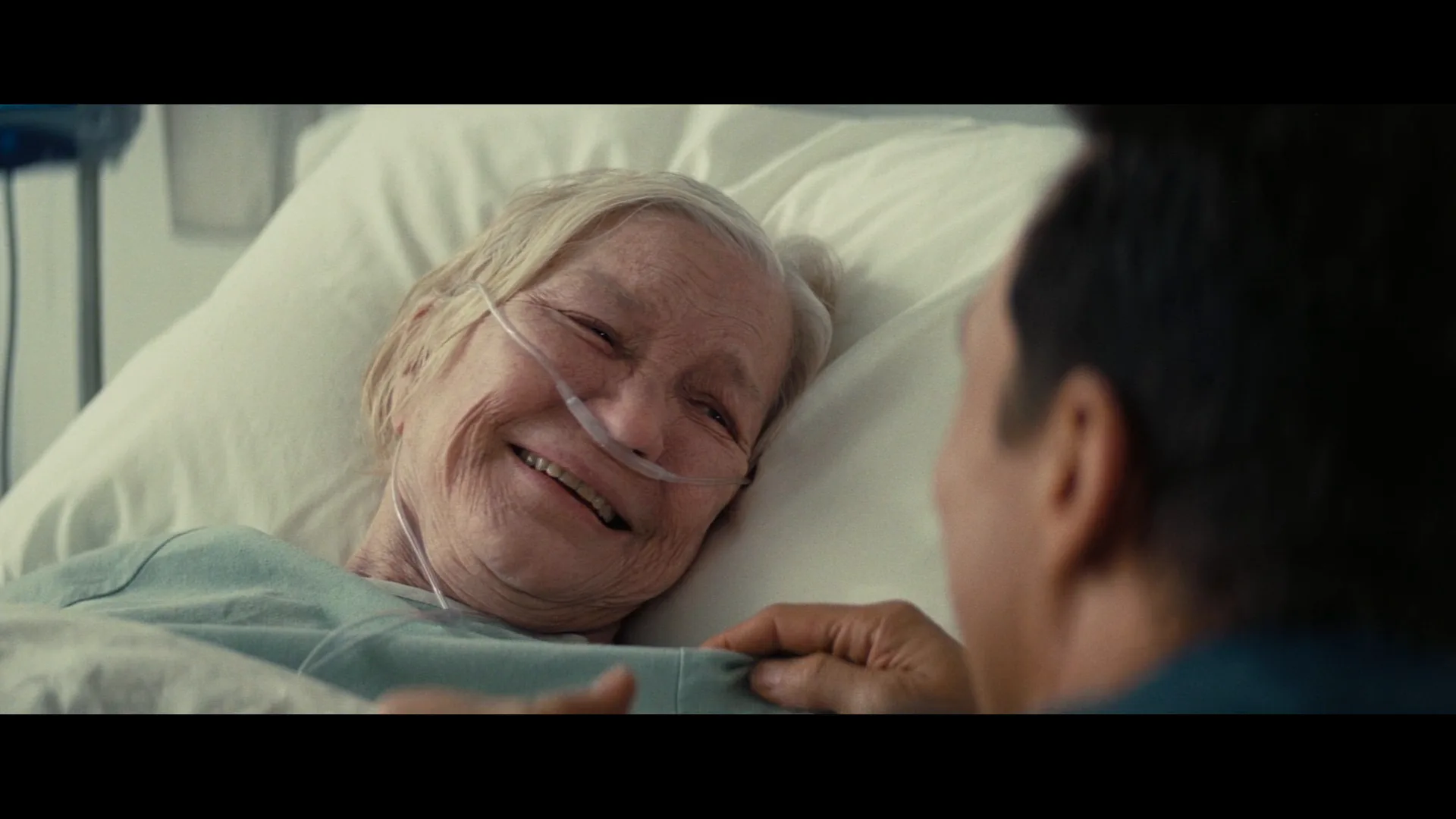
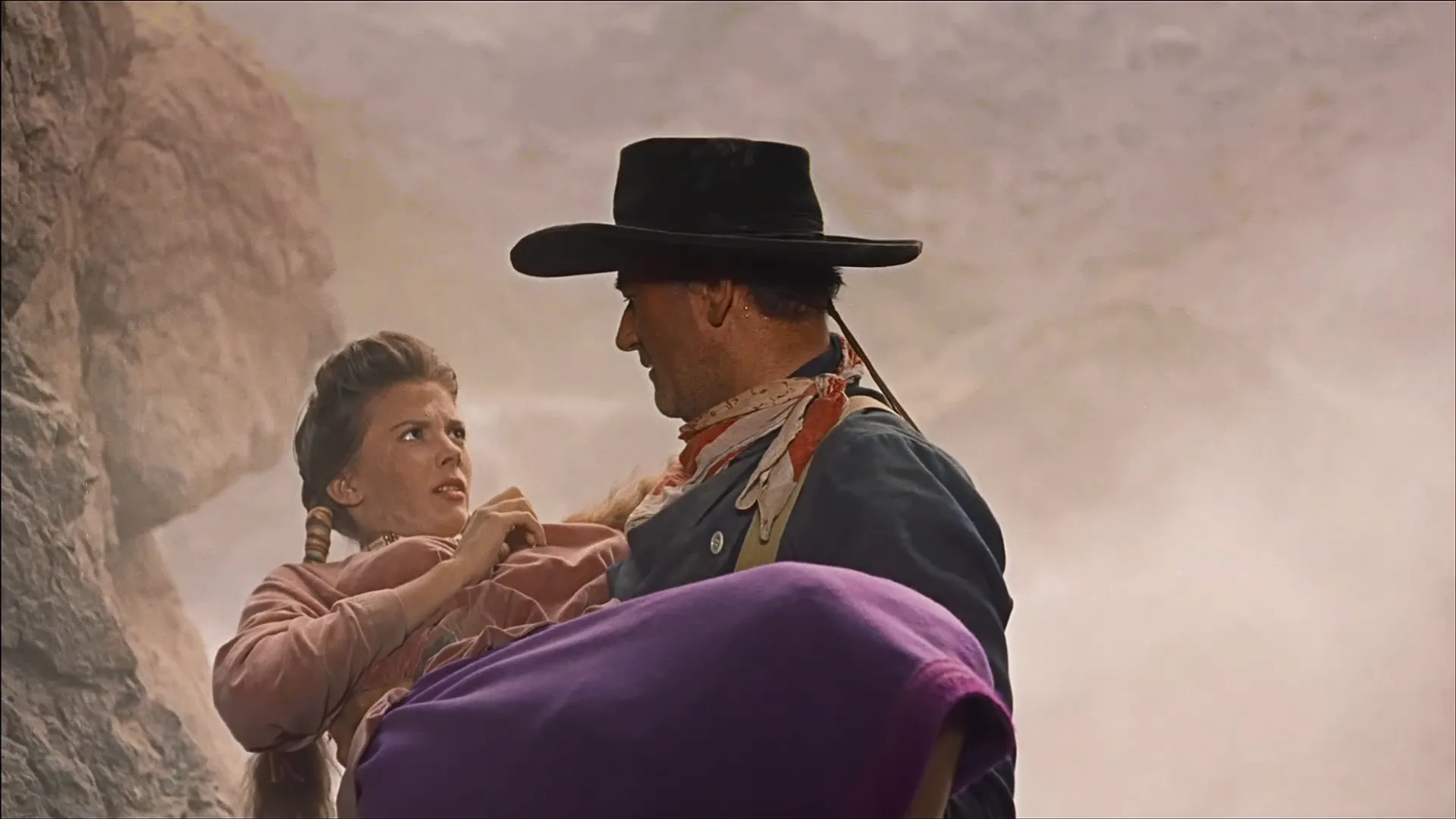
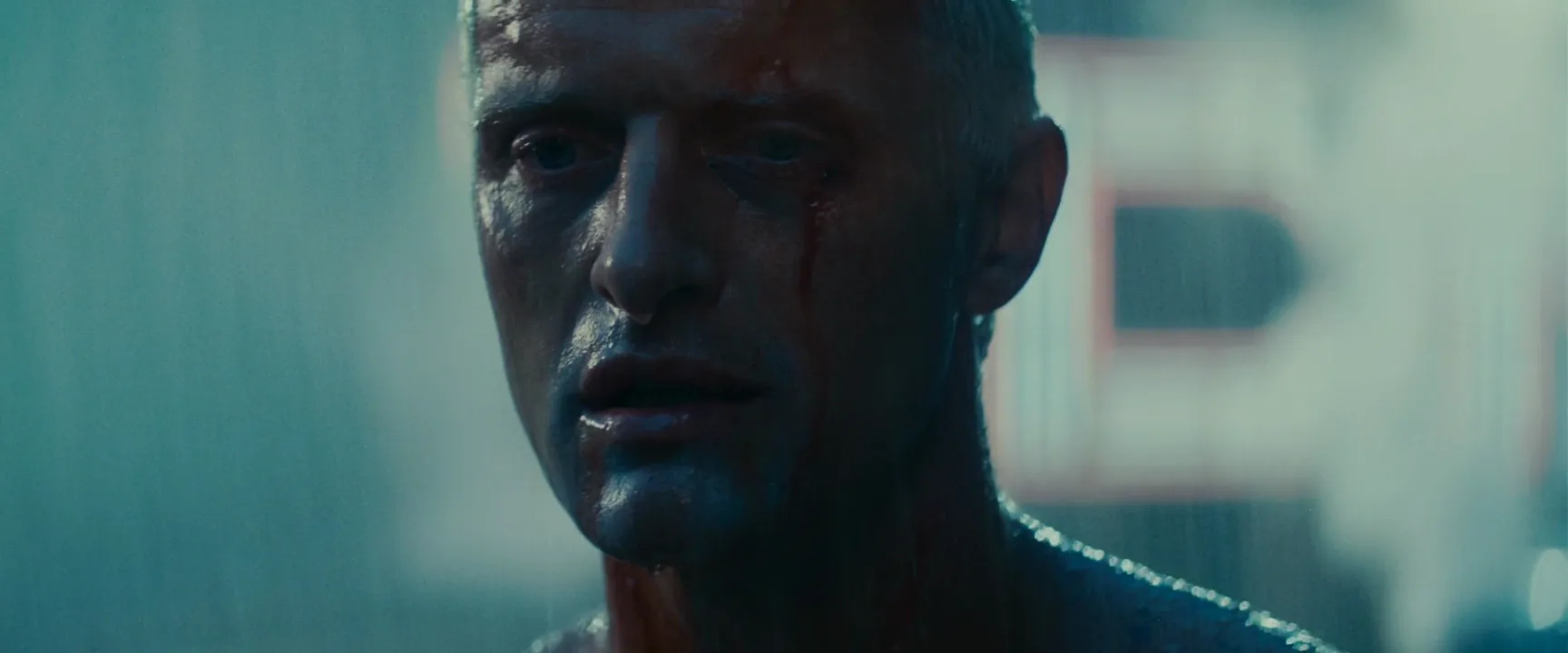
5 framesFrames from cathartic moments, where something the film held back is finally let go.

How to create a catharsis with AI
4 promptsCatharsis is a performance moment, so the prompt must describe the break itself: tears, a laugh through tears, a body going slack. In FlashBoards, keep the cathartic frame next to earlier frames of the character holding it in. The fourth prompt re-shoots a real film shot from a text description alone, and the original plays next to the result so you can compare.
Dim kitchen at night. A gray-haired man in his sixties with a thick white mustache and a faded blue flannel shirt embraces his adult son, a man in his thirties with a shaved head and a short red beard, seen from behind. The father's face rests on the son's shoulder toward camera, eyes shut tight, tears on his cheeks, mouth open in a sob. Close-up over the son's shoulder, 50mm lens, eye level. One warm pendant lamp, cold blue window light behind. Cinematic film still, soft grain.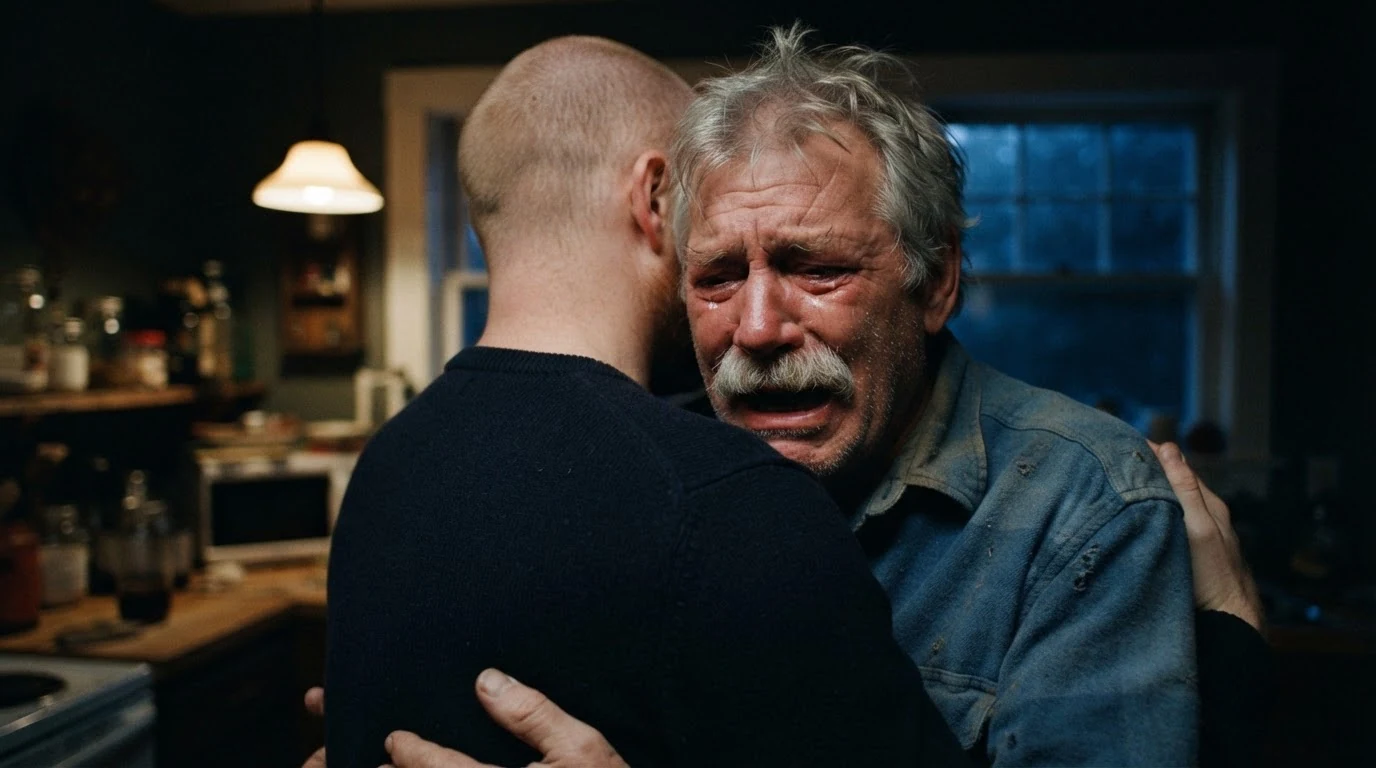
"Eyes shut tight, tears on his cheeks, mouth open in a sob" describe the break, not a generic sad face. The over-the-shoulder close-up keeps one face readable. This is the start frame for the video.
Open FlashBoardsA long empty hospital corridor at dawn. A woman in her late twenties with short bleached hair, a gap between her front teeth and a green hoodie sits on the floor against the wall, head tipped back, laughing and crying at once. Fluorescent light above, warm sunrise through a window at the far end. Wide shot, 35mm lens, camera at floor height, empty space around her. Cinematic film still.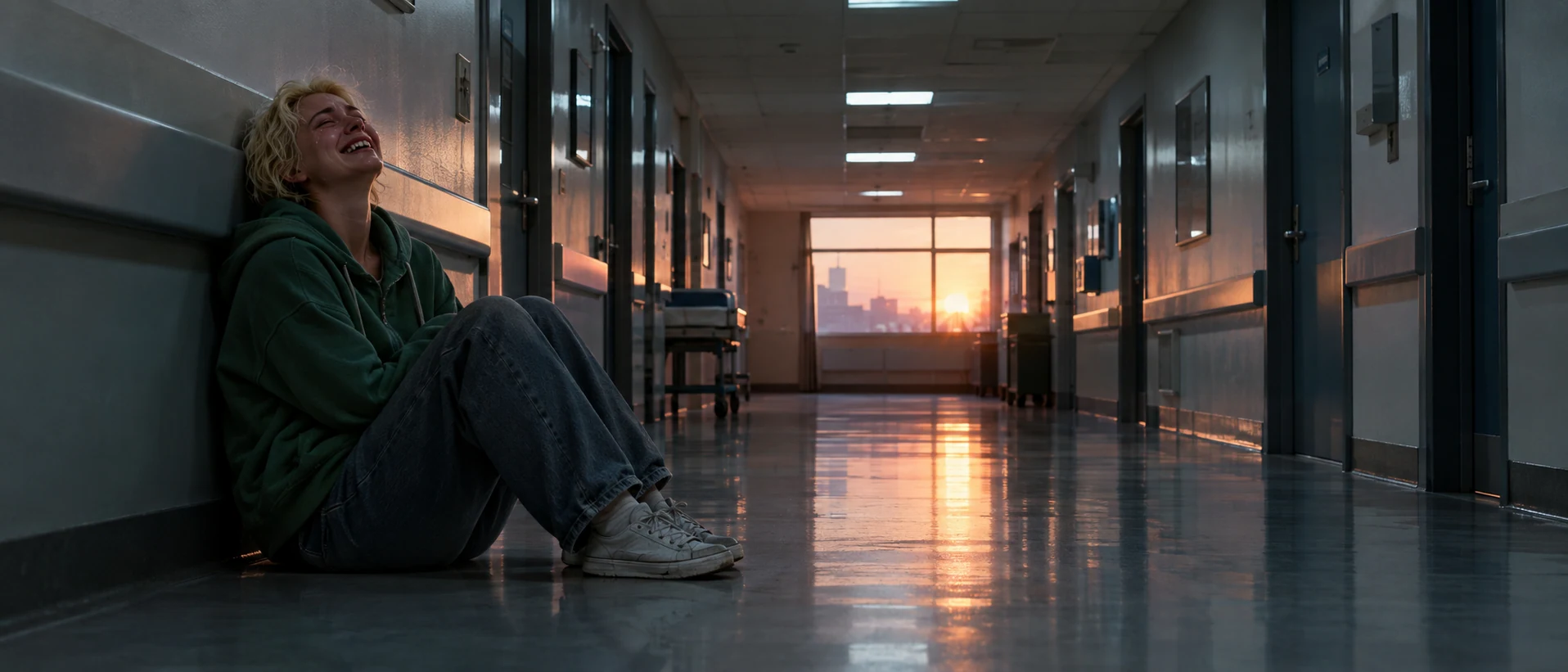
Catharsis as relief: "laughing and crying at once" and "head tipped back" read as tension leaving the body; the wide frame and sunrise add release through space and light.
Open FlashBoardsCamera: very slow push in over the son's shoulder, ending on a tighter close-up of the father's face. Action: from the first frame the father's shoulders shake with sobs. The sobbing eases, the father takes a long, shaky breath, and a small tired smile breaks through the tears, eyes still closed.Shaking shoulders put motion in the first frame; sobbing to breath to smile is the release happening on screen.
Open FlashBoards{
"output": "Full-screen live-action scene from The Searchers (1956) from its very first frame: one continuous shot. 1950s Technicolor western look, 35mm VistaVision grain, hazy afternoon sun behind thick clouds of pale dust that fill the sky with a soft pinkish-beige glow, a weathered tan rock wall on the left, saturated wardrobe colors.",
"characters": {
"S1": {
"name": "Ethan Edwards, played by John Wayne",
"look": "tall, broad man in his late forties, weathered profile, black wide-brim hat with a thin chin cord, dark navy cavalry shirt with brass buttons, red-and-cream neckerchief, a tan strap across his chest",
"voice": "low, hoarse, quiet"
},
"S2": {
"name": "Debbie, played by Natalie Wood",
"look": "young woman, dark brown hair in two long braids, faded rose-pink cotton blouse, a purple wool blanket wrapped around her legs",
"voice": "she never speaks in this shot"
}
},
"shots": [
{
"shot": 1,
"camera": "static, low angle looking up from waist height, normal lens, medium shot; S1 right of centre in profile facing screen left, S2 held in his arms on the left, the rock wall along the left edge, a wall of drifting dust behind them; the frame settles in the first moment and then holds still to the end",
"action": [
"BEGINNING: alive from the first frame, S1 swings S2 up off the ground into his arms, her body rising into frame from the lower left, the purple blanket over her legs swinging up across the bottom of the frame toward the right.",
"THEN: he holds her at chest height, one arm under her knees, the other across her back; she leans back away from him, stiff, both fists clenched against her own chest, staring up into his face in fear, lips parted.",
"THEN: a long still beat: S1 looks down at her face, jaw set, head motionless under the hat brim; she does not blink or move, her fists stay pressed together; only the dust moves behind them.",
"THEN: still looking down at her, he speaks the line quietly; his head stays still; her eyes stay on his face, the fear in them starting to soften, brow lifting.",
"THEN: after a pause, her fists open; her screen-right arm reaches up over his shoulder and around the back of his neck, her screen-left hand opens with fingers spread against his arm.",
"THEN: she pulls herself in, both arms locked around his neck, her cheek against his; he turns his head toward her and draws her closer against his chest.",
"END: her face is buried in his neck, her braids hanging down her back, his head bowed over hers, the hat brim hiding both faces; both bodies go slack with relief as the dust drifts past."
],
"dialogue": [
{
"speaker": "S1",
"on_screen": true,
"when": "after the long still look, in the middle of the shot, before she reaches for his neck",
"delivery": "quiet, hoarse, gentle, almost a whisper",
"line": "<d>[English] Let's go home, Debbie.</d>"
}
]
}
],
"sound": {
"ambience": "dry wind gusting across the rocks, dust hissing past, the rustle of the blanket and cloth as he lifts her",
"speech": "exactly these spoken phrases, each said once, in this order",
"never_spoken": "no narration and no voice-over: the descriptions, performance notes and step words of this prompt are never spoken aloud",
"music": "a film score under the scene, always below the voices: warm, slow strings that swell gently as she embraces him",
"subtitles": "none"
}
}Remakes the reunion shot from The Searchers (1956), dir. John Ford, DP Winton Hoch: the static low angle against the rock wall and dust, Debbie held high and frozen in fear, Ethan's verbatim line "Let's go home, Debbie." and the late embrace that releases the tension.
The release lives in the action steps: both fists clenched against her own chest at the start, a long still beat before Ethan's one line, then her arm around the back of his neck. The static low angle leaves the shift to the actors, and the score only swells gently as she embraces him.
Common mistakes
- Models default to a posed, dry-eyed sad look. Name the signs: tears, open mouth, shaking shoulders.
- Two full faces compete. Turn one person's back to camera.
- In video, crying loops endlessly. Write the change: sobbing eases, a breath, a smile.
Keep the reference frames, prompts and every generated take side by side — images and video in one canvas.
FAQ
5 questionsWhat does catharsis mean in film?
Catharsis is the emotional release a viewer feels when tension the story has built finally breaks, through tears, relief, joy or laughter, usually at or just after the climax. In film it names the audience's experience, not a plot event.
What is a cathartic ending?
A cathartic ending releases the emotion the audience has held throughout the film: the character finally cries, forgives, escapes or is reunited, and the viewer feels it with them. It does not have to be happy; a tragic death can be cathartic too.
What is an example of catharsis in a movie?
In Good Will Hunting (1997), Sean tells Will "It's not your fault" again and again until Will breaks down in his arms. The film has spent its running time on Will's defenses, so their collapse releases everything the audience has carried.
Is catharsis the same as the climax?
No. The climax is the decisive plot event where the central conflict is resolved; catharsis is the emotional release the audience feels because of it. They often coincide, but catharsis can come a moment later, as in Rocky, or be deliberately withheld, as in an anticlimax.
Can comedy be cathartic?
Yes. Laughter is one of the oldest forms of release: a joke at the right moment lets the audience spend tension a scene has built. The pressure has to come first; a joke with no tension behind it is just a joke.
Related terms
3- ClimaxStorytelling
The climax is the story's decisive peak: the protagonist faces the central conflict head-on and the main dramatic question is answered.
- Tragic HeroStorytelling
A tragic hero is an admirable protagonist brought down by a flaw or error of their own, whose fall stirs pity and fear rather than contempt.
- DenouementStorytelling
The denouement is the final part of the plot after the climax, where loose threads are tied up and the new balance of the characters' world is shown.
Further reading
Aristotle, Poetics, on tragedy and katharsis. Robert McKee, Story (1997), on climax and emotional payoff.