 FlashBoards Learn
- Learn
- Storytelling
- Dramatic Irony
Storytelling · Film language
Dramatic Irony
Also called: audience knows more than the character
Dramatic irony is when the audience knows something a character doesn't: the body in the chest, the cameras around the town, the family hidden under the floor. Every line the character speaks then carries a second meaning, and every choice becomes suspense, comedy or dread.
- What it does
- Gives the audience information a character lacks, so ordinary actions play as suspense, comedy or tragedy.
- Use it when
- You want the viewer ahead of the character, watching them walk toward something they can't see.
- Watch out
- If the audience never clearly registers the secret, there is no irony, just a character in a scene.
- Try this prompt
Wide shot, couple laughing at a kitchen table at night, a man in a gray raincoat standing in the dark garden behind them, visible through the window, 16:9
What is dramatic irony?
Dramatic irony is a gap in knowledge between the audience and the people on screen: we know the truth, the character acts without it. It is one of the three classic forms of irony, with verbal and situational irony, and one of the most useful narrative techniques because it makes the viewer an accomplice.
In Rope (1948), two young men strangle a classmate, hide the body in a wooden chest and serve dinner from its lid to his friends and family. The party looks harmless and is unbearable, because we saw what went into the chest.
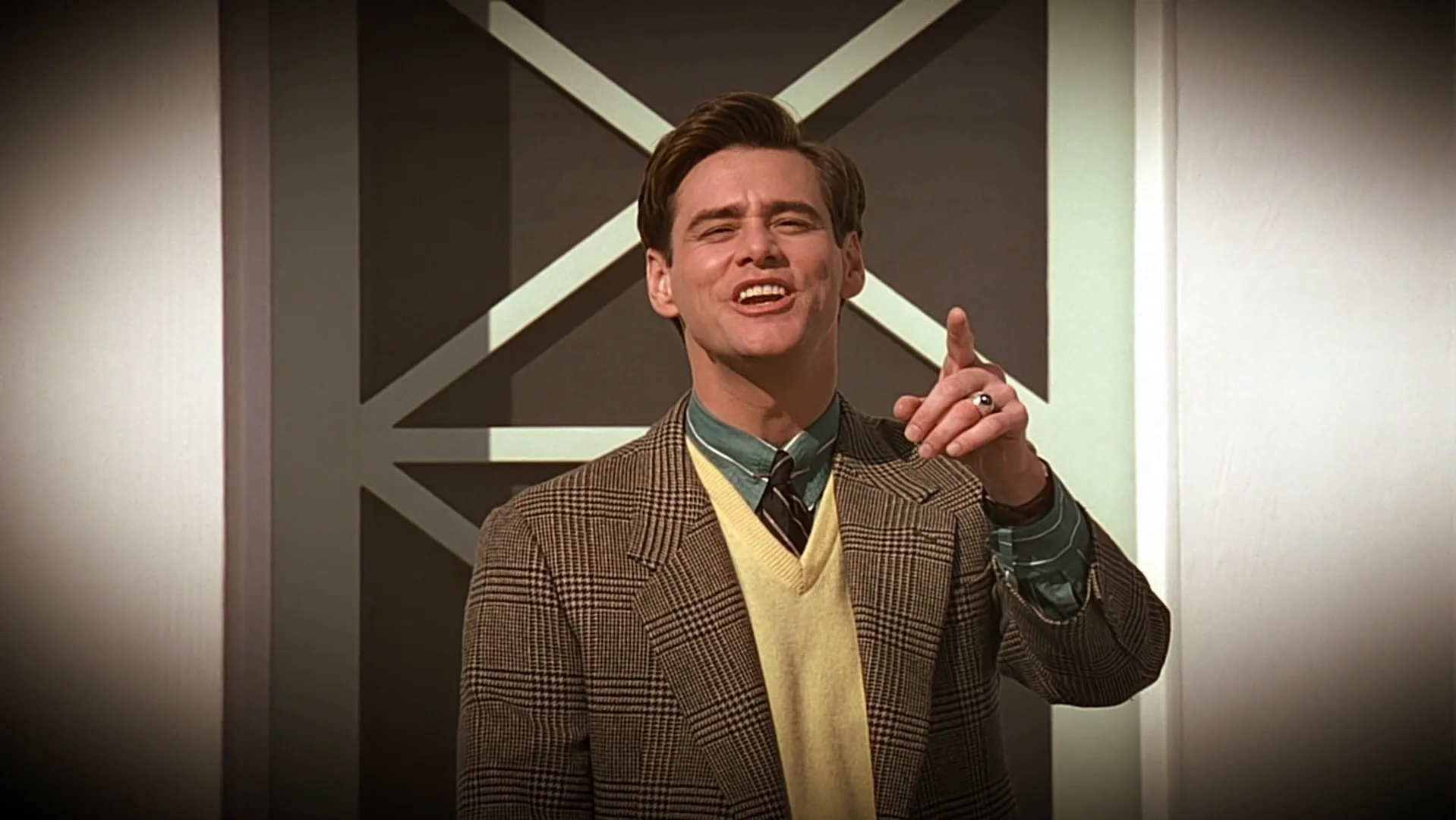
The gap can run through a whole film. In The Truman Show (1998) we learn early that Truman's life is a television program; he doesn't.
The three stages of dramatic irony
Dramatic irony is often split into three stages, a checklist for when a scene built on a secret isn't landing.
- Installation. The audience gets the information: a cutaway to the bomb, a scene the hero didn't witness, a prologue that states the ending. It must be unmistakable.
- Exploitation. The character acts without that knowledge: double-meaning dialogue, near-misses, almost finding out. This is where the value lives.
- Resolution. The character learns the truth or the consequence arrives, often the emotional peak.
Weak uses skip stage two: the secret is revealed almost as soon as it is installed.
Tragic irony
Tragic irony is dramatic irony where what the audience knows is disaster. The characters walk toward it hopeful, and their hope is what hurts.
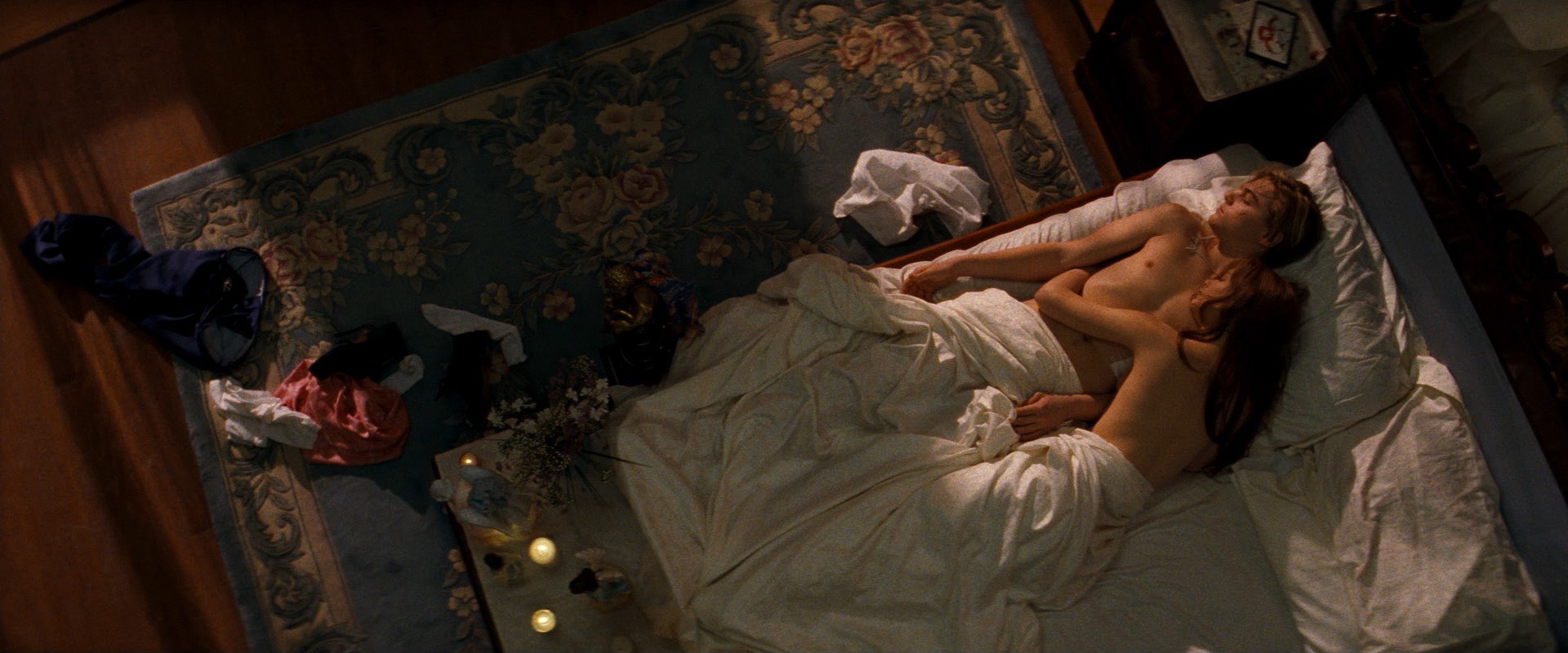
The model is Oedipus Rex: we know Oedipus is the killer he is hunting, so every curse he lays on the murderer falls on himself. Romeo and Juliet opens with a prologue announcing the lovers' deaths; Baz Luhrmann's Romeo + Juliet (1996) gives it to a TV news anchor, so every tender scene plays against a known ending, and in the last act we know Juliet's death is faked while Romeo does not.
Unlike foreshadowing, which hints, tragic irony tells us plainly.
Why filmmakers use dramatic irony
Suspense. Hitchcock's example, from his interviews with François Truffaut: show the audience a bomb under a table, and small talk above it grips. This is the engine of suspense. Inglourious Basterds (2009) opens with the camera showing a family hidden under the floorboards while an SS officer questions the farmer above them.
Comedy. In Mrs. Doubtfire (1993) we know the nanny is the father in disguise, so every scene with his ex-wife is a joke about to explode.
Genre commentary. The Cabin in the Woods (2012) shows technicians steering the teenagers from a control room almost from the start: every horror cliché becomes a comment on the genre.
How to stage dramatic irony on screen
- Install with a clean image. An insert shot of the timer, the poison, the letter. Hold it long enough to read.
- Keep the secret in frame. Deep staging puts the information and the unaware character in one shot, like the chest under the candlesticks in Rope.
- Cut away to remind. When the secret is off-screen, cross-cutting back to it resets the clock.
- Show what the hero can't see. An omniscient point of view installs most of this information.
- Protect the resolution. Give the discovery a close-up and time.
In FlashBoards, map the gap on one board: a column for what the audience knows, one for each character, with frames and generated shots under the scene where the gap opens or closes.
Dramatic irony vs. situational and verbal irony
- Dramatic irony is about knowledge: the audience knows, the character doesn't, across scenes.
- Situational irony is about outcome: the result is the opposite of what was expected, usually a surprise to the audience too.
- Verbal irony is about meaning: a character says the opposite of what they mean.
The quick test: who is surprised? If the audience is, it is situational irony or a twist. If only the character is, it is dramatic irony.
Dramatic Irony examples in film
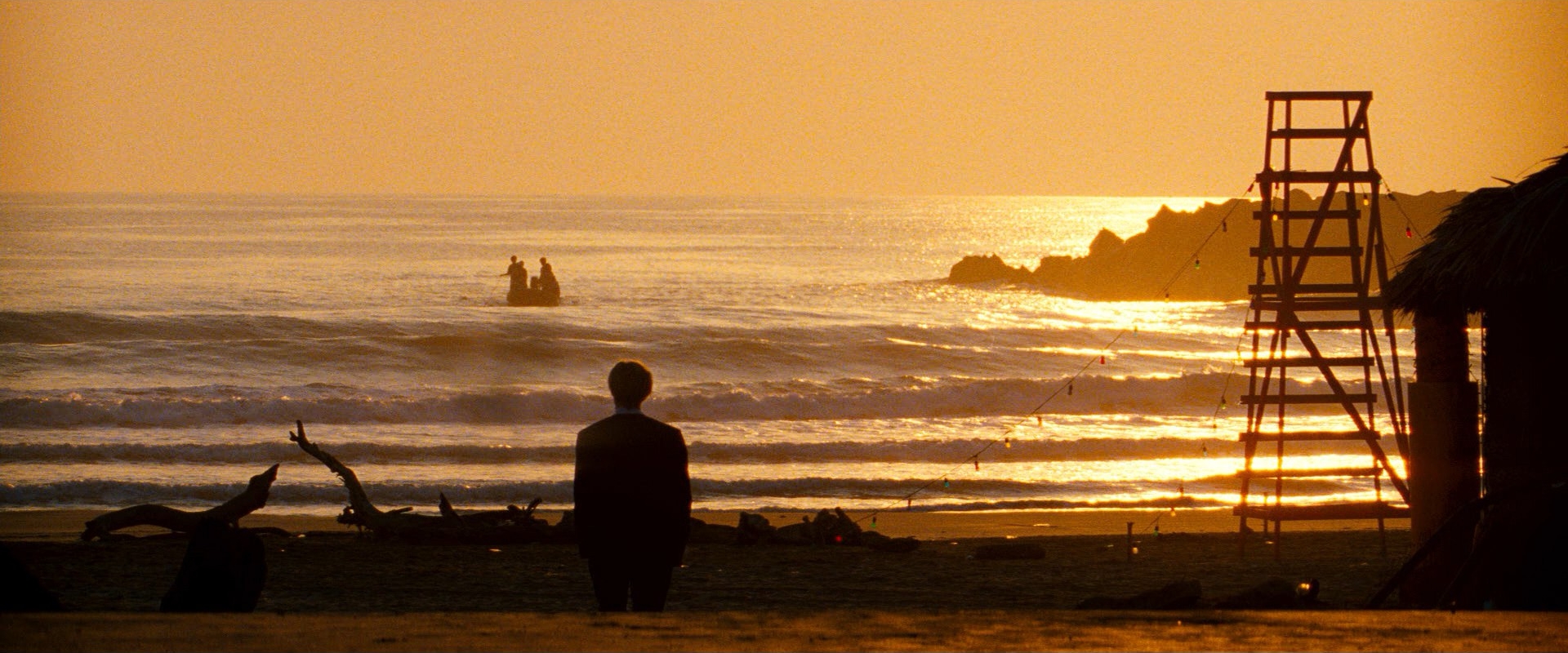
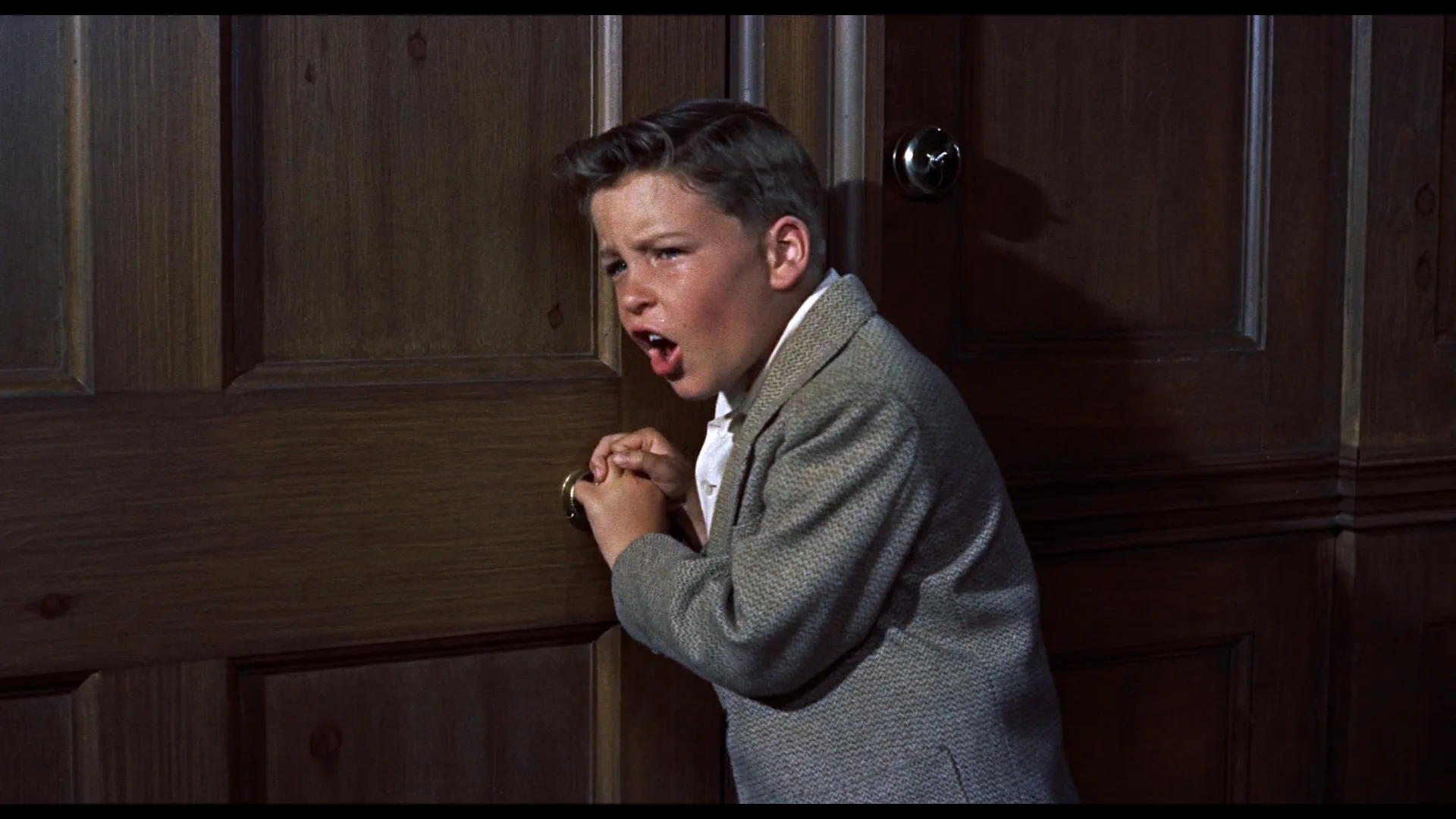
4 framesFour frames where the image means one thing to the character and another to us.
How to create a dramatic irony with AI
4 promptsIn one frame, dramatic irony is staging: the character and the secret share the shot, and only one of them knows it. Build the start frame, try a second composition, then animate the danger moving unnoticed. Keep the takes on one FlashBoards board beside your notes on who knows what. The fourth prompt re-shoots a real film shot from a text description alone, and the original plays next to the result so you can compare.
Wide shot of a warm kitchen at night: a young couple laughing over wine at a wooden table, she with short bleached hair, he with a red beard and round glasses, facing each other, backs to a large window. In the dark garden beyond the glass a tall man in a gray raincoat stands still, faintly lit by the kitchen light, watching them. Deep focus, 28mm lens, cinematic still
Backs to a large window and deep focus put the secret and the unaware couple in one sharp frame; watching against laughing is the irony.
Open FlashBoardsCrowded café, camera near floor level: under a marble table a black briefcase with a glowing red timer sits sharp in the foreground, while above it two cheerful middle-aged men, one bald with a gray goatee, one in a navy suit with slicked black hair, lean in over espresso, unaware. 35mm lens, soft window daylight, wide anamorphic frame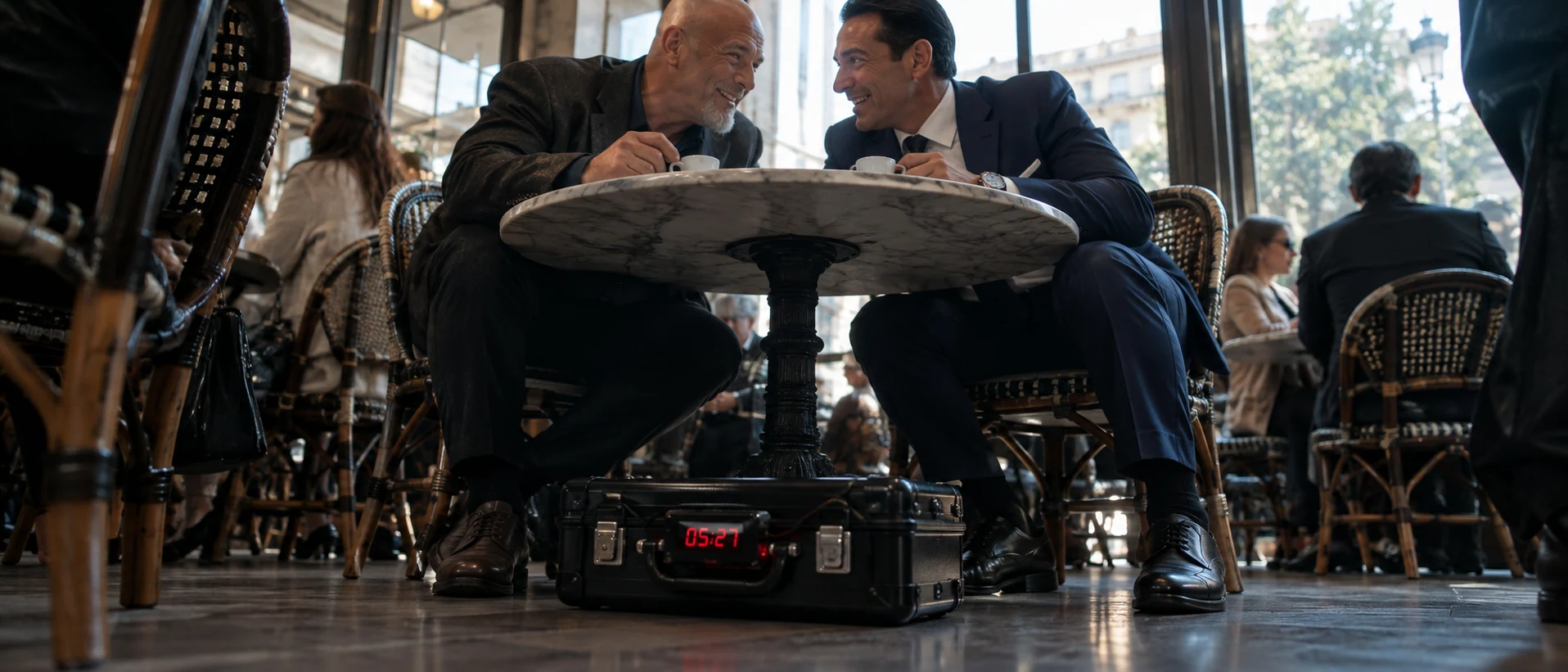
The bomb under the table: near floor level and foreground make the timer the first thing we read, unaware supplies the surface.
Open FlashBoardsCamera: locked-off wide shot, a very slow push toward the window from the first frame. Action: the couple laughs and clinks wine glasses. In the garden the man in the gray raincoat takes two slow steps toward the glass. The couple keeps talking, facing each other. The shot ends with the man close to the window and the couple still laughing.Motion starts at once with the glasses; the push drifts toward the secret, and ending on still laughing keeps the gap open.
Open FlashBoards{
"output": "Full-screen live-action scene from The Truman Show (1998), directed by Peter Weir, from its very first frame: one continuous shot, no cuts. Bright, saturated late-1990s 35mm film, crisp sunny suburban morning, hard warm sunlight from front left throwing the shadows of the porch pillars onto the white wall to the right; clean pastel palette: white clapboard house with the brass house number 36 above the door, dark screen door with white X-shaped bracing, a white porch rail with low shrubs.",
"characters": {
"S1": {
"name": "Truman Burbank, played by Jim Carrey",
"look": "slim man in his mid-thirties, short dark side-parted hair, big toothy grin; brown houndstooth tweed jacket over a pale yellow V-neck sweater vest, teal shirt buttoned to the collar and a dark patterned tie, light khaki trousers",
"voice": "bright, sing-song, theatrical, performed for the neighbors"
}
},
"shots": [
{
"shot": 1,
"camera": "locked-off camera across the street, eye level, long lens; the camera body never moves. It opens on a wide view of the whole porch and door with S1 small in the centre. Soon after the start the lens zooms in steadily and fast on S1, and as it zooms a soft dark circular vignette closes in around the frame edges, until he fills a medium close-up from the chest up inside a round peephole view, as if seen through a lens hidden in a neighbor's garden. The zoom stops and holds for the rest of the shot.",
"action": [
"BEGINNING: alive from the first frame, S1 stands in the centre of the porch in front of the screen door, bent forward at the waist with both hands on the porch rail, looking down toward screen right, already talking.",
"THEN: he straightens up, lifts his head toward neighbors just off frame to the right of the lens, mouth wide open in a big greeting.",
"THEN: his left hand (screen right) swings out in a quick wave toward screen right, then comes back up beside his shoulder with the index finger pointing up.",
"THEN: as the zoom rushes in and the dark round vignette closes around him, he holds the raised finger by his shoulder, grinning, eyes bright and looking just to the right of the lens, his right hand (screen left) hanging still at his side.",
"THEN: in the medium close-up he delivers the line like a game-show host, head bobbing slightly on each word, eyebrows raised, the finger keeping time.",
"THEN: on the last words he jabs the pointing finger forward toward the neighbors on screen right and bursts out laughing.",
"THEN: he throws his head back and tilts it hard toward screen left, eyes squeezed shut, mouth wide open in a big laugh, shoulders shaking.",
"END: his head swings back upright, still laughing openly with all his teeth showing, looking just right of the lens, completely unaware that the lens is watching him."
],
"dialogue": [
{
"speaker": "S1",
"on_screen": true,
"when": "from the first frame, as he straightens up from the rail",
"delivery": "bright, sing-song, already in full swing",
"line": "<d>[English] Good morning.</d>"
},
{
"speaker": "S1",
"on_screen": true,
"when": "right after, running through the zoom and the whole medium close-up, ending just before he throws his head back laughing",
"delivery": "theatrical, rhythmic, a little too cheerful, like a catchphrase he says every day",
"line": "<d>[English] In case I don't see you, good afternoon, good evening, and good night.</d>"
}
]
}
],
"sound": {
"ambience": "quiet suburban morning: birdsong, a faint lawn sprinkler, a distant car heard from down the street",
"speech": "exactly these spoken phrases, each said once, in this order, then his laugh",
"never_spoken": "no narration and no voice-over: the descriptions, performance notes and step words of this prompt are never spoken aloud",
"music": "a film score under the scene, always below the voices: light, airy strings and soft piano with a bright, too-perfect sitcom warmth",
"subtitles": "none"
}
}Remakes Truman's morning greeting from The Truman Show (1998), keeping the locked-off zoom into a vignetted close-up, his exact line from the film and the unaware laugh.
The camera never moves, but the zoom into a round dark vignette turns Truman's catchphrase into hidden-lens footage; completely unaware keeps him performing while we know who is watching.
Open FlashBoardsCommon mistakes
- Models make characters notice the threat. State where they look: facing each other, backs to the window.
- Shallow focus blurs a background secret; ask for deep focus.
- In video the watcher tends to burst in. End on the unresolved moment.
Keep the reference frames, prompts and every generated take side by side — images and video in one canvas.
FAQ
4 questionsWhat is dramatic irony in simple terms?
Dramatic irony is when the audience knows something important that a character doesn't. The character's words and choices then take on a second meaning, creating suspense (we see the danger), comedy (we know the disguise) or tragedy (we know the ending).
What are some examples of dramatic irony in film?
In Rope (1948) guests eat from a chest we know holds a body. In The Truman Show (1998) we know Truman's life is a TV show. Inglourious Basterds (2009) opens with a family hidden under the floor during an interrogation.
What is the difference between dramatic irony and suspense?
Dramatic irony is the information gap: the audience knows, the character doesn't. Suspense is the anxious waiting that gap often produces. Suspense can exist without it, when nobody knows what's coming, but dramatic irony is one of the surest ways to build it.
Is Romeo and Juliet an example of dramatic irony?
Yes, tragic irony specifically. The prologue tells us the lovers will die, and in the final act we know Juliet only appears dead while Romeo believes she is gone. His choice rests on a mistake we can see and he can't.
Related terms
3- IronyStorytelling
Irony is a gap between what is said, expected or known and what is actually meant or happens; film uses verbal, situational and dramatic irony, plus cosmic and historical variants.
- ForeshadowingStorytelling
Foreshadowing plants hints — an object, a line, an image — that prepare the audience for what comes later, so the payoff feels both surprising and inevitable. Chekhov's gun is its strictest form.
- Inciting IncidentStorytelling
The inciting incident is the event that upsets the protagonist's normal life and sets the main conflict in motion — the moment the story truly begins.
Further reading
François Truffaut, Hitchcock/Truffaut (1966). Aristotle, Poetics. Robert McKee, Story (1997).