 FlashBoards Learn
- Learn
- Storytelling
- Villain
Storytelling · Film language
Villain
Also called: villain writing, bad guy
A villain is an antagonist driven by malicious goals or methods. The ones audiences remember believe they are right, want something concrete and press exactly on the protagonist's weakness. Writing a villain means designing that pressure: a goal that collides with the hero's, a logic that holds, and a method that crosses a line.
- What it does
- Turns the story's conflict into a person with a will, a logic and a line the hero refuses to cross.
- Use it when
- Your opposition feels generic, the stakes feel abstract, or the climax lacks a face.
- Watch out
- Evil for its own sake is flat; give the villain a want, a reason and a rule they keep.
- Try this prompt
Medium shot in a sunlit greenhouse, a calm silver-haired man in a cream cardigan pruning roses while a nervous young clerk waits, 35mm film still
What is a villain?
A villain is the antagonist with bad intent. The antagonist is a function: whoever or whatever blocks the protagonist. The villain adds a moral charge, choosing to harm, deceive or dominate to get what they want. "Bad guy" is the casual word for the same role.
In storytelling terms the villain is usually the engine. The villain acts, the hero reacts and spends two acts catching up.
How to write a villain
Four questions do most of the work.
- What do they want? A concrete, filmable goal: the bearer bonds in the vault in Die Hard (1988), the Infinity Stones in Avengers: Infinity War (2018). "Power" is not a goal; the key to the building is.
- Why do they think they are right? Thanos believes wiping out half of all life will save the universe. The conviction, not the math, is what frightens.
- Where does the hero break? Build the villain backward from the protagonist's flaw. A proud hero meets flattery; a loyal one loses someone they love.
- What is their rule? Anton Chigurh in No Country for Old Men (2007) lets a coin toss decide who lives. A private code makes a villain consistent, and consistency reads as menace.
Then make them competent: a villain who loses to luck makes the hero's win cheap.
What are the types of villains?
Most screen villains fit a handful of patterns, close cousins of the character archetypes:
- The mastermind. Plans three moves ahead, calmest in the room: Hans Gruber in Die Hard.
- The force. Closer to weather than a person: Chigurh, the shark in Jaws (1975).
- The zealot. The cause justifies everything: Thanos.
- The manipulator. Works through someone else's power, whispering rather than striking.
- The tyrant. Rules a small world by fear: Amon Göth in Schindler's List (1993).
- The fallen hero. Once stood where the hero stands: Anakin becoming Vader, or Walter White in Breaking Bad. Films that trace the fall are often built as an origin story, like Joker (2019).
- The anti-villain. A sympathetic aim pursued by wrong means; see anti-villain.
What makes movie villains memorable on screen?
- The introduction. Inglourious Basterds (2009) opens with Hans Landa's long, polite conversation at a farmhouse table. The threat grows from courtesy.
- The entrance. Darth Vader first steps through smoke into a corridor of fallen soldiers in Star Wars (1977): silhouette first, face never.
- Silhouette. A mask, a coat or a color should identify the villain from the outline alone.
- Stillness and light. Let the hero move and sweat while the villain barely shifts; hide part of the face and save the fully lit close-up for when the mask drops.
In FlashBoards, collect villain reference frames beside your protagonist's on one board, generate the introduction shot in a few variations and compare them side by side.
Villain vs. antagonist
Every villain is an antagonist; not every antagonist is a villain. The antagonist only has to stand in the way, so it can be a storm, a rival or an honest detective chasing an innocent hero. The villain must also mean harm.
If your opposition is a decent person with a conflicting goal, don't pile on cruelty; the story is richer when both sides have a point. If they are a villain, commit to a method the audience cannot excuse. That gap between motive and method is where the anti-hero and the anti-villain live.
Villain examples in film
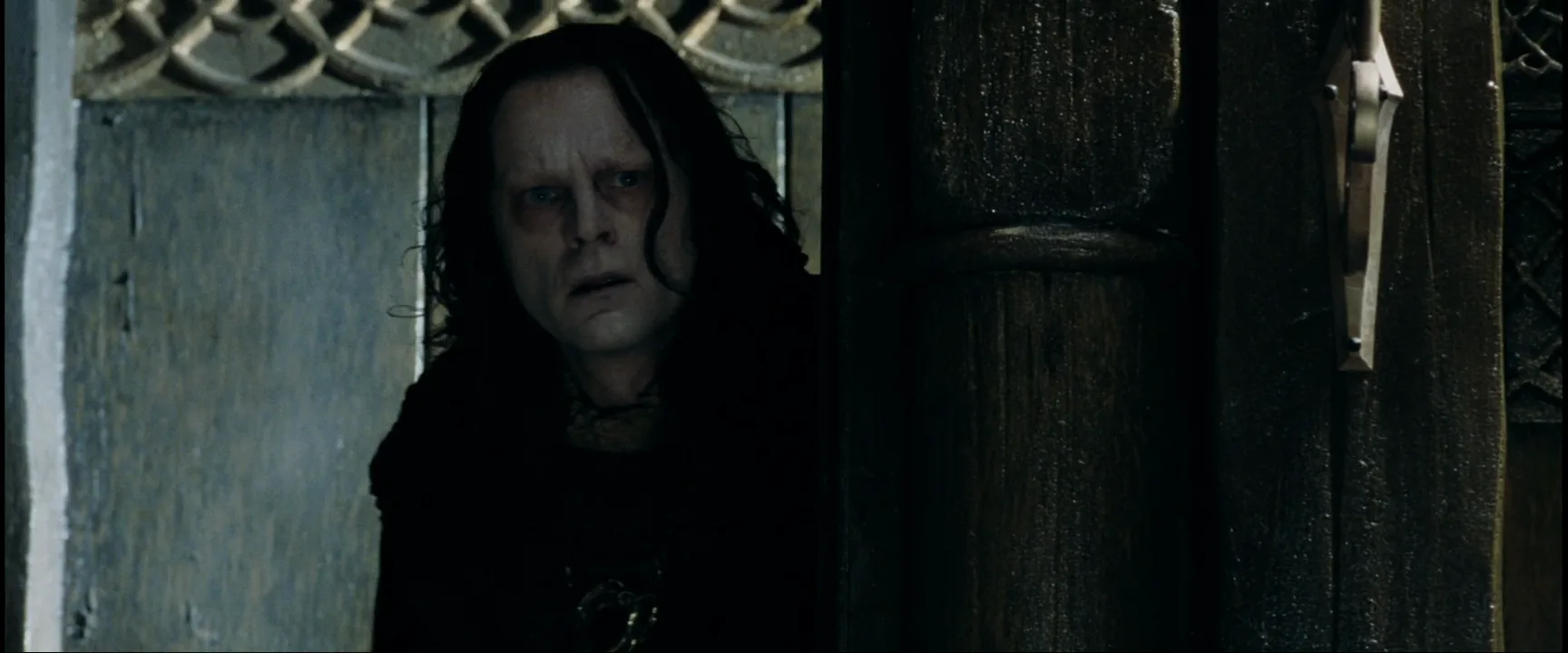
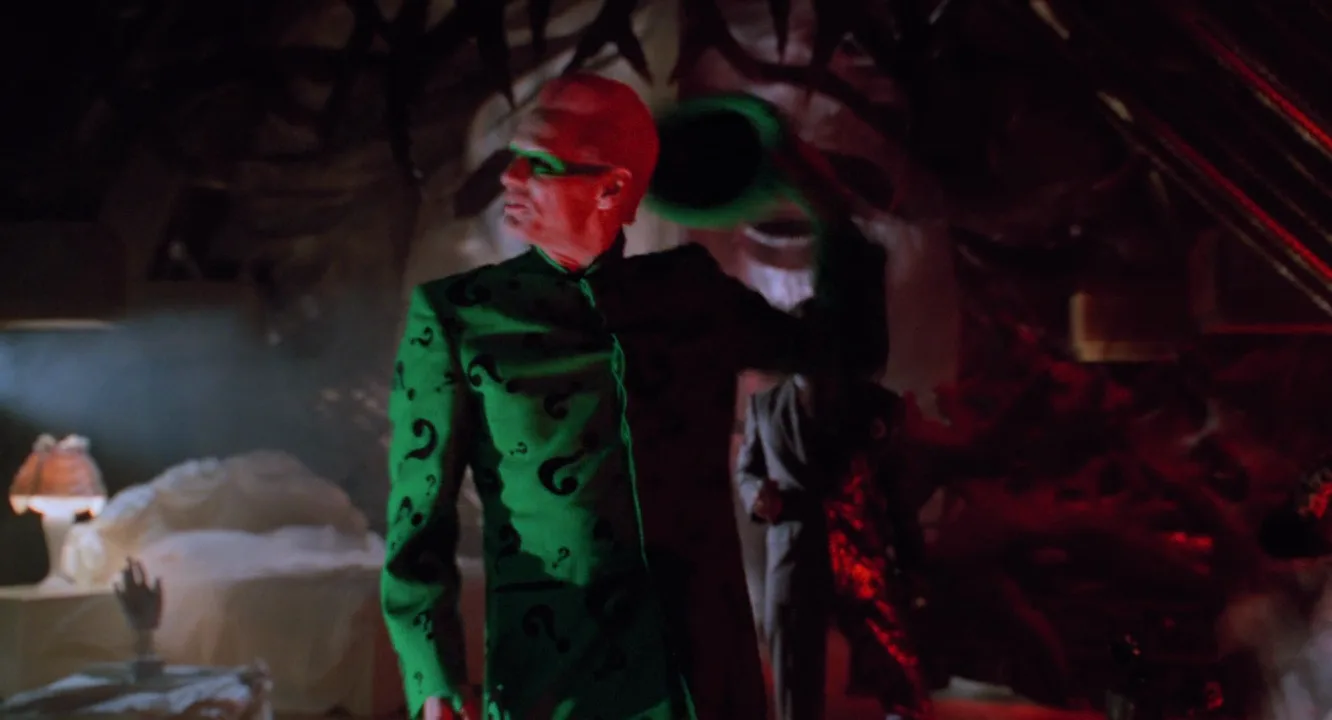
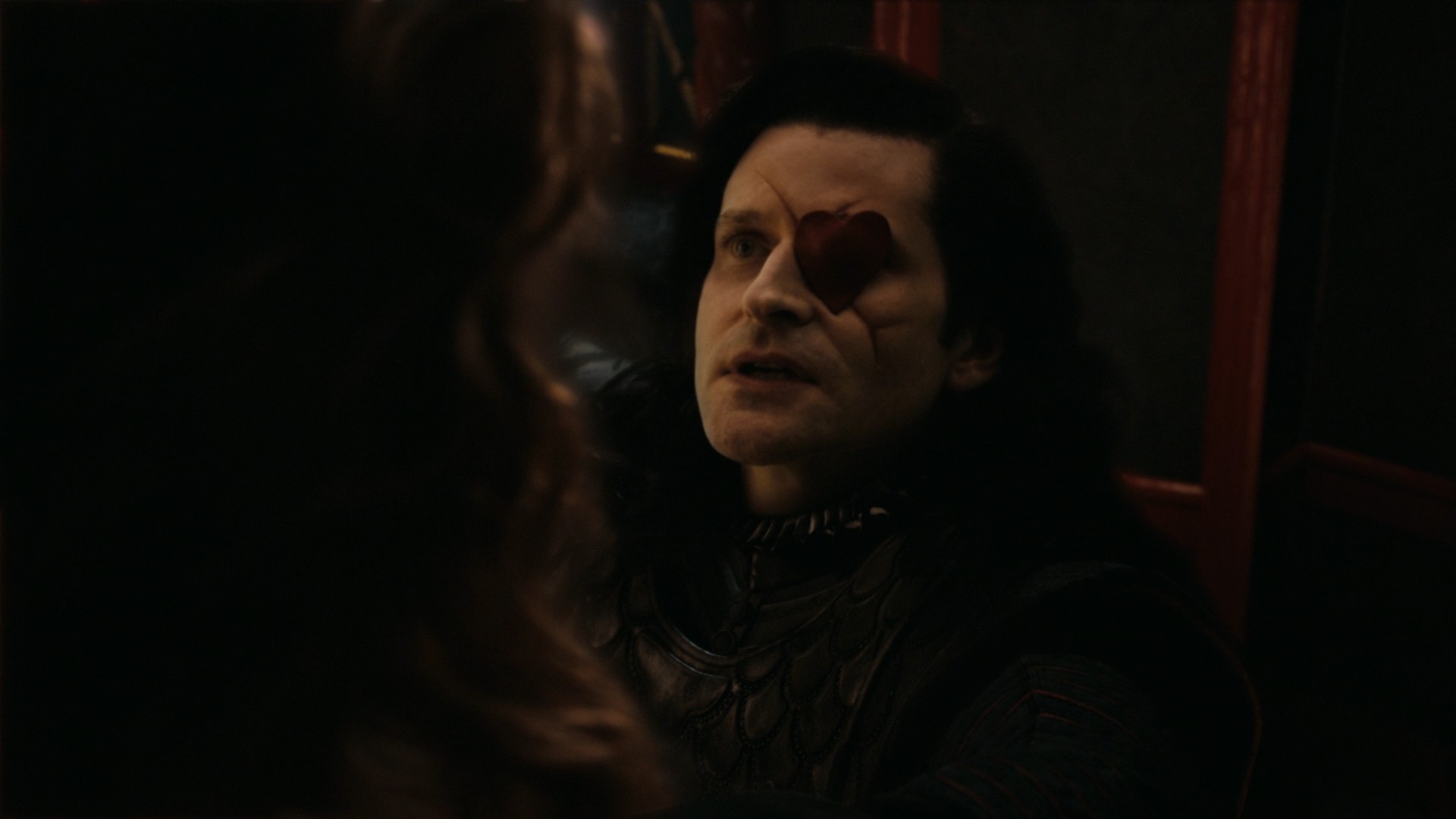
4 framesFour villains who read before they speak.
How to create a villain with AI
4 promptsDirect a villain through behavior, space and light, not a snarl. Nano Banana 2 Lite stages a calm introduction, GPT Image 2.5 tries another villain type, and MiniMax H3 Max Turbo animates the first frame, all on one FlashBoards board. The fourth prompt re-shoots a real film shot from a text description alone, and the original plays next to the result so you can compare.
Medium shot in a sunlit Victorian glass greenhouse full of red roses, 40mm lens at eye level. Center, sharp: a man in his sixties with a silver side-parted haircut, a neat white beard and a cream wool cardigan, calmly pruning a rose with small silver shears, not looking up. Left foreground, softer: a thin young clerk with round glasses and an oversized gray suit, clutching a leather folder, shoulders tense. Warm hazy daylight, 35mm film still.
The menace is contrast: calmly pruning, not looking up against clutching a leather folder, shoulders tense. Warm light keeps the villain polite on the surface, so the tension lives in body language.
Open FlashBoardsSymmetrical wide shot of a long, empty marble dining table in a cold modern hall with tall windows. At the far end, centered and small: a woman in her forties with a sharp platinum bob and a high-collared white tailored suit, seated perfectly upright, hands folded. At the near end, back to camera, one empty chair pulled out. Flat overcast light, pale gray palette, anamorphic film still.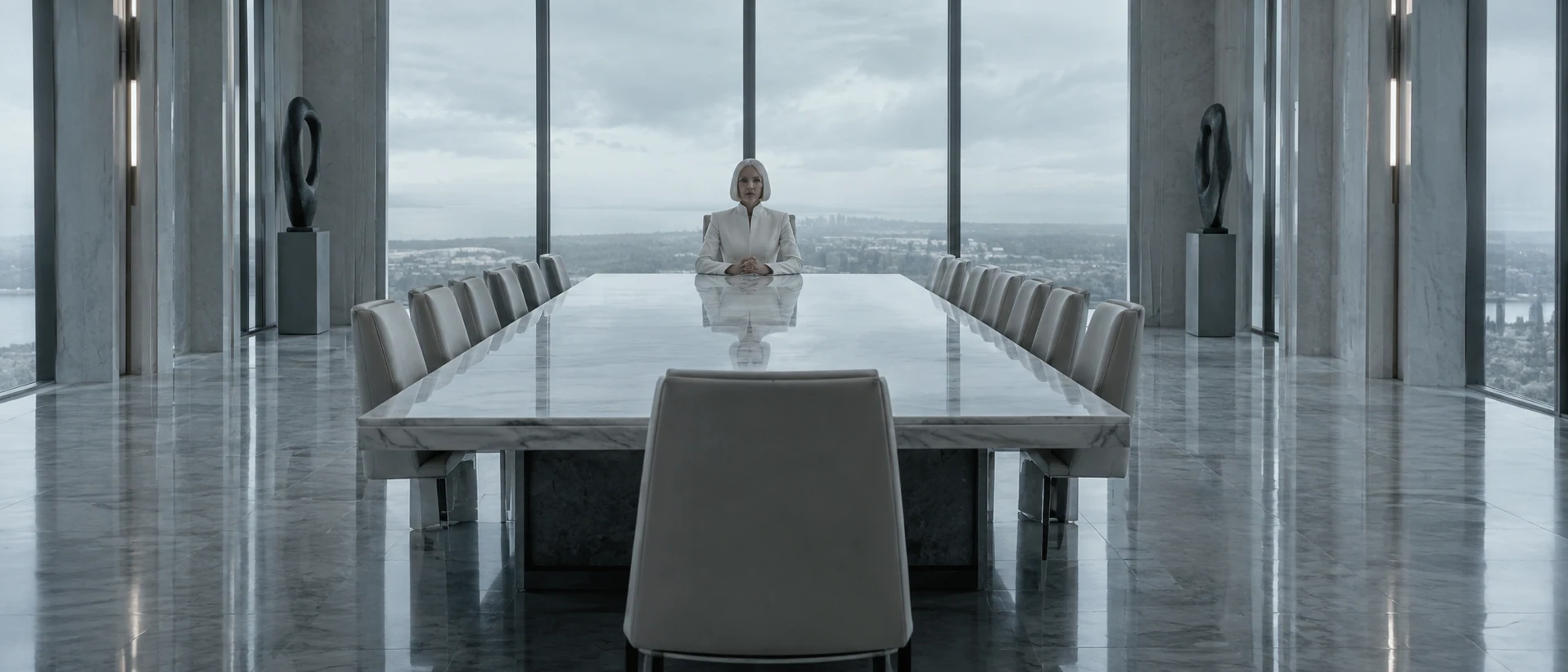
Space tells the tyrant: symmetrical, far end and one empty chair pulled out make the viewer the next guest. The white suit keeps a strong silhouette without the black-cape cliché.
Open FlashBoardsCamera: a slow, steady push-in toward the older man, starting at once and ending on a medium close-up. Action: The man keeps pruning with small, precise cuts from the first moment. He snips one rose off its stem, turns his head and holds it out toward the young clerk, smiling slightly. The clerk flinches and grips the folder tighter.Keeps pruning from the first moment makes the shot alive immediately. One gesture, offering the rose, carries the threat; the clerk's flinch tells the audience how to read it.
Open FlashBoards{
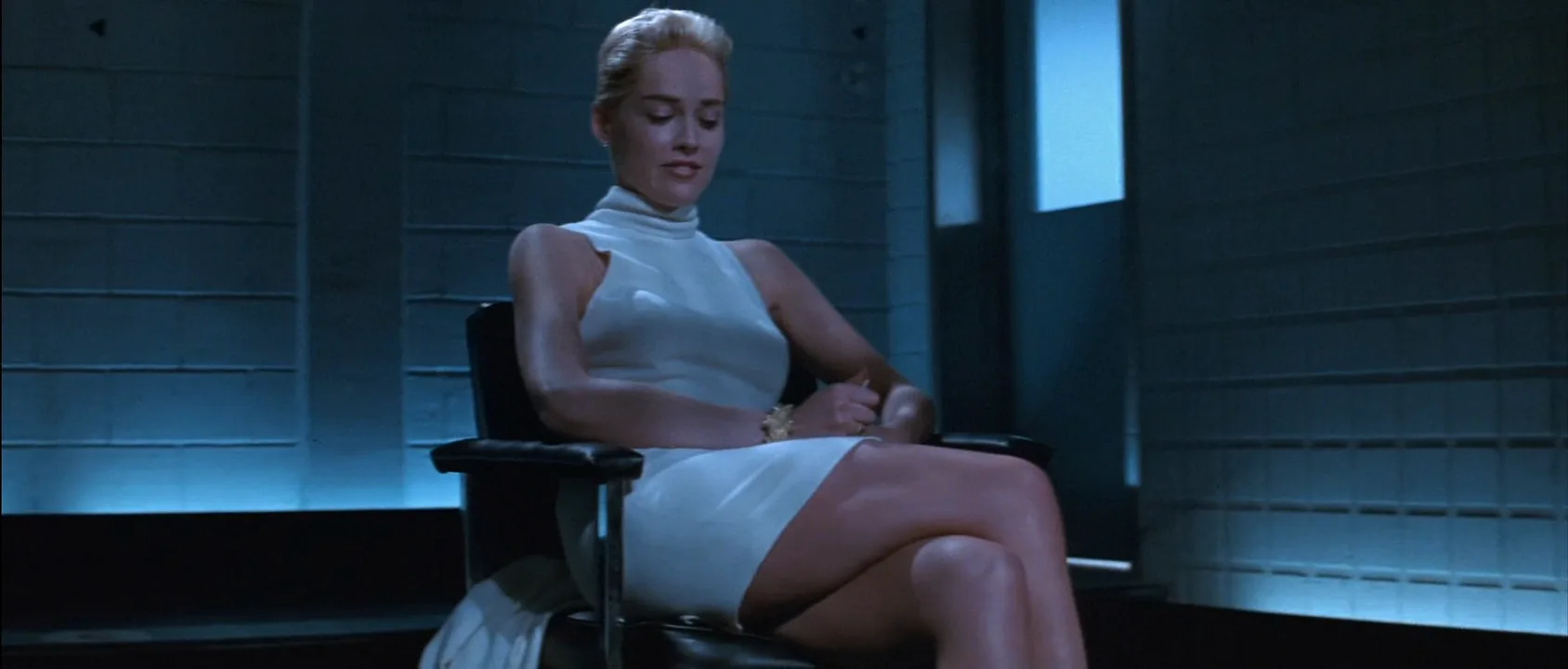
"output": "Full-screen live-action 35mm film footage from its very first frame, one continuous shot, a remake of the interrogation shot from Basic Instinct (1992): a bare police interrogation room with gray-blue tiled walls, a cold cyan strip of light glowing along the base of the back wall, one white spotlight from above on the suspect, dark shadowed corners, cool steel-blue palette with warm skin.",
"characters": {
"S1": {
"name": "Catherine Tramell, played by Sharon Stone",
"look": "woman in her thirties, blonde hair pulled back tight, sleeveless white high-necked dress, seated in a black upholstered swivel chair, a lit cigarette in the hand resting on the armrest at screen right",
"voice": "low, unhurried, amused, faintly mocking"
}
},
"shots": [
{
"shot": 1,
"camera": "starts as a centered medium-wide shot at seated eye level, then pans right and dollies out slowly and steadily, ending on a wider shot with her at the left third and the empty tiled wall and a pale window panel filling the right of frame",
"action": [
"BEGINNING: alive from the first frame, she sits upright and centered in the chair, legs crossed, both forearms on the armrests, the cigarette glowing in the hand at screen right, head tilted slightly down, eyes lowered toward her hands",
"THEN: she lifts her head and looks straight ahead at the unseen detectives just left of camera, a small closed-mouth smile, brows relaxed",
"THEN: she settles deeper into the chair and shifts her crossed legs, the hands stay still on the armrests, the smile stays",
"THEN: as the frame widens she glances down at the cigarette in her hand at screen right, then back up, calm and unblinking",
"END: she sits small at the left third of a wide cold room, perfectly composed, gaze held on the detectives, no one else in frame"
],
"dialogue": [
{
"speaker": "S1",
"on_screen": true,
"when": "from the first frame, through most of the shot",
"delivery": "relaxed, lightly amused, as if the questioning is a game she is winning",
"line": "<d>[English] I have a degree in psychology. It goes with the turf. Games are fun.</d>"
}
]
}
],
"sound": {
"ambience": "hum of the room lights, the soft creak of the chair, faint fabric rustle",
"speech": "exactly these spoken phrases, each said once, in this order",
"never_spoken": "no narration and no voice-over: the descriptions, performance notes and step words of this prompt are never spoken aloud",
"music": "a film score under the scene, always below the voices: a low sustained string note with a slow, sly pulse",
"subtitles": "none"
}
}Remakes the interrogation shot from Basic Instinct (1992), carrying over the pan right with dolly out, the cyan-lit tiled room, the white dress and Catherine's verbatim line.
The threat is all composure: a small closed-mouth smile, hands that stay still, and a camera that pans right and dollies out until she sits small in a cold room yet still owns it.
Open FlashBoardsCommon mistakes
- "Villain" or "evil" pulls models toward sneers, capes and red eyes. Describe behavior (calm, not looking up) and wardrobe instead.
- Two-character shots collapse into equal portraits. Say who is sharp and who is soft.
- In video, villains get theatrical, laughing and pointing. Ask for one small, precise action and let the other character react.
Keep the reference frames, prompts and every generated take side by side — images and video in one canvas.
FAQ
4 questionsHow do you write a good villain?
Give the villain a concrete goal that collides with the hero's, a reason they believe they are right, and a method the audience cannot excuse. Build them backward from the protagonist's weakness so every confrontation tests it, make them competent, and introduce them in a scene that shows their threat before the hero understands it.
What is the difference between a villain and an antagonist?
An antagonist is anything that blocks the protagonist: a person, nature, society or the hero's own flaw. A villain is an antagonist who also means harm, with malicious goals or methods. Every villain is an antagonist, but a storm or an honest detective chasing an innocent hero is an antagonist without being a villain.
What makes a movie villain memorable?
Conviction, competence and a strong introduction. Memorable screen villains believe they are right, win at least one round on skill, and arrive in a scene that fixes their threat in the audience's mind. A clear silhouette, controlled stillness and part of the face in shadow make them recognizable before they speak.
Can the protagonist be the villain?
Yes. A villain protagonist drives the story while doing harm, and the audience follows without approving. Walter White in Breaking Bad starts as a sympathetic chemistry teacher and ends as the most dangerous man in his world. The story still needs consequences, so the audience feels the cost of each choice.
Related terms
4- AntagonistStorytelling
The antagonist is the force that stands in the protagonist's way — a person, a group, nature, society or the hero's own nature — and gives the story its conflict.
- ProtagonistStorytelling
The protagonist is the main character whose goal drives the story and whose choices the audience follows; they don't have to be good, just central.
- Character ArchetypeStorytelling
A character archetype is a recurring role that audiences recognize across cultures — the mentor, the trickster, the shadow, the herald — which writers adapt rather than copy.
- Origin StoryStorytelling
An origin story shows how a character — often a hero or villain — became who they are, making the transformation itself the plot.
Further reading
Robert McKee, Story (1997); Christopher Vogler, The Writer's Journey (3rd ed., 2007).