 FlashBoards Learn
- Learn
- Camera Movement
- Crash Zoom
Camera Movement · Film language
Crash Zoom
Also called: snap zoom, whip zoom, smash zoom
A crash zoom is a zoom in or out so fast, often under half a second, that the frame slams from a wide view onto a face or detail. Also called a snap zoom, it punctuates a shock, a realization or a joke, and it openly announces that a camera is watching.
- What it does
- Hits the viewer with one detail at full force and makes the camera itself feel like it reacted.
- Use it when
- A beat needs an exclamation mark: a reveal, a scare, a punchline, a genre homage.
- Watch out
- Every crash zoom spends some of the audience's trust in the image; used often, it turns a film into parody.
- Try this prompt
Crash zoom: locked-off camera, the lens snaps from a wide shot to an extreme close-up of the man's eyes in under half a second, then holds still
What is a crash zoom?
A crash zoom is a zoom shot pushed to extreme speed. Unlike most camera movement, the camera stays put; only the focal length changes, say from 25mm to 250mm, in a handful of frames. Because nothing travels toward the subject, the whole image scales from one point: the face and the wall behind it grow together, with no parallax.
Snap zoom is the common synonym; whip zoom borrows from the whip pan. It goes in, from wide to extreme close-up, or out to reveal the room, and usually stops dead.
Why do filmmakers use crash zooms?
A crash zoom jolts the scale without a cut, so the viewer feels the camera flinch.
Shock and emphasis. Hong Kong kung fu films of the 1970s snapped in on a fighter's glare, and Italian westerns of the same era zoomed hard into eyes before a draw. The move says this matters, now.
Comedy and self-awareness. The move is so visible that it reads as a wink. Edgar Wright's Hot Fuzz (2007) crash zooms on routine police work as if it were a showdown, and Quentin Tarantino uses the move in Kill Bill: Vol. 1 (2003) as homage to those kung fu and western films.
Rule of thumb: one crash zoom is an accent, three in a scene is a style, more is a genre joke.
How to shoot a crash zoom
- Lens. A true zoom with a 10x or wider ratio and a short zoom throw. Cinema zooms are parfocal and hold focus; many still-photo zooms drift soft, so check the long end.
- Speed. Four to twelve frames at 24 fps (about 1/6 to 1/2 second). Past a second it becomes an ordinary zoom.
- Operation. Whip the zoom ring by hand for an organic lurch, or run a servo at full speed for repeatable takes. Tape the end mark so the operator lands on it.
- Support. A locked-off tripod: at 250mm any shake is magnified tenfold. Put the target where the zoom converges, usually frame center.
- Exposure and sound. Stop down to T4–T5.6 for focus margin, keep a 180° shutter for natural smear, and add a whoosh or sting in the mix.
- No zoom lens? Shoot 4K for a 1080p finish and animate a scale-up with motion blur, within about 2x. Editors use the same digital punch as one of the stylized transitions.
Crash zoom vs. dolly in: what changes on screen?
A dolly shot moves the camera toward the subject, so near objects slide past far ones and the space opens around you. A crash zoom moves nothing, so the frame flattens and crops like a magnifying glass. A push-in feels like leaning closer; a crash zoom forces the image on you. Combine the two at opposite rates and you get the dolly zoom, which locks the face and stretches the background instead.
Crash Zoom in motion
7 clipsA real crash zoom lasts a fraction of a second, so most film clips here are slower eye zooms: the same optics at a speed you can study. The background scales with the face, with no parallax. Kill Bill and the commercial run at full crash speed.

How to create a crash zoom with AI
3 promptsA video model will not crash zoom unless the prompt insists on speed, a locked camera and a hard stop. Nano Banana 2 Lite builds the wide start frame, GPT Image 2.5 draws a landing frame with zoom blur, and MiniMax H3 Max Turbo animates the snap from recipe 1. Keep the clips beside your takes on one FlashBoards board and compare.
Cinematic film still, medium-wide shot on a 28mm lens at eye level, camera centered: a lanky man in his fifties with a ginger handlebar mustache, a chipped front tooth and a mint-green bowling shirt sits alone at a roadside diner counter at night, holding an opened letter in both hands. A coffee cup beside him, red neon sign glowing through the window behind. Warm tungsten light, 35mm film grain.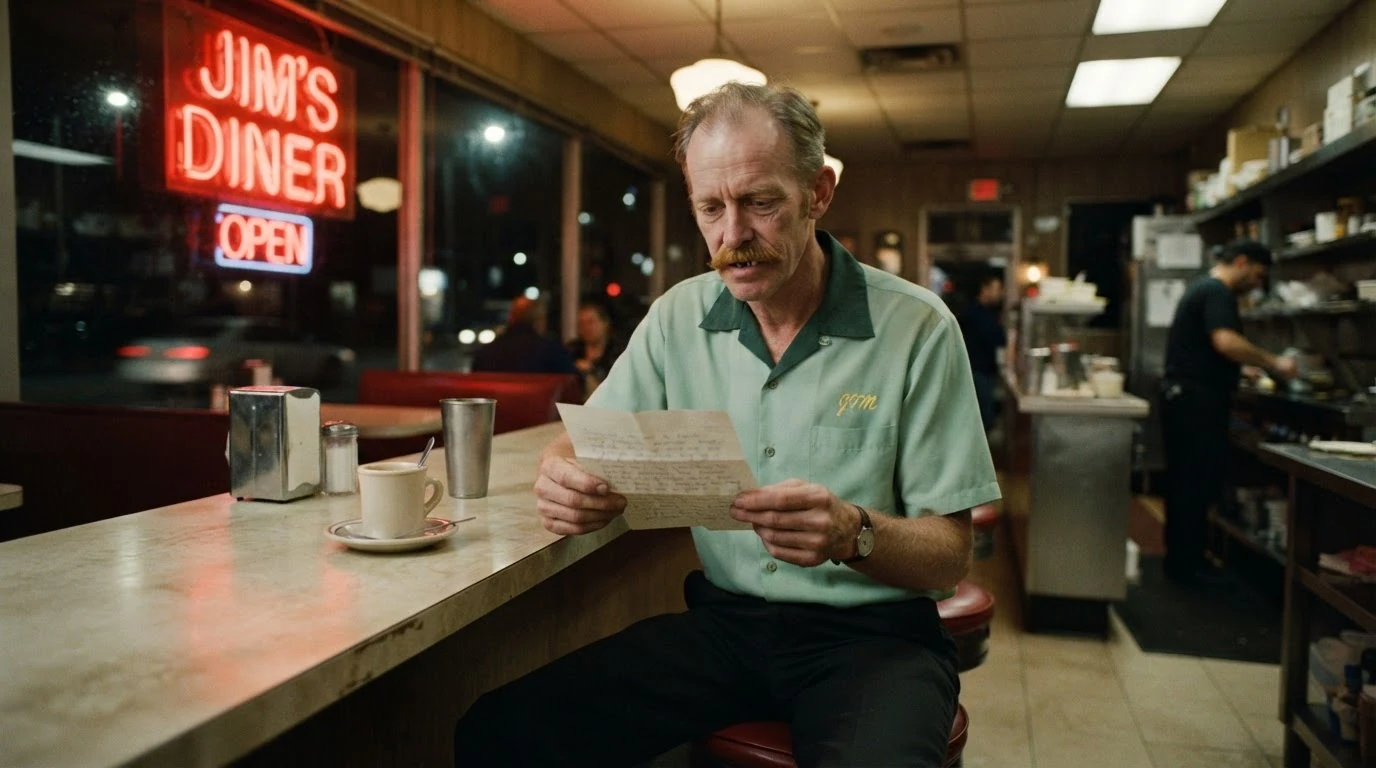
Medium-wide and camera centered give the zoom a target in the middle of the frame; the face is large enough to stay coherent when magnified.
Open FlashBoardsCinematic film still, the landing frame of a crash zoom: extreme close-up of a woman in her sixties with a silver buzz cut, red cat-eye glasses and one gold hoop earring, frozen mid-sip from a floral teacup, eyes wide in disbelief. Radial zoom blur streaks toward the center at the frame edges, her eyes sharp. Pastel kitchen tiles behind, soft window light, 1970s film color.
Radial zoom blur with eyes sharp is how a still shows a snap zoom: the smear of its last frames. Landing frame signals the end of a move, not a portrait.
Open FlashBoardsCamera: locked-off on a tripod, it never moves. After one short beat the lens crash zooms in, extremely fast, in under half a second, from the medium-wide shot to an extreme close-up of the man's eyes and mustache, then stops dead and holds still. Action: the shot opens with him already reading the letter, lips moving. He stops and freezes. As the zoom hits, his eyes go wide and his mustache twitches, and he stays frozen in the close-up.Locked-off, it never moves prevents a dolly; under half a second and stops dead and holds define a crash rather than a creep. Reading keeps the frame alive from the start.
Open FlashBoardsCommon mistakes
- A slow push-in. Models default to a gentle creep. State the speed (under half a second) and say the camera holds after landing.
- Dolly instead of zoom. If the counter and window slide apart, the camera moved. Add locked-off tripod, only the lens zooms.
- A melting face. Magnifying a tiny face invents features. Start from medium-wide, not a far wide shot.
- Clean stills. Image models skip the smear; ask for radial zoom blur at the edges, center sharp.
Keep the reference frames, prompts and every generated take side by side — images and video in one canvas.
FAQ
4 questionsWhat is the difference between a crash zoom and a snap zoom?
None in practice. Crash zoom, snap zoom, whip zoom and smash zoom all name the same move: a zoom in or out so fast, usually under half a second, that the frame jolts onto its target. Some editors reserve snap zoom for small punches.
What is a crash zoom used for?
It punctuates a beat. In thrillers and horror it hits a shock on a face; in action it underlines a glare before a fight; in comedy it treats a reaction or a trivial object as high drama. It also works as homage to 1970s kung fu films and westerns.
Is a crash zoom the same as a whip pan?
No. A whip pan rotates the camera sideways so fast that the image streaks horizontally, usually to jump between subjects or hide a cut. A crash zoom keeps the camera still and changes focal length, so the image scales toward or away from one point. Both can double as transitions.
How do I do a crash zoom without a zoom lens?
Shoot at a higher resolution than your delivery, for example 4K for a 1080p edit, and animate a quick scale-up in your editor with motion blur on. Keep the punch-in within about 2x to avoid softness, add a whoosh, and land on a strong frame. It looks cleaner than real glass.
Related terms
4- Dolly ShotCamera Movement
A dolly shot is filmed with the camera on a wheeled dolly, usually on track, so it can glide smoothly toward, away from or alongside the action; unlike a zoom, the camera really moves, so perspective and parallax change.
- Zoom ShotCamera Movement
A zoom shot changes the lens's focal length during the take, so the image grows or shrinks from a fixed camera position; because the camera doesn't move, perspective stays the same — the key difference from a dolly.
- Whip PanCamera Movement
A whip pan is a pan so fast that the image dissolves into motion blur; it snaps attention between two points, links two characters with energy or hides a cut, making it one of the liveliest transitions in film.
- Film TransitionsEditing
Transitions are the ways one shot or scene gives way to the next — the plain cut, dissolve, fade, wipe, match cut and hidden or stylised moves like whip and mask transitions.
Further reading
Steven D. Katz, Film Directing Shot by Shot. Blain Brown, Cinematography: Theory and Practice.