 FlashBoards Learn
- Learn
- Camera Movement
- Whip Pan
Camera Movement · Film language
Whip Pan
Also called: swish pan, flash pan, zip pan, whip shot
A whip pan is a pan so fast that the image smears into horizontal motion blur between two framings. It snaps attention from one point to another, links two characters or places with a jolt of energy, and can hide a cut inside the blur, which makes it one of the liveliest transitions in film.
- What it does
- Throws the eye from A to B in a fraction of a second, with a streak of motion blur in between.
- Use it when
- You want energy, comic timing, a snap reaction, or a transition that hides the cut.
- Watch out
- A whip that's too slow becomes a sloppy pan, and a mushy landing kills the snap.
- Try this prompt
Holds on her face for 2 seconds, then an extremely fast whip pan right with heavy horizontal motion blur, landing hard on the man at the door, camera rotating in place
What is a whip pan?
A whip pan, also called a swish pan, flash pan or zip pan, is a pan done fast enough that the frames in the middle of the move turn into streaks. A normal pan lets you read the space it crosses. A whip pan deliberately doesn't: the camera leaves one composition, the world smears for a handful of frames, and the camera lands on the next composition.
Physically it is still a rotation around the camera's vertical axis. The camera stays in place and swivels. What makes it a whip is speed: roughly a 90-degree turn in a third of a second or less, which at 24 fps means six to eight frames of blur. Those frames carry the energy, and they are also where an editor can hide a cut.
In the camera movement family, its closest relative is the crash zoom. Both are fast punctuation that announces the camera.
Why do filmmakers use whip pans?
- Comic timing. Wes Anderson whips between characters and details in Moonrise Kingdom (2012) and The Grand Budapest Hotel (2014). The camera snaps from one centered tableau to the next, and the precision of the snap is part of the joke. Edgar Wright uses whips the same way, as a visual rimshot.
- Rhythm and connection. Damien Chazelle whips between musicians in Whiplash (2014) and La La Land (2016), so the camera moves like a player in the band.
- Transitions through time and space. The breakfast-table montage in Citizen Kane (1941) uses whip pans to jump across years of a marriage in a couple of minutes: each swish carries the couple further apart.
- Panic and reaction. A whip toward a sound or a threat mimics a head snapping round.
Unlike a cut, a whip keeps the geography. The viewer feels the direction and distance between A and B, even if nothing in between is readable.
How to shoot a whip pan
Head and body. On sticks, use a fluid head with the pan drag set low, or a remote head for repeatable speed. Stand facing the end frame, then twist back to the start frame: when you roll, you unwind naturally into the landing. Handheld and gimbal whips work too, with a rougher, more nervous feel, as in a handheld shot.
Speed and holds. Hold on A for a beat (1-2 seconds), whip in 0.2-0.4 seconds, land and hold on B. Rehearse until the landing is clean: either a hard stop, or a small overshoot that settles back.
Shutter. The blur comes from shutter speed. At 24 fps, the standard 180-degree shutter (1/48 s) gives a natural smear. Opening to 270-360 degrees makes it heavier. A fast shutter such as 1/500 s gives crisp, strobing frames instead of motion blur, which kills the effect unless you want it.
Lens. Longer lenses blur more per degree of rotation, so a whip on 50-85mm needs a smaller swing than one on 24mm.
Focus and exposure. Put A and B at similar distances, or pull focus during the blur where nobody can see it. Keep exposure consistent at both ends so the landing doesn't pump.
Sound. A short whoosh in the mix sells the speed.
How does a whip pan transition work?
A whip pan transition hides the cut inside the blur. Shot A ends with a whip out in one direction; shot B starts with a whip in from the same direction at the same speed. The editor cuts on the blurriest frames, and two places or two moments feel joined by one continuous move.
To make it invisible, match four things across the two shots: direction, speed, lens and shutter. Match the brightness of the blur too. Three to six frames of blur on each side of the cut is usually enough.
It is one of the classic seamless transitions among film transitions, and it can be built in post: add a directional blur to the last frames of A and the first frames of B, keyframe a fast horizontal slide, and cut in the middle. Use it where the story wants a jump with energy, not as glue between every scene.
Whip tilt: the vertical whip
A whip tilt is the same idea on the vertical axis: an extremely fast tilt up or down that smears the image into vertical streaks. It links points stacked in height, such as a face and something falling from above, a hand and an object hitting the floor, or a street and a window high on a building.
It is also a classic transition route through the sky. Whip up into the sky at the end of one scene, whip down from the sky into the next, and cut in the blur, where nothing is visible but light.
On set, a whip tilt is harder than a whip pan. The camera's weight works against you on the vertical axis, so balance the head properly and set the tilt drag low. Land on a level horizon, because a tilted landing reads as sloppy rather than dynamic.
Yo-yo whip pan: back and forth
A yo-yo whip fires several whip pans back and forth between the same two points: A, B, A, B. The repetition turns the move into rhythm, like watching a tennis rally. It suits arguments volleyed between two people, a character torn between two options, or music cut to a beat.
Three rules make it work. Land on exactly the same frame each time, so the repetition reads as design. Keep the holds short and even, or shorten them progressively to escalate. Stop after two to four volleys, before the joke wears out.
Whip pan vs. pan vs. crash zoom
- A pan is readable. It follows action or reveals space, and the viewer sees everything it crosses.
- A whip pan is deliberately unreadable in the middle. It only cares about the start and end frames and the energy between them.
- A crash zoom is fast too, but it changes scale, not direction: it slams toward one subject instead of throwing the eye sideways to a new one.
- A cut jumps without motion. A whip keeps the viewer oriented in space, and when the cut is hidden inside a whip, you get both at once.
Choose the pan when the space between A and B matters, the whip when only the connection matters.
Whip Pan in motion


11 clipsWatch the ends of each move: a good whip holds a readable frame, smears for a handful of frames, then lands hard on a second readable frame in the same space. Notice what each whip connects, and whether it lands on a dead stop or a small overshoot that settles.
How to create a whip pan with AI
3 promptsVideo models default to smooth, readable pans, so a whip needs its speed, blur, direction and landing spelled out. Nano Banana 2 Lite draws a start frame with the whip's motivation built in, GPT Image 2.5 gives you a mid-whip frame to cut on, and MiniMax H3 Max Turbo animates the start frame into the whip itself, the recipe that matters most. In FlashBoards, keep the endpoints, the film references and every take on one board and compare them side by side.
Cinematic film still, symmetrical medium shot inside a narrow pastel-green barbershop, 40mm lens at eye level: a stocky barber in his fifties with a shaved head, a thick grey handlebar mustache and a white tunic stands centered behind an empty red leather chair, scissors raised mid-snip, his head already turning sharply toward frame right; at the right edge of the frame, the brass handle and rain-streaked glass of the shop's front door; soft overcast daylight, matte pastel palette, 35mm film grain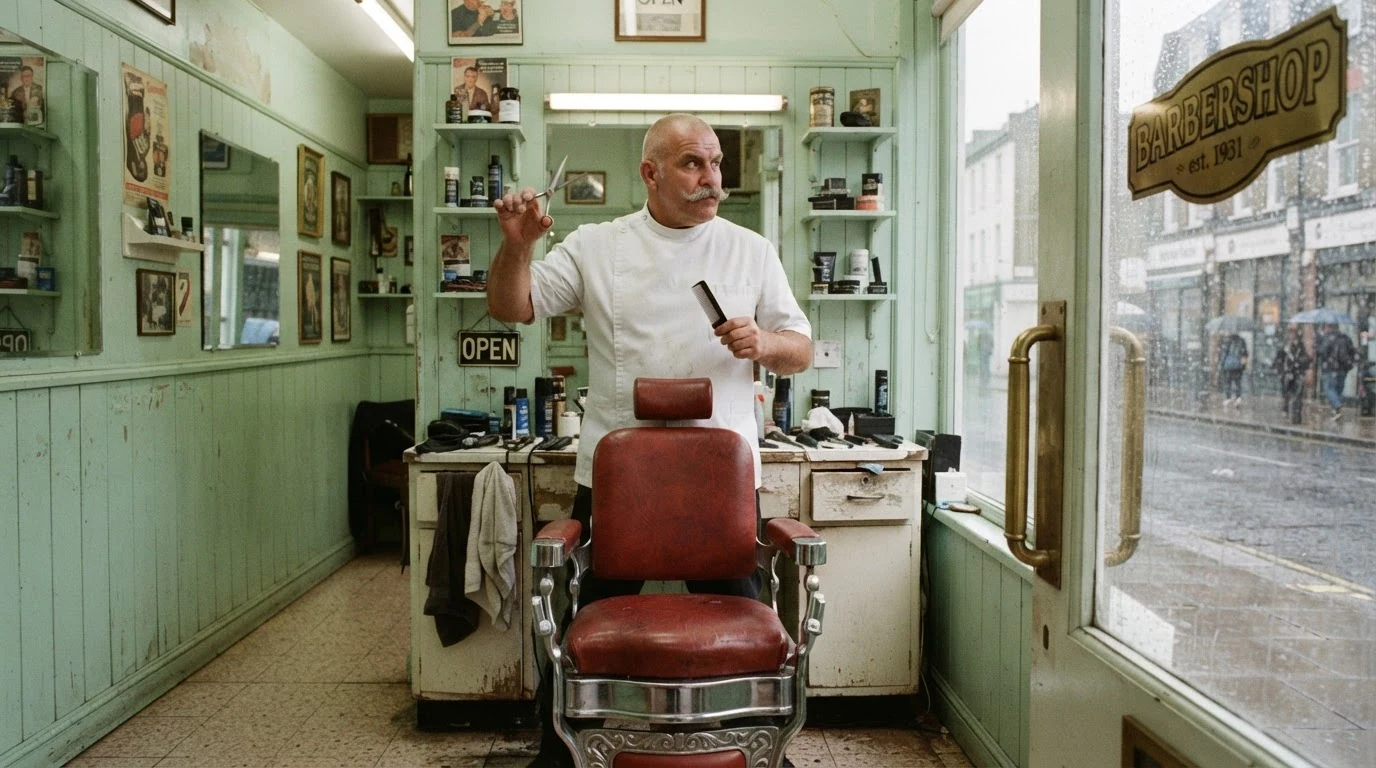
The start frame has to motivate the whip: his head already turning sharply toward frame right gives the move its direction, and putting the front door at the right edge means the landing is already part of the picture. Symmetrical and centered give the composed endpoint a whip leaves from, and specific features (shaved head, handlebar mustache) make the barber a clearly invented character.
Open FlashBoardsCinematic film still caught in the middle of a whip pan inside a small jazz club at night: the whole frame smeared into long horizontal streaks of motion blur, warm stage lights stretched into amber lines, the brass bell of a saxophone and the cymbals of a drum kit readable only as bright streaks, dark red walls, everything in the frame equally blurred in one direction, 50mm lens, anamorphic widescreen, 35mm film grain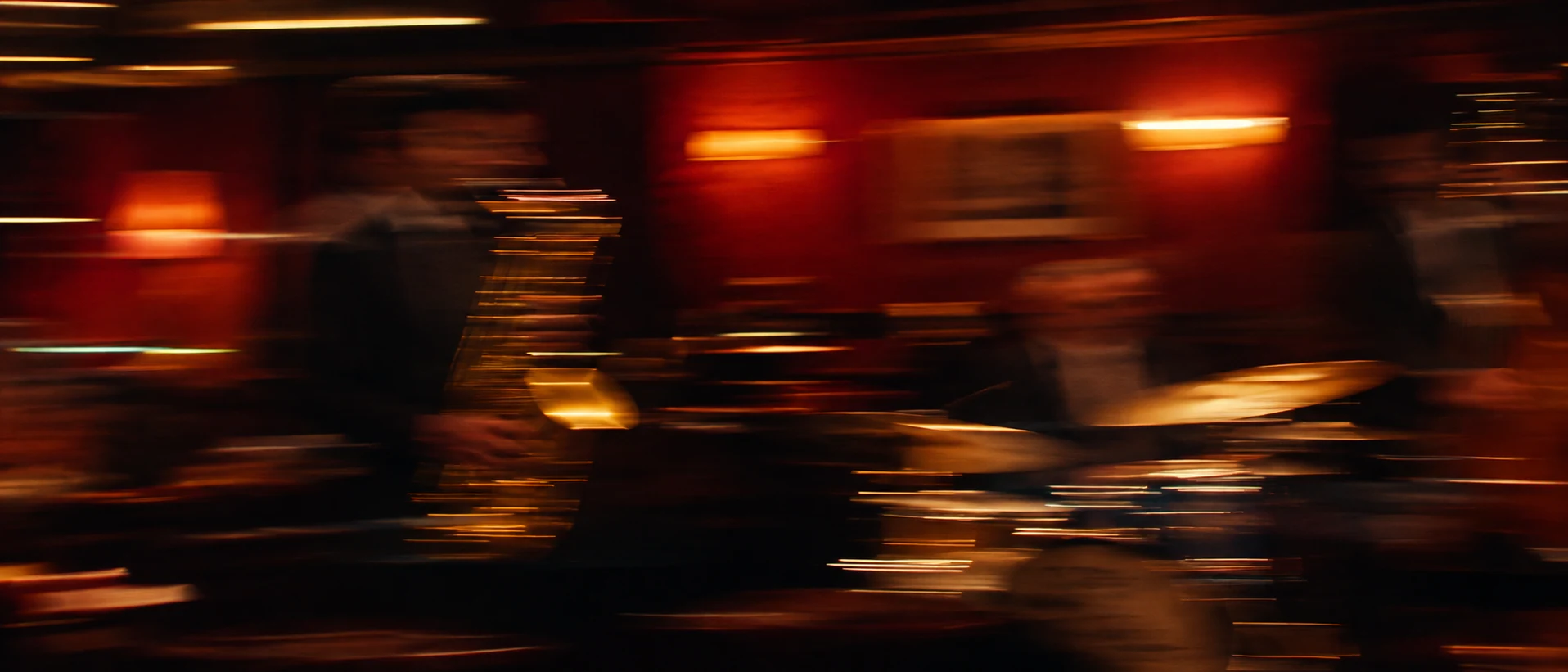
A second take: the frame from the middle of the whip, the one an editor cuts on. Long horizontal streaks and equally blurred in one direction ask for directional blur, not soft focus, and naming the bright objects being smeared gives the blur something to streak. Drop it between two clips for a whip transition.
Open FlashBoardsCamera: starts on the barber in the locked-off symmetrical medium shot, then after a short beat whips right in one extremely fast pan, rotating in place on a tripod; for a split second the whole frame smears into heavy horizontal motion blur, then the camera lands hard on the glass front door, framed centered, and holds perfectly still. Action: the barber is already snipping at the air and turning his head sharply toward the door as the shot begins. In the middle, while the camera whips, the door swings open. At the end the camera holds on the open doorway, where a short woman in her sixties with a silver bob and a yellow raincoat stands dripping, shaking out a folded umbrella.Extremely fast, for a split second and heavy horizontal motion blur keep the whip a small slice of the clip instead of a slow pan. Rotating in place on a tripod stops the camera drifting forward, and lands hard ... holds perfectly still gives a clean landing. The barber moves from the first frame, so the shot never starts frozen; the door is already in the start frame, and the woman, who is new, is described in full, because anything vague at the landing gets invented.
Open FlashBoardsCommon mistakes
- Too slow. The model delivers a smooth, readable pan. Use extremely fast, for a split second and heavy horizontal motion blur, and keep the clip to 5 seconds.
- A cut or morph instead of a move. Ask for one continuous whip, camera rotating in place, and say where the landing is (to the right, the front door).
- An invented landing. Whatever the camera whips to is drawn from your words. Put it at the edge of the start frame, or describe it as fully as the start.
- Blur without motion. The frame just goes soft. Name the direction: horizontal motion blur, whips right.
- Mushy landing. Write lands hard and holds perfectly still.
- Frozen start. With only a camera move in the prompt, the model slowly pushes in on a still picture. Start
Action:with something already moving. - Whip tilt read as a crane. Say camera tilts up in place, vertical motion blur.
Keep the reference frames, prompts and every generated take side by side — images and video in one canvas.
FAQ
6 questionsWhat is the difference between a whip pan and a swish pan?
There is no difference. Whip pan, swish pan, flash pan and zip pan are all names for the same move: a horizontal pan so fast that the image turns into motion blur between the start and end frames. “Swish pan” is the older name found in classic film writing.
How fast is a whip pan?
Typically a 90-degree turn in about 0.2-0.4 seconds, which at 24 fps is five to ten frames of blur. The exact speed depends on the lens: longer lenses blur more per degree, so they need a smaller, slightly slower swing. If you can read objects mid-move, it's a fast pan, not a whip.
How do you do a whip pan transition?
End the first shot with a whip out in one direction and start the second shot with a whip in from the same direction at the same speed, lens and shutter. In the edit, cut between the blurriest frames of each shot. You can also fake it in post with directional blur and a fast horizontal slide.
What movies use whip pans?
Wes Anderson's films, including Moonrise Kingdom (2012) and The Grand Budapest Hotel (2014), use whip pans as comic punctuation. Damien Chazelle whips between musicians in Whiplash (2014) and La La Land (2016). Edgar Wright uses them for rhythm and jokes, and the breakfast montage in Citizen Kane (1941) is a classic example of whip pans used as transitions across time.
What shutter speed should I use for a whip pan?
Start with the 180-degree rule: at 24 fps, a shutter of 1/48 or 1/50 s gives natural motion blur. For a heavier smear, open the shutter angle toward 270-360 degrees. Avoid fast shutter speeds like 1/500 s, which freeze each frame and make the whip look choppy and strobing instead of blurred.
Can AI video generators make a whip pan?
Yes, if you are explicit. Video models default to slow, readable pans, so describe the speed (extremely fast, for a split second), the blur (heavy horizontal motion blur), the direction and the landing. Start from a still frame whose subject is already turning toward the target, keep the target in or at the edge of that frame, and ask for the camera to rotate in place and land hard.
Related terms
3- PanCamera Movement
A pan swivels the camera horizontally from a fixed position — left or right around its vertical axis — to follow action, connect two points in space or reveal a scene bit by bit.
- Crash ZoomCamera Movement
A crash zoom is an abrupt, very fast zoom in or out that slams the frame onto a face or detail; it punctuates a shock or a joke and openly announces the camera's presence.
- Motion BlurLenses, Focus & Exposure
Motion blur is the smear a moving subject leaves when it travels during the exposure of a frame; its amount depends on shutter speed or shutter angle, and it makes movement feel smooth, fast or, when exaggerated, frantic.
Further reading
Blain Brown, Cinematography: Theory and Practice. Steven D. Katz, Film Directing Shot by Shot. Walter Murch, In the Blink of an Eye.