 FlashBoards Learn
- Learn
- Camera Movement
- Double Dolly Shot
Camera Movement · Film language
Double Dolly Shot
Also called: Spike Lee dolly, Spike Lee shot, floating dolly, double dolly shot
A double dolly shot puts the actor on a second dolly that travels with the camera dolly, so the character glides through the location without taking a step. The body stays still while the world slides past behind it, which reads as dreamlike, fated or unsettling. It is Spike Lee's signature move.
- What it does
- Makes a character float through space as if carried by something outside their control.
- Use it when
- A character is in a trance, walking toward fate, or cut off from the world around them.
- Watch out
- Show the feet or let the actor bob and the illusion breaks; the effect lives above the waist.
- Try this prompt
Low-angle waist-up shot of a woman gliding toward camera down a brownstone street, body perfectly still, the houses sliding past behind her
What is a double dolly shot?
In an ordinary dolly shot the camera rides and the actor walks. In a double dolly both ride: the actor stands on a platform or second dolly, and the grips push the whole rig down the track at one speed. Framing barely changes, but the street behind keeps moving.
A walking body bobs: shoulders rise and fall, arms swing. Remove that while the background still flows past, and the character seems pulled along.
It is also called the Spike Lee dolly or floating dolly. No zoom is involved: the lens stays put and both camera and actor travel.
Why does Spike Lee use the double dolly?
Spike Lee has returned to the shot in Mo' Better Blues (1990), Jungle Fever (1991), Malcolm X (1992) and BlacKKKlansman (2018), a textbook auteur signature. He saves it for moments when a character is no longer in charge of their own path.


The best-known version is in Malcolm X: Denzel Washington's Malcolm glides along a street toward the ballroom where he will be killed. In BlacKKKlansman the two leads float side by side, guns raised, in an image that steps outside the film's realism.
The effect on the viewer: detachment (shock, love, grief, a high), inevitability (something is moving them toward an ending) and alarm, because nobody moves like this in life.
How to shoot a double dolly
- Rig. Lay 10–20 m of straight track. Put the actor on a small platform or doorway dolly tied to the camera dolly with a rigid bar so the distance can't drift, with an apple box to lean on.
- Frame. Waist-up or tighter hides the platform. A slight low angle, camera at chest height, adds sky and rooftops behind the figure.
- Lens. 25–35mm makes the background slide visibly; long lenses flatten the move into a static-looking shot.
- Speed. Walking pace, about 1–1.5 m/s. Faster reads as a car shot.
- Performance. Level shoulders, fixed eyeline, no rhythm in the body; let the eyes and breath carry the emotion.
- Light. The actor never changes position in frame, so a key and bounce can ride on the rig.
Double dolly vs. dolly zoom
A dolly zoom moves the camera while zooming the opposite way, so the background's perspective stretches or compresses behind a subject of constant size: vertigo. A double dolly uses no zoom; camera and actor travel together, the background slides past with natural parallax, and the character floats.
A Snorricam also locks the face, but the actor really walks, so the world lurches. An ordinary tracking shot of a walking actor is the baseline both play against. More moves live in camera movement.
Double Dolly Shot in motion


8 clipsWatch the body, not the camera. In the first five clips the actor stays still while the background slides past. The last four are ordinary follow shots for comparison: the camera moves as much, but you see the stride and the bob of the head.

How to create a double dolly shot with AI
3 promptsVideo models default to walking, so the prompt must describe the look: a still upper body, a fixed distance to camera, a background sliding past. Nano Banana 2 Lite builds the start frame, GPT Image 2.5 a corridor variation, and MiniMax H3 Max Turbo animates the float. Keep the Malcolm X clip beside your takes on one FlashBoards board.
Cinematic film still, low-angle medium shot from waist height, 28mm lens: a woman in her fifties with close-cropped silver hair, a small gap between her front teeth and a long burgundy wool coat stands upright in the center, framed from the waist up, arms still, eyes fixed beyond the camera. Behind her a street of brownstone row houses and bare trees recedes under an overcast sky. Soft daylight, muted colors, 35mm film grain.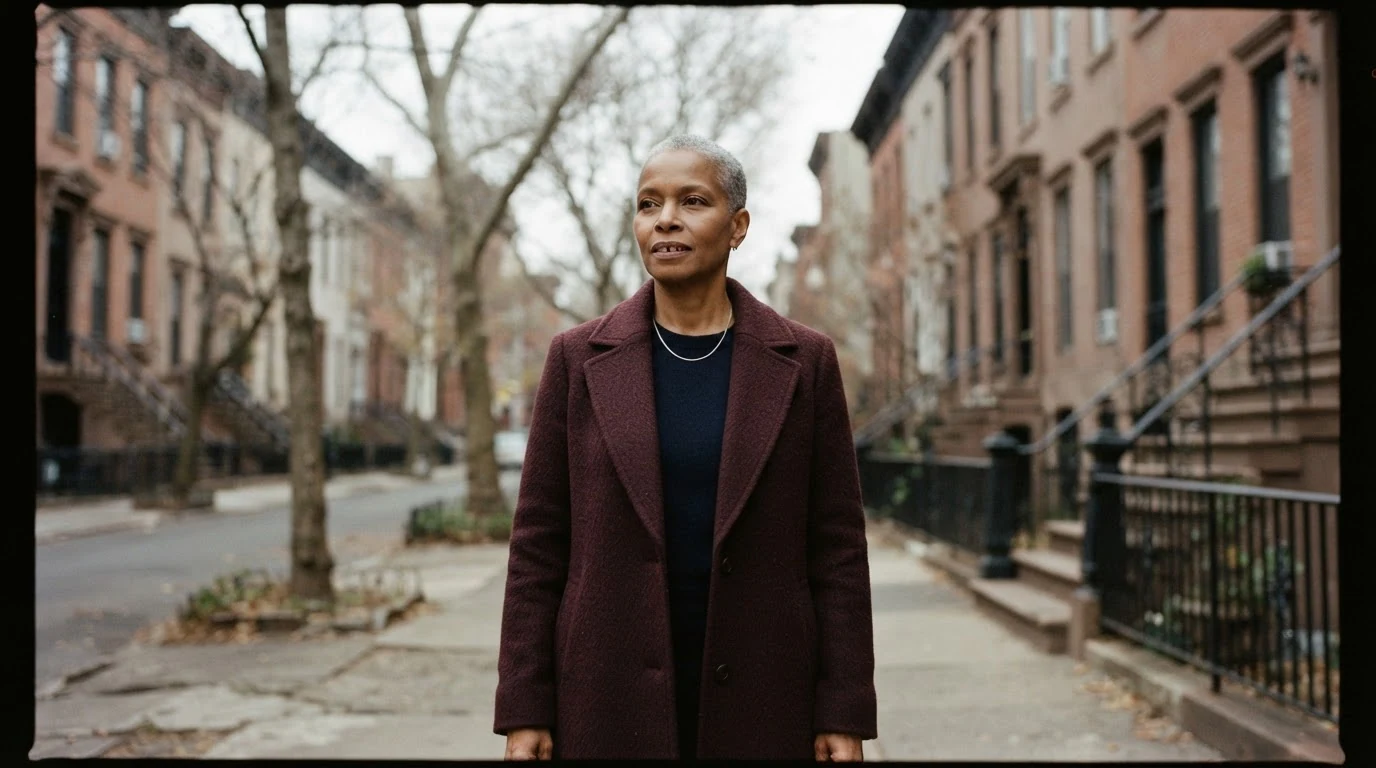
Framed from the waist up hides the feet, as on set. Low-angle and a 28mm lens give the row houses depth so they can visibly slide once the frame moves.
Open FlashBoardsCinematic widescreen still, medium close-up from chest height, 32mm lens: a lanky young man with a shaved head, a thin mustache and a small gold hoop earring, in a mustard corduroy jacket, stands perfectly upright and centered in a long hospital corridor, face sharp and blank. The walls, doors and ceiling lights are streaked with horizontal motion blur while he stays crisp. Cool fluorescent light, pale green walls.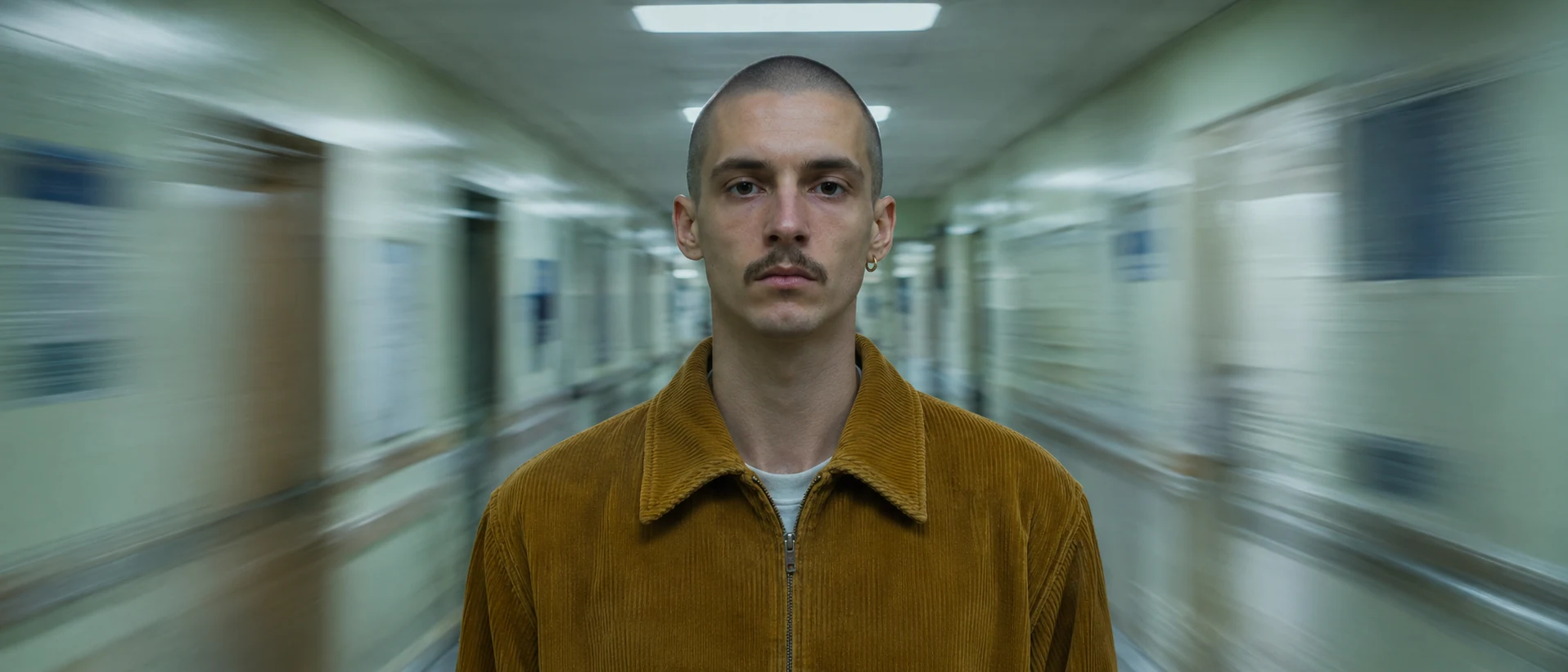
A still can't move, so this take shows the result: a sharp, motionless figure against a background streaked with horizontal motion blur. Useful as a storyboard frame.
Open FlashBoardsCamera: a smooth backward dolly along the street at walking pace from the first frame to the last, same low angle, same distance, so the woman stays the same size in the center. Action: from the start she glides forward with the camera, body upright and motionless, shoulders level, as if carried; only her hair and coat collar stir. The brownstones and bare trees slide steadily past behind her. Midway her eyes narrow slightly. At the end she is still gliding, gaze fixed beyond the camera.Same distance, same size and body upright and motionless, as if carried describe the float instead of naming a technique. Motion starts on frame one.
Open FlashBoardsCommon mistakes
- The actor walks. Describe the body: upright, motionless, shoulders level, gliding. Keep the frame waist-up so there are no legs to animate.
- A slow push in. Say the background slides past and name what is in it.
- Accidental dolly zoom. Don't write zoom; ask for a physical move at a fixed distance.
- Invented scenery. Name only what the start frame shows.
Keep the reference frames, prompts and every generated take side by side — images and video in one canvas.
FAQ
4 questionsWhat is a Spike Lee dolly shot?
It is another name for the double dolly: the actor stands on a dolly or platform that moves with the camera dolly, so the character glides through a scene without walking. Spike Lee has used it in Mo' Better Blues, Malcolm X and BlacKKKlansman, usually at moments of trance, shock or destiny, and it is his best-known visual signature.
How do you do a double dolly shot?
Put the actor on a platform or second dolly rigidly linked to the camera dolly and push the rig down straight track at walking pace. Frame from the waist up to hide the platform, use a 25–35mm lens so the background slides visibly, and ask the actor for level shoulders and a steady eyeline.
Is a double dolly the same as a dolly zoom?
No. A dolly zoom combines a camera move with an opposite zoom, so the background's perspective warps behind a subject of constant size. A double dolly uses no zoom: actor and camera travel together, the background slides past with normal parallax, and the character floats. One feels like vertigo, the other like being carried.
Which Spike Lee movies use the double dolly?
It appears in Mo' Better Blues (1990), Jungle Fever (1991), Malcolm X (1992) and BlacKKKlansman (2018), among other Spike Lee films. The most famous example is Malcolm gliding along a street toward the ballroom near the end of Malcolm X.
Related terms
5- Dolly ZoomCamera Movement
A dolly zoom moves the camera toward or away from the subject while zooming the opposite way, so the subject keeps the same size but the background seems to stretch away or rush in — a jolt of dread or sudden realisation made famous by Hitchcock's Vertigo (1958).
- SnorricamCamera Movement
A Snorricam is a rig strapped to the actor's body with the camera aimed back at them, so their face stays locked in the frame while the world lurches around — a staple for drunkenness, panic or euphoria.
- Dolly ShotCamera Movement
A dolly shot is filmed with the camera on a wheeled dolly, usually on track, so it can glide smoothly toward, away from or alongside the action; unlike a zoom, the camera really moves, so perspective and parallax change.
- Tracking ShotCamera Movement
A tracking shot moves the camera through space with a moving subject — on a dolly, Steadicam, vehicle or drone — following, leading or flanking it so the audience travels with the action.
- Auteur TheoryFilm History & Theory
Auteur theory holds that the director is the true author of a film, whose personal style and themes recur across their work; it grew from Truffaut and Cahiers du cinéma's 'politique des auteurs' in the 1950s and was popularized in the US by Andrew Sarris.
Further reading
Blain Brown, Cinematography: Theory and Practice (chapters on dollies and camera support). Steven D. Katz, Film Directing Shot by Shot.