 FlashBoards Learn
- Learn
- Camera Movement
- Snorricam
Camera Movement · Film language
Snorricam
Also called: body mount shot, body rig shot, chest rig shot, body cam rig
A Snorricam is a camera rig strapped to the actor's body with the lens aimed back at them, usually at the face. Camera and actor move as one unit, so the face stays locked in the frame while the world behind it lurches, tilts and spins. It is the shot for drunkenness, panic, drug highs and euphoria.
- What it does
- Pins the actor's face to the frame and hands all the movement to the world behind them.
- Use it when
- A character loses control: drunk, high, panicking, fleeing or riding a rush of joy.
- Watch out
- The effect is loud; use it for a few beats, not a whole scene, or it becomes a gimmick.
- Try this prompt
Snorricam shot, camera rigged to the actor's chest facing his face, 18mm, face locked center, night street tilting and motion-blurred behind him
What is a Snorricam shot?
A rigid arm is bolted to a vest on the actor's torso, with the camera at its end, 50–90 cm away, aimed back at the actor. When the actor stumbles or turns, the camera goes along: the face holds its place in the frame while everything behind it swings past.
The rig is named after the Snorri Bros., Einar Snorri and Eiður Snorri Eysteinsson, an Icelandic photographer-director duo who built the modern rig for music videos in the mid-1990s. The idea is older — Martin Scorsese strapped a camera to Harvey Keitel for the drunken bar scene in Mean Streets (1973). Of all camera movement, it is the one the actor operates.
Why do filmmakers use a Snorricam?
The shot puts the audience inside a body that is out of control. The steady face lets us read every twitch; the unsettled background makes us feel the dizziness instead of watching it.
- Intoxication. The classic drunk walk: head centered, room swinging.
- Panic and addiction. Darren Aronofsky used body-mounted shots in Requiem for a Dream (2000) as his characters come apart.
- Euphoria. On a laughing or sprinting character the rig reads as a wild high.
It is subjective without being a POV shot: we are not behind the eyes, we are chained to the face.
How to shoot a Snorricam shot
Rig. A padded vest with a hard plate and a stiff arm of aluminum tube, carbon rod or speed rail. Any flex shows as a wobbling face, so triangulate the arm, lock every joint, add a safety cable and balance the weight.
Lens and distance. 14–24 mm on full frame, 50–70 cm from the face. A wide-angle lens stretches the background and exaggerates its motion. Focus is set once; the distance never changes.
Hide the arm under the chin or just outside the frame edge, or plan a paint-out.
Blocking and light. Big, loose movement reads best: stumbling, spinning, turning corners. Walk a spotter alongside. Put a small LED on the arm for a key that stays constant on the face, and keep a 180° shutter or longer so the background smears.
Snorricam on front: the classic face rig

The front mount is what most people mean: the rig sits on the chest or waist and holds the face at a fixed distance while the background swings. Below the eye line it looks looming, even grotesque; at eye level, neutral. This is the variant for reaction — we watch the character feel the chaos.
Snorricam on back: looking ahead over the shoulders


In the back-mounted variant the rig sits behind the actor, so the frame moves with their shoulders and shows the space ahead as they push through it. The back of the head anchors the bottom of the frame while the street sways with every step. It trades the face for direction. A slight camera roll in the rigging unsettles the horizon further.
Snorricam vs. locked-on shot
Both pin one subject while the world moves, and the Snorricam is a special case of the locked-on shot. The difference is the carrier: a locked-on shot rigs the camera to any moving object — a wheel, a bike, a skateboard — or fakes the lock in post; a Snorricam rigs it to a human body and frames that person.
A locked-on car shot feels mechanical and smooth; a Snorricam carries a body's rhythm, every stumble and step. Unlike a handheld shot, which floats around the subject, it never lets go.
Snorricam in motion





11 clipsIn each clip, watch what stays still: the face or back the camera is fixed to holds its place in the frame while the world behind it swings, tilts and blurs. Front mounts show the face; back mounts show where the character is heading.


How to create a snorricam with AI
3 promptsModels default to a camera watching a character, so describe the Snorricam as a mechanical fact: where the camera is fixed, how far from the face, what stays still and what moves. Build the front-rig start frame, try the back mount as a second take, then animate the start frame — all on one FlashBoards board next to the reference loops.
Cinematic film still, Snorricam shot, the view from a camera rigidly mounted to a man's chest: the lens looks up and back at his face from 60 cm below the chin, extreme low angle, his jacket lapels filling the bottom edge of the frame. He is in his forties, with a ginger handlebar mustache, a chipped front tooth and a mustard corduroy jacket; face centered and sharp, eyes half-closed, laughing drunkenly, hands at his sides. Behind him a neon night street, tilted 15 degrees and motion-blurred. 18mm lens, 35mm film grain.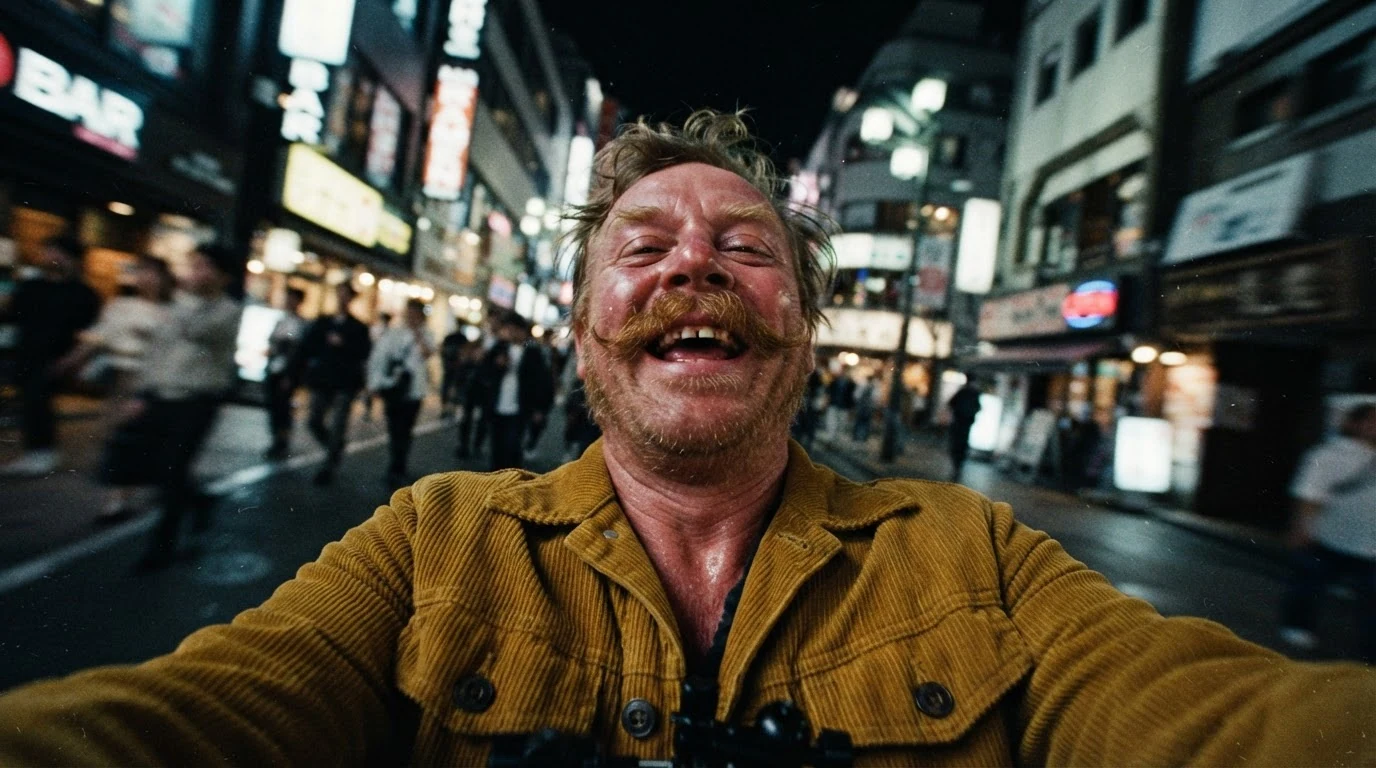
The view from a camera rigidly mounted to a man's chest puts the viewer on the rig instead of watching it, and lapels filling the bottom edge locks in the low angle. Centered and sharp against a tilted, motion-blurred street builds the steady-face, moving-world split; hands at his sides prevents a selfie arm.
Open FlashBoardsCinematic film still, back-mounted Snorricam shot: camera fixed to the upper back of a young woman, looking forward over her shoulders. Her long platinum braid and olive bomber jacket fill the bottom center, perfectly sharp. Ahead, a crowded night market with paper lanterns and food-stall steam, tilted off level and streaked with motion blur. 16mm lens, warm lantern light.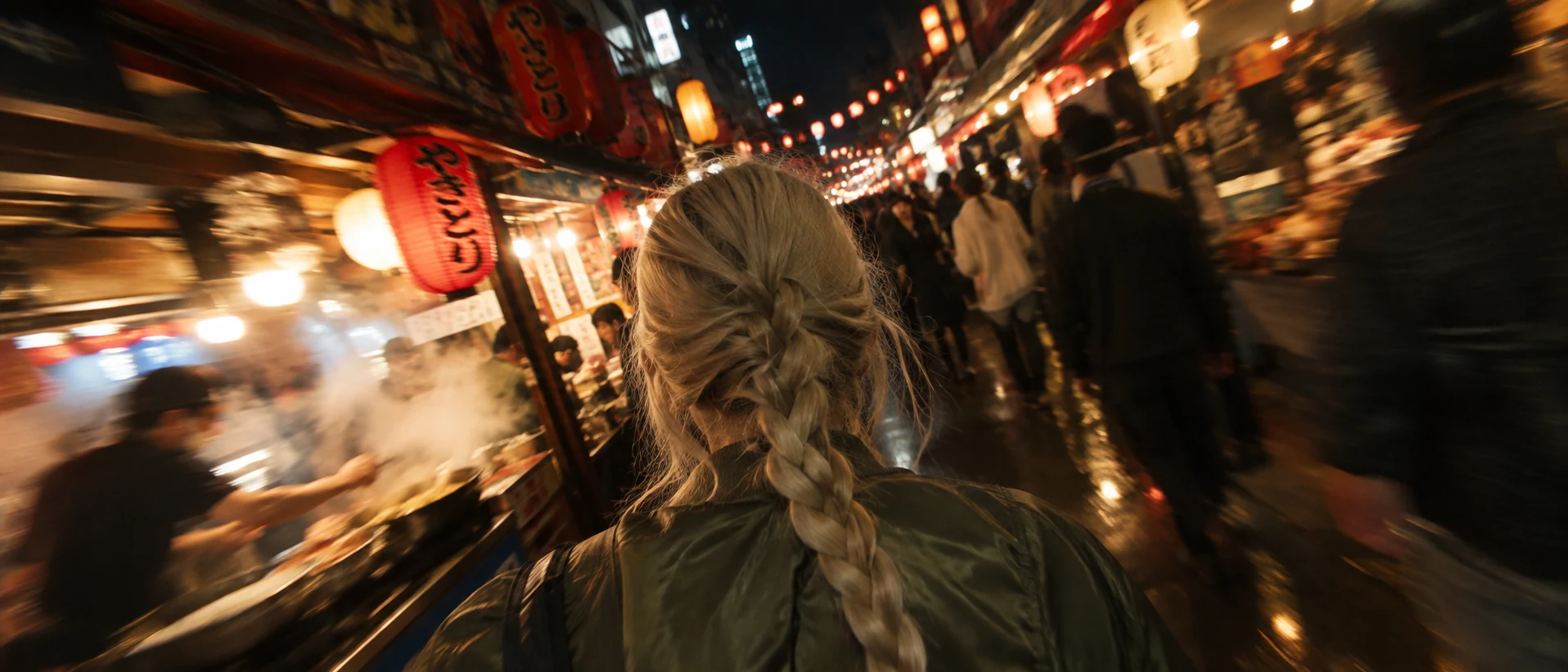
Fixed to the upper back … over her shoulders moves the rig behind her, perfectly sharp anchors her body, and the tilted, streaked market gives the direction of travel across a wide 21:9 frame.
Open FlashBoards{
"output": "Full-screen live-action film scene from its very first frame: one continuous Snorricam shot at night on a crowded neon-lit city street, wet asphalt, glowing shop signs and streetlights, passers-by on the pavements, warm neon mixed with cold street light, wide-angle distortion, 35mm film grain.",
"characters": {
"S1": {
"name": "the drunk reveller",
"look": "man in his forties with messy ginger hair, a ginger handlebar mustache, a chipped front tooth and a mustard corduroy jacket over a dark shirt, seen from just below the chin, his face in the centre of the frame, his hands low at his sides and out of frame",
"voice": "no words, only loud, breathy drunken laughter"
}
},
"shots": [
{
"shot": 1,
"camera": "Snorricam: the camera is rigidly attached to S1's chest on an 18mm lens, 60 cm below his chin, looking up and back at his face, and moves as one piece with his body; his face stays centered at the same size for the whole shot, never drifting, never growing or shrinking, while all the motion goes into the neon street behind him, which swings, tilts and smears with motion blur",
"action": [
"BEGINNING: alive from the first frame, S1 is already staggering forward, laughing with his mouth wide open, and the neon street behind him bobs up and down with every heavy step",
"THEN: S1 lurches toward screen left; his face stays locked in the centre while the street behind him tilts hard the other way, the horizon dropping toward the right edge of the frame",
"THEN: S1 spins halfway around; the neon signs and passers-by whip across the background from screen right to screen left in long streaks of motion blur, his face still centered at the same size",
"END: S1 steadies himself and stands swaying, still laughing, eyes half-closed; his face stays centered at the same size and the street behind him settles, still slightly tilted"
],
"dialogue": [],
"voice": "silence: nobody speaks in this shot, no words at all; the only human sound is S1's breathy drunken laughter"
}
],
"sound": {
"ambience": "night-street crowd murmur, heavy uneven footsteps on wet asphalt, distant traffic hum",
"speech": "no words in this video; the only human sounds are drunken laughter, breaths and footsteps",
"never_spoken": "no narration and no voice-over: the descriptions, performance notes and step words of this prompt are never spoken aloud",
"music": "a film score under the scene, always below the voices: a woozy, detuned synth pad over a lurching, off-balance drum pulse",
"subtitles": "none"
}
}Face stays centered at the same size tells the model what must not move, so motion goes into the background instead of a push-in. Already staggering makes the clip alive from frame one.
Open FlashBoardsCommon mistakes
- Selfie arm. Models draw an outstretched arm with a phone. Say where the hands are and that the camera is mounted to the chest.
- Drifting face. Video models move the face with the background. Repeat centered at the same size; put motion words on the background.
- Too stable a world. A level, sharp background gives an ordinary close-up. Ask for a tilted horizon and motion blur.
- Visible hardware. Describe the camera position, not the harness.
Keep the reference frames, prompts and every generated take side by side — images and video in one canvas.
FAQ
4 questionsWhat is a Snorricam shot?
A Snorricam shot is filmed with a camera rigged to the actor's body and pointed back at them, usually at the face. Camera and actor move together, so the face stays fixed in the frame while the background sways and spins — a way to show drunkenness, panic or euphoria from inside the character.
What is a body-mounted camera shot called?
It is usually called a Snorricam, after the Snorri Bros., the Icelandic duo who built the modern rig in the 1990s. Crews also say body mount, body rig or chest rig shot. A rig on the back looking forward is a back-mounted Snorricam; the classic version faces the actor from the chest.
How do you make a DIY Snorricam?
Use a sturdy vest with a rigid plate, a stiff aluminum or carbon arm and a light camera with a 14–24 mm lens. Mount it 50–70 cm from the face, lock every joint so the arm can't bounce, add a safety cable and balance the weight. Rehearse with a spotter.
What is the difference between a Snorricam and a POV shot?
A POV shot shows what the character sees, with the camera at their eyes. A Snorricam usually shows the character's face, with the camera fixed to their body looking back. Both are subjective, but POV puts us behind the eyes; the Snorricam chains us to the face while the world moves.
Related terms
5- Locked-On ShotCamera Movement
A locked-on shot keeps one moving object pinned to the same spot in the frame — by rigging the camera to it or by stabilising on it in post — so the object seems frozen while the world swings around it.
- POV ShotCamera Angles
A POV shot shows exactly what a character sees by placing the camera at their eyes — usually right after a shot of them looking — so the audience shares their perspective, including movement, obstruction or distortion.
- Handheld ShotCamera Movement
A handheld shot is filmed with the camera held in the operator's hands or on the shoulder, without a stabiliser, so its natural sway and jolts make the scene feel immediate, documentary-like or anxious.
- Camera RollCamera Movement
A camera roll rotates the camera around its own lens axis, so the horizon and the whole image turn inside the frame — from a slow lean to a full 360° barrel roll — to convey disorientation, a shift of power or a stylised transition.
- Camera MovementCamera Movement
Camera movement is any change of the camera's position or direction during a shot — pans, tilts, dollies, cranes, handheld and more — used to guide attention, reveal space and set the emotional rhythm of a scene.
Further reading
Blain Brown, Cinematography: Theory and Practice (Routledge). David Bordwell and Kristin Thompson, Film Art: An Introduction (McGraw-Hill), chapter on camera mobility.