 FlashBoards Learn
- Learn
- Camera Movement
- Truck Shot
Camera Movement · Film language
Truck Shot
Also called: trucking, truck left, truck right, lateral tracking shot
A truck shot slides the whole camera sideways, parallel to the scene, on a dolly, slider or vehicle. Near objects sweep past faster than distant ones, so the frame gains depth and the viewer feels carried along beside the action rather than turning to watch it.
- What it does
- Moves the camera sideways along the scene, so foreground and background slide at different speeds and the space reads as deep.
- Use it when
- You want to travel beside a walking character, scan a row of people or shop fronts, or reveal a space layer by layer.
- Watch out
- Without anything close to the lens, a truck looks like a pan; with the lens swiveling, it stops being a truck.
- Try this prompt
Camera trucks right at walking pace along a rainy street, lamp posts in the foreground sweeping past, a woman walking in step with the lens
What is a truck shot?
A truck shot is a camera movement in which the camera travels left or right along a line parallel to the scene while the lens keeps pointing the same way. Crews also say trucking, crabbing or lateral track. Despite the name, no vehicle is needed: the term means moving the whole camera base sideways.
Because the camera really moves, perspective changes: a lamp post two meters away crosses the frame in a second, a building fifty meters away barely drifts. That speed gap, parallax, is the truck's signature.
Why do filmmakers use truck shots?
- Walk beside someone. Trucking with a character in profile keeps them the same size while the world streams past. It is the side-on form of the tracking shot: we are next to the character, not behind their eyes.
- Read a line. A truck along faces, a counter or a traffic jam turns a crowd into a sequence, as in the long sideways crawl past a traffic jam in Godard's Weekend (1967).
- Build depth. Pillars and passers-by sliding across the lens add depth layering.
- Hide and reveal. A column crossing the lens works as a natural wipe.
Slow trucks feel descriptive; fast ones with close foreground feel urgent.
How to shoot a truck shot
Gear. The classic rig is a dolly on straight track parallel to the set. A 60–120 cm slider handles short moves; a camera car or a gimbal operator stepping sideways handles long ones.
Lens and foreground. A 24–35 mm lens 1–3 m from the subject gives strong parallax; a long telephoto flattens the move toward a pan. Put posts, plants or extras between camera and subject: the foreground sells the move.
Speed. Match walking pace (about 1–1.5 m/s) with a person; 0.2–0.5 m/s reads as a glide along a static scene.
Blocking. Keep the actor at a steady distance from the track and respect screen direction in surrounding cuts.
Truck left
In a truck left, the camera slides to its own left and the scene flows rightward across the frame: near objects enter at the left edge and exit fast, the background drifts slowly. Because the eye reads left to right, a truck left with a walking character can feel like moving against the flow. Sling Blade, The Chorus and The Adjustment Bureau below truck left.
Truck right
In a truck right, the camera slides to its right and the scene flows leftward. It moves with the reading direction, feels forward-going and often opens a scene: start on a detail at the left of the set, glide to find the characters. The Fall and Saving Mr. Banks below truck right.
Truck shot vs. pan
A pan keeps the camera in one spot and swivels the lens. A truck keeps the lens pointing the same way and moves the whole camera.
The test is the foreground. In a pan, near and far objects slide at about the same rate and never uncover each other. In a truck, the foreground races past, so a post that hid a door now reveals it. A pan looks around; a truck takes you somewhere.
Truck Shot in motion
9 clipsWatch the foreground against the background: near objects cross the frame much faster than the walls behind them.
How to create a truck shot with AI
3 promptsAn image model gives you a side-on start frame with layers at different distances; the video model supplies the slide. Nano Banana 2 Lite builds the start frame, GPT Image 2.5 tries a static-scene take, and MiniMax H3 Max Turbo animates recipe 1. Keep clips and takes on one FlashBoards board to compare parallax.
Cinematic film still, medium wide shot, 35mm lens at shoulder height, camera perpendicular to the sidewalk: a tall woman in her forties with a gray bob, a thin scar on her chin and a mustard trench coat walks left to right past lit shop windows on a wet evening street, in clean profile. An iron lamp post and parked bicycles stand close to the lens, out of focus; behind her a bakery and a bookshop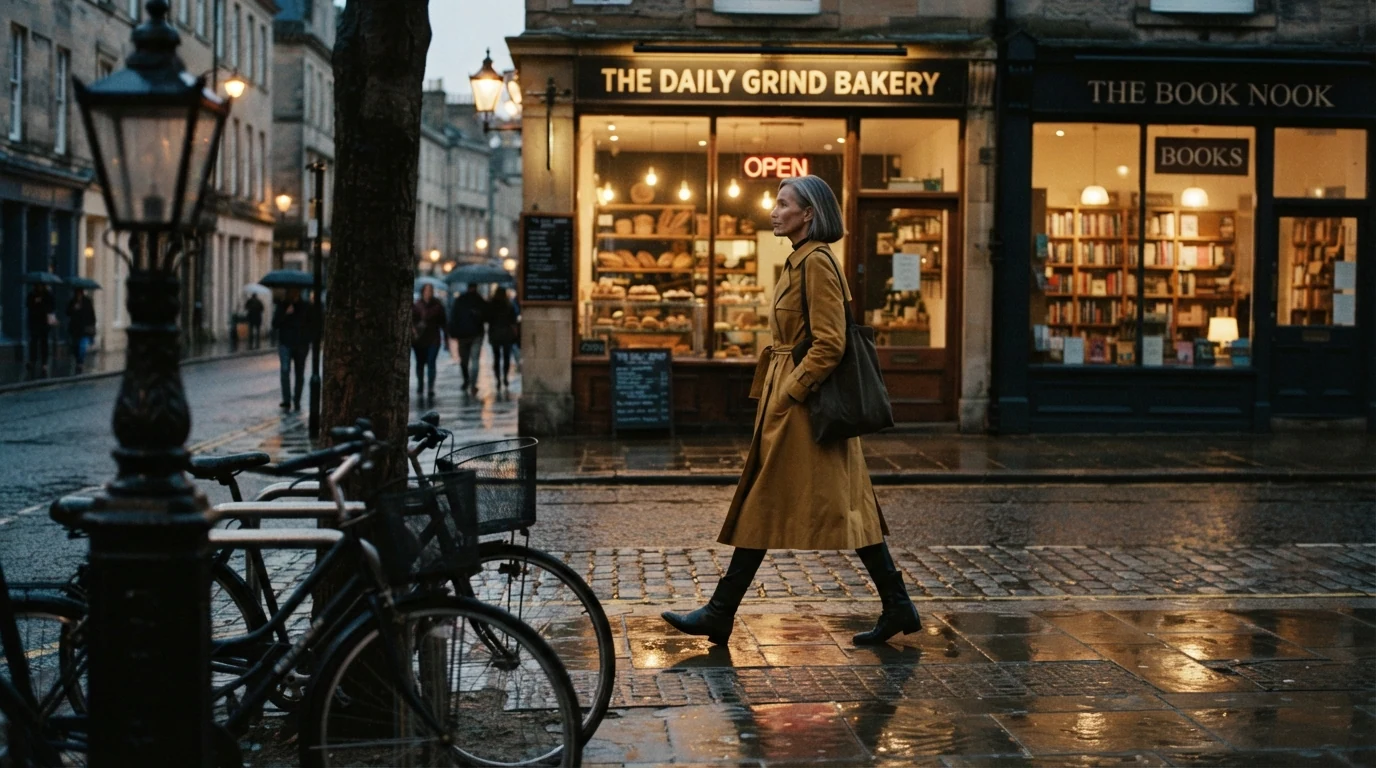
Perpendicular to the sidewalk and clean profile set the side-on geometry. The lamp post and bicycles close to the lens are the layer that will race past.
Open FlashBoardsCinematic film still, wide side-on view of a diner counter seen from behind it, 28mm lens at seated eye level, camera parallel to the counter: a row of customers on red stools stretching flat across the frame at one distance, including a bald man with a braided gray beard and a young woman in round tortoiseshell glasses, each under a hanging lamp. A chrome napkin holder at the left edge of frame is motion-smeared horizontally, the rest crisp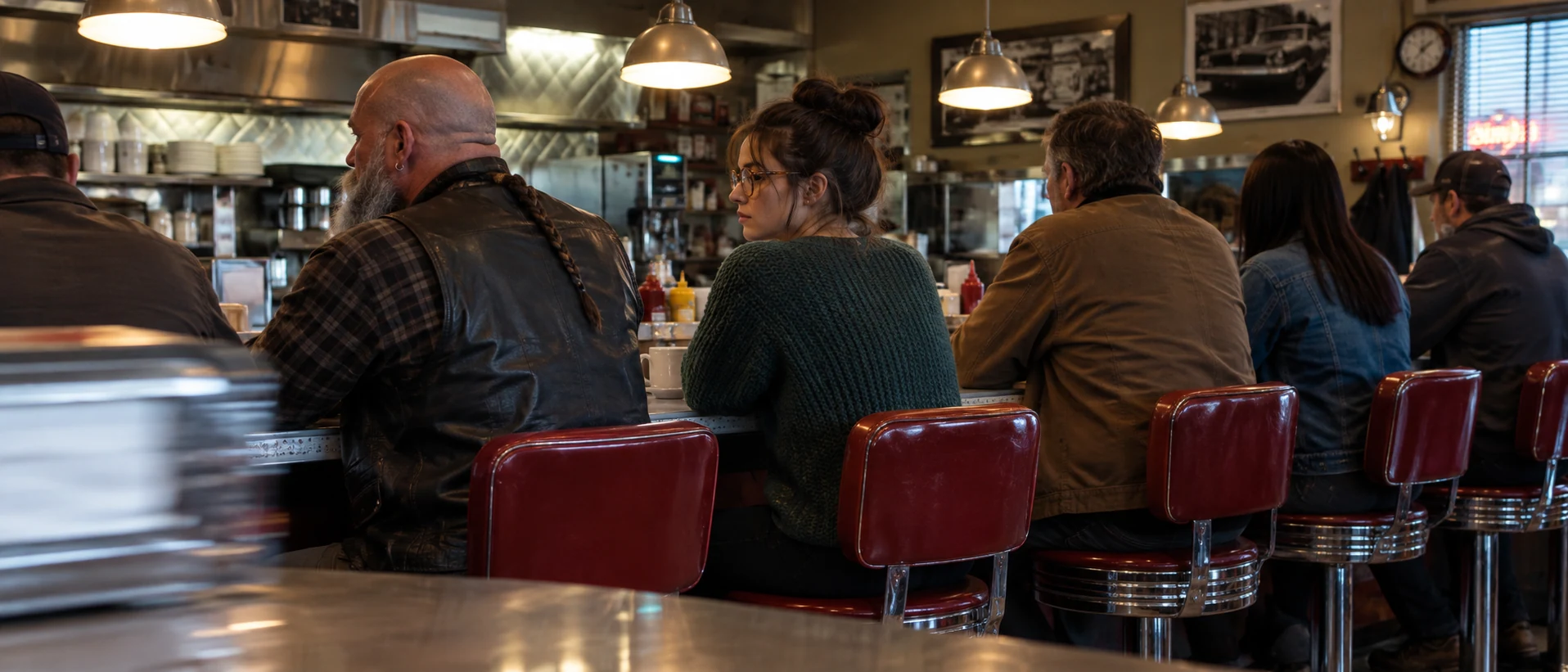
The other use of a truck: scanning a static line. Parallel to the counter keeps the row flat to the lens; the motion-smeared edge implies lateral travel.
Open FlashBoardsCamera: a smooth truck right at walking pace, sliding sideways parallel to the shop fronts, the lens pointing straight at the sidewalk the whole time. The lamp post and bicycles sweep quickly out of the left edge of frame while the shop windows slide past more slowly. Action: the woman is already mid-stride, walking in step with the camera so she stays near frame center. She passes the bakery window, its warm light falling across her coat, then glances into the bookshop.Sliding sideways parallel to and the lens pointing straight rule out a pan. Naming fast and slow layers pins the parallax; already mid-stride keeps the shot alive from frame one.
Open FlashBoardsCommon mistakes
- A pan instead of a truck. Write sliding sideways, parallel to and the lens pointing straight.
- No parallax. Put a post or plant close to the lens in the start frame.
- The walker drifts out. Add walking in step with the camera.
- A slow push-in. Open
Action:with motion already happening.
Keep the reference frames, prompts and every generated take side by side — images and video in one canvas.
FAQ
4 questionsWhat is a truck shot in film?
A truck shot is a camera move where the whole camera slides left or right, parallel to the scene, while the lens keeps pointing the same way, usually on a dolly, slider or vehicle. Near objects cross the frame faster than distant ones, giving strong parallax and a sense of traveling alongside the action.
What is the difference between trucking and tracking?
Trucking names a direction: the camera moves sideways. Tracking names a relationship: the camera travels with a moving subject in any direction. Flanking a walking character from the side is both. A truck along a static row of faces follows no one, so it is not a tracking shot.
What do truck left and truck right mean?
They are directions called from the camera's point of view. Truck left moves the camera to its left, so the scene appears to flow right across the frame. Truck right moves the camera to its right, so the scene flows left. The terms let crews call the move without ambiguity.
Is a crab shot the same as a truck shot?
In everyday use, yes. Crabbing describes the camera moving sideways like a crab, which is what a truck does. Some crews reserve crab for a dolly steered to roll sideways or diagonally, but crab, truck and lateral tracking shot all mean the camera sliding parallel to the scene.
Related terms
5- PanCamera Movement
A pan swivels the camera horizontally from a fixed position — left or right around its vertical axis — to follow action, connect two points in space or reveal a scene bit by bit.
- Tracking ShotCamera Movement
A tracking shot moves the camera through space with a moving subject — on a dolly, Steadicam, vehicle or drone — following, leading or flanking it so the audience travels with the action.
- Parallax ShotCamera Movement
Parallax is the difference in apparent speed between near and far objects when the camera moves sideways: the foreground sweeps past quickly while the background drifts slowly, which sells depth — and can be faked in post by animating image layers.
- Dolly ShotCamera Movement
A dolly shot is filmed with the camera on a wheeled dolly, usually on track, so it can glide smoothly toward, away from or alongside the action; unlike a zoom, the camera really moves, so perspective and parallax change.
- Depth LayeringComposition & Framing
Depth layering builds a shot in distinct planes — foreground, midground and background — each holding something meaningful, so the flat screen gains volume and several actions or ideas can be read at once.
Further reading
Blain Brown, Cinematography: Theory and Practice (Routledge) — chapter on camera movement. Steven D. Katz, Film Directing Shot by Shot (Michael Wiese Productions) — sections on lateral tracking and dolly moves.