 FlashBoards Learn
- Learn
- Camera Movement
- Parallax Shot
Camera Movement · Film language
Parallax Shot
Also called: parallax effect, motion parallax, 2.5D parallax
A parallax shot is a sideways camera move in which near objects sweep across the frame quickly while distant ones drift slowly. That difference in speed is how the eye reads depth, so parallax turns a flat image into a space the viewer seems to travel through. It can also be faked in post by animating image layers.
- What it does
- Makes depth visible: foreground, subject and background move at different speeds.
- Use it when
- You want a flat wide shot to feel deep, or want to travel along a character or a place.
- Watch out
- Without something close to the lens, a sideways move shows almost no parallax.
- Try this prompt
Side-on truck shot, soft reeds 1 m from the lens sweep past, woman walks a boardwalk, hills barely move, 28mm, dusk
What is a parallax shot?
Parallax is the apparent shift of an object against its background when the viewpoint moves. When a camera travels sideways, the angle to a post one meter away changes a lot; the angle to a distant mountain barely changes.
A parallax shot is composed to show that difference. It is usually a truck shot on a slider, dolly or car, framed with at least three planes: something near the lens, the subject, and a deep background. Of all the camera movements, it is the one built most directly around depth.
Why filmmakers use parallax
- Depth on a flat screen. A locked-off landscape reads as a picture. Slide past a fence or a row of trees and it gains volume, because relative motion is a strong depth cue.
- A sense of travel. Fast foreground parallax against a still horizon feels like a view from a train; slow parallax feels like walking alongside someone.
- Hiding and revealing. A pillar or trunk crossing the lens is a natural wipe.
- Watching from cover. Slats or reeds sliding past make the viewer an unseen observer. Combined with foreground, midground and background layering, one move carries three layers of information.
How to shoot a parallax shot
- Move, don't rotate. Parallax comes from the lens changing position: a 60–120 cm slider, a dolly on straight track, a car mount or a gimbal walked sideways, parallel to the subject.
- Put something close to the lens. Reeds, a railing or a column 0.5–2 m away do most of the work.
- Pick the lens for the separation. 18–35mm exaggerates the speed gap between planes; a telephoto lens compresses it.
- Height and focus. Lens at the subject's eye or chest height, foreground soft, perhaps a focus pull onto the subject during the move.
- Speed. At 24 fps, a sharp foreground crossing the frame in under a second strobes. Slow down or keep it soft.
Faking parallax in post: 2.5D layers
Parallax can be built without moving a camera. Disney's multiplane camera of the 1930s shifted painted glass layers at different rates. The digital version, 2.5D parallax, cuts a photo into planes, fills the gaps behind each cutout and flies a virtual camera through them — the look The Kid Stays in the Picture (2002) made famous. Its tells are cardboard figures and torn edges, so keep the moves short and slow.
Parallax shot vs. pan
A pan rotates the camera on a fixed point. Rotated around the lens's optical center, near and far objects keep their relationship and the image slides as one sheet — which is why panorama photographers use a nodal mount. A parallax shot moves the lens itself, so the planes separate and overlap.
A zoom only magnifies, so it shows no parallax either. The test: if near and far objects shift against each other, the camera moved.
Parallax Shot in motion
9 clipsWatch the nearest object, then the horizon: the foreground sweeps past while hills, buildings and sky barely shift.
How to create a parallax shot with AI
3 promptsParallax needs layers at clearly different distances, so build the start frame for it. Nano Banana 2 Lite makes that frame, GPT Image 2.5 gives an urban variation, and MiniMax H3 Max Turbo animates recipe 1 with a sideways truck. Keep clips and takes on one FlashBoards board to compare how the layers separate.
Cinematic film still, side-on wide shot, 28mm lens at chest height: tall dry reeds one meter from the lens fill the left third, soft and out of focus. In the midground a woman in her thirties with a shaved head, a copper nose ring and a mustard-yellow raincoat walks right along a wooden boardwalk across a salt marsh. Behind her flat gray water, low hills and a small white lighthouse on the far shore. Dusk, cool blue light, light haze, film grain.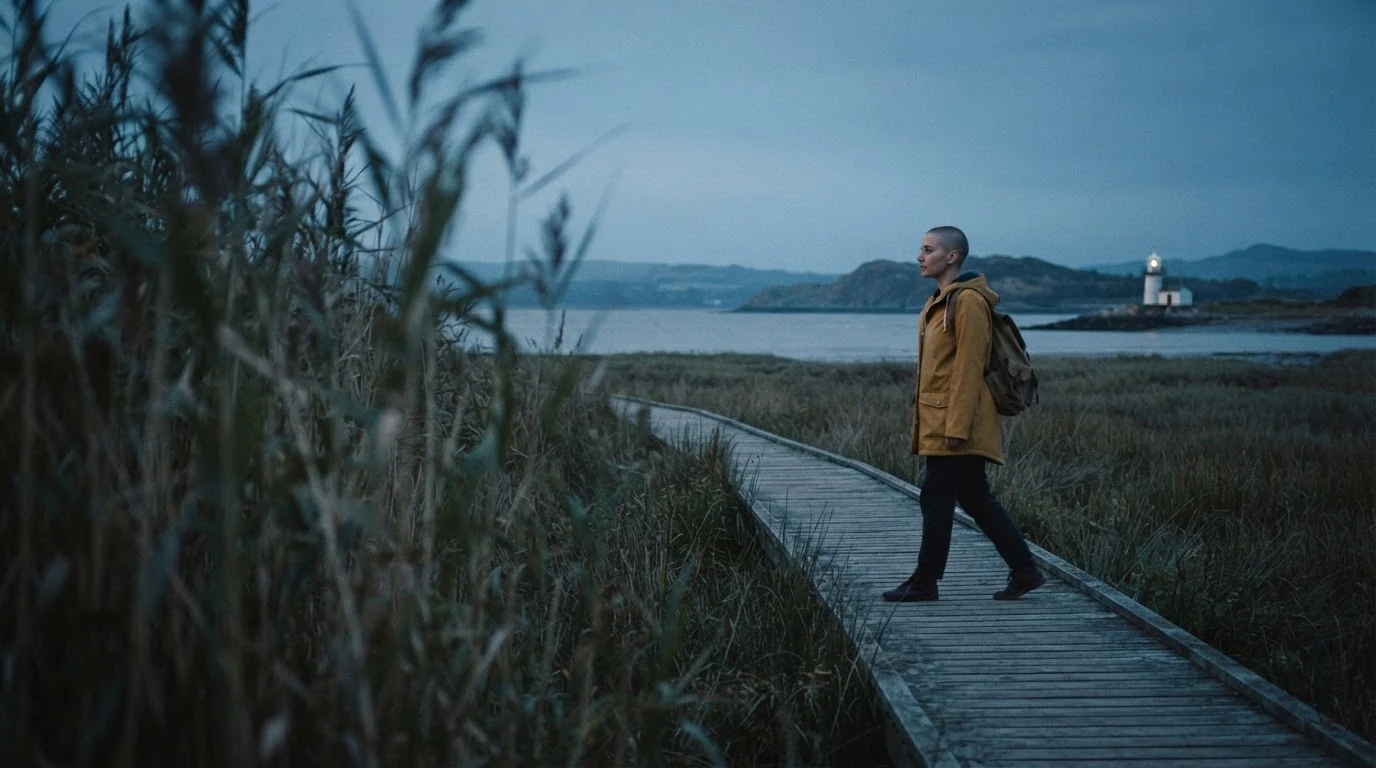
Side-on, one meter from the lens and far shore set up three planes at very different distances; walks right gives the video a direction.
Open FlashBoardsAnamorphic widescreen film still, lateral view across a rainy night street, 40mm lens at eye height. Near foreground: blurred black iron columns of an elevated railway. Midground: a heavyset street vendor with gray mutton-chop sideburns and a green apron flips skewers on a steaming grill cart. Far background: red and teal neon signs blurred by rain. Wet asphalt reflections.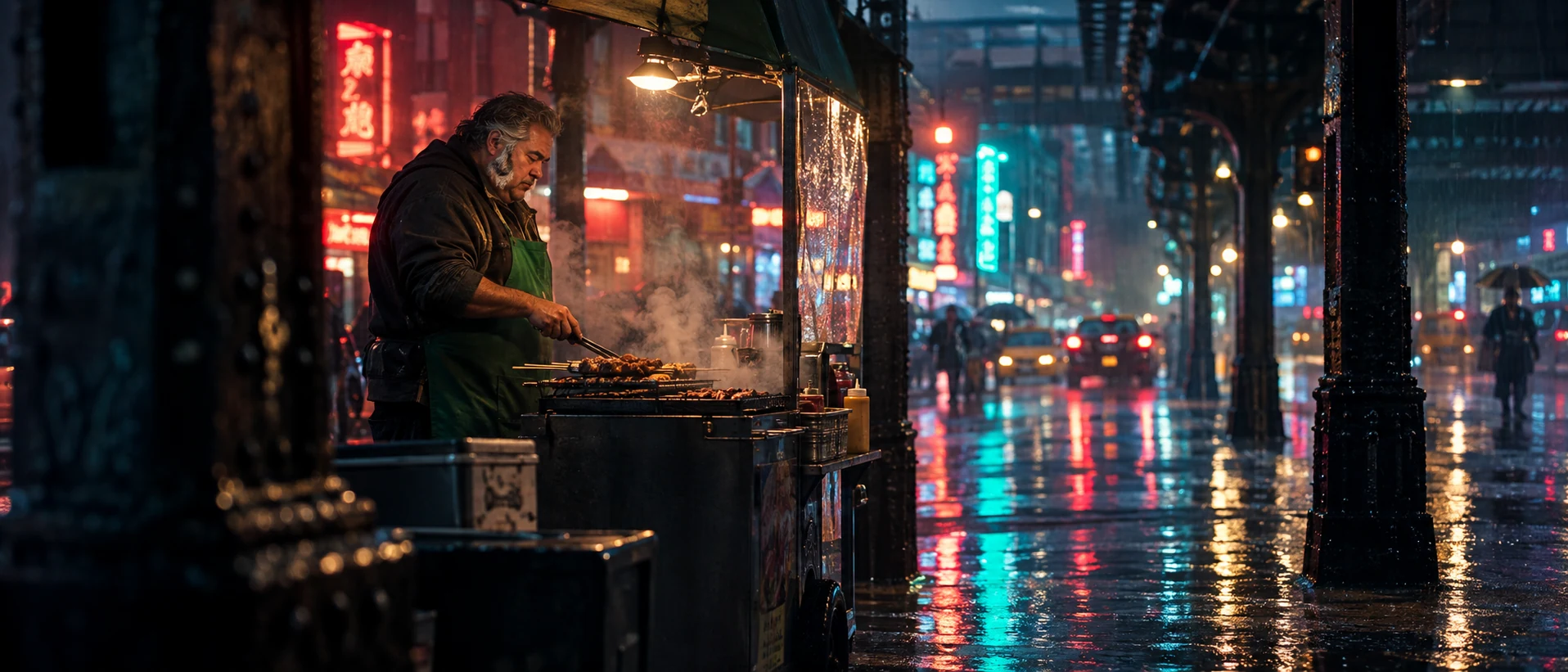
The columns are the foreground layer; lateral view keeps the frame flat to a future camera path.
Open FlashBoardsCamera: a steady lateral truck to the right at walking pace, parallel to the boardwalk, moving from the first frame; the camera slides sideways and keeps facing the marsh. Action: The woman is already walking right and the camera keeps pace, so she stays near the center. The reeds sweep quickly across the lens in a soft blur and exit left. The water and hills drift slowly, and the lighthouse barely moves. The shot ends with open marsh between the camera and the woman.Lateral truck and keeps facing the marsh prevent a pan; three stated speeds — quickly, slowly, barely — spell out the parallax.
Open FlashBoardsCommon mistakes
- Pan instead of truck. Say lateral truck, slides sideways, parallel to, and name what the camera keeps facing.
- One speed for everything. With no near object the frame slides like a flat card; add a soft foreground and say which layer moves fastest.
- Warped faces. Keep foreground occluders beside the subject, not across the face.
- Invented scenery. Name only what is in the first frame.
Keep the reference frames, prompts and every generated take side by side — images and video in one canvas.
FAQ
4 questionsWhat is the parallax effect in film?
The parallax effect is the difference in apparent speed between near and far objects when the camera moves sideways. The foreground crosses the frame quickly, the subject moves at a medium rate, and the background barely shifts. Viewers read that difference as depth, so a flat image feels like a real space.
Is a parallax shot the same as a truck shot?
Not exactly. A truck shot names the move: the camera slides sideways, parallel to the scene. Parallax is the effect that move produces when objects sit at different distances. Every truck shot has some parallax, but a parallax shot is composed to show it, with a strong foreground close to the lens.
Does a pan create parallax?
Very little. A pan rotates the camera in place instead of changing its position, so near and far objects keep their relationship and the image slides as one. For visible parallax, the lens has to travel: on a slider, dolly, vehicle or gimbal walked sideways.
What is 2.5D parallax?
2.5D parallax fakes a camera move on a still image. The photo is cut into layers — sky, background, subject, foreground — the gaps are filled, and each layer sits at its own depth. A virtual camera moves through them, so the layers slide at different speeds, as if the photo were a real space.
Related terms
7- PanCamera Movement
A pan swivels the camera horizontally from a fixed position — left or right around its vertical axis — to follow action, connect two points in space or reveal a scene bit by bit.
- Zoom ShotCamera Movement
A zoom shot changes the lens's focal length during the take, so the image grows or shrinks from a fixed camera position; because the camera doesn't move, perspective stays the same — the key difference from a dolly.
- Truck ShotCamera Movement
A truck shot slides the whole camera sideways, parallel to the scene, on a dolly, slider or vehicle; nearby objects sweep past faster than distant ones, giving strong parallax and a sense of travelling along the action.
- Depth LayeringComposition & Framing
Depth layering builds a shot in distinct planes — foreground, midground and background — each holding something meaningful, so the flat screen gains volume and several actions or ideas can be read at once.
- Dolly ShotCamera Movement
A dolly shot is filmed with the camera on a wheeled dolly, usually on track, so it can glide smoothly toward, away from or alongside the action; unlike a zoom, the camera really moves, so perspective and parallax change.
- Arc ShotCamera Movement
An arc shot moves the camera along a curved path around a subject, so the subject holds its place in the frame while the background revolves behind it — a way to heighten a climactic beat, bind two characters together or give a hero moment extra charge.
- Camera MovementCamera Movement
Camera movement is any change of the camera's position or direction during a shot — pans, tilts, dollies, cranes, handheld and more — used to guide attention, reveal space and set the emotional rhythm of a scene.
Further reading
Bruce Block, The Visual Story (Focal Press) — space, depth cues and relative movement. Steven D. Katz, Film Directing Shot by Shot (Michael Wiese Productions) — camera movement and staging in depth.