 FlashBoards Learn
Color · Film language
Technicolor
Also called: three-strip Technicolor, Technicolor process
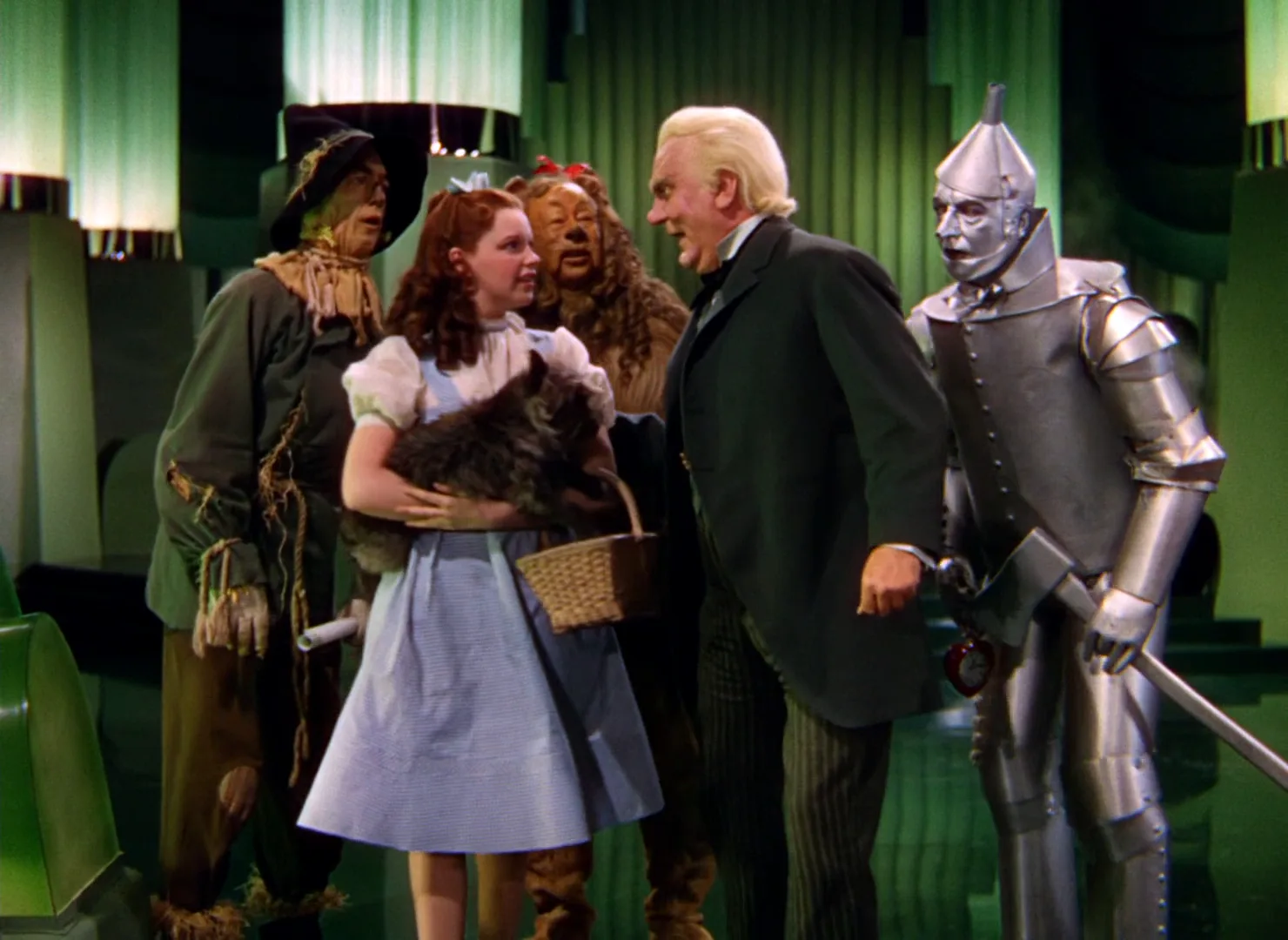
Technicolor is a family of color film processes, best known for its three-strip system (1932 to the mid-1950s) that split light onto three black-and-white negatives and printed them with dyes. The result is dense, saturated, jewel-like color with deep blacks: the look of The Wizard of Oz and the classic Hollywood musical.
- What it does
- Gives a frame pure, saturated primaries, clean skin tones and inky blacks that read as heightened, storybook reality.
- Use it when
- You want a musical, fantasy, melodrama or period piece to feel like golden-age Hollywood rather than modern digital.
- Watch out
- Saturation alone is not Technicolor: without a controlled palette, bright frontal light and dense blacks it just looks garish.
- Try this prompt
1950s Technicolor musical still, woman in emerald satin dress on a painted soundstage street, cobalt sky backdrop, bright frontal light, dye-transfer color
What is Technicolor?
Technicolor was a company before it was a look. After early two-color processes, it introduced the three-strip system in 1932. Disney's Flowers and Trees (1932) was the first cartoon in it, Becky Sharp (1935) the first feature, and Snow White and the Seven Dwarfs (1937) and The Wizard of Oz (1939) made it the prestige format of the Golden Age of Hollywood.
The camera had a prism behind the lens. One path went through a green filter to its own negative; the other went through a magenta filter to two negatives running face to face, recording blue and red. Three black-and-white separations of the same frame.
The color was made in the lab. Each separation became a gelatin matrix that soaked up one dye (yellow, magenta or cyan) and pressed it onto blank film. These dye-transfer prints held pure, stable dyes, which is why the color looks so solid and why good prints have barely faded.
Why does Technicolor look so saturated?
The separations kept colors apart, the dyes were chosen for strength, and studios designed sets and costumes to show them off. Technicolor's color consultants, most famously Natalie Kalmus, pushed for controlled palettes: a few strong hues against neutral or dark grounds.
The effect is heightened reality. Color saturation that high tells the audience this world is a show, a dream or a memory. The Wizard of Oz builds it into the story: Kansas is sepia, Oz is color, and the ruby slippers (silver in the book) were made red to exploit the process. Later, Hitchcock and John Ford used Technicolor for thrillers and westerns, richer but more restrained.
The signature: clean skin, primaries that hold their hue in shadow, and blacks that stay black.
How to get the Technicolor look today
Three-strip cameras were retired in the mid-1950s, and US dye-transfer printing ended in 1975; The Godfather Part II (1974) was among its last famous prints. Today you rebuild the look:
- Design the palette first. Two or three saturated hues for costumes and key props, quieter walls. A planned color palette does more than any grade.
- Light bright and frontal. The process was slow, so sets were flooded with hard light. Think high-key lighting, clean fill, no haze.
- Protect skin. Warm, even complexions; keep faces out of green and yellow.
- Grade for separation. Push chroma on the primaries, hold neutrals neutral, deepen blacks, keep highlights gentle. On a vectorscope you want distinct spokes, not one big smear.
Shooting on film stock adds texture, but modern negative is flatter by design; the vivid part still comes from set and grade. For Academy-era authenticity frame 4:3; for 1950s epics, go wide.
Technicolor vs. Eastmancolor and colorization
Eastmancolor (1950) was a single-strip color negative any camera could load. Technicolor adopted it too, making separations from it in the lab and still printing in dye transfer, so a 1950s "Color by Technicolor" credit usually means the lab and print, not a three-strip camera. Ordinary Eastmancolor prints faded over the decades, often toward magenta; dye-transfer prints mostly held.
Colorization is a different thing entirely: it adds invented color to footage shot in black and white. Technicolor recorded the real costumes and paint on set. Its palettes remain a reference point for film color today.
Technicolor examples in film
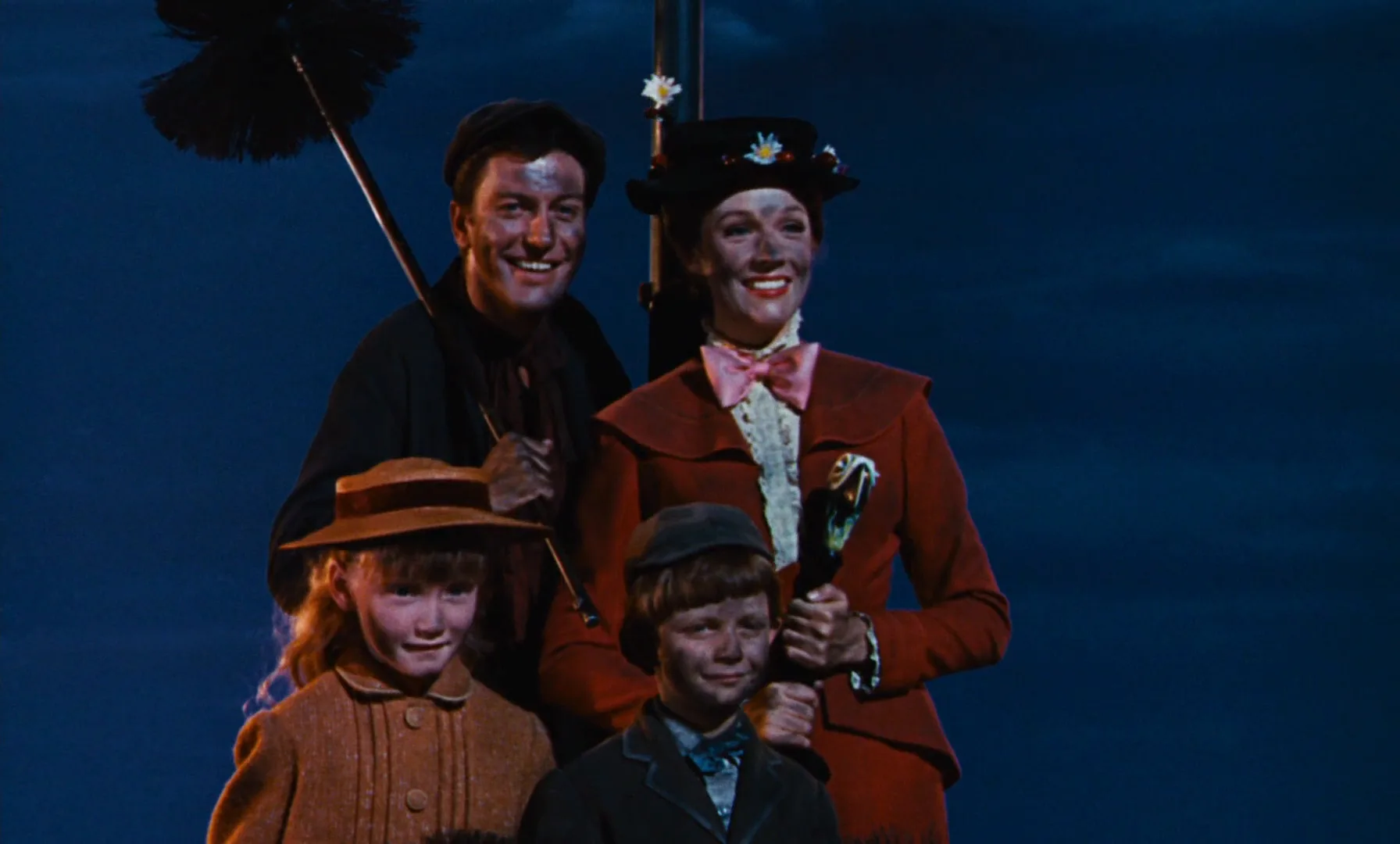
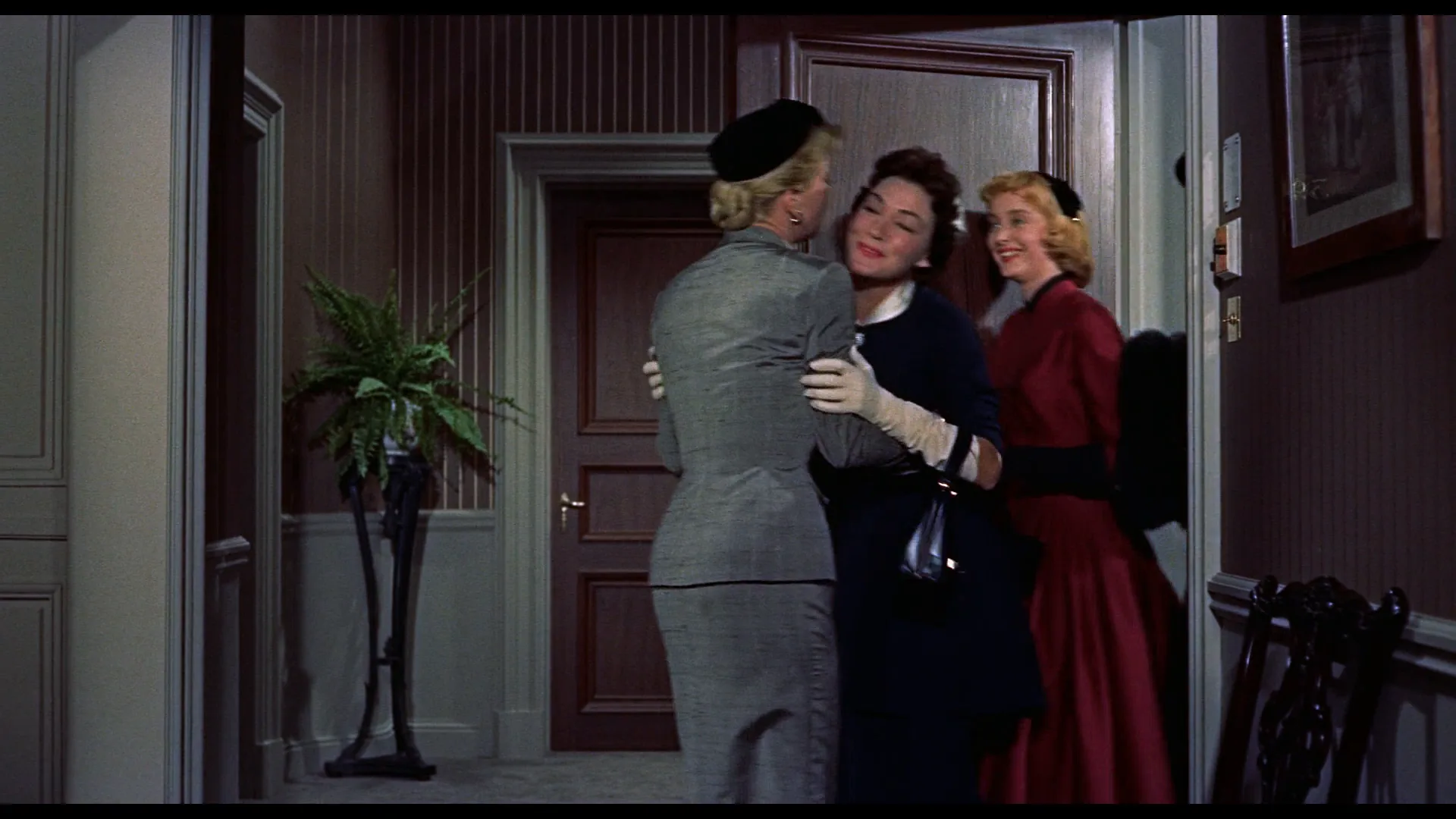
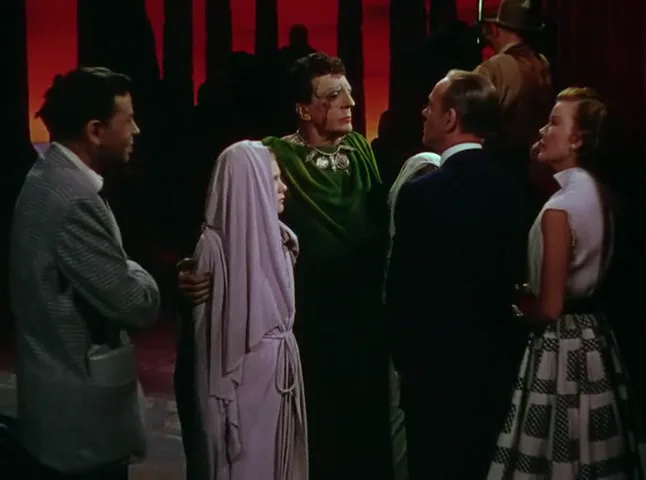
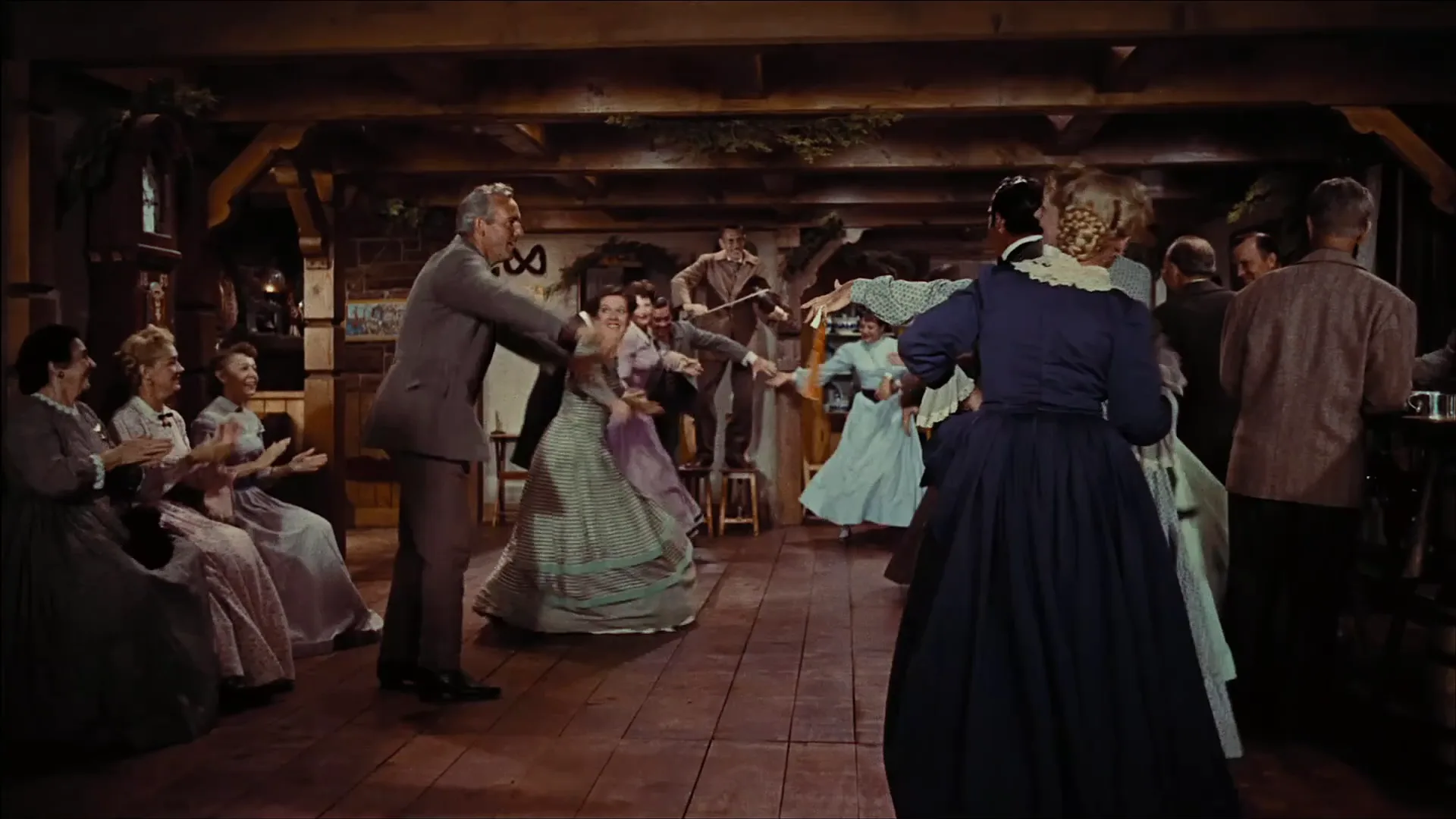
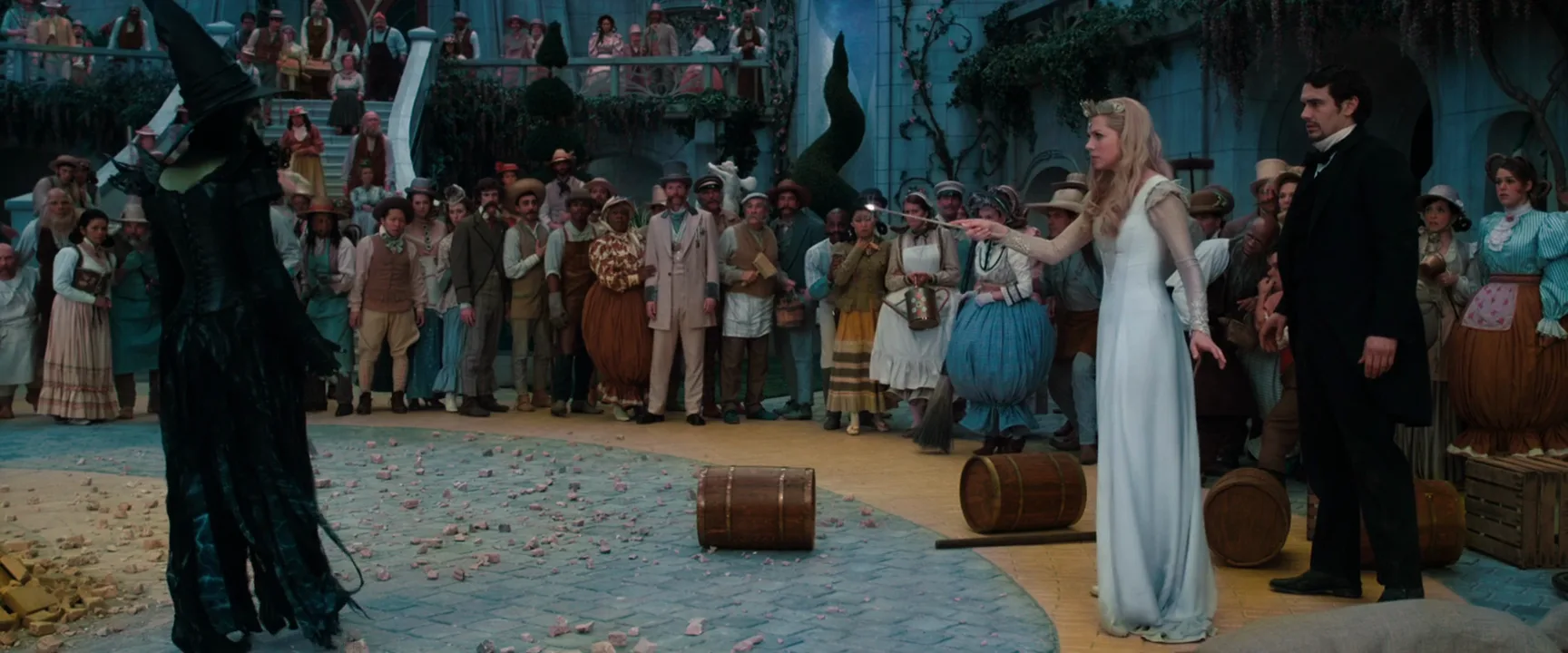
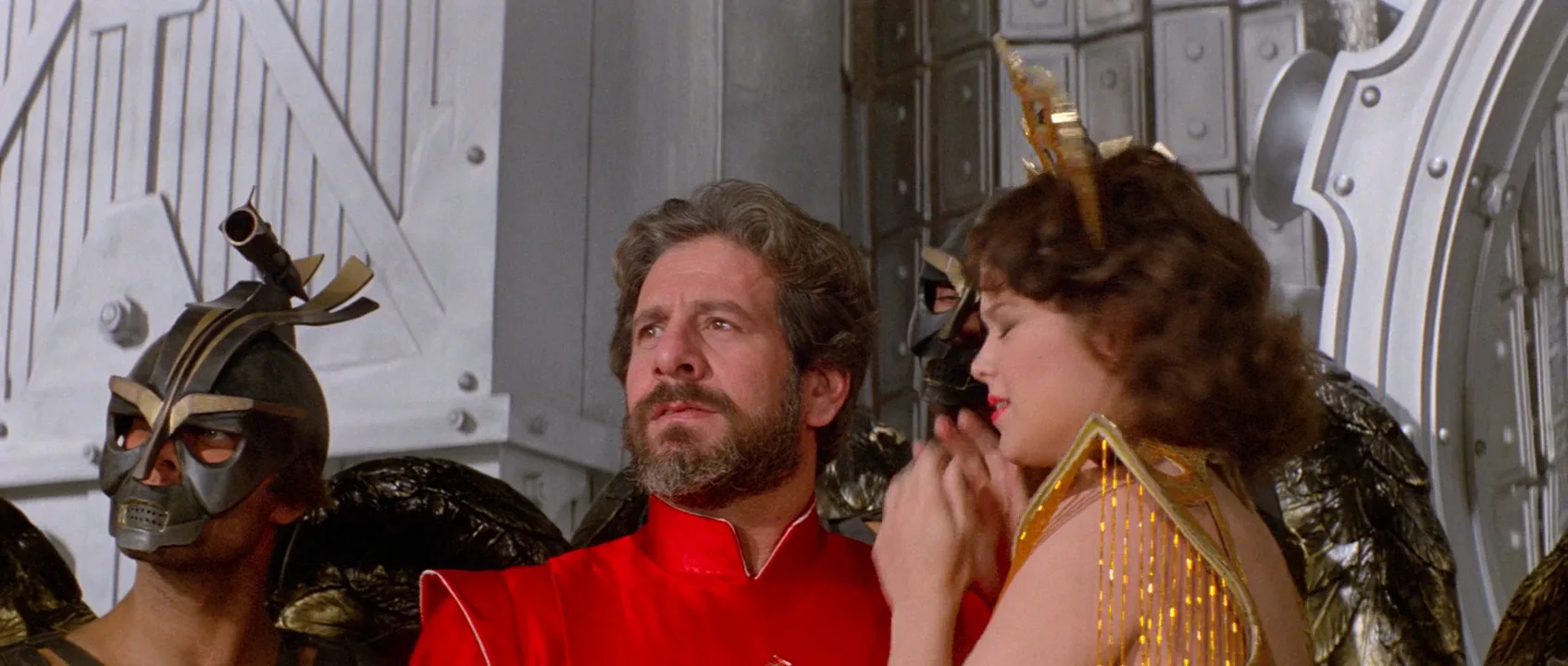
8 framesFrames from Technicolor-era films and later films that borrow the palette. Look for a few strong primaries against quieter grounds.
How to create a technicolor with AI
4 promptsLeft alone, models turn "Technicolor" into a generic vintage filter. Name the palette, the light and the print: a few saturated primaries, hard frontal studio light, dense blacks. Keep the film frames and your takes on one FlashBoards board to compare hue and density side by side. The fourth prompt re-shoots a real film shot from a text description alone, and the original plays next to the result so you can compare.
Three-strip Technicolor still from a 1950s Hollywood musical, full shot on a painted soundstage street. A tall woman in her thirties with a short auburn bob, freckles and a small gap in her front teeth wears a saturated emerald satin dress and holds a closed lemon-yellow umbrella. Behind her, a flat cobalt painted sky and cream storefronts with red awnings. Hard frontal studio light, warm clean skin, dense black shadows, dye-transfer color, fine grain.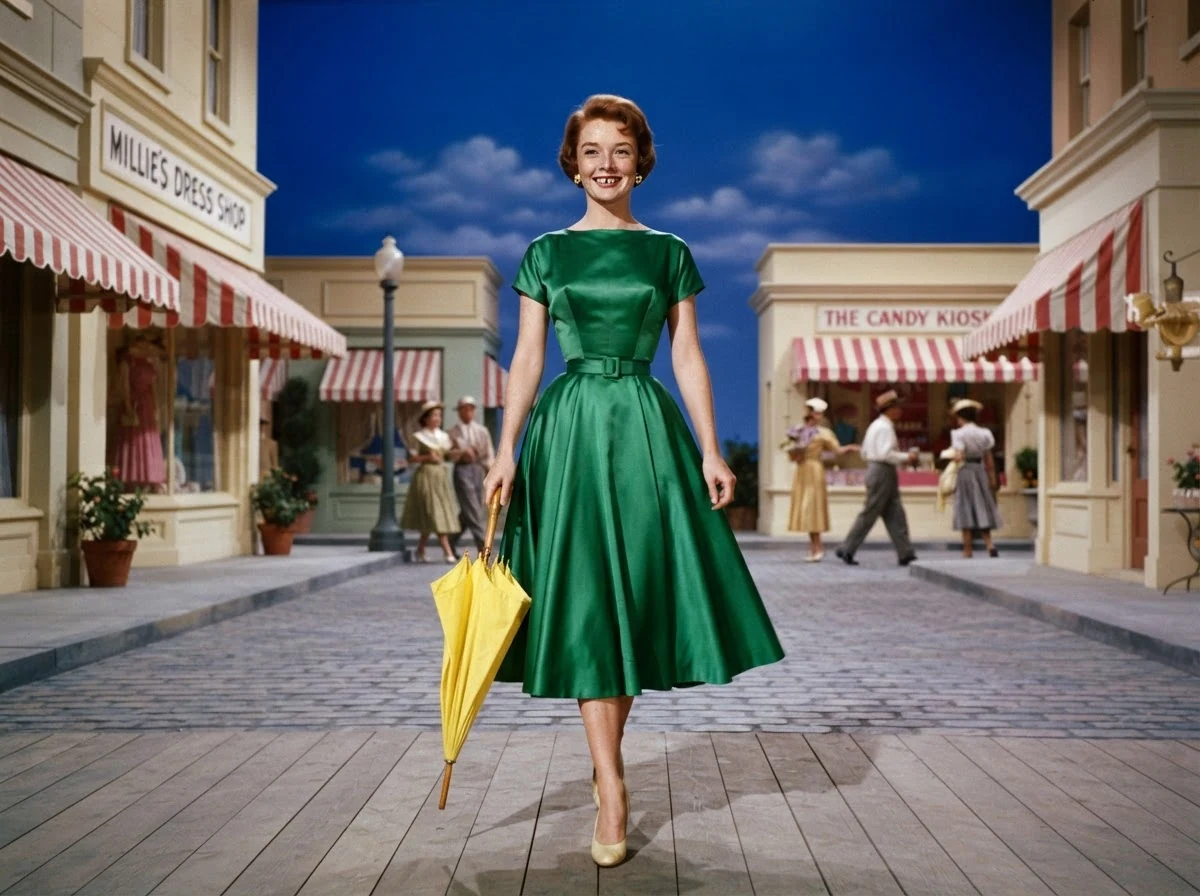
"Three-strip Technicolor" and "dye-transfer color" set the era, but the named hues on a cream ground do the real work. "Hard frontal studio light" and "dense black shadows" block the soft, faded vintage default.
Open FlashBoards1950s widescreen Technicolor western, wide shot of a ranch porch in late afternoon. A lean rancher in his fifties with a gray-streaked red beard and a crooked nose, in a faded blue shirt and tan vest, beside a woman with braided black hair in a crimson calico dress. Orange sandstone buttes under a deep blue sky. Hard sunlight from the left, strong color separation, deep black shadows under the porch roof, dye-transfer print.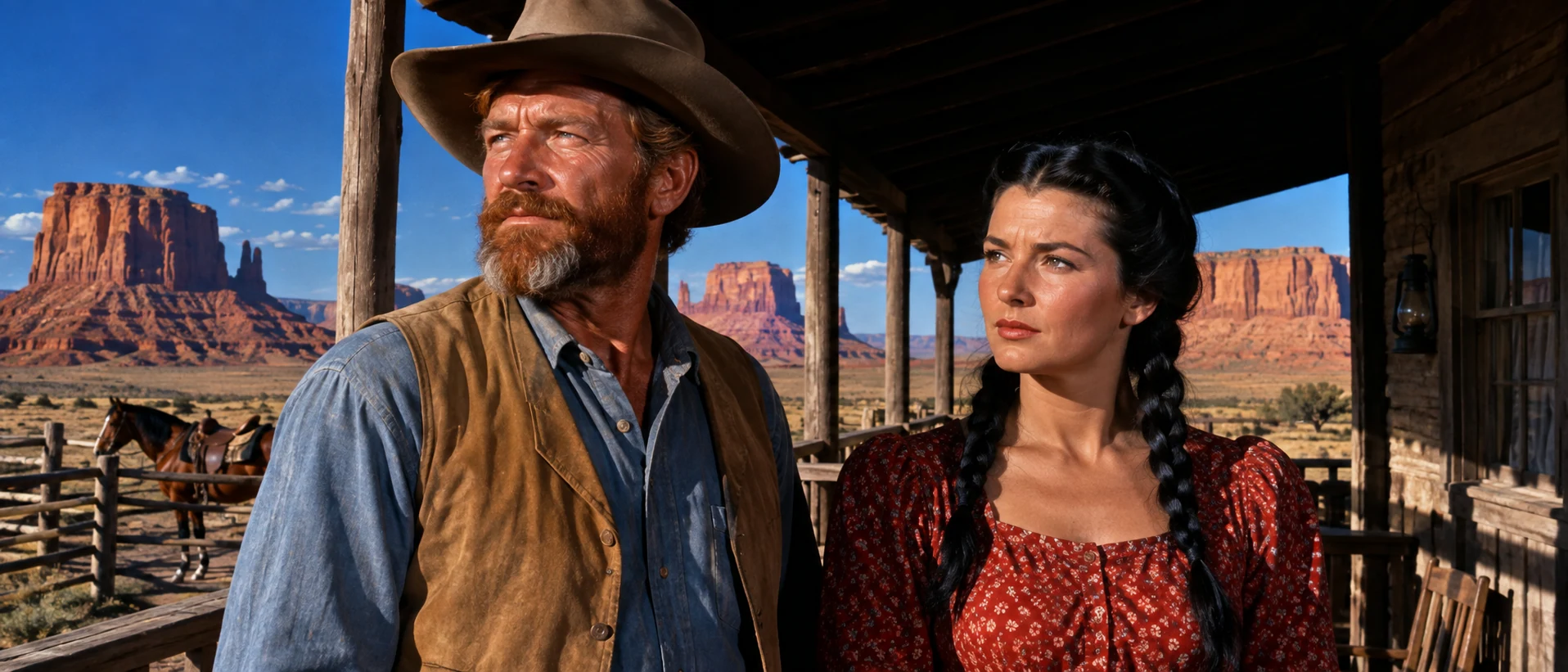
This take moves the look outdoors. "Widescreen" and 21:9 point at 1950s epics; crimson, blue and orange give three separated hues, and "deep black shadows" keeps the print density a plain saturation boost lacks.
Open FlashBoardsCamera: slow steady dolly from left to right along the painted street, holding the woman in full shot. Action: she is already walking toward the camera, swinging the closed yellow umbrella. She opens it, spins it once over her shoulder and smiles, ending in a pose facing the camera. The emerald dress, red awnings and cobalt sky stay bright and saturated under hard frontal studio light.Motion starts on frame one ("already walking"), so the model does not just push in on a still. The last sentence restates palette and light so the color holds as the shot moves.
Open FlashBoards{
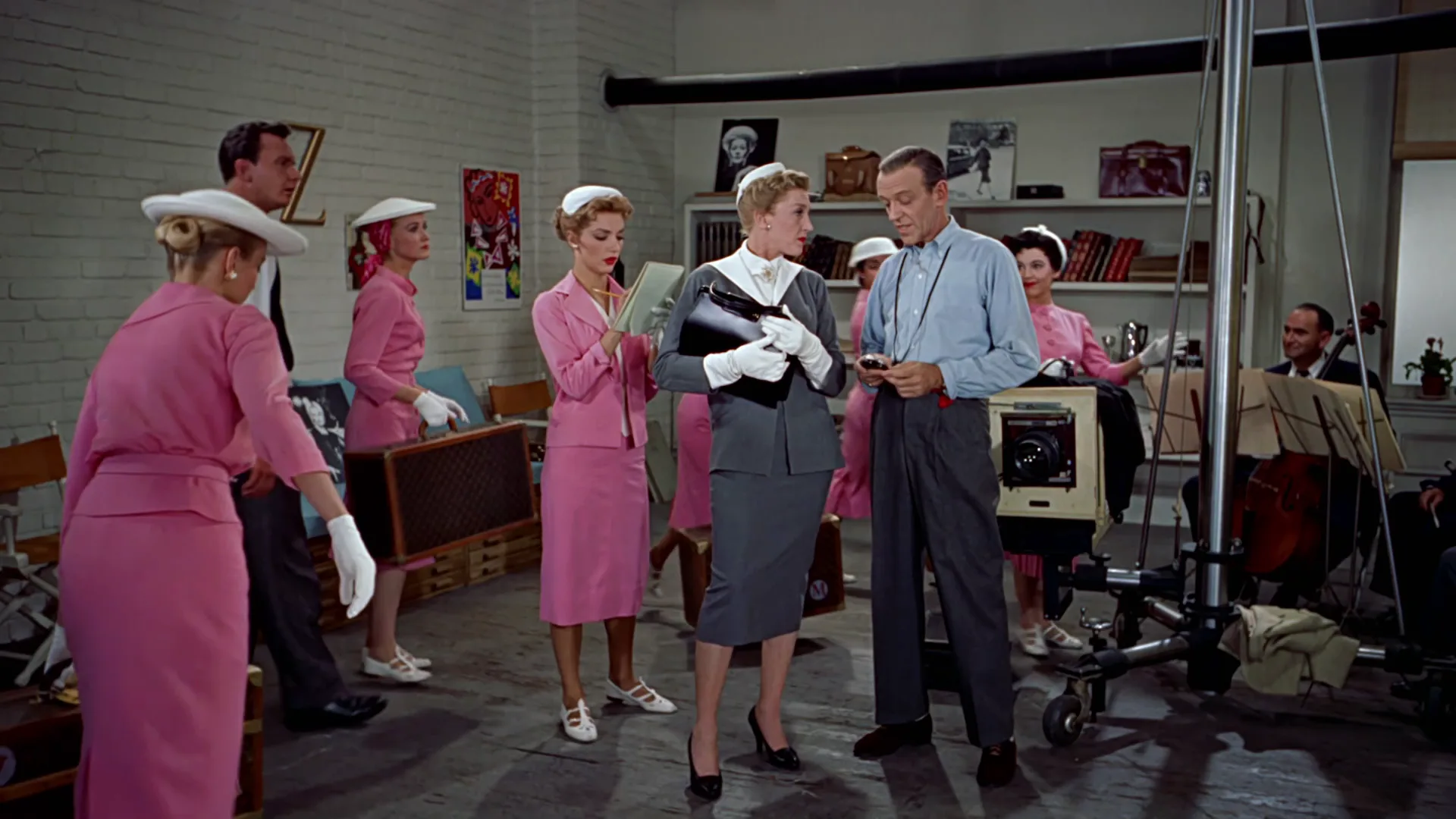
"output": "Full-screen live-action 1950s Technicolor musical shot from Funny Face (1957), alive from its very first frame: one continuous shot, no cuts. Three-strip Technicolor dye-transfer look: candy-pink dresses popping against a pale grey-green photo studio, hard even frontal studio light, clean warm skin, dense blacks, fine grain.",
"characters": {
"S1": {
"name": "Maggie Prescott, played by Kay Thompson",
"look": "tall woman in her fifties, short blonde hair, fitted charcoal-grey suit with a white collar, white gloves, a black handbag tucked under her left arm",
"voice": "brisk, commanding magazine-editor voice"
},
"S2": {
"name": "Dick Avery, played by Fred Astaire",
"look": "slim man in his fifties, thinning hair, pale blue shirt open at the neck, grey trousers",
"voice": "light, dry, amused"
}
},
"shots": [
{
"shot": 1,
"camera": "static wide shot at eye level, almost locked off, with a slight drift to the right as the crowd settles; everything in sharp focus",
"action": [
"BEGINNING: alive from the first frame, a dozen models in identical candy-pink sheath dresses, white gloves and white hats stream across the foreground from left to right and right to left, some carrying brown leather suitcases; Maggie and Dick stand side by side at centre-right, half hidden behind them",
"THEN: a model with a pink scarf over her hair crosses right to left in front of the pair; another in pink swings a large brown trunk down onto the floor at lower left",
"THEN: the crowd thins; Maggie, at centre, turns her head right to Dick and talks, her gloved right hand gesturing at chest height; Dick, on her right side of frame, looks down at a small object he holds in both hands at his waist",
"THEN: at the far left a model in pink bends at the waist over a suitcase, then straightens; a dark-haired man in a black waistcoat enters behind her and stops, hands on hips",
"THEN: Dick lifts his head and answers Maggie with a dry sideways look, hands still at his waist; the models in pink at the back stand still in a loose row",
"END: a blonde model in pink with a wide white hat stands at the left edge in profile facing right; Maggie still faces Dick, left hand on her handbag; the whole frame is held, pink against grey"
],
"dialogue": [
{
"speaker": "S1",
"on_screen": true,
"when": "from the first frame, while the models cross",
"delivery": "crisp, pitching an idea",
"line": "<d>[English] A woman can be beautiful, as well as intellectual. See facing page.</d>"
},
{
"speaker": "S1",
"on_screen": true,
"when": "right after, as the crowd thins",
"delivery": "expectant question",
"line": "<d>[English] And how is the facing page?</d>"
},
{
"speaker": "S2",
"on_screen": true,
"when": "after Maggie's question, while he looks down at his hands",
"delivery": "deadpan, unimpressed",
"line": "<d>[English] The facing page looks as intellectual as a snake.</d>"
},
{
"speaker": "S1",
"on_screen": true,
"when": "at the end of the shot",
"delivery": "dismissive, quick",
"line": "<d>[English] Nonsense. Marion can be very deep.</d>"
}
]
}
],
"sound": {
"ambience": "busy photo studio: heels on a hard floor, suitcases set down, rustle of dresses",
"speech": "exactly these spoken phrases, each said once, in this order",
"never_spoken": "no narration and no voice-over: the descriptions, performance notes and step words of this prompt are never spoken aloud",
"music": "a film score under the scene, always below the voices: bright, bouncy 1950s studio-orchestra strings and muted brass",
"subtitles": "none"
}
}Remakes the studio shot from Funny Face (1957) where candy-pink models flood the frame around Kay Thompson and Fred Astaire; the prompt carried over the pink-on-grey palette, the locked-off wide framing and the four spoken lines.
The palette does the Technicolor work: one saturated hue repeated across many bodies against a neutral grey set, under hard frontal light. Naming the film, cast and verbatim lines keeps the staging and timing close to the original.
Open FlashBoardsCommon mistakes
- Sepia instead of color. "Vintage" yields brown, faded images; say "saturated primaries" and name the hues.
- Everything saturated. Name a quiet background (cream walls, gray suit) so the key colors pop.
- Soft, hazy light. Add "hard frontal studio light" or you get moody soft light.
- Orange-teal creep. List exact costume and set colors to keep blockbuster grading out.
Keep the reference frames, prompts and every generated take side by side — images and video in one canvas.
FAQ
4 questionsWhat is three-strip Technicolor?
A color process used from 1932 into the 1950s. A prism in the camera split light onto three black-and-white negatives recording red, green and blue. In the lab each record became a matrix that transferred one dye onto the print, giving saturated, stable color with deep blacks, as in The Wizard of Oz.
What was the first Technicolor film?
Technicolor made two-color films from the late 1910s. In three-strip, Disney's Flowers and Trees (1932) was the first cartoon and Becky Sharp (1935) the first feature shot entirely in the process. Snow White and the Seven Dwarfs (1937) followed as the first full-length cel-animated feature.
Was The Wizard of Oz the first color film?
No. Color existed for decades before 1939 through hand coloring, tinting, two-color processes and three-strip features like Becky Sharp (1935). The Wizard of Oz is famous because its switch from sepia Kansas to full-color Oz makes the process part of the story.
Why did Technicolor stop being used?
The three-strip camera was bulky, needed huge amounts of light and a Technicolor crew. Single-strip color negative such as Eastmancolor worked in any camera, so three-strip was retired by the mid-1950s. Dye-transfer printing from color negatives continued in the US until 1975.
Related terms
4- Film StockCameras & Capture
Film stock is the light-sensitive celluloid a movie is shot on: a base coated with emulsion whose format (16, 35, 65mm), speed and color response shape grain, contrast and palette before any grading.
- Color SaturationColor
Saturation is how pure a color is — how far it sits from neutral grey; raising or draining it lets filmmakers build a vivid, heightened world or a muted, weary one.
- ColorizationPost-Production & VFX
Colorization adds color to black-and-white footage, once by hand-painting frames and now digitally frame by frame or with AI models.
- Golden Age of HollywoodFilm History & Theory
The Golden Age of Hollywood is the studio era from the arrival of sound (late 1920s) to the early 1960s, when a few studios controlled stars, production and theaters and perfected the invisible classical style — Casablanca, Citizen Kane, The Wizard of Oz.
Further reading
Fred E. Basten, Glorious Technicolor: The Movies' Magic Rainbow (1980). Richard W. Haines, Technicolor Movies: The History of Dye Transfer Printing (1993).