 FlashBoards Learn
- Learn
- Film Movements & Styles
- Dogme 95
Film Movements & Styles · Film language
Dogme 95
Also called: Dogma 95, Dogme, Vow of Chastity
Dogme 95 is a Danish film movement founded in 1995 by Lars von Trier and Thomas Vinterberg. Its Vow of Chastity bans sets, added lighting, score, genre plots and optical tricks, and demands a handheld camera on real locations, so the performances and the raw moment carry the film.
- What it does
- Strips a film down to actors, a real place and a handheld camera, so the drama feels caught rather than staged.
- Use it when
- The story is about people cracking under pressure and you want the audience trapped in the room with them.
- Watch out
- The rules remove polish, not craft: without strong actors and precise blocking the result is just messy video.
- Try this prompt
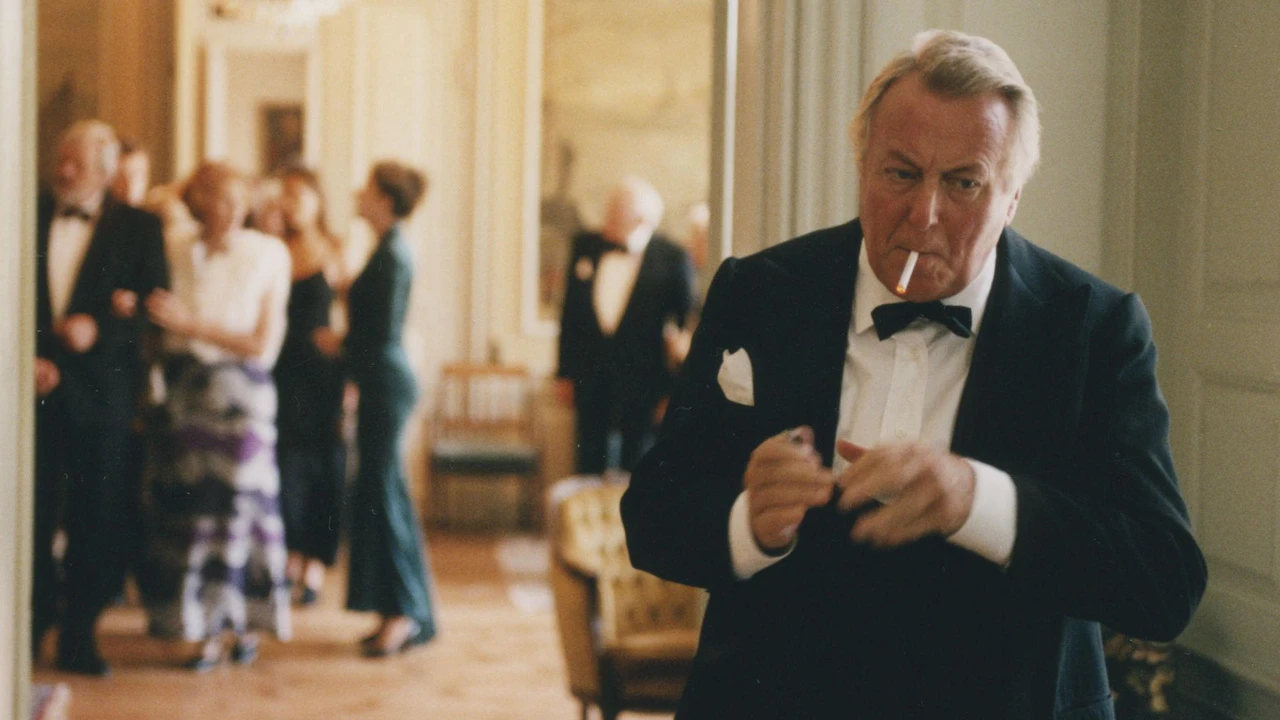
handheld camera at eye level, crowded family dinner in a real manor dining room, only window daylight, consumer video texture, 4:3
What is Dogme 95?
Dogme 95 was a manifesto before it was a style. In 1995 Lars von Trier and Thomas Vinterberg attacked what they saw as cosmetic filmmaking, the illusion built by sets, lighting, music and effects, and set ten rules against it: the Vow of Chastity. Kristian Levring and Søren Kragh-Jacobsen signed next. Films that obeyed could carry a numbered Dogme certificate. The first two, Festen and The Idiots (both 1998), premiered in competition at Cannes, where Festen won the Jury Prize. Among the film movements that rejected studio polish, it sits closest to cinéma vérité: a set of constraints rather than a single look.
What are the Dogme 95 rules?
The ten points, in short:
- Shoot on location; bring in no props or sets.
- Record sound with the image; music only if it plays in the scene, so everything is diegetic sound.
- The camera must be handheld.
- Color only; no special lighting, at most one lamp on the camera.
- No optical work or filters.
- No superficial action: no murders, no weapons.
- The film happens here and now.
- No genre films.
- Academy 35mm format.
- The director is not credited.
Each rule removes a tool a filmmaker can hide behind. With no score, a scene has to earn its emotion; with no lighting, the ambient light of the room decides what the audience sees.
Dogme 95 films and why the style works
The first four were Festen (Vinterberg), The Idiots (von Trier), Mifune's Last Song (Kragh-Jacobsen) and The King Is Alive (Levring). Lone Scherfig's Italian for Beginners (2000) proved it could carry a warm ensemble comedy.
The effect comes from proximity. Anthony Dod Mantle shot Festen largely on a small consumer video camera that could sit among the dinner guests. When the son stands to give his toast, the camera searches faces and arrives late, and that hesitation becomes the audience's own shock. Editors cut for performance, with jump cuts and broken continuity.
How to shoot in the Dogme style
- Camera. A light body you can hold through a long take. Operate handheld at eye level on a 24–35mm equivalent lens, within arm's length of the actors.
- Location. A real apartment or house, dressed only with what lives there. Choose it for its windows: they are the lighting plan.
- Light. Schedule by the sun, let windows blow out and faces fall into shadow; switch on the lamps already in the room.
- Sound. Boom and radio mics, no score. Rich room tone replaces music.
- Blocking. Rehearse actors, not camera. Run whole scenes and let the operator find the coverage over several takes.
- Edit. Keep the best performance, even across a continuity jump.
Dogme 95 vs. mumblecore
Mumblecore shares Dogme's cheap digital cameras and real apartments, but not its intent. Dogme was a written rule set with a manifesto and certification, aimed at confrontational drama: family secrets, madness, grief. Mumblecore was a loose 2000s American label for micro-budget films driven by improvised, low-key dialogue. A Dogme film pushes a room to breaking point; a mumblecore film lets a conversation drift, often in calmer framing.
Dogme 95 examples in film
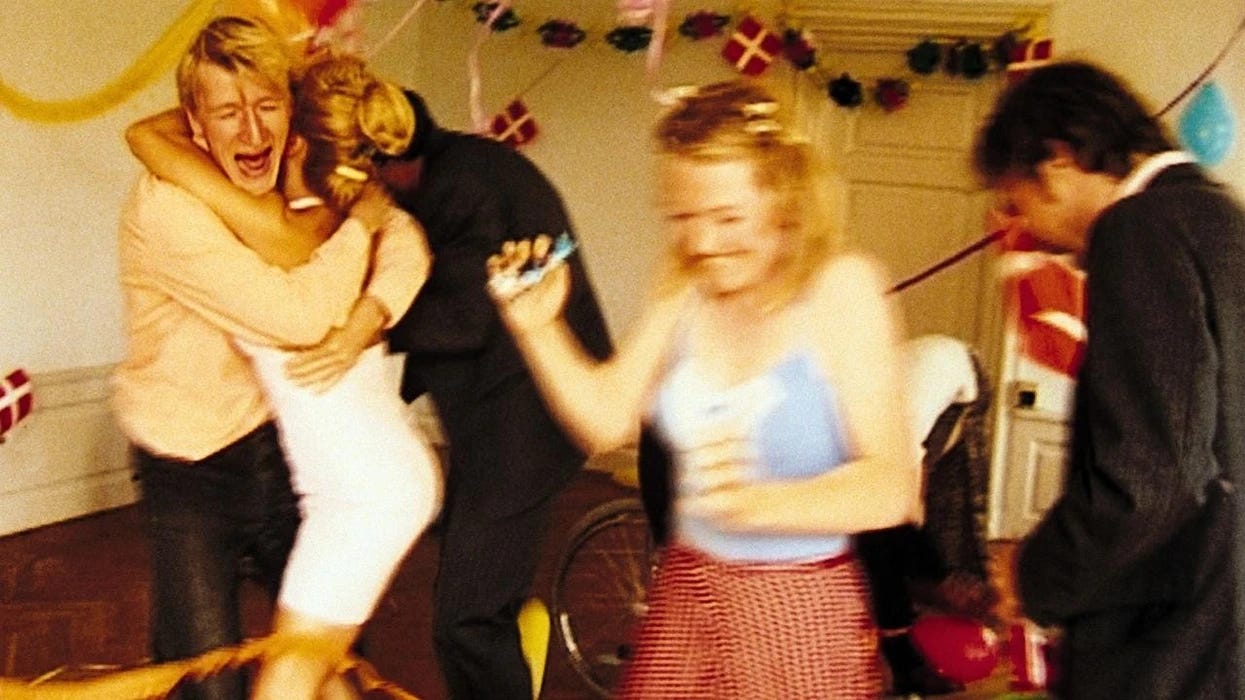
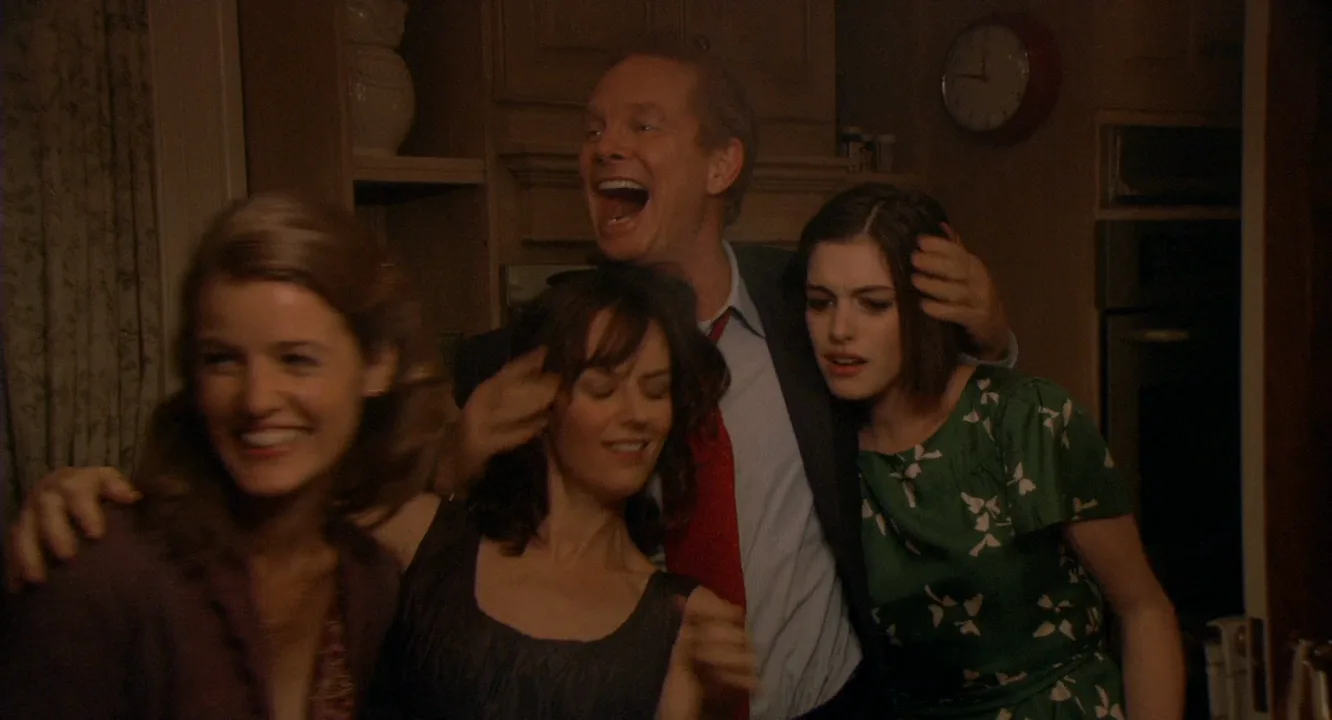
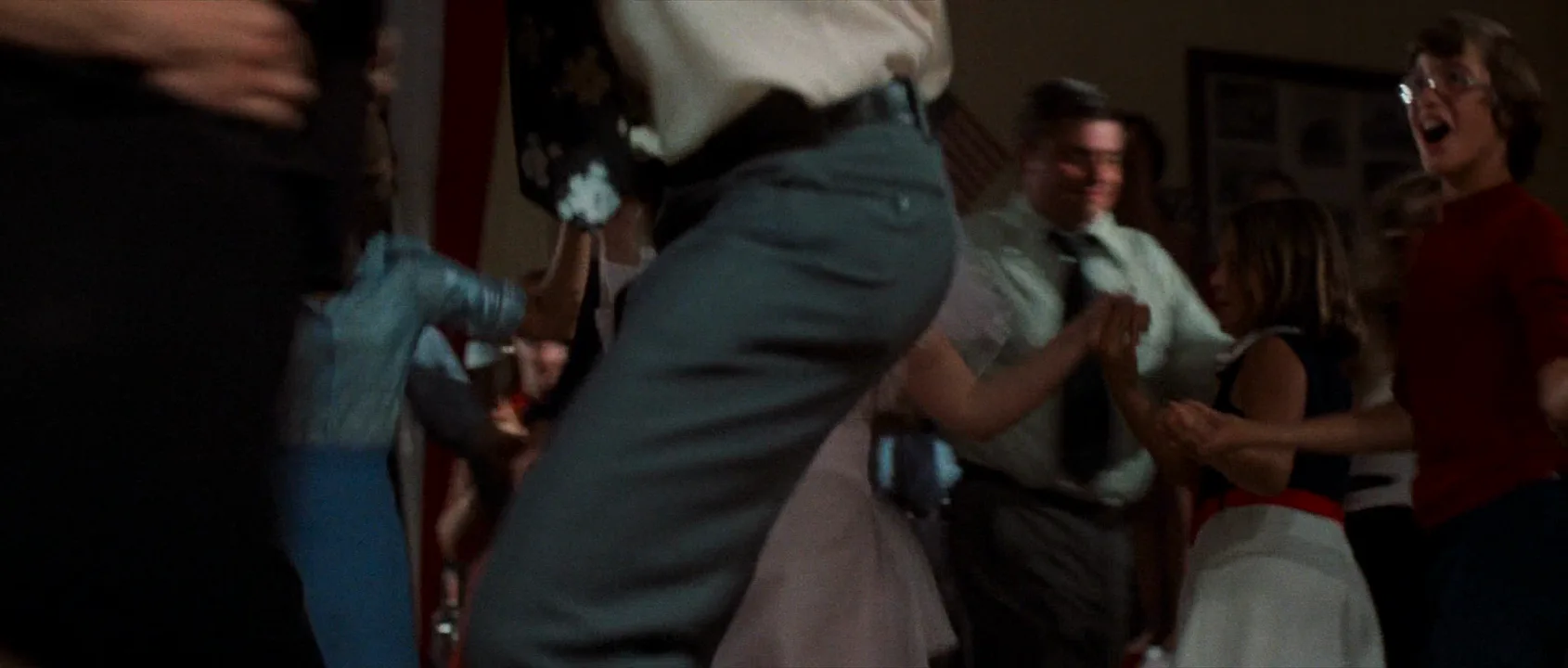
6 framesTwo frames from Dogme films, then frames from other films using the same tools: handheld camera in a crowd, existing light, home-video texture.
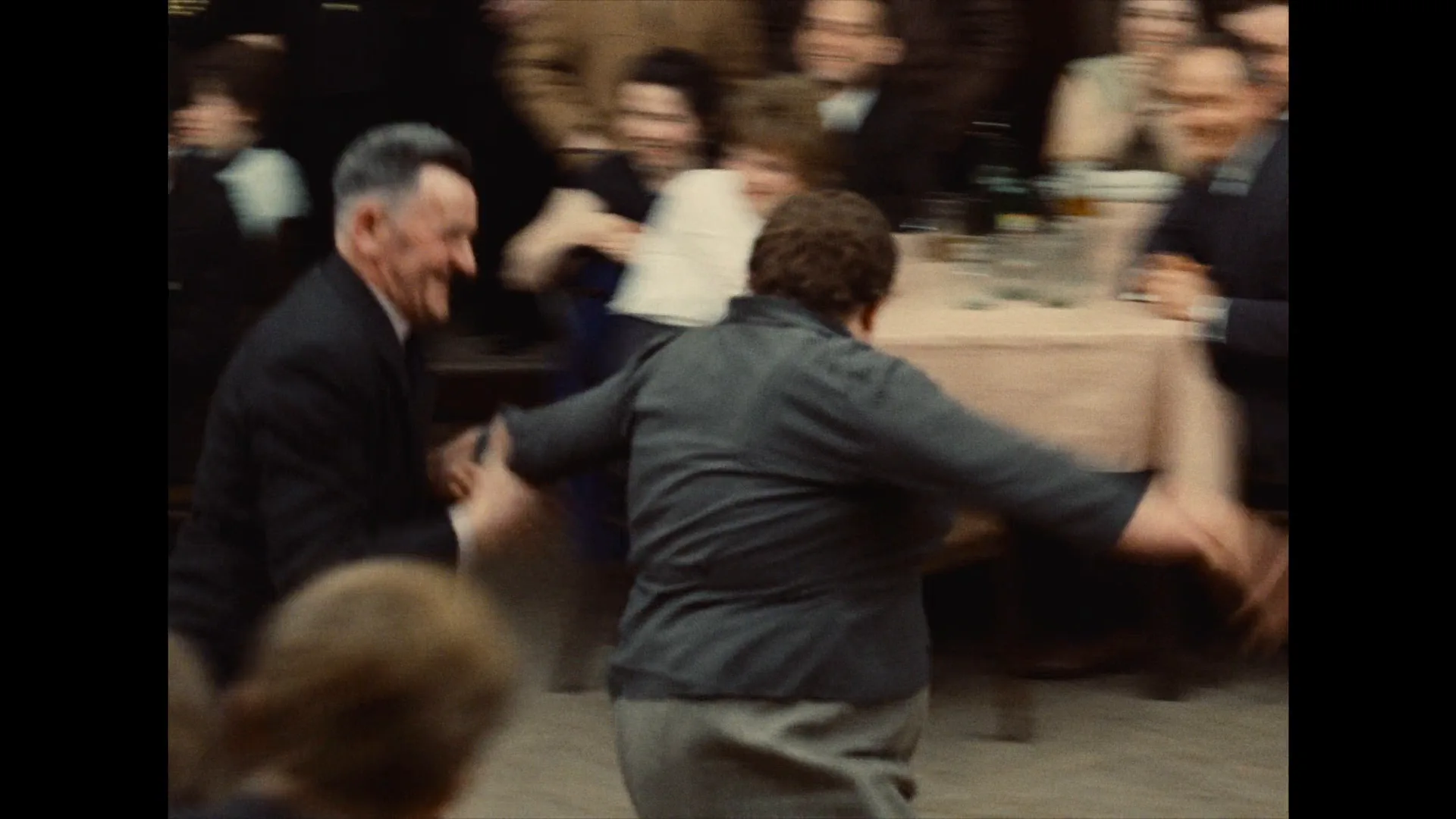
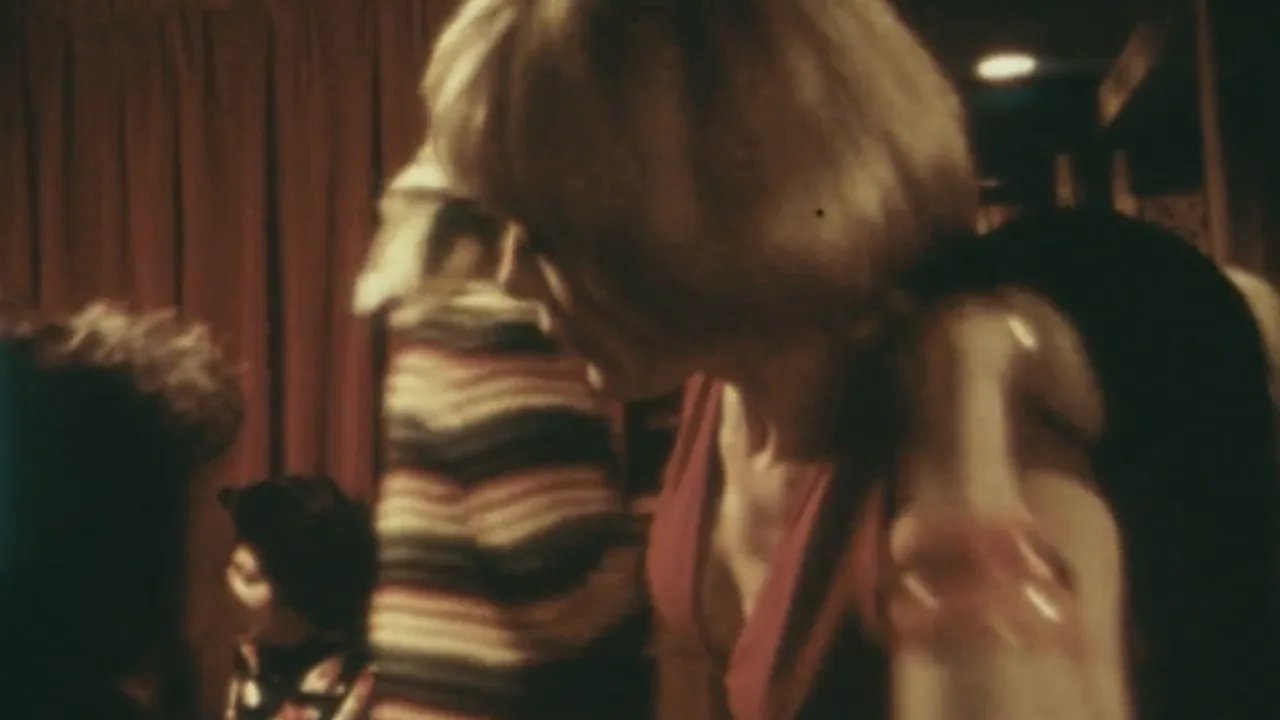
How to create a dogme 95 with AI
4 promptsModels lean toward polish, so describe the Dogme look as physical ingredients: a real room, window daylight, a small handheld video camera, people too close to the lens. Nano Banana 2 Lite draws the start frame, GPT Image 2.5 a tighter 4:3 take, and MiniMax H3 Max Turbo animates frame one. Keep references and takes on one FlashBoards board to compare them. The fourth prompt re-shoots a real film shot from a text description alone, and the original plays next to the result so you can compare.
Candid frame from a late-1990s consumer video camera, handheld at eye level at a long family dinner table in an old manor dining room: a gaunt man in his sixties with a white walrus mustache and a burgundy velvet bow tie stands mid-sentence with a raised wine glass, seated guests in evening dress turn toward him, a blurred shoulder in the left foreground; flat grey daylight from tall windows blown out white, faces underexposed, muted colors, video noise, horizon slightly tilted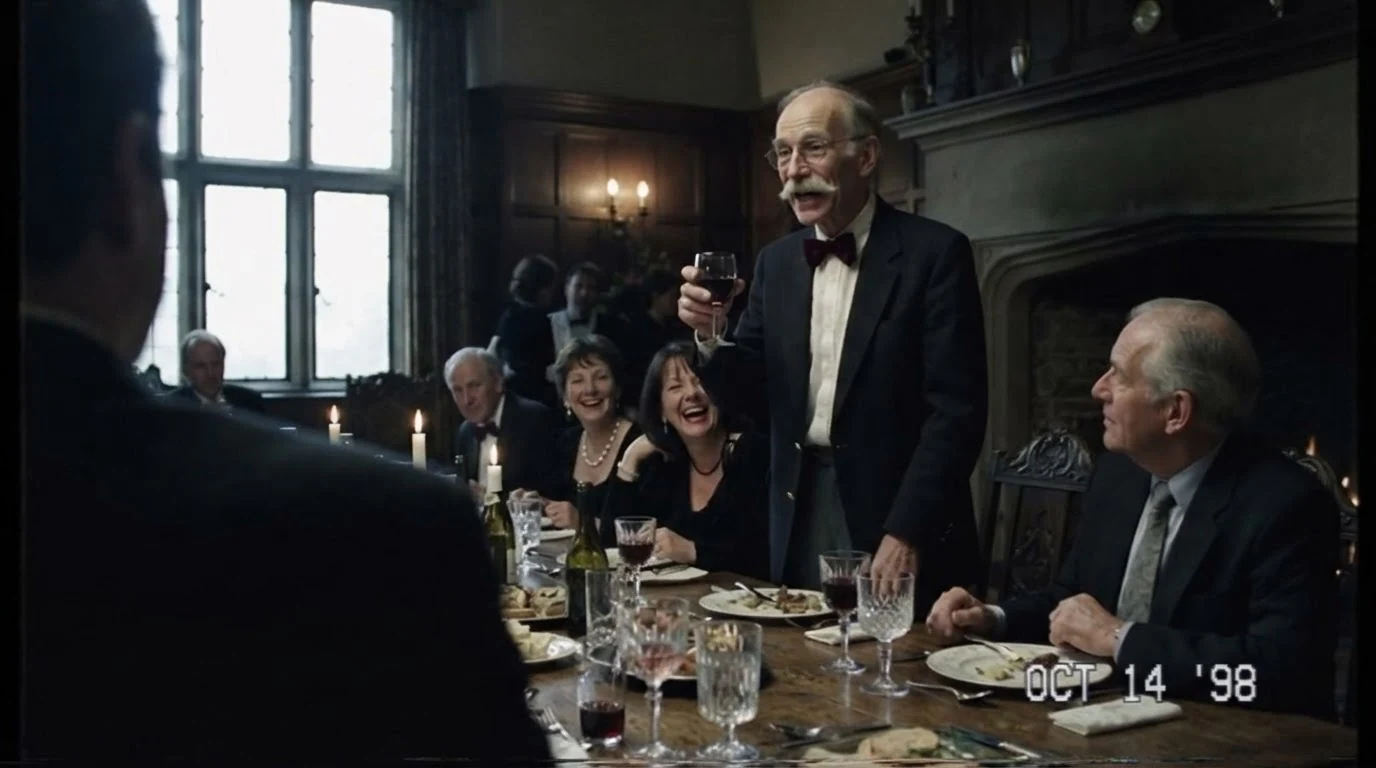
Late-1990s consumer video camera pulls the image away from cinematic polish. Flat grey daylight and windows blown out white describe available light as it behaves. The foreground shoulder and tilted horizon put the camera among the guests.
Open FlashBoardsRaw handheld video still in a cramped real apartment kitchen at night: a woman in her thirties with a cropped copper-red bob, freckles and an oversized grey cardigan shouts at her younger brother, a lanky man with a shaved head and a chipped front tooth, half cut off by the right frame edge; lit only by the yellow ceiling bulb and the open fridge, harsh shadows, focus caught on her face, slight motion blur, grainy digital video, 28mm at arm's length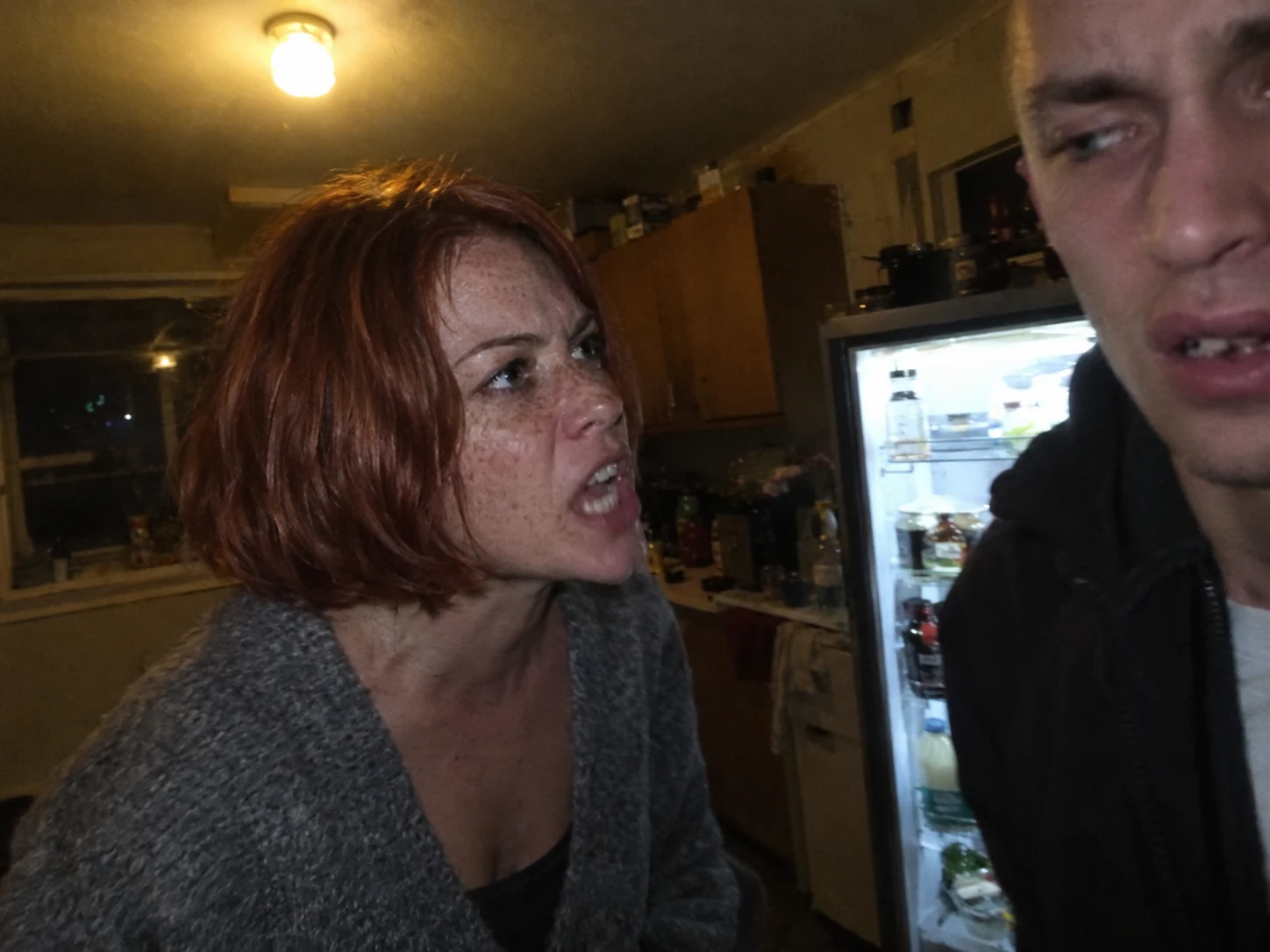
The 4:3 frame nods to the Academy rule. Lit only by the ceiling bulb and the open fridge keeps light inside the location, and half cut off plus focus caught on her face imitate an operator who reacts rather than composes.
Open FlashBoardsCamera: handheld at eye level with constant small sway from the first frame; it pushes slowly past the foreground shoulder toward the standing man, then swings quickly left along the table to the seated guests, arriving a moment late and refocusing on their faces. Action: the mustached man keeps speaking, glass trembling; he lowers it and stares down the table. The guests stop smiling, a woman sets down her fork, the table goes still.Constant small sway from the first frame keeps the shot alive at once. A swing that arrives late and refocuses is the Dogme signature: the camera discovers the reaction. The action uses only what recipe 1 shows.
Open FlashBoards{
"output": "Full-screen live-action scene from Rachel Getting Married (2008), from its very first frame: one continuous handheld shot, no cuts. Digital-video look of a family home at night: a wood-paneled kitchen lit only by warm household bulbs, amber-brown palette, deep shadows, soft grain, a round wall clock with a red rim on the back wall.",
"characters": {
"S1": {
"name": "Paul, played by Bill Irwin",
"look": "man in his late fifties, thinning sandy-blond hair, dark suit jacket, pale blue shirt with open collar, loosened red tie",
"voice": "warm, excited, a little breathless"
},
"S2": {
"name": "Rachel, played by Rosemarie DeWitt",
"look": "woman in her thirties, dark shoulder-length wavy hair, black sleeveless top",
"voice": "laughing"
},
"S3": {
"name": "Emma, played by Anisa George",
"look": "woman in her thirties, long auburn hair with a small barrette, plum cardigan over a patterned top",
"voice": "laughing"
},
"S4": {
"name": "Kym, played by Anne Hathaway",
"look": "young woman, dark bob with a fringe, green dress with a white leaf print and short puffed sleeves",
"voice": "mock-outraged, laughing"
}
},
"shots": [
{
"shot": 1,
"camera": "handheld at chest height, close medium group shot, constant small sway and bob like a guest filming the party; it holds on the huddle, then pans slowly right to follow S4 as she walks away, ending on her back at the kitchen counter",
"action": [
"BEGINNING: alive from the first frame, S1 stands in the centre laughing with his head thrown back; his right hand (screen left) presses on S2's hair as he pulls her in, his left arm (screen right) wraps S4's shoulders, his ringed hand on her green sleeve; S4, right third, looks up at his face.",
"THEN: S3 leans in from the left edge and drapes her arm over S2's shoulders; S2 ends up in the centre, smiling up at the ceiling while S1 kisses the top of her head.",
"THEN: the four squeeze into one tight knot, heads bumping; S4 leans her head against S2 with one hand on her own hair and her mouth wide open, S3 grins toward the camera.",
"THEN: S1 straightens and roars with laughter toward the camera; S4 glances sideways, mouth open, and starts to wriggle out from under his arm.",
"THEN: S4 slips free and turns away to the right; S1's hand trails after her shoulder, S2 laughs with her eyes down; the camera starts to pan right past S1's shoulder and the group slides out of frame left.",
"END: S4 walks to the kitchen counter beside a white stand mixer, back to the camera; she turns her head toward screen left, raises one hand to her forehead and rests the other on her hip; the camera settles on her back."
],
"dialogue": [
{
"speaker": "S4",
"on_screen": true,
"when": "while the four are squeezed together, after S3 joins the hug, drawn out until she starts to wriggle free",
"delivery": "loud, mock-outraged, half laughing",
"line": "<d>[English] So unfair!</d>"
},
{
"speaker": "S1",
"on_screen": false,
"when": "at the very end, while the camera is on S4's back, heard from behind the camera on the left",
"delivery": "warm, curious, still laughing",
"line": "<d>[English] When did you find out about this?</d>"
}
]
}
],
"sound": {
"ambience": "a small room full of family laughter, a clink of glasses, shoes on a wooden floor",
"speech": "exactly these spoken phrases, each said once, in this order",
"never_spoken": "no narration and no voice-over: the descriptions, performance notes and step words of this prompt are never spoken aloud",
"music": "a film score under the scene, always below the voices: a loose acoustic guitar and hand-drum groove, as if a band is playing in the next room",
"subtitles": "none"
}
}Remakes the kitchen huddle from Rachel Getting Married (2008): the prompt carries over the four-person hug, Kym's "So unfair!", the slow handheld pan right that follows her to the counter, and the warm practical light.
The camera line holds on the huddle, then pans slowly right to follow S4 gives the operator no plan beyond whoever moves, the Dogme habit of letting actors lead the camera. The two lines are the film's own, with Paul's heard off screen, and lit only by warm household bulbs keeps the light inside the room.
Open FlashBoardsCommon mistakes
- Models add rim lights, glowing skin and perfect bokeh. Name the real sources (window daylight, ceiling bulb) and state underexposure.
- Frames come out centered and composed. Ask for a foreground shoulder, a figure cut by the edge, a tilted horizon.
- The keyword "Dogme 95" alone gives generic arthouse; describe camera, room and light.
- Video handheld turns into a smooth float. Write constant small sway, arrives late, refocuses.
Keep the reference frames, prompts and every generated take side by side — images and video in one canvas.
FAQ
4 questionsWhat is Dogme 95?
Dogme 95 is a filmmaking movement launched in 1995 by Danish directors Lars von Trier and Thomas Vinterberg. Directors who joined took a Vow of Chastity: shoot on real locations with a handheld camera, with no added lighting, sets, score, optical effects or genre formulas, and leave the director uncredited. The first films, Festen and The Idiots, arrived in 1998.
What are the 10 rules of Dogme 95?
Shoot on location with no brought-in sets or props; record sound with the image and use no non-diegetic music; handheld camera only; color with no special lighting; no optical work or filters; no murders or weapons; the story happens here and now; no genre films; Academy 35mm format; and the director is not credited.
What was the first Dogme 95 film?
Festen (The Celebration, 1998), directed by Thomas Vinterberg and shot by Anthony Dod Mantle, carries Dogme certificate number one. It premiered at Cannes in 1998 alongside Lars von Trier's The Idiots, Dogme number two, and won the Jury Prize. Its family birthday dinner torn apart by a son's toast became the movement's model.
Is Dogme 95 still active?
Not as an organized movement. Dozens of films worldwide carried the certificate, but the founders moved on and certification faded in the 2000s. Its handheld digital camera, available light and actor-first shooting became standard tools in independent film and TV drama.
Related terms
7- MumblecoreFilm Movements & Styles
Mumblecore is the 2000s American micro-budget indie movement — Andrew Bujalski, the Duplass brothers, Joe Swanberg — built on improvised, naturalistic dialogue among twentysomethings, cheap digital video and domestic locations.
- Handheld ShotCamera Movement
A handheld shot is filmed with the camera held in the operator's hands or on the shoulder, without a stabiliser, so its natural sway and jolts make the scene feel immediate, documentary-like or anxious.
- Ambient LightLighting
Ambient (available) light is whatever light already exists at a location — sun through windows, street lamps, shop signs — before the crew adds its own; DPs either shoot with it as it is or shape and supplement it.
- Cinéma VéritéFilm Movements & Styles
Cinéma vérité is a 1960s documentary approach, born with Jean Rouch and Edgar Morin's Chronicle of a Summer, in which lightweight sync-sound cameras record real life and the filmmaker openly provokes and takes part in it.
- Diegetic SoundSound & Music
Diegetic sound comes from inside the story world — dialogue, footsteps, a radio the characters can hear — while non-diegetic sound, like the score or a narrator, exists only for the audience.
- Guerrilla FilmmakingFilmmaking Process & Crew
Guerrilla filmmaking is shooting fast and cheap with a tiny crew, real locations and often no permits, grabbing scenes in public before anyone stops the shoot.
- Jump CutEditing
A jump cut joins two shots of the same subject from nearly the same angle, so time visibly skips forward and the cut itself becomes noticeable — used for energy, unease or elapsed time.
Further reading
Lars von Trier and Thomas Vinterberg, Dogme 95 manifesto and Vow of Chastity (1995). Mette Hjort and Scott MacKenzie (eds.), Purity and Provocation: Dogma 95 (BFI, 2003).