 FlashBoards Learn
- Learn
- Film Movements & Styles
- Video Game Aesthetic
Film Movements & Styles · Film language
Video Game Aesthetic
Also called: video game look, FPS POV, game-like camera
The video game aesthetic is a film style that borrows the look and logic of games: first-person gun POV, a third-person camera trailing the hero, HUD graphics like reticles and health bars, and respawn or level structures. It makes the audience feel they are playing the scene rather than watching it.
- What it does
- Puts the viewer behind the controller: they aim, advance and retry with the hero.
- Use it when
- The story is about control, simulation, surveillance, repetition or a character who treats violence like a game.
- Watch out
- Heavy CGI alone is not game-like; without a player perspective, HUD or level logic it is just effects.
- Try this prompt
first-person view at eye height, 16mm, gloved hands holding a rifle from lower right, crosshair dot at frame center, ammo counter bottom right, dim concrete corridor
What is the video game aesthetic in film?
It is a way of staging and designing a film so it reads like gameplay. In the film movements and styles family it is a borrowed visual language, not a movement with a manifesto: filmmakers raised on consoles quote the cameras, interfaces and rules of games.
The test is recognizable game logic: a player's viewpoint, an interface over the image, or a world built like a level with goals and retries. A CGI battle with none of these is just a CGI battle.
The four game devices films borrow
First-person shooter shot
The camera is the character's eyes, with hands and a weapon entering from the lower edge of frame: a POV shot held far longer than a normal cutaway. Doom (2005) stages an extended first-person sequence in this grammar, and Hardcore Henry (2015, dir. Ilya Naishuller) runs almost its whole length from a head-mounted camera.
Third-person follow camera
The camera trails behind the hero's shoulder, a moving cousin of the over-the-shoulder shot. 1917 (2019) was widely compared to a game for its unbroken trailing camera.
HUD and interface graphics
Reticles, targeting boxes and health bars over the picture. Scott Pilgrim vs. the World (2010) turns it into game jokes, with points and extra lives on screen.
Respawn and level structure
The plot behaves like a game: die, reset, retry. Run Lola Run (1998) plays its run three times; Edge of Tomorrow (2014) resets a soldier's day each time he dies.
Why do filmmakers make movies look like video games?
Mostly for complicity. A first-person gun view hands the viewer the trigger, which is why it appears in films about killers, snipers and simulations: the discomfort is the point. HUD overlays turn people into targets and data, a fast way to show a machine or surveillance system watching a human.
Game structure also solves story problems: a respawn loop justifies repeating scenes, and level-like spaces turn an action film into a chain of goals. Tron (1982) and Ready Player One (2018) make the game world the setting, which puts the weight on worldbuilding.
How to shoot a first-person shooter shot and a game-style follow
First person. Mount a small camera on a helmet or chest rig, lens just in front of the operator's eyes, on a 14–18mm full-frame equivalent to match a shooter's wide field of view. Keep the prop weapon in the lower right third, moving with the body. Stabilize until the shake feels like walking, and block the action toward the barrel.
Third person. Put the camera on a gimbal or Steadicam 1.5–2 m behind the actor, slightly above shoulder height, on a 24–28mm lens. Frame the hero lower left or lower center, back to camera, path visible ahead, distance constant.
HUD. Add interface graphics in post, inside title-safe, in one color family, locked to the frame rather than the scene. For a broken digital texture, pair them with a glitch effect.
Video game aesthetic vs. POV shot
A POV shot is a single editing device: we see what a character sees. The video game aesthetic is a whole style that adds the grammar of play: a weapon in frame, interface graphics, goals, a camera that behaves like a controller.
An FPV drone shot can feel like a racing game, but it is a camera technique with no character perspective, interface or rules.
Video Game Aesthetic in motion



7 clipsFive film shots with targeting overlays, then three loops from a tactical shooter, the kind of game these films quote. Watch how the frame becomes the player's eye: a weapon sight locked to the center while the world slides behind it.
How to create a video game aesthetic with AI
3 promptsModels know game screenshots well; the work is keeping the player's perspective and a minimal interface. Build the first-person start frame, try a third-person take, then animate the first frame. Keep references, takes and HUD notes on one FlashBoards board to compare side by side.
First-person shooter view, camera at eye height, 16mm lens. Gloved hands hold a matte-black rifle entering from the lower right, barrel toward center. Ahead, a wet concrete subway corridor under flickering green fluorescent tubes. Five meters ahead a teammate crouches behind a pillar: a tall woman with a shaved head, a thin scar through her left eyebrow and an olive armor vest, signaling forward. Minimal HUD: white crosshair dot at center, ammo counter reading 30 bottom right. Teal-green light, crisp game-engine clarity.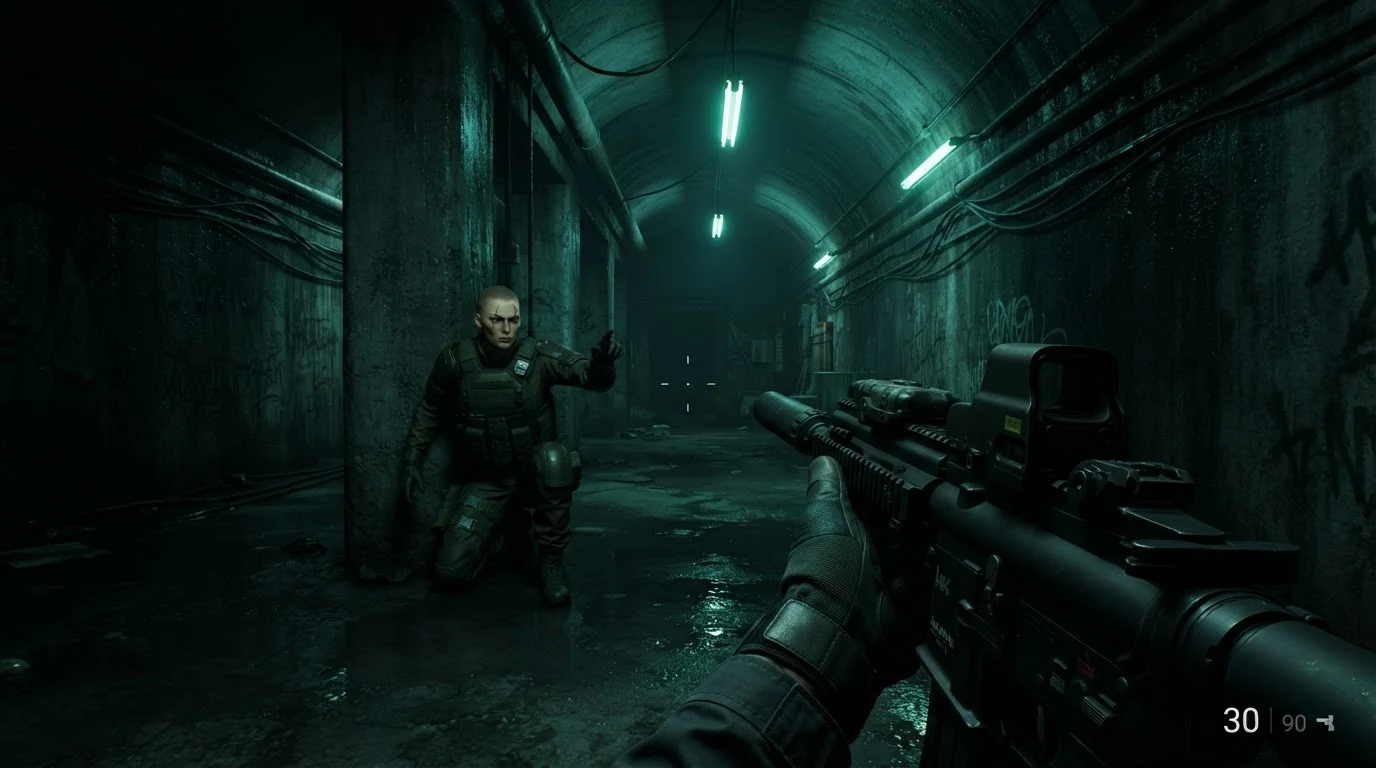
"First-person shooter view", "eye height" and hands entering lower right set the player's viewpoint; naming only two HUD elements keeps the interface legible.
Open FlashBoardsThird-person action game camera, over the right shoulder, 1.5 meters behind and slightly above the hero: a wiry young courier with copper-red dreadlocks tied up, a yellow cycling jacket and a boxy delivery backpack, back to camera in the lower left third, running across a rooftop at dusk toward a gap between buildings. An orange waypoint marker floats above the far rooftop, a thin stamina bar at bottom center. Neon skyline, magenta sky, 24mm, deep focus.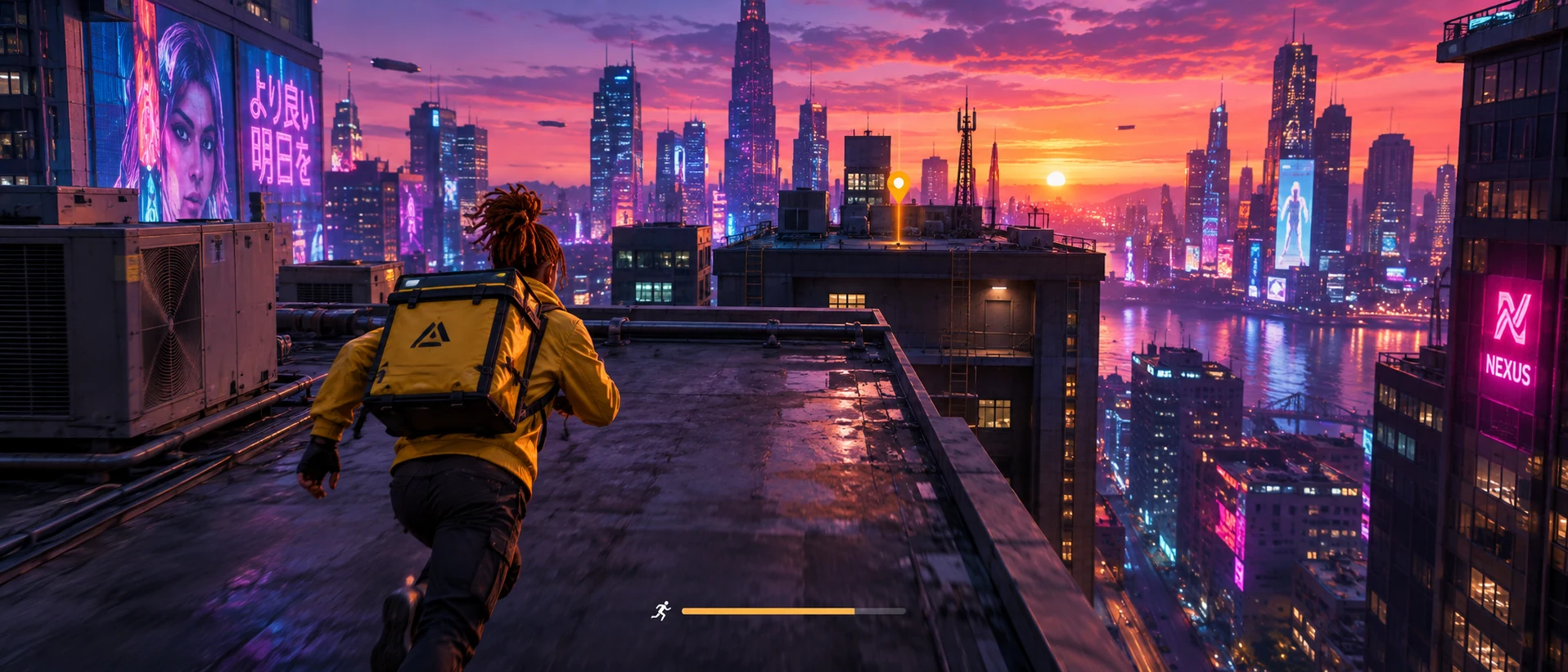
The exact camera position plus "back to camera in the lower left third" lock the follow framing; the waypoint and stamina bar add a goal and a resource without clutter.
Open FlashBoardsCamera: first-person view already walking forward at a steady pace, gentle head bob, the rifle and hands stay locked in the lower right, the crosshair dot stays fixed at center. Action: The fluorescent tubes flicker as the camera advances down the corridor. The woman behind the pillar waves forward, runs to the next pillar and crouches again. The camera follows her line and settles aimed down the corridor toward the dim far end."Already walking forward" keeps the shot alive from the first frame; "locked" and "stays fixed" hold weapon and HUD in place.
Open FlashBoardsCommon mistakes
- The player disappears. Models fall back to a wide shot; state "first-person", eye height and where the hands enter.
- HUD soup. "A game HUD" yields garbled icons. Name two or three elements and their corners, or add them in post.
- Sliding overlays in video. Say the crosshair "stays fixed at center".
- Third person turns around. Write "back to camera" and give the camera's distance behind the hero.
Keep the reference frames, prompts and every generated take side by side — images and video in one canvas.
FAQ
4 questionsWhat is the video game aesthetic in film?
A style that makes a film look and behave like a game: first-person shots over a weapon, a third-person camera trailing the hero, reticles and health bars on screen, and plots built on levels or respawns. The viewer is put in the player's place, sharing the aim, the route and the retries.
What movies look like video games?
Clear examples: Hardcore Henry (2015), shot almost entirely in first person; Doom (2005), with its first-person shooter sequence; Scott Pilgrim vs. the World (2010), with on-screen points; Edge of Tomorrow (2014) and Run Lola Run (1998), built on reset loops; and Tron (1982) and Ready Player One (2018), set inside games.
How do you make a video look like a video game?
Commit to one game camera: a head-mounted wide lens for first person, or a gimbal locked 1.5–2 m behind the actor for third person. Block action toward the camera, keep the grade clean and saturated, and add a minimal interface in post, such as a crosshair or waypoint. Repetition and checkpoints in the edit complete the game logic.
Is CGI the same as a video game aesthetic?
No. CGI is a production method; the video game aesthetic is a set of visual and structural cues. A fully CGI film can feel like conventional cinema, while a practical film feels like a game if it uses a player viewpoint, interface graphics or a respawn structure. Look for the game logic, not the rendering.
Related terms
4- POV ShotCamera Angles
A POV shot shows exactly what a character sees by placing the camera at their eyes — usually right after a shot of them looking — so the audience shares their perspective, including movement, obstruction or distortion.
- FPV Drone ShotCamera Movement
An FPV shot is flown with a small, agile drone piloted through video goggles, letting the camera dive, weave and thread through gaps, doorways and crowds in one continuous rollercoaster-like move.
- Glitch EffectPost-Production & VFX
A glitch effect imitates digital or analog failure — tearing, pixel blocks, color-channel splits, frozen frames — to signal malfunction, a hacked feed or a character's breakdown.
- WorldbuildingStorytelling
Worldbuilding is designing the rules, history, geography, cultures and look of a story's world so that everything on screen feels consistent — the groundwork for production design and for coherent AI-generated scenes.
Further reading
Jesper Juul, Half-Real: Video Games between Real Rules and Fictional Worlds (MIT Press, 2005). Alexander R. Galloway, Gaming: Essays on Algorithmic Culture (University of Minnesota Press, 2006), chapter on the first-person shot in film and games.