 FlashBoards Learn
- Learn
- Film History & Theory
- Persistence of Vision
Film History & Theory · Film language
Persistence of Vision
Also called: phi phenomenon, beta movement, apparent motion
Persistence of vision is the 19th-century idea that the eye holds each image for a fraction of a second, blending a film's still frames into motion. Perception science has retired it: movies move because the brain reads small, regular jumps between frames as continuous motion (beta movement, the phi phenomenon), while flicker fusion hides the dark gaps.
- What it does
- Names the old, now-discarded explanation for why a series of still frames looks like movement.
- Use it when
- You explain how cinema's illusion of motion works; say apparent motion or beta movement for the accurate version.
- Watch out
- Don't present it as the real mechanism: afterimages would stack frames into a smear, not make figures move.
- Try this prompt
Close-up of a spinning 19th-century zoetrope, ink drawings of a galloping horse seen through its slits, oil-lamp light
What is persistence of vision?
Persistence of vision is a claim about the eye: an image supposedly lingers on the retina for a fraction of a second after the light is gone, so the next picture overlaps it and the two fuse. For most of the 20th century it was the standard answer to "why do movies move?"
The observation underneath is real: a sparkler swung in the dark leaves a ring of light. What doesn't hold up is the jump from "images linger" to "lingering images create motion".
The idea grew up with the optical toys. Peter Mark Roget described in 1824 how wheel spokes look curved through the gaps of a fence; Joseph Plateau's phenakistiscope (1832) made drawings on a slotted spinning disc appear to move, and the zoetrope put them in a slotted drum. Muybridge's galloping-horse photographs (1878) and the first film projectors inherited the explanation along with the machines. The full arc is in the history of film.
Why is persistence of vision considered a myth?
Think through what a lingering image would do. If each frame stayed on the retina until the next arrived, you would see frames stacked on each other: a horse with eight legs, a double exposure. An afterimage also stays where it landed on the retina; it doesn't travel. Persistence can explain blur and ghosting, not a figure moving from one spot to the next.
Film scholars Joseph and Barbara Anderson made the case in "The Myth of Persistence of Vision" (1978), pointing out that film studies kept repeating the idea long after perception research had moved on. The current view: the brain's motion system does the work, reading a sampled series of positions much as it tracks a real object.
For a filmmaker the accurate version is more useful: the illusion has rules you can shoot for or against. It's one of the foundational ideas of film history and theory.
Phi phenomenon vs. beta movement
Both names come from Gestalt psychology. In 1912 Max Wertheimer published experiments in which two lines flashed one after the other and, at the right interval, observers saw movement between them. Researchers group these effects as apparent motion.
- Beta movement is what cinema relies on: two positions of a figure shown in quick succession read as one object moving between them. Flipbooks, chasing marquee bulbs and film frames all work this way, best when the jumps are small and the timing steady.
- The phi phenomenon, in Wertheimer's strict sense of "pure phi", is motion sensed across the gap without any object seeming to travel through it.
In writing about film, "phi phenomenon" is often used loosely for both; strictly, the moving figure on screen is beta movement.
Flicker fusion: the part the old theory got half right
A separate illusion runs through every screening. A film projector's shutter blocks the light while the next frame moves into the gate, so the screen goes dark dozens of times a second. You don't notice because above the flicker fusion threshold, pulsing light looks steady.
That's why projectors flash each frame more than once: a two-bladed shutter turns 24 fps into 48 flashes a second, and three-bladed shutters did the same for the slower footage of silent film. The frame rate carries the motion; the flash rate hides the flicker. Flicker fusion keeps the screen lit, apparent motion makes the figures move.
What apparent motion means on set and in AI video
The brain builds motion from small, regular steps, so anything that makes the steps big or irregular weakens the illusion:
- Fast pans strobe. At 24 fps a quick pan jumps the background so far between frames that it judders. Slow down, track a subject, or let motion blur bridge the gap.
- Shutter angle links frames. A 180° shutter at 24 fps leaves enough blur to connect each frame to the next, the logic of the 180-degree shutter rule. A narrow shutter gives the staccato look of the Omaha Beach landing in Saving Private Ryan (1998).
- Break it on purpose. Step printing and stop-motion on twos make the steps visible.
- AI video. When a face or prop changes too much between frames, viewers see morphing instead of movement.
In FlashBoards, keep reference clips of the motion you want next to your generated takes and play them side by side.
How to create a persistence of vision with AI
3 promptsThe illusion happens in the viewer's head, so no model can draw it, but you can generate the devices built to produce it and set one spinning. Keep all three takes on one FlashBoards board beside your frame-rate notes.
Cinematic close-up, 50mm lens, camera at table height. A 19th-century zoetrope on a scarred oak workbench: a black metal drum on a wooden spindle with a ring of narrow vertical slits. Inside, a paper strip of twelve ink drawings of a galloping horse in successive poses, visible through the slits. The drum is spinning, slit edges softly blurred. Warm oil-lamp light from the right, dark workshop, dust in the air.
Galloping horse in successive poses makes the strip a motion sequence, narrow vertical slits keeps it a zoetrope, and the drum is spinning primes recipe 3.
Open FlashBoardsAnamorphic widescreen film still, medium-wide shot, 35mm lens, inside a cramped projection booth. A projectionist in his sixties with a shaved head, a thick gray walrus mustache and a moss-green cardigan leans toward the glass porthole. Beside him a 35mm film projector runs, film feeding from a reel on the top spool, the two-bladed shutter a blur behind the lens, a hard white beam cutting through haze. Warm work lamp, film cans on a shelf.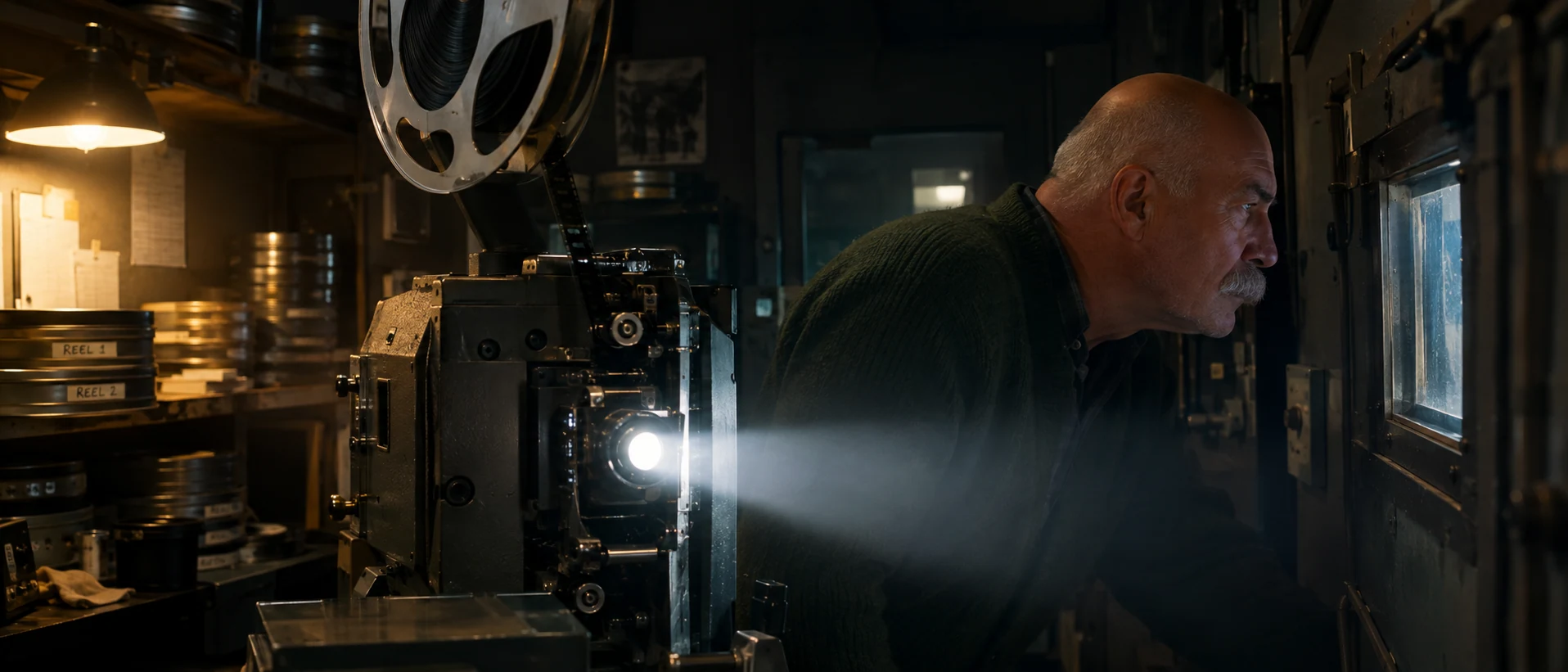
The companion take: two-bladed shutter and film feeding from a reel point at flicker fusion; haze makes the beam visible.
Open FlashBoardsCamera: slow, steady push-in toward the slits of the drum, ending with three slits filling the frame. Action: the zoetrope is already spinning at a steady speed. Through the slits, the horse drawings flick past one after another, so the horse appears to gallop in place. The lamp flame flickers gently, dust drifts through the light. The drum keeps the same speed to the end.Already spinning keeps the shot alive from frame one; flick past and gallop in place name the effect, and the push-in ends where the illusion reads.
Open FlashBoardsCommon mistakes
- Decorative strip. Without "successive poses" the model paints a random frieze.
- Closed drum. Slits merge into a solid band; state "narrow vertical slits" and keep the camera at table height.
- The gallop doesn't read. The model animates the object, not your perception. Frame tighter on two or three slits and ask for a slower spin.
- Wrong-era projector. Say "35mm film projector" and "film feeding from a reel".
Keep the reference frames, prompts and every generated take side by side — images and video in one canvas.
FAQ
4 questionsWhat is persistence of vision in film?
It's the traditional explanation for why a film's still frames look like motion: the eye supposedly retained each image briefly, blending it into the next. Perception research has replaced it with apparent motion, the brain's reading of small, regular changes in position between frames as continuous movement.
Is persistence of vision real?
Afterimages are real, which is why a sparkler leaves a trail in the dark. But they don't explain moving pictures: a lingering image would stack frames into a blur or double exposure rather than move a figure from one spot to the next. Screen motion is built by the brain's motion system.
What is the difference between phi phenomenon and beta movement?
Beta movement is seeing one object move between two positions when two still images appear in quick succession; it's the illusion behind films and flipbooks. Pure phi, described by Max Wertheimer in 1912, is motion sensed between two flashing points without any object seeming to cross the gap. Both are forms of apparent motion.
Why does 24 fps look smooth?
Beta movement links the small position changes between frames, motion blur from a roughly 1/48-second exposure softens the jumps, and projectors flash each frame at least twice so the screen stays above the flicker fusion threshold. Fast pans can still judder because the jumps between frames get too large.
Related terms
3- Frame RateFormats & Exhibition
Frame rate is how many frames are captured or shown per second: 24 fps is the cinema standard, 25/30 fps is broadcast video, and 48–120 fps (HFR) looks hyper-smooth; shooting faster than playback creates slow motion.
- History of FilmFilm History & Theory
The history of film runs from 1890s motion studies and the Lumières' projections through silent cinema, the coming of sound and color, the studio era, national new waves and widescreen to digital production and streaming.
- Step PrintingPost-Production & VFX
Step printing repeats each frame several times (often from footage shot at a low frame rate), producing smeared, stuttering motion — the signature look of Chungking Express.
Further reading
Joseph Anderson and Barbara Anderson, "The Myth of Persistence of Vision" (Journal of the University Film Association, 1978) and "The Myth of Persistence of Vision Revisited" (Journal of Film and Video, 1993). Max Wertheimer, "Experimentelle Studien über das Sehen von Bewegung" (1912).