 FlashBoards Learn
- Learn
- Film History & Theory
- History of Film
Film History & Theory · Film language
History of Film
Also called: film history, cinema history, film timeline
The history of film is the story of how moving pictures went from 1890s motion studies and the Lumière brothers' first paid screenings to silent features, sound, color, the studio era, widescreen, the new waves, digital cameras and streaming. Every era added a tool, and each tool changed how shots are framed and cut.
- What it does
- Maps when each tool of film language appeared, so you can read any shot as a product of its technology and its time.
- Use it when
- You design a period look, pitch a reference, or want to know why older films are framed, lit and cut the way they are.
- Watch out
- Tidy 'firsts' are often myths or marketing; motion studies, sound tests and color experiments all predate the famous titles.
- Try this prompt
1896 actuality film frame, black and white 4:3, locked-off camera, busy cobblestone street, heavy grain and flicker
What is film history?
Film history studies how cinema developed as a technology, an industry and an art, and how the three kept pushing each other. The static wide shots of the 1890s and the handheld street shooting of the 1960s are both answers to what the gear allowed. This page is the timeline on the film theory map; the linked articles go deep on each era.
From motion studies to the talkies (1878–1930)
- 1878–1880s: motion studies. Eadweard Muybridge photographed a galloping horse with a row of cameras, published as The Horse in Motion (1878). That is chronophotography, a series of stills, not a film. Louis Le Prince's Roundhay Garden Scene (1888) is usually cited as the oldest surviving motion picture.
- 1890s: invention. Edison's Kinetoscope showed films to one viewer at a time. In December 1895 the Lumière brothers projected films to a paying audience in Paris.
- 1900s–1910s: the language forms. Georges Méliès used stop tricks and multiple exposures in A Trip to the Moon (1902); Edwin S. Porter cut between locations in The Great Train Robbery (1903). Nickelodeons made movies cheap mass entertainment, and films grew to feature length.
- 1920s: the silent art peaks. Expressionist shadows in The Cabinet of Dr. Caligari (1920), Soviet montage in Battleship Potemkin (1925), surrealism in Un Chien Andalou (1929). More in silent film.
- 1927–1930: sound. The Jazz Singer (1927) was mostly silent, but its synchronized songs and a few spoken lines were enough. The studios converted within about three years, fixing the speed at 24 fps.
From the studio era to streaming (1930–today)
- 1930s–1950s: the studio era. A few studios owned the stars, soundstages and theaters, and the Golden Age of Hollywood perfected invisible continuity editing. Three-strip Technicolor reached features with Becky Sharp (1935); The Wizard of Oz (1939) moves from sepia Kansas into full color. Citizen Kane (1941), shot by Gregg Toland, made deep focus a signature.
- 1945–1950s: postwar shake-up. Italian neorealism shot real streets with nonprofessional actors. The 1948 Paramount decision forced studios to sell their theaters, and television kept audiences home. Hollywood answered with spectacle: Cinerama, 3D and CinemaScope, launched with The Robe (1953).
- 1959–1970s: new waves. Lighter cameras and faster stocks sent young directors onto real locations. The French New Wave opened with The 400 Blows (1959) and Breathless (1960); in the US, New Hollywood ran from Bonnie and Clyde (1967) to The Godfather (1972), with Gordon Willis's dark, top-lit interiors.
- 1975–1990s: blockbusters. Jaws (1975) and Star Wars (1977) set the model of the wide summer release. Jurassic Park (1993) sold computer-generated creatures; Toy Story (1995) was the first fully computer-animated feature.
- 2000s–today: digital. High-definition cameras reached studio features in the early 2000s, and within about a decade most theaters swapped 35mm for digital projection, making digital cinematography the default. Streaming now finances and premieres features.
Using film history in your own work
Each era's look follows its gear: hand-cranked cameras on tripods gave the locked-off tableau, slow stocks demanded hard studio light, and widescreen spread actors sideways. So period is a set of choices, not a filter. A scene meant to feel like 1896 has a still camera, a 4:3 frame, deep focus and passersby glancing at the lens. A 1950s look means saturated dye color, even high-key light and a wide frame full of blocked actors.
On a FlashBoards board, lay the eras out left to right: reference frames per period, notes on aspect ratio, lighting and movement under them, and your generated tests beside the references.
Common myths in film history
- "Audiences fled from the Lumières' train." A legend without solid contemporary evidence.
- "The Jazz Singer was the first sound film." Sound shorts and features with recorded scores came earlier; it was the first hit feature with synchronized singing and speech.
- "Movies work because of persistence of vision." An outdated explanation; see persistence of vision.
How to create a history of film with AI
3 promptsModels are fast at testing which cues sell a period: frame shape, color process, lighting and whether the camera moves. Generate one street in two eras, animate the early one, and compare the takes side by side on a FlashBoards board next to real reference frames.
1896 actuality film frame, black and white, 4:3, locked-off camera on a tripod at eye level, wide shot down a cobblestone market street. A baker in his fifties with a round bald head, a thick grey walrus mustache and a flour-dusted apron walks toward the camera carrying a tray of loaves. Two young girls in white pinafores and straw boaters walk beside him. A horse-drawn cart stands at the right edge. Flat overcast daylight, deep focus, heavy film grain, fine scratches.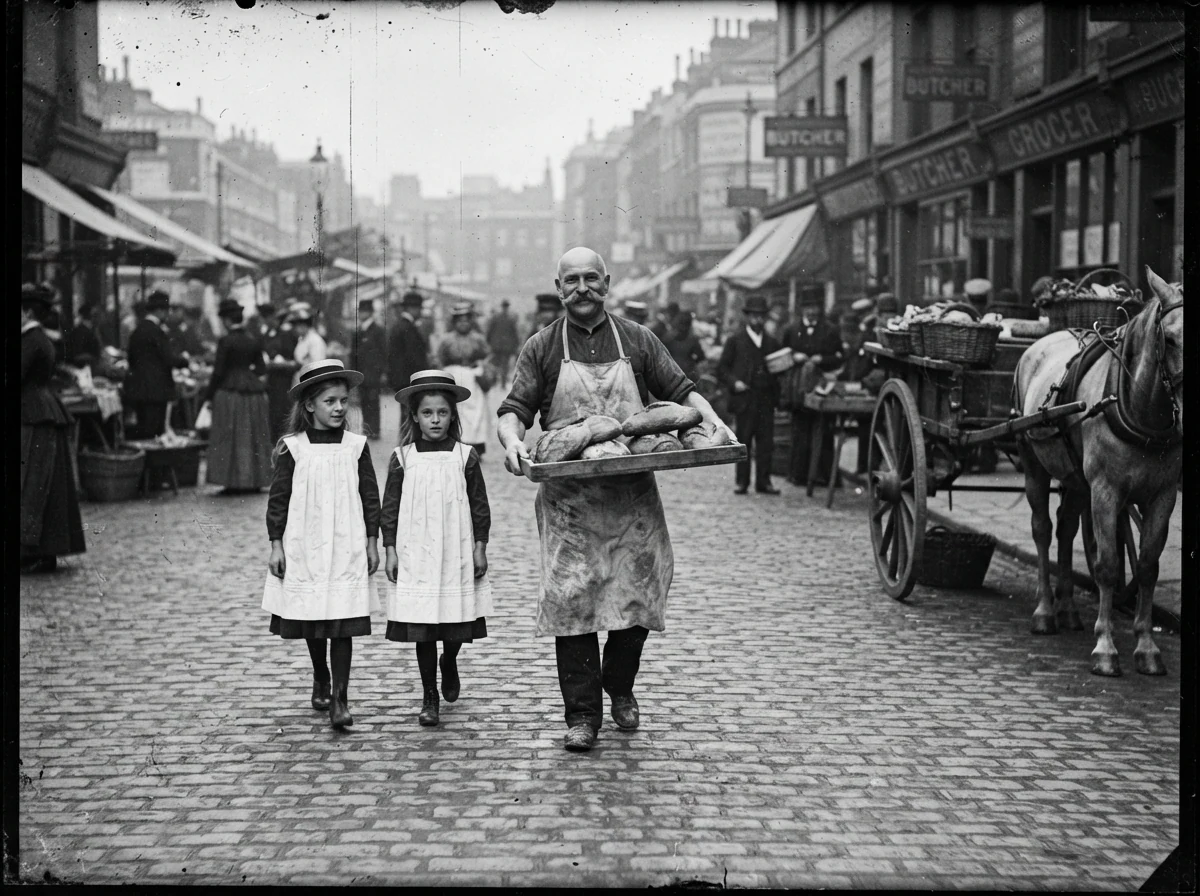
Actuality, locked-off camera and wide shot rebuild the single-take street film; 4:3 and deep focus keep it from sliding into modern black and white with shallow focus.
Open FlashBoards1950s Hollywood musical film still, three-strip Technicolor look, CinemaScope widescreen. A soundstage cobblestone street painted in saturated red, lemon yellow and teal, painted sky backdrop. In the center a dancer in her twenties with a sleek copper bob, a beauty mark above her lip and a canary-yellow full-skirted dress spins mid-twirl; six chorus dancers in striped shirts pose symmetrically across the frame. Bright, even high-key studio lighting, eye-level camera, rich dye color.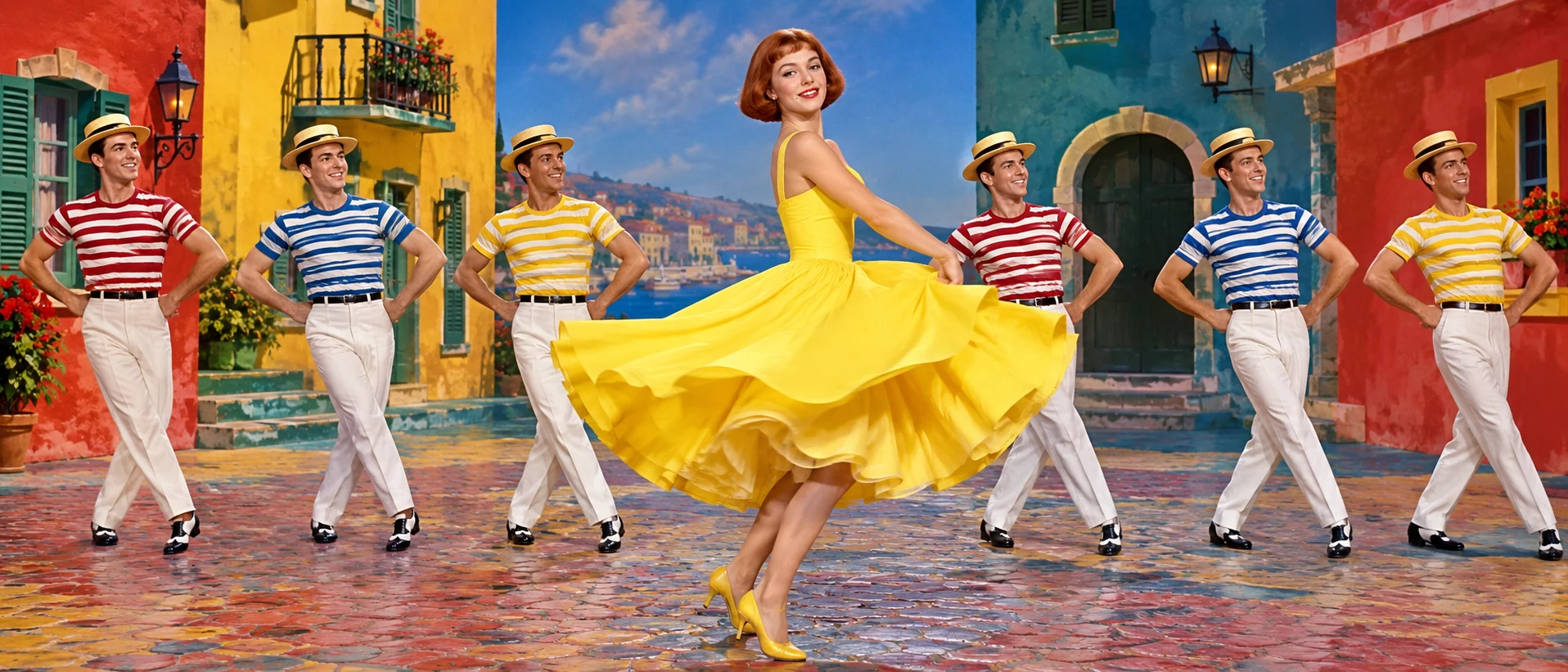
The same street sixty years later: Technicolor and saturated give the dye palette, CinemaScope and 21:9 spread the chorus sideways, high-key studio lighting and a painted sky put it on a soundstage.
Open FlashBoardsBlack and white 1890s actuality footage, heavy grain and flicker, movement slightly fast and jerky like a hand-cranked camera. Camera: locked off on a tripod, completely still for the whole shot. Action: The baker is already striding toward the camera with the loaves. The two girls stop, stare into the lens and wave. The baker walks past close to the lens and out of frame left while the horse tosses its head and the cart rolls away.Completely still for the whole shot blocks a modern push-in; already striding makes the clip alive from the first frame. Girls staring into the lens is the telltale gesture of early street films.
Open FlashBoardsCommon mistakes
- Era bleed. Models add modern makeup, digital sharpness and shallow focus; name the year, the process and deep focus.
- Wrong frame. Set 4:3 for early cinema; name CinemaScope and use 21:9 for the 1950s.
- Sepia creep. Write black and white; add sepia only on purpose.
- A drifting camera. State locked off, completely still for pre-1910 shots.
Keep the reference frames, prompts and every generated take side by side — images and video in one canvas.
FAQ
5 questionsWhat was the first movie ever made?
It depends on what counts. Louis Le Prince's Roundhay Garden Scene (1888) is usually named the oldest surviving motion picture. Edison's Kinetoscope showed films to single viewers from 1894, and the Lumière brothers' paid screening in Paris in December 1895 is the usual start of cinema as projected films for an audience.
What are the main eras in film history?
A common timeline: early cinema (1890s–1900s), the silent era (to about 1927), the coming of sound (1927–1930), the studio era (1930s–1950s), postwar movements and widescreen, the new waves and New Hollywood (1959–1970s), blockbusters and video (1975–1990s), and digital and streaming (2000s onward).
When did movies get sound and color?
Synchronized sound broke through with The Jazz Singer (1927), and the industry converted within about three years. Color is older than sound: early films were hand-colored, tinted or toned. Three-strip Technicolor reached features in 1935, but black and white stayed common until the mid-1960s.
When did film switch to digital?
Gradually. Digital editing and effects spread in the 1990s, digital cameras reached studio features in the early 2000s, and by the early 2010s most theaters projected digitally. Some directors still shoot 35mm or 65mm.
Why should filmmakers study film history?
Every technique solved a problem, and knowing the problem tells you when it fits. History also gives precise references: "1970s New Hollywood interior" tells a DP, a designer or an AI model far more than "vintage".
Related terms
5- Silent FilmFilm History & Theory
Silent film is cinema without synchronized recorded dialogue, dominant until the late 1920s: stories were told through pantomime, intertitles, expressive lighting and live music in the theater.
- Golden Age of HollywoodFilm History & Theory
The Golden Age of Hollywood is the studio era from the arrival of sound (late 1920s) to the early 1960s, when a few studios controlled stars, production and theaters and perfected the invisible classical style — Casablanca, Citizen Kane, The Wizard of Oz.
- French New WaveFilm Movements & Styles
The French New Wave (late 1950s–60s) was launched by Cahiers du cinéma critics turned directors — Truffaut, Godard, Chabrol, Rohmer — who shot cheaply on the streets with handheld cameras, jump cuts and a personal, playful voice (The 400 Blows, Breathless).
- TechnicolorColor
Technicolor is a family of color film processes; its three-strip version (from 1932 into the 1950s) split light onto three negatives and printed them by dye transfer, producing the saturated, jewel-like color of The Wizard of Oz and classic Hollywood musicals.
- Persistence of VisionFilm History & Theory
Persistence of vision is the old explanation for cinema's illusion of motion — the eye supposedly retains each frame until the next; perception science now credits the brain's apparent-motion processing (phi phenomenon, beta movement) instead.
Further reading
David Bordwell and Kristin Thompson, Film History: An Introduction · Geoffrey Nowell-Smith (ed.), The Oxford History of World Cinema · David A. Cook, A History of Narrative Film