 FlashBoards Learn
- Learn
- Filmmaking Process & Crew
- Camera Operator
Filmmaking Process & Crew · Film language
Camera Operator
Also called: cameraman, cam op, A-camera operator
A camera operator is the crew member who physically runs the camera during a take: framing the shot, panning, tilting and executing every move to the design set by the cinematographer. Working hand in hand with the focus puller and dolly grip, the operator decides in real time what the audience sees inside the frame line.
- What it does
- Turns the DP's planned frames and moves into what is actually recorded, take after take.
- Use it when
- Any shoot where the DP needs to watch light, exposure and several cameras instead of one eyepiece.
- Watch out
- The operator executes the design; improvising framing without the DP and director on board breaks coverage.
- Try this prompt
Medium-wide shot on a tripod, operated pan following a courier up a cobbled street, subject held on the left third with lead room
What is a camera operator?
The camera operator is the person with an eye on the viewfinder and hands on the controls while the camera rolls. Crews shorten the title to cam op; older credits and many sets still say cameraman. On multi-camera shoots each body gets its own operator: the A-camera operator runs the main camera, B- and C-camera operators the others.
The job sits in the camera department of the film crew, directly under the cinematographer. The DP designs the image; the operator makes it happen live, with an actor who never lands in exactly the same place twice. Keeping a close-up composed while the actor leans, turns and stands up is the craft.
In the US, union operators belong to the International Cinematographers Guild (IATSE Local 600), and many add SOC after their names, for the Society of Camera Operators.
What does a camera operator do?
Before the take. In the blocking rehearsal the operator agrees with the DP and director where the frame edges fall. They set dolly marks and tell the grips and electricians what is in shot: a stand, a cable, the boom's shadow.
During the take. The operator frames, pans, tilts and follows action: steady headroom, lead room when someone walks, a clean reframe when two actors split, and a move that lands on its final frame at the same beat every time. On a dolly shot the operator controls the head, the dolly grip pushes and the first AC pulls focus.
After the take. The operator is the only person who saw the frame through the glass, so they report at once: good for camera, or the boom dipped in at the end. That report tells the director whether to go again.
Camera operator tools and technique
The support shapes how the operator works:
- Fluid head and pan bar. The default on tripods and dollies; drag settings let a pan ease in and out without a jerk.
- Geared head. Two handwheels, one for pan, one for tilt. Harder to learn, but it gives repeatable, silky moves on long lenses.
- Remote head. On cranes and car rigs the operator frames from a monitor at a wheels or joystick station.
- Shoulder rig. For handheld work a cinema camera with lens and battery often weighs 8 to 12 kg, carried take after take.
- Steadicam. A specialist with vest, arm and sled. Garrett Brown, who invented the rig, operated it on Rocky (1976) and The Shining (1980). More in Steadicam shot.
Good operators also watch the viewfinder's surround area outside the frame lines, where the boom or a stand appears a moment before it enters the shot.
Camera operator vs. cinematographer
The word cameraman once covered both jobs, and on small shoots one person still does both. On a staffed production they split like this:
| | Cinematographer (DP) | Camera operator | |---|---|---| | Main job | Designs the image and the look | Executes framing and moves | | Watches | Monitors, light, exposure, all cameras | One eyepiece, one frame | | Leads | Camera, grip and electric departments | The shot, with focus puller and dolly grip | | In post | Dailies and final grade | Rarely involved |
Splitting the jobs frees the DP to light and judge the whole picture. Many DPs still operate their own A-camera; Roger Deakins is the best-known example.
How do you become a camera operator?
The traditional path climbs the camera ladder: trainee or loader, second AC, first AC, then operator. The other path is operating documentaries, music videos and shorts to build a reel.
The skills are physical and social: steady hands for a twelve-hour day, instinctive composition, moves repeatable within a few frames, and calm communication with actors, the DP and the grips.
Using FlashBoards in prep. Put the storyboard, the coverage plan and a generated start and end frame for each complex move on one FlashBoards board, so the operator, dolly grip and focus puller rehearse against the same pictures. More crew roles are in the filmmaking process hub.
How to create a camera operator with AI
3 promptsIn an AI shot the model is your operator, and it frames exactly as loosely as you write. Brief it the way a DP briefs a cam op: the support, where the subject sits in frame, and where the move starts and lands. In FlashBoards the start frame, a rig reference and the clip sit side by side on one board.
Medium-wide shot from a tripod at shoulder height, 50mm lens: a fictional bicycle courier in her twenties with a shaved head and a bright yellow windbreaker, pushing a bicycle up a steep cobbled street at dusk. She is on the left third of the frame, walking toward the right, with open space in front of her. Warm shop windows on the right, cool blue sky, wet cobbles, background softly out of focus.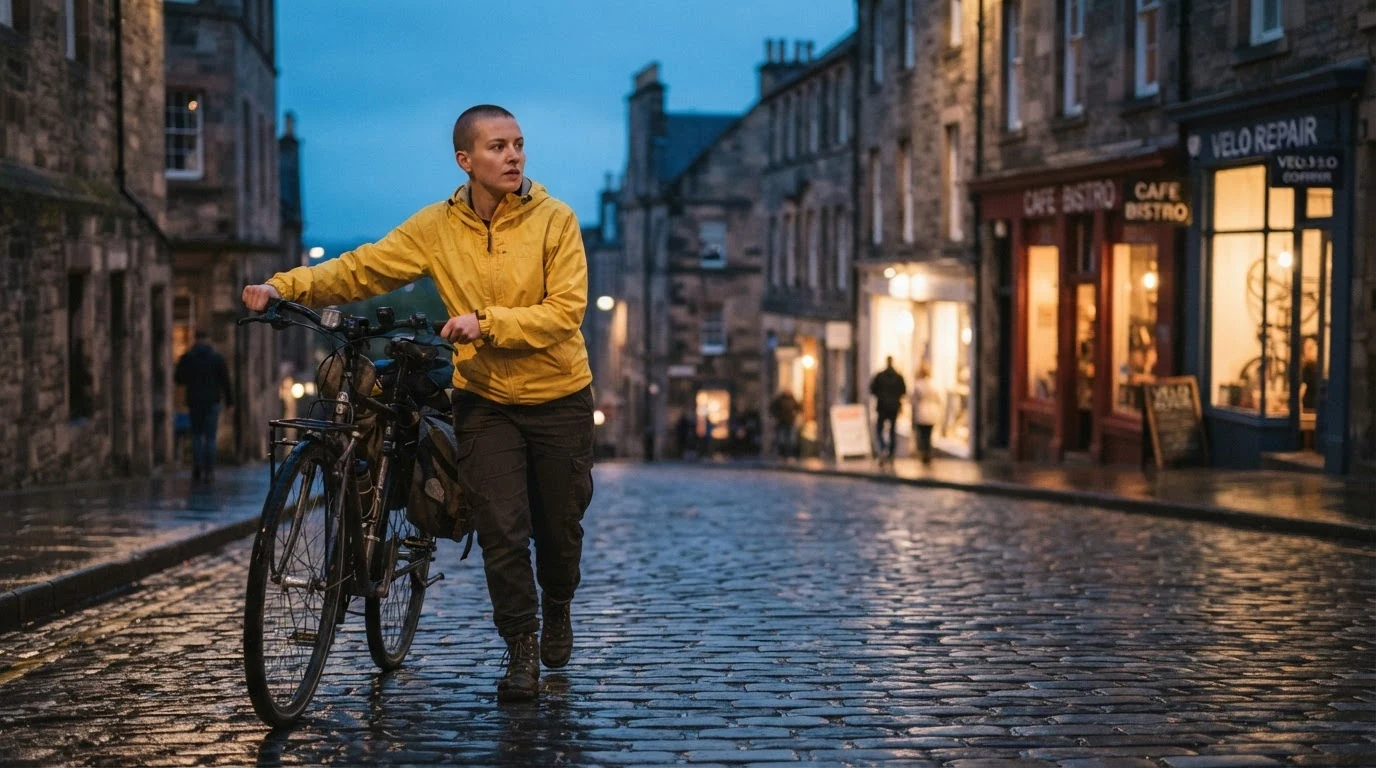
On the left third, walking toward the right, with open space in front of her builds lead room, so the pan in recipe 3 has somewhere to go. Tripod at shoulder height, 50mm fixes support and perspective.
Open FlashBoardsBehind-the-scenes photograph on a night exterior film set: a fictional camera operator, a stocky man in his fifties with a gray beard and a black knit cap, eye pressed to the eyepiece of a cinema camera on a geared head, both hands on the handwheels. The camera sits on a dolly on track; beside him a young focus puller with curly red hair holds a wireless focus handset. A dolly grip in gloves holds the push bar. Work lights, cables on wet asphalt. Documentary photo style, available light.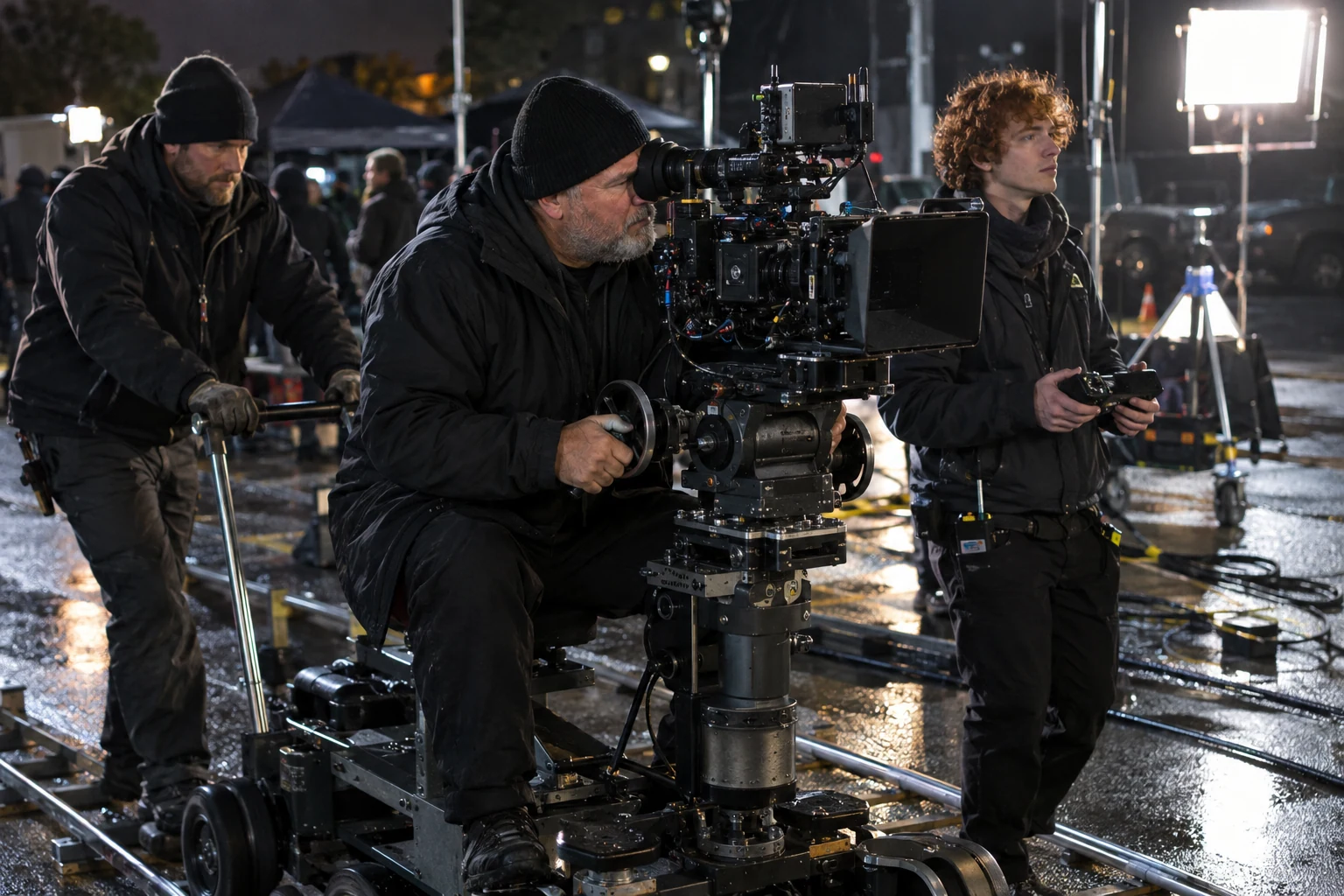
This take shows the job instead of the shot. Eye pressed to the eyepiece, both hands on the handwheels makes the role readable at a glance; naming the focus puller and dolly grip puts the team in one frame.
Open FlashBoardsCamera: tripod-mounted pan to the right at walking speed, with a slight tilt up as the street climbs, keeping her on the left third with open space in front of her. The camera stays in place and only turns. Action: she is already walking uphill, pushing the bicycle. She passes the lit shop windows, glances at one without stopping, and keeps climbing as the pan follows her.Pan to the right at walking speed ties the move to the subject, as an operator would; the camera stays in place and only turns keeps it from becoming a tracking shot. Already walking makes the shot alive from the first frame.
Open FlashBoardsCommon mistakes
- Subject drifts to the center. Restate the frame position (left third, open space in front) in the video prompt too.
- Pan becomes a dolly. Without the camera stays in place and only turns, clips often slide sideways with parallax.
- Stock-photo operators. Describe the head, handwheels and crew, not just a cameraman.
Keep the reference frames, prompts and every generated take side by side — images and video in one canvas.
FAQ
4 questionsWhat does a camera operator do?
A camera operator physically runs the camera during takes: framing each shot, panning, tilting, following the actors and executing planned moves on a tripod, dolly, crane, Steadicam or handheld, to the design set by the cinematographer. After each take they report whether it was good for camera.
What is the difference between a camera operator and a cinematographer?
The cinematographer, or director of photography, designs the image: lenses, lighting, exposure, movement and look, and leads the camera, grip and electric departments. The camera operator executes the framing and moves during each take. On large productions these are two people; on small shoots the DP often operates.
Is a camera operator the same as a cameraman?
Mostly, yes. Cameraman is the older, informal word for the person running the camera, and in news and documentary it still means the operator. In old film credits it could also mean the cinematographer, which is why crews now prefer camera operator or cam op.
Who does the camera operator work with most closely?
Three people: the director of photography, who defines the frames and moves; the first assistant camera, or focus puller, who keeps the image sharp; and the dolly grip, who pushes the dolly or crane so the move lands on its marks at the same moment as the actor.
Related terms
5- CinematographerFilmmaking Process & Crew
The cinematographer, or director of photography (DP), designs the film's image with the director — framing, lenses, lighting, exposure, camera movement and look — and leads the camera, grip and electric departments.
- Camera MovementCamera Movement
Camera movement is any change of the camera's position or direction during a shot — pans, tilts, dollies, cranes, handheld and more — used to guide attention, reveal space and set the emotional rhythm of a scene.
- Film CompositionComposition & Framing
Composition is the arrangement of everything inside the frame — subjects, lines, shapes, light, color and empty space — to direct attention and express the meaning of a shot.
- Steadicam ShotCamera Movement
A Steadicam shot is filmed with a body-worn stabiliser — vest, spring-loaded arm and balanced sled — that lets the operator walk, run and climb stairs while the camera glides; it made long moving takes like Rocky's steps run and The Shining's corridors possible.
- GripFilmmaking Process & Crew
Grips build and move everything that supports the camera and shapes light without being electrical — dollies, cranes, rigs, flags, silks and C-stands; the department is led by the key grip.
Further reading
Blain Brown, Cinematography: Theory and Practice (Routledge) · American Cinematographer magazine (ASC)