 FlashBoards Learn
- Learn
- Filmmaking Process & Crew
- Filming Location
Filmmaking Process & Crew · Film language
Filming Location
Also called: location, shooting location, location scouting, recce
A filming location is any real place used for filming outside a studio: a house, a street, a desert, a diner that stays a diner. Location scouting finds and vets it for look, light, sound, access, permits and cost, and the location manager secures it. It gives a film texture a set rarely matches.
- What it does
- Puts the story in a real place with real light, depth and texture the camera can't fake cheaply.
- Use it when
- The world must feel lived-in, the scale is too big to build, or the budget can't cover a set.
- Watch out
- You inherit everything the place comes with: sun path, traffic noise, ceiling height, neighbors and permit rules.
- Try this prompt
Location scout photo of an empty roadside diner in the high desert at golden hour, 24mm, eye level, gravel lot, neon sign
What is a filming location?
A filming location is a real place the production borrows instead of building. Crews split them into practical locations (existing interiors like a kitchen, an office, a bar) and exteriors (streets, fields, coastlines).
A location rarely plays itself. A suburb stands in for another state, a hotel lobby becomes an embassy, one farmhouse supplies the kitchen and another the porch. The audience reads the result as the story's setting. Some places become part of a director's voice: John Ford returned to Monument Valley for Stagecoach (1939) and The Searchers (1956).
Locations are chosen in pre-production, and the choice drives the shooting schedule: scenes are grouped by place, not story order.
What is location scouting?
Location scouting turns INT. DINER - NIGHT into an address. It runs in rounds:
- Breakdown. From the script breakdown, the location department lists every place the script needs.
- Scouting. Scouts search film-office databases and the streets, then photograph each option: wide views, every wall, windows, the street, parking.
- Recce. The director, cinematographer and production designer visit the shortlist and choose.
- Tech scout. Department heads walk the locked location to plan power, rigging, sound and the day.
In FlashBoards, pin each option's scout photos, sun-path notes and script pages side by side on one board, so the recce compares places instead of folders.
What does a location manager do?
The location manager turns a chosen place into a legal, workable set. They negotiate the fee and contract with the owner, get permits from the film office, arrange traffic control, deliver insurance certificates, notify neighbors and plan parking and base camp.
On shoot days the location department opens up, protects floors and walls, handles neighbors and wraps out, then restores the property and settles damage claims. A scout finds options; the manager owns the relationship and the paperwork.
What to check on a location scout
Read the place as a camera, a microphone and a crew of forty will.
- Light. Note the compass direction of key windows and check a sun-path app for call time and wrap. A west-facing room can be perfect at 10 a.m. and unusable at 3 p.m., when direct sun pours in.
- Space. Measure how far back the camera can get. In a 3-meter room even a 24mm won't give a true wide shot, and low ceilings leave nowhere to hang lights.
- Sound. Stand silent for five minutes. Flight paths, highways, fridges and HVAC are all problems for location sound.
- Power. Household circuits can't feed big lights; plan a generator or tie-in.
- Access. Load-in route, stairs, truck parking, restrooms, cell signal.
- Control and cost. Can you close the street or the shop? Check fees, permit rules and curfew hours.
Filming location vs. soundstage
A soundstage is a soundproofed building where sets are built and everything is controlled. A location gives real texture, real views out of the windows and scale you could never build, but you trade control for it.
| | Location | Soundstage | |---|---|---| | Look | Real textures and views | Built | | Light | Sun moves | Fully controlled | | Sound | Uncontrolled | Quiet by design | | Walls | Fixed | Wild walls fly out |
Many films mix both. The Shining (1980) used Oregon's Timberline Lodge for the Overlook's exterior and built the interiors on stages in England. A studio backlot sits in between: permanent exterior streets inside the lot.
Choosing locations on a low budget
On small productions the location is the cheapest source of production value. Write toward places you can get, and minimize company moves: one building that serves as three locations can save a shoot day. Shooting without permission, common in guerrilla filmmaking, leaves you without insurance or a way back for reshoots. Crossing borders adds visas and fixers, covered in international production planning, another trade-off in the filmmaking process.
How to create a filming location with AI
3 promptsYou can't generate the real address, but you can show the location department what the script needs before the scout. Make a scout-style frame, a location package and a walk-through, then pin them on the FlashBoards board next to the real scout photos.
Location scout photograph of an empty roadside diner in the high desert at golden hour. Single-story diner with a long row of windows, a red neon sign on the roof, a gravel parking lot in front. Low mountains on the horizon. A location scout stands at the left edge of the lot: a stocky woman in her forties with short silver hair, a gray field jacket and a clipboard, looking toward the diner. Low sun from the right raking across the building, long shadows. Wide 24mm lens, eye level, documentary photo.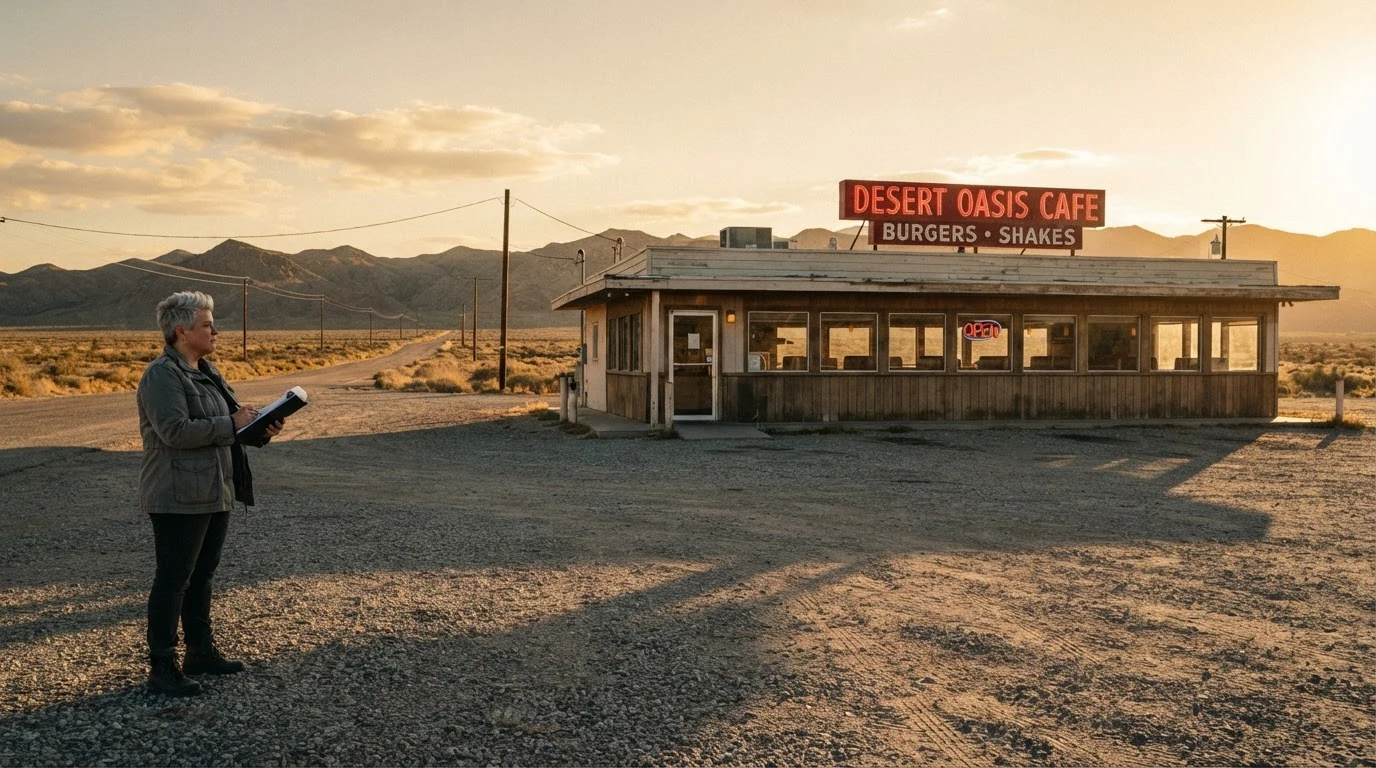
Location scout photograph and documentary photo keep the image plain and informational, not cinematic. Low sun from the right records the light direction a DP needs. The scout gives scale; her silver hair and field jacket keep her consistent in the video.
Open FlashBoardsA location scouting photo sheet for one small corner laundromat at night: six photographs in a three-by-two grid on white. Photo 1: exterior from across a wet street, glowing storefront. Photo 2: interior wide from the entrance, rows of washers. Photo 3: the opposite wall with dryers and a bench. Photo 4: the ceiling with fluorescent tubes. Photo 5: the back door to an alley. Photo 6: the view out the front window. Same yellow walls and green floor tiles in every photo, flat available light.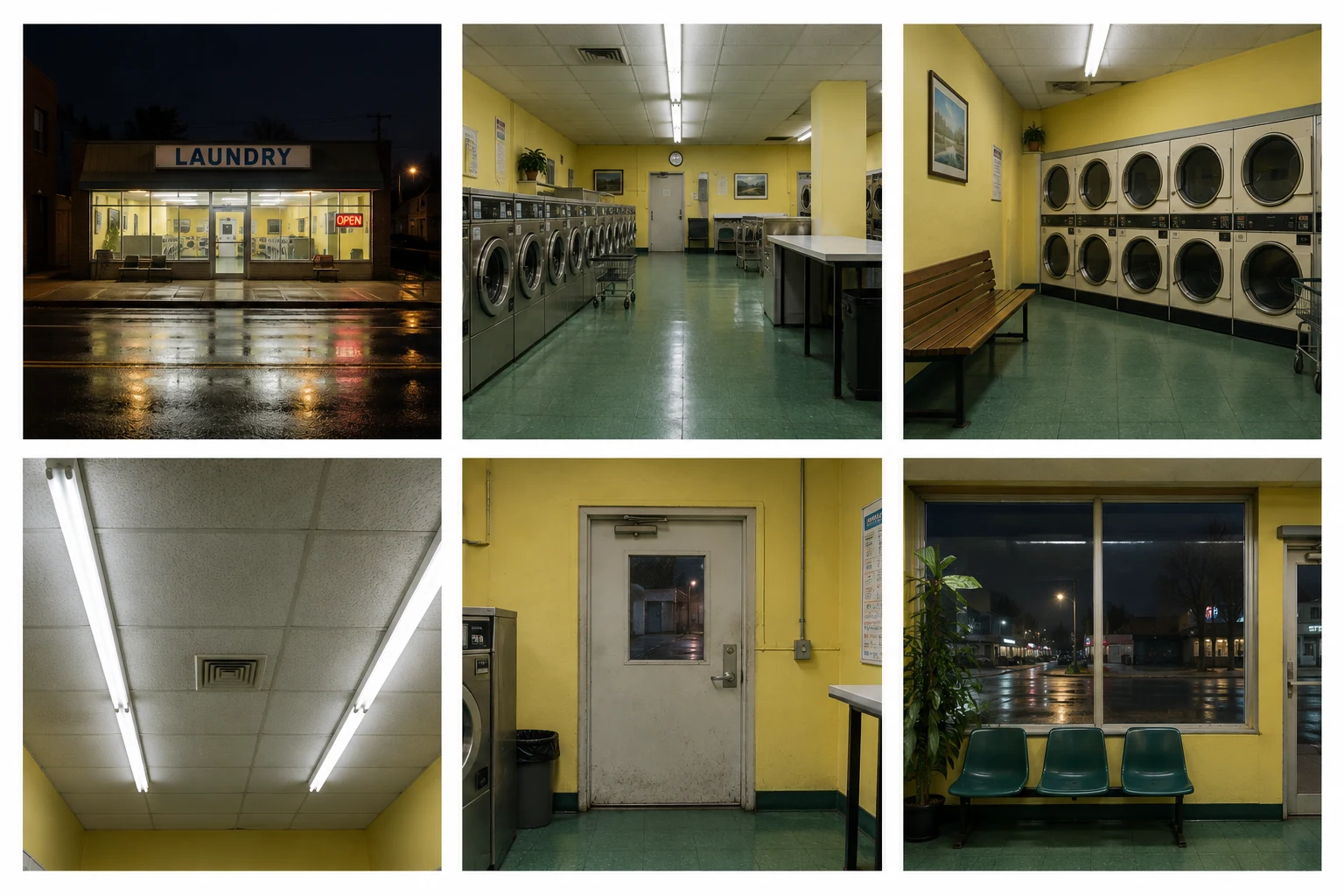
The grid copies a real scout package: exterior, every wall, the ceiling for lighting, exits and the view out. Repeating yellow walls and green floor tiles ties six images to one place.
Open FlashBoardsCamera: a slow handheld walk forward across the gravel lot toward the diner at eye level, relaxed walking pace, slight sway. Action: the silver-haired scout is already walking toward the diner. Halfway across the lot she stops, lifts the clipboard and looks along the row of windows. The red neon sign on the roof flickers on and the long shadows stretch across the gravel.Already walking makes the clip alive from the first frame. The handheld walk mimics how a scout approaches a place, and everything named already exists in recipe 1, so the model doesn't invent new buildings.
Open FlashBoardsCommon mistakes
- It looks like a film still. Models add grading and drama; ask for a location scout photograph in documentary style.
- The sun has no direction. State where the light comes from and the time of day.
- Grid photos show different buildings. Repeat two or three fixed details in every photo.
- An AI frame is not a location. Permits, sound and power still need a real visit.
Keep the reference frames, prompts and every generated take side by side — images and video in one canvas.
FAQ
4 questionsWhat is location scouting?
Location scouting is finding and vetting real places for each scene in a script. Scouts search databases and streets, photograph options and present them to the director, cinematographer and production designer. Once a place is chosen, a tech scout brings department heads to plan light, power, sound and access.
What does a location manager do?
A location manager secures and runs filming locations: negotiating fees and contracts with owners, obtaining permits, arranging traffic control, notifying neighbors and planning parking and base camp. On shoot days they manage the location, then restore the property and settle any damage claims after wrap.
What is a recce in filmmaking?
Recce, short for reconnaissance, is the British term for a location scout, especially the visit where the director and key crew see a shortlisted place in person. A technical recce follows once the location is locked, so each department can plan lighting, rigging, sound and logistics.
Do you need a permit to film on location?
Usually. Private property needs the owner's written agreement, and most cities require a film permit for streets and parks, often with proof of insurance. Rules vary by city and crew size; some waive permits for tiny crews without tripods. Check with the local film office before scheduling.
Related terms
4- SoundstageFilmmaking Process & Crew
A soundstage is a large soundproofed building with a high grid for lights where sets are built and filmed under full control of light, sound and weather.
- SettingStorytelling
Setting is where and when a story takes place — period, location, social world — and in film it's made concrete by locations, production design and light.
- Location SoundSound & Music
Location sound is everything recorded on set during the shoot — dialogue, ambience, room tone, wild lines — by the production sound mixer and boom operator, in sync with picture.
- Pre-ProductionFilmmaking Process & Crew
Pre-production is the planning phase between greenlight and the first shoot day: casting, crewing, location scouting, design, storyboards and shot lists, breakdown, schedule and budget are locked here.
Further reading
Blain Brown, Cinematography: Theory and Practice (Routledge). Eve Light Honthaner, The Complete Film Production Handbook (Routledge).