 FlashBoards Learn
- Learn
- Filmmaking Process & Crew
- Pre-Production
Filmmaking Process & Crew · Film language
Pre-Production
Also called: preproduction, prep, pre-production phase
Pre-production is the planning phase between the greenlight and the first shoot day. Casting, crewing, locations, design, storyboards, shot lists, the script breakdown, the schedule and the budget all get locked here, so the shoot becomes execution instead of improvisation. Most on-set problems trace back to a decision nobody made in prep.
- What it does
- Turns a locked script into a shootable plan: people, places, pictures, days and money.
- Use it when
- From the moment money and a start date are real until the first call time on day one.
- Watch out
- Every question left open in prep gets answered on set, at the most expensive rate per minute of the whole production.
- Try this prompt
Untextured gray 3D previs frame of a narrow night alley, one orange figure on a bicycle riding toward a low camera, 24mm lens
What is pre-production?
Pre-production is the second of the five stages of film production: development, pre-production, production, post-production and distribution. Development ends when a project is financed and greenlit; pre-production starts there and ends when the camera rolls on the first day of principal photography.
In practice it is the phase where a script stops being literature and becomes logistics. Every scene is broken down into the things it needs, every thing gets a price and a date, and every picture the director imagines gets drawn, described or tested before a crew of forty people stands around waiting for it. Producers often say prep is where films are actually made; the shoot only proves whether the plan was good.
Three deliverables define a finished prep: a schedule that says what gets shot on which day, a budget that the schedule fits into, and a visual plan (lookbook, storyboards, shot lists) that tells each department what the camera will see. If any of the three is missing on day one, the production is still in prep, just paying shoot-day rates for it.
What happens in pre-production? The checklist
Order varies by project, but the dependencies don't: you can't schedule before you break down the script, and you can't lock locations before you know the schedule. A working pre-production checklist looks like this:
- Lock the shooting script. Number the scenes. Later revisions go out on colored pages so nobody works from an old draft.
- Script breakdown. The first AD or production manager runs a script breakdown, tagging cast, extras, props, wardrobe, vehicles, stunts, effects and locations for every scene.
- Schedule and budget. The breakdown feeds a shooting schedule, ordered by location and cast availability rather than story order, and a production budget built on that schedule. The two are revised together until they agree.
- Hire key crew. Director of photography, production designer, first AD, costume designer, editor. Department heads then hire their own teams.
- Casting. Auditions, callbacks, chemistry reads, offers and deals. Casting often runs in parallel with everything else and quietly drives the schedule, because actor availability dictates which days are possible.
- Locations. Scouting, photographing, negotiating, permits. The location manager narrows options; the director, DP and designer choose on a recce; the whole team walks the chosen filming locations again on the tech scout.
- Design. Sets, costumes, hair and makeup, props and graphics get designed and approved against a mood board and then a lookbook.
- Visual planning. Storyboards for anything complex, shot lists for every scene, previs for stunts and effects, camera and lens tests.
- Rehearsals and table read. The full cast reads the script aloud; key scenes get blocked in rehearsal space or on location.
- Legal and logistics. Insurance, contracts, clearances, travel, catering, equipment orders, unit base and parking.
- Final production meeting. Every department head walks through the schedule day by day. Then the first call sheet goes out.
Who runs pre-production?
Prep has two tracks that must meet: the logistical track and the creative track.
Logistics belong to the producer's side. The line producer owns the budget and hires; the production manager runs the office, deals and vendors; the first assistant director owns the breakdown and the schedule and will later run the set by it. The location manager, casting director and production coordinator report into this track.
The creative track belongs to the director and the department heads. The director works through the script with the cinematographer on coverage and shot design, with the production designer on the world, and with the costume designer on the characters. Their answers become the storyboards, shot lists, set drawings and costume plots.
The tracks collide in the scheduling meeting. A director who wants a shot at sunset on a location only available in the morning finds out in prep, where it costs a conversation, instead of on the day, where it costs the scene. The first AD's job is largely to force these collisions early.
Visual pre-production: from mood board to previs
For the director and DP, prep is where the film's look is decided, not discovered. The usual chain runs from loose to exact:
- Mood board: tone, color, texture, references from films and photographs. Nothing is binding yet.
- Lookbook: the approved look, organized by character, location and act. Departments design from it.
- Storyboards and shot lists: the scene cut into setups. Boards show framing and movement; the shot list adds lens, camera support, coverage and order of shooting.
- Previs: rough 3D or animated versions of complex sequences, so stunts, effects and camera moves can be timed and costed before anyone builds a rig.
On the camera side, prep also means lens and filter tests, makeup and wardrobe tests on camera, a lighting plan per location, sun-path checks for every exterior, and a gear list the rental house can actually fill. A good tech scout ends with the gaffer and key grip knowing where the generator parks and which windows need gelling.
Hitchcock is the classic example of how far this can go: he was known for planning his films shot by shot on paper before the shoot began. Few productions need that degree of control, but every production benefits from knowing which scenes need it.
This is where FlashBoards fits: one infinite board per project, where the mood board, lookbook frames, AI-generated storyboard panels, previs clips and the director's notes sit side by side, so the DP, designer and first AD work from the same picture of the film rather than from five different folders.
How long does pre-production take?
Length scales with the number of decisions, not the number of pages. Typical ranges:
| Project | Typical prep | What dominates it | |---|---|---| | Short film, 1–3 shoot days | 2–6 weeks | Locations, casting, favors | | Music video or commercial | 1–3 weeks | Treatment approval, one or two big set pieces | | Indie feature, 18–25 days | 6–10 weeks | Casting, locations, the schedule | | Studio feature with VFX | 3–6 months or more | Set builds, previs, effects planning |
A rough rule for independent features: plan at least as many weeks of prep as the shoot has weeks, and more if you are building sets or shooting stunts. Micro-budget films are the exception that proves the rule: they have no money to fix problems on set, so they need proportionally more prep, not less.
Prep gets cut first when a schedule slips, because the start date is tied to actor availability and financing. The cost shows up later: overtime, extra days, reshoots and scenes that look improvised because they were.
Pre-production vs. post-production
Both phases happen away from the set, and both are about control, but they work on opposite material. Pre-production plans what the camera will capture; post-production shapes what the camera actually captured.
| | Pre-production | Production | Post-production | |---|---|---|---| | Works with | The script and ideas | Actors, sets, light | Footage and sound | | Key outputs | Schedule, budget, boards, shot lists | Dailies, sound files, continuity notes | Edit, VFX, grade, mix, deliverables | | Cost of a change | Low: a conversation or a redraw | Highest: the whole crew waits | Medium, and limited to what was shot |
The phases leak into each other. Editors and VFX supervisors are often hired in prep to check that the plan will cut and composite, and post schedules are drafted before the shoot. The old line "we'll fix it in post" is really an admission that something wasn't fixed in prep.
Common pre-production mistakes
- Scheduling before breaking down. A schedule without a breakdown is a guess; missed stunt rehearsals and forgotten picture vehicles show up on the day.
- Boarding everything or nothing. Board action, effects and anything with a hard cut point. For dialogue scenes a shot list and a blocking plan are usually enough, and the actors need room.
- Scouting at the wrong hour. A location seen at noon can be unusable at 4 p.m. when the sun drops behind the building opposite. Scout at the time you'll shoot.
- Locking the look without camera tests. Wardrobe that reads on a mood board can moiré, clip or vanish on the sensor.
- Treating prep as paperwork. The documents matter less than the decisions they record. If the director hasn't committed, a beautiful shot list only hides the gap.
- No buffer. Build weather cover sets and a contingency line into the budget. Prep is also where you decide what gets cut if day 12 goes wrong.
How to create a pre-production with AI
3 promptsAI doesn't replace a first AD, but it compresses the slowest parts of visual prep: getting a picture into everyone's head before money is spent. Start with a gray previs frame in Nano Banana 2 Lite to test staging and lens, draw the same beat as a storyboard page in GPT Image 2.5, then have MiniMax H3 Max Turbo move the previs frame to check timing. Keep all three next to the shot list on one FlashBoards board.
Previsualization frame, untextured 3D blockout with flat matte gray clay shading and simple low-detail geometry. A narrow city alley at night between two tall brick-shaped gray blocks, wet ground rendered as a plain reflective gray plane, a stack of three gray crates on the left side at mid-distance, a single doorway with a warm rectangle of light on the right. One figure in solid orange, a cyclist on a simple bicycle, rides down the center of the alley toward the camera, about twenty meters away. Low camera at hip height, 24mm wide lens, symmetrical one-point perspective with the vanishing point just above the cyclist's head. Soft ambient light, no textures, clean previs look, a small white label in the top-left corner reading SC 12 SH 3.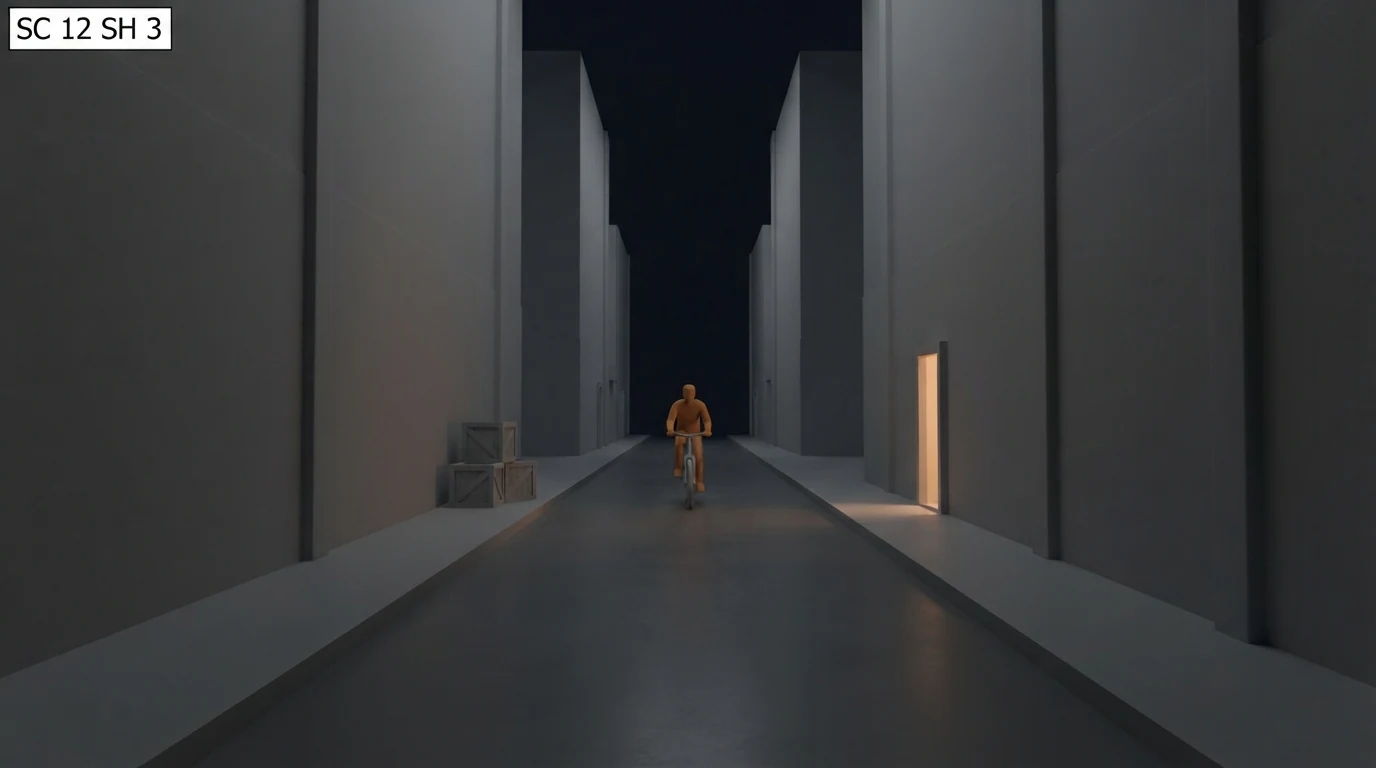
Untextured 3D blockout and flat matte gray clay shading keep the image from turning into a finished photograph: previs has to read as a plan, not a promise. The solid orange hero figure is the standard trick for finding the subject in a gray frame. Low camera at hip height and 24mm wide lens are the actual camera decisions being tested, and the crates and lit doorway are named because they are the blocking marks the video will use.
Open FlashBoardsA storyboard page for one film scene, six panels in a two-row grid on off-white paper, loose graphite pencil with gray marker shading, consistent style across all panels. Each panel has a thin black border, a small number from 1 to 6 below it, and simple red arrows showing camera or subject movement. The character in every panel is the same courier: a young woman with a shaved head, a long green scarf and a boxy yellow delivery backpack, riding a bicycle. Panel 1: wide shot of a narrow night alley, she rides toward camera, crates on the left. Panel 2: low angle close-up of the front wheel hitting a puddle. Panel 3: medium shot, she swerves around the crates. Panel 4: over-the-shoulder from behind her toward a lit doorway ahead. Panel 5: close-up of her face, eyes wide. Panel 6: wide shot, the rear wheel skids sideways as she brakes by the doorway.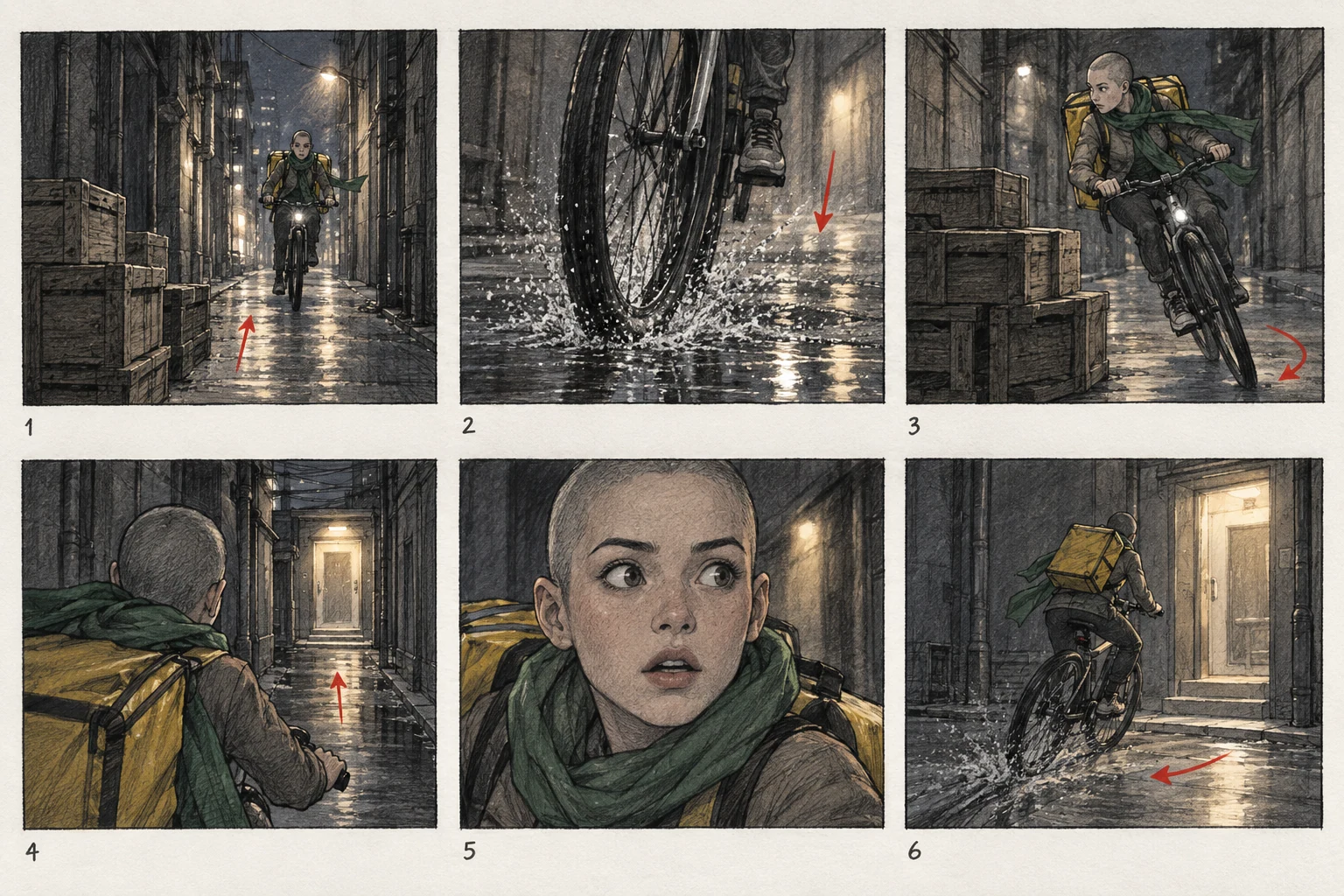
Six panels in a two-row grid and a small number below each panel give a page you can pin next to the shot list and talk through with the crew. The courier's identity anchors (shaved head, green scarf, yellow delivery backpack) are what keep her the same across all panels. Naming the shot size in every panel (wide, low angle close-up, over-the-shoulder) forces real coverage instead of six versions of one angle.
Open FlashBoardsCamera: a steady dolly move backward at hip height at the speed of a fast walk, keeping the orange cyclist centered, the gray alley walls sliding past on both sides. Action: the orange cyclist is already pedaling hard toward the camera and gaining on it. She swerves right around the stack of gray crates on the left, then straightens out. Near the lit doorway on the right she brakes hard and the rear wheel skids sideways, stopping her side-on to the camera. The clean gray previs look stays the same throughout.Already pedaling hard makes the shot alive from the first frame instead of a slow push on a still. The move is stated with a direction, a height and a speed (backward at hip height at the speed of a fast walk), which is exactly what a previs clip is for: checking whether a dolly can stay ahead of a bicycle. Every beat uses only objects already in recipe 1, the crates and the lit doorway, so the model doesn't invent new set pieces.
Open FlashBoardsCommon mistakes
- Previs turns photoreal. Image models drift toward finished renders. Repeat untextured, flat gray clay shading and simple geometry, and give the hero a single solid color.
- Storyboard characters drift between panels. Put the same three identity anchors in the prompt for every page, and ask for consistent style across all panels.
- Labels and panel numbers come out garbled. Keep burned-in text to a few characters, or leave it out and write scene and shot numbers as notes next to the frame on the board.
- The camera move is vague. Without direction, height and speed, video models default to a slow push-in. State the move as you would on a shot list.
- Mistaking a clip for a schedule. An AI previs clip tests staging and rough timing; it says nothing about how long the setup takes to light and rig. Take that question to the first AD and the DP.
Keep the reference frames, prompts and every generated take side by side — images and video in one canvas.
FAQ
6 questionsWhat is pre-production in film?
Pre-production is the planning stage of a film that runs from the greenlight to the first day of shooting. In it the team locks the script, breaks it down, builds the schedule and budget, hires crew, casts actors, finds locations, designs sets and costumes, and plans every shot with storyboards and shot lists. The goal is to walk onto set with every major decision already made.
What should a pre-production checklist include?
A solid pre-production checklist covers: a locked, numbered shooting script; a script breakdown; a shooting schedule and a matching budget; key crew hired; cast signed; locations scouted, secured and permitted; approved designs for sets, costumes and makeup; storyboards and shot lists; camera and wardrobe tests; rehearsals and a table read; insurance and contracts; a final production meeting; and the first call sheet.
How long does pre-production take?
It depends on scale. A short film shooting for one to three days typically needs two to six weeks of prep. An independent feature usually preps for six to ten weeks, roughly as long as the shoot or longer. Studio features with set builds and visual effects can prep for several months. Cutting prep rarely saves money; it moves the cost onto the set.
What are the five stages of film production?
Development, pre-production, production, post-production and distribution. Development shapes the idea, script and financing. Pre-production plans the shoot. Production is the shoot itself, principal photography. Post-production turns the footage into a finished film through editing, sound, VFX and color. Distribution gets it to audiences in cinemas, on streaming or at festivals. Pre-production is the bridge from paper to set.
Is storyboarding part of pre-production?
Yes. Storyboards are one of the core visual documents of pre-production, alongside the shot list, lookbook and previs. The director and cinematographer usually board action, stunts, effects and any sequence with precise timing, while simpler dialogue scenes may only get a shot list. Today many filmmakers generate first-pass storyboard panels with AI image models and refine them with the storyboard artist.
What is the difference between pre-production and production?
Pre-production is planning; production is shooting. In prep, changes cost a phone call, a redraw or a revised schedule. In production, the full cast and crew are on the clock, so every change costs time at the highest rate of the whole project. Pre-production ends and production begins on the first day of principal photography.
Related terms
8- Post-ProductionPost-Production & VFX
Post-production is everything after the shoot that turns footage into a finished film: editing, sound design and mix, music, VFX, color grading, titles and delivery masters.
- StoryboardFilmmaking Process & Crew
A storyboard is a sequence of drawn or generated panels, one per planned shot, showing framing, action and camera movement with notes — a visual draft of the film before anything is shot.
- Shot ListFilmmaking Process & Crew
A shot list is a scene-by-scene table of every planned setup — shot size, angle, movement, lens, action and notes — that tells the crew exactly what to capture and in what order on the day.
- Script BreakdownFilmmaking Process & Crew
A script breakdown goes through the screenplay scene by scene and tags every production element — cast, extras, props, wardrobe, vehicles, effects, locations — so it can be budgeted and scheduled.
- Shooting ScheduleFilmmaking Process & Crew
A shooting schedule orders all scenes into shooting days — grouped by location, cast availability and day/night — rather than by story order, and is the backbone for call sheets and budget.
- Mood BoardFilmmaking Process & Crew
A mood board is a loose collage of images, colors, textures and frames that captures the emotional tone of a project before its look is locked — a starting point for a lookbook, storyboard or AI generation.
- Principal PhotographyFilmmaking Process & Crew
Principal photography is the main shooting period of a film with the principal cast, from the first to the last scheduled shoot day; second-unit work, pickups and reshoots fall outside it.
- Film ProductionFilmmaking Process & Crew
Film production is the whole process of making a film — development, pre-production, production (the shoot), post-production and distribution; in the narrow sense, 'production' is just the shooting phase.
Further reading
Eve Light Honthaner, The Complete Film Production Handbook. Maureen A. Ryan, Producer to Producer: A Step-by-Step Guide to Low-Budget Independent Film Producing. Steven D. Katz, Film Directing Shot by Shot (1991).