 FlashBoards Learn
- Learn
- Filmmaking Process & Crew
- Virtual Production
Filmmaking Process & Crew · Film language
Virtual Production
Also called: LED volume, StageCraft, in-camera VFX, ICVFX
Virtual production is filmmaking where live action and real-time computer graphics meet on set. Most often it means an LED volume: a wall of screens showing a game-engine environment that shifts with the tracked camera, so the background, its light and its parallax are captured in camera instead of added in post.
- What it does
- Puts a digital environment on set, live, so actors, light and camera react to it and the shot is close to final when you call cut.
- Use it when
- Scenes in places you can't reach or hold (magic hour all day, space, moving vehicles, reflective costumes) and the world can be designed before the shoot.
- Watch out
- Every creative decision about the environment moves into pre-production; a wall that isn't finished on shoot day is expensive green screen.
- Try this prompt
Behind-the-scenes wide of an LED volume stage, curved wall showing a red desert canyon at dusk, actor on a sand floor set piece, camera on a dolly
What is virtual production?
Virtual production is an umbrella term for any workflow where computer-generated imagery is created, viewed or photographed during the shoot rather than after it. The version most people mean today is in-camera visual effects (ICVFX) on an LED volume, the setup popularized by The Mandalorian (2019) and Industrial Light & Magic's StageCraft stage.
An LED volume has four working parts:
- The wall. Hundreds of LED panels bolted into a curved wall, often with a ceiling of panels above, built inside a soundstage. The screens display the environment and also act as the main light source for the scene.
- The real-time engine. A game engine such as Unreal Engine renders the 3D environment at the frame rate of the camera. Environments can be full 3D worlds, photographed 2.5D plates, or a mix of both.
- Camera tracking. Markers or sensors report the camera's position, rotation and lens data many times per second. The engine redraws the part of the wall the lens sees, called the inner frustum, from the camera's exact point of view, so the background shifts with correct parallax as the camera moves.
- The brain bar. A team of engine operators, technicians and VFX artists at workstations beside the stage who move the sun, swap sets, relight the sky or nudge a mountain between takes.
Outside the frustum, the rest of the wall keeps showing the environment at lower detail. It is never seen sharply by the lens, but it lights the actors and throws reflections into eyes, visors, car paint and puddles, which is the part green screen could never give you.
Virtual production also covers workflows with no LED wall at all: previsualization in a game engine, virtual location scouting in VR, virtual cameras for animated and motion-capture films, and live composites on green screen. Together they shift a large share of the work traditionally done in post-production forward into pre-production, and it is now one of the core stages of the filmmaking process on large productions.
The main types of virtual production
Productions mix and match these, but it helps to name them separately because each changes different jobs on the crew.
LED volume (ICVFX)
The final background is photographed on the wall. What the camera records is, ideally, the finished shot, with only cleanup and seam work left for VFX. The Mandalorian is the reference example: large parts of its first season were shot in a volume, with DPs Greig Fraser and Baz Idoine lighting mostly with the wall itself.
Live compositing and simulcam
The actors stand in front of a green or blue screen, but the tracked camera feeds a real-time composite to the monitors, so the director and operator frame against the actual environment instead of a flat color. The key is still pulled in post; the benefit is that framing and eyelines are decided on set.
Virtual cameras and performance capture
For films built almost entirely in the computer, a director or cinematographer handles a tracked device that works like a camera inside the digital set. James Cameron's Avatar (2009) is the landmark here, and Jon Favreau's The Lion King (2019) staged and "photographed" its animated world with virtual cameras and VR scouting.
Previs, techvis and virtual scouting
The cheapest and most common kind. The team walks the digital set in VR, tries lenses, checks where the sun falls at 6 p.m., and exports camera positions and crane heights for the real shoot. It sits right next to the storyboard and the shot list in the planning process.
Why do filmmakers use LED volumes?
The idea is old: put the background behind the actors and photograph it with them. Studios did it with rear projection for decades of car interiors, and 2001: A Space Odyssey (1968) used large-scale front projection for its Dawn of Man landscapes. Oblivion (2013) projected sky footage on huge screens around its glass-walled Sky Tower set, so the actors and the reflective set were lit by the actual clouds. Gravity (2013) placed actors inside a box of LED panels that played the lighting of Earth and space around them, and First Man (2018) used a large LED screen outside the cockpit windows. LED volumes combine all of this with a camera-tracked, fully 3D background.
What it gives the filmmaker:
- Interactive light and reflections for free. A chrome helmet, a windshield or wet skin reflects the real environment, not a green spill that must be painted out. The glow of a sunset wraps around faces in the same color it has in the background.
- Actors see the world. Performers react to a horizon, a creature or a burning city instead of tape marks. Eyelines are right because there is something to look at.
- Control of time and weather. Golden hour lasts twelve hours. The same dusk can be repeated for every take, every coverage angle and every reshoot.
- Fewer company moves. A desert, a starship bridge and a snowy pass can be shot on the same stage in one week, which changes the math of a shooting schedule and travel budget.
- Decisions on the day. The director sees a near-final image on the monitor and edits can start from footage that looks like the film.
The cost is flexibility later. Whatever is on the wall is baked into the plate; changing the sky after the shoot is harder than on green screen. That is why productions that use volumes well tend to plan harder, not less.
How to shoot on an LED volume
The practical rules come from the physics of the screens and the lens.
Keep the wall out of focus. LED panels are a grid of tiny light points. Shot sharp, they produce moiré, a shimmering interference pattern with the camera sensor. Use a large-format sensor, a longer lens or a wider aperture so the wall sits in soft depth of field, and keep actors several meters in front of the screens. Finer pixel pitch (the distance between LEDs, around 2–3 mm on many feature stages) lets you get closer.
Build a real foreground. The seam where the wall meets the floor is the weak spot. Art departments dress the stage floor with sand, rocks, grass or deck plating that continues the digital set, and add physical props at mid-ground so the eye reads one continuous space. Well-made practical effects like smoke, dust and rain sell the blend.
Light with the wall, then add. The screens give soft, colored ambient light and top light from the ceiling. But LEDs built for display emit narrow red, green and blue spectra, which can render skin oddly. The gaffer usually adds full-spectrum fixtures for the key, hard sources for sun, and flags to stop the wall from flattening contrast. Match color temperature between the wall and the lamps before the actors arrive.
Respect the tracking. The inner frustum lags the camera by a few frames. Fast whip pans and quick handheld moves can reveal it. Moderate dolly, crane and slider moves show off parallax best. Lens data (focal length, focus, iris) must reach the engine so the virtual background defocuses and scales correctly.
Sync everything. Camera shutter, LED refresh and engine render all lock to the same timing signal (genlock). Without it you get banding or flicker, especially at high shutter angles or high frame rates.
Finish the world before shoot day. Environments must be built, lit and approved in advance, often in review sessions with the DP and production designer on the actual stage. Budget time for a pre-light day on the volume, just as you would on a cyclorama.
Virtual production vs. green screen
Both are forms of background replacement, but they sit at opposite ends of the schedule.
| | LED volume | Green screen | |---|---|---| | When the background is made | Before the shoot | After the shoot | | Light on actors | From the environment itself | From studio lamps, plus green spill to remove | | Reflections | Real, captured in camera | Must be faked or avoided | | What actors see | The world | A colored wall and tape marks | | Changing the background later | Hard, it's in the plate | Easy, it's a key | | Best for | Controlled dialogue scenes, vehicles, reflective surfaces, long magic hours | Big action, heavy destruction, wide shots with many digital extensions |
Many productions use both. A volume can show a green patch only inside the camera's frustum while the rest of the wall keeps lighting the set, giving a clean key with correct ambient light. And wide establishing shots are often completed in post even on shows built around a volume.
Planning a volume shoot with boards and AI
Because virtual production moves design decisions to the front, its paperwork is visual: a mood board for the look of each environment, a lookbook for the sky, color and time of day, storyboards that mark which shots use the wall, and previs frames for the brain bar and art department.
In FlashBoards you can keep all of it on one infinite board per sequence: reference frames from films shot on volumes, generated environment concepts for the wall, storyboard panels, and notes on lenses and pixel-pitch distance next to each setup. Generating a few AI versions of the same environment at different times of day lets the director and DP pick the light before anyone commissions the full 3D build, and the chosen frames go straight to the virtual art department as a brief. See the recipes below for a starting point, then compare the takes side by side on the board.
How to create a virtual production with AI
3 promptsYou can't generate a real LED volume, but you can generate the two things a volume shoot needs early: pictures of the setup for pitching and planning, and near-final frames that show how the in-camera shot should look. Put every take on one FlashBoards board next to your references and storyboard.
Behind-the-scenes wide shot of a virtual production LED volume stage. A tall curved wall of LED screens shows a red desert canyon at dusk with an orange sky; a ceiling of LED panels glows above. In the middle of the stage, a woman in her 40s with a shaved head and a long dusty green coat stands on a sand-covered floor set piece with real rocks. A cinema camera on a dolly with small tracking markers faces her, two crew members in black by the camera. The canyon image is sharp on the wall and its warm light falls on the sand and the actor. 24mm lens, eye-level, realistic production still.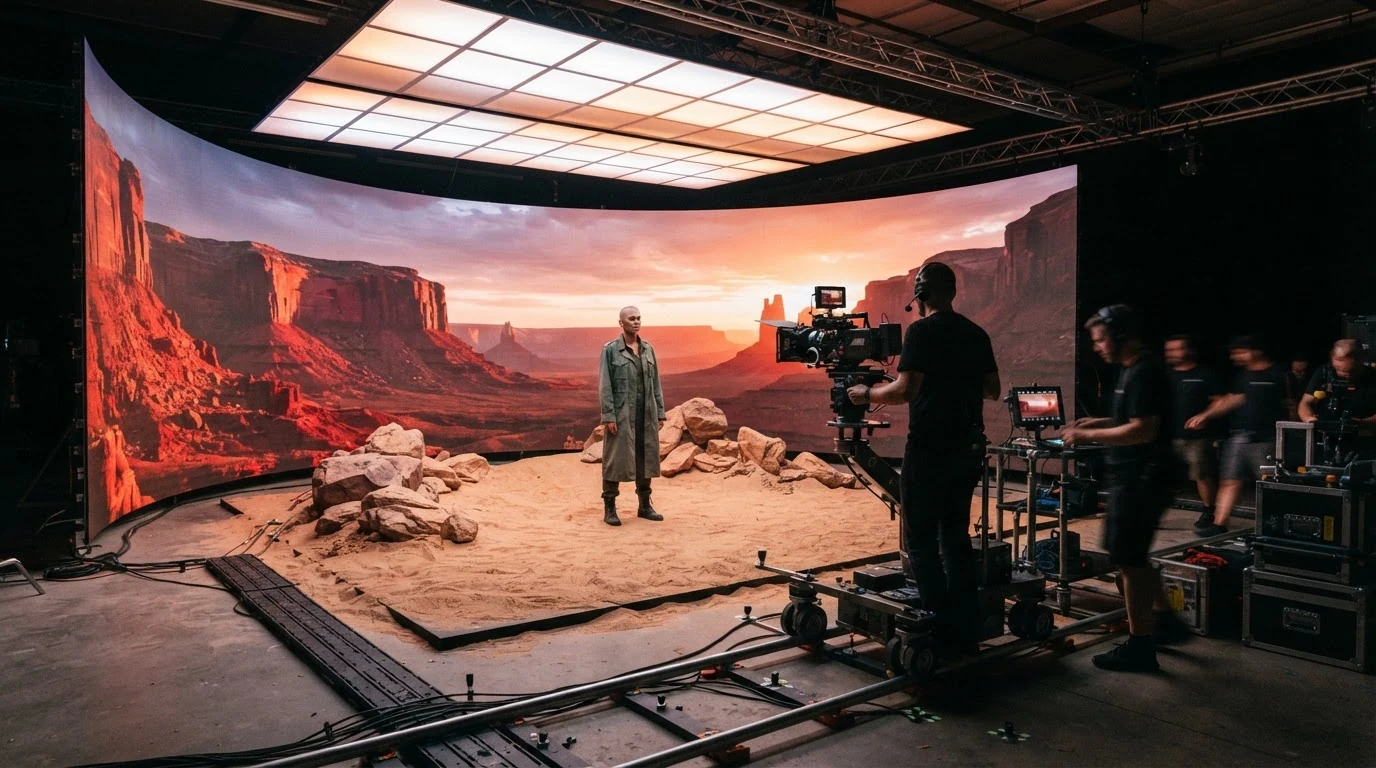
"Behind-the-scenes wide" and "LED volume stage" make the model show the machinery, not just a desert. Naming the ceiling panels, the sand floor set piece and the tracking markers gives you the three elements that read as virtual production. "Its warm light falls on the sand and the actor" states the key selling point, light from the wall.
Open FlashBoardsCinematic film still, in-camera shot on an LED volume: medium close-up of a man in his 60s with a grey beard and round wire glasses driving a 1960s sedan at night. Through the windshield and side window, a rain-soaked city street with red and blue neon signs slides past, softly out of focus. The neon colors reflect on the wet windshield, the chrome trim and the lenses of his glasses; a moving band of cyan light crosses his face. 50mm lens, shallow depth of field, anamorphic 2.39:1, moody, realistic skin.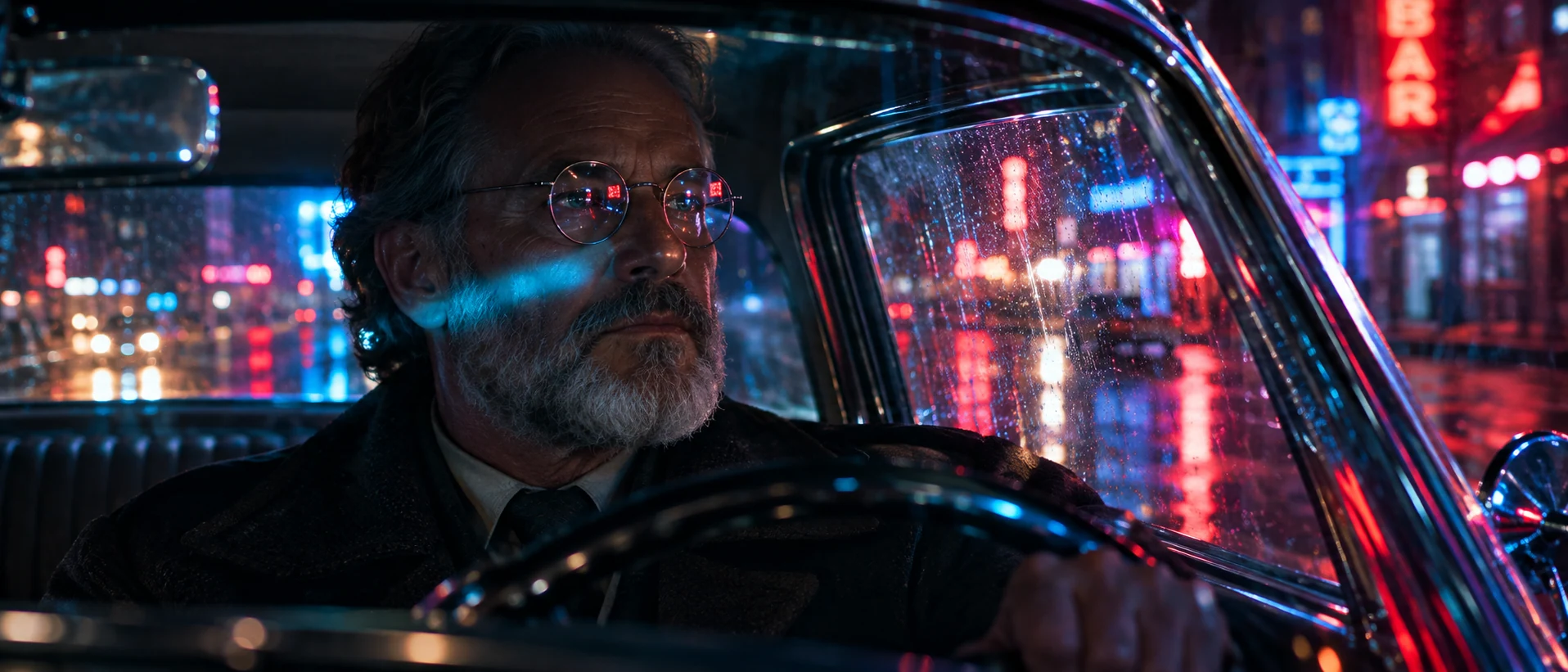
This is the final-frame view: what the volume is for. The reflections on the windshield, chrome and glasses and the "moving band of light" across the face are the details that separate an LED process shot from a green screen composite. "Softly out of focus" matches the real rule of keeping the wall in soft focus.
Open FlashBoardsCamera: the camera slowly tracks sideways to the right from the first frame, a steady dolly move at walking pace, keeping the actor in the center of the frame. Action: the woman in the green coat is already walking slowly across the sand toward the rocks, coat moving with each step. The canyon on the LED wall shifts behind her with parallax as the camera moves, near cliffs sliding faster than the distant sky. The two crew members follow beside the camera dolly. The warm orange light stays on her face and the sand.The camera and the actor both move from the first frame, so the clip starts alive instead of drifting into a push-in. "Near cliffs sliding faster than the distant sky" spells out parallax, the effect camera tracking creates on a real volume. Everything named is already in recipe 1's frame.
Open FlashBoardsCommon mistakes
- Models often draw a flat screen with a picture on it. Say "tall curved wall of LED screens" and "ceiling of LED panels" to get the wraparound volume.
- Without a stated floor set piece, the actor floats on a black stage floor. Name the sand, rocks or deck plating that bridges into the wall.
- In final-frame prompts the background comes out razor sharp and looks pasted in. Ask for soft focus and for reflections of the environment on faces, glass and metal.
- In video, if the camera doesn't move sideways the wall looks like a painted backdrop. Ask for a lateral dolly and describe near and far layers moving at different speeds.
Keep the reference frames, prompts and every generated take side by side — images and video in one canvas.
FAQ
6 questionsWhat is virtual production in film?
Virtual production is a way of making films where real-time computer graphics are part of the shoot. Most often it means filming actors in front of LED walls that display a game-engine environment, updated live to match the tracked camera. The background, its light and reflections are captured in camera, so the shot is close to finished on set instead of built later in post.
What is an LED volume?
An LED volume is a stage enclosed by a curved wall of LED panels, often with an LED ceiling, used for virtual production. The screens show a digital environment and also light the set. Because the camera is tracked, the section of wall in the lens's view is rendered from the camera's perspective, producing correct parallax when the camera moves.
What does ICVFX mean?
ICVFX stands for in-camera visual effects. Instead of compositing a digital background in post-production, the effect is photographed directly: the background is displayed on an LED wall behind the actors and recorded together with them. Post work shrinks to cleanup, seam fixes and occasional extensions, and the director sees a near-final image on the monitor during the take.
Is virtual production better than green screen?
Neither is better in every case. An LED volume wins on interactive light, real reflections and performances, because actors see the world around them. Green screen wins when the background must change after the shoot, for huge action and destruction, and on wide shots with digital set extensions. Many productions use both, sometimes on the same stage.
Was The Mandalorian filmed with virtual production?
Yes. Much of The Mandalorian's first season (2019) was shot on ILM's StageCraft LED volume, with environments rendered in Unreal Engine and driven by camera tracking. It became the best-known example of the technique and pushed many studios to build their own LED stages for film and series work.
What software is used for virtual production?
Real-time game engines, most commonly Unreal Engine, render the environments on the wall. Around them sit camera-tracking systems, media servers that split the image across LED processors, and 3D tools for building assets. On the planning side, teams use storyboards, previs and reference boards to lock the look of each environment before the shoot.
Related terms
6- Background ReplacementPost-Production & VFX
Background replacement keeps the actor or object and swaps what is behind them — via green or blue screen keying, rotoscoping, masks or LED volumes.
- SoundstageFilmmaking Process & Crew
A soundstage is a large soundproofed building with a high grid for lights where sets are built and filmed under full control of light, sound and weather.
- Post-ProductionPost-Production & VFX
Post-production is everything after the shoot that turns footage into a finished film: editing, sound design and mix, music, VFX, color grading, titles and delivery masters.
- Digital CinematographyCameras & Capture
Digital cinematography records motion pictures on an electronic sensor instead of film stock; since the 2010s it has been the industry standard, with cinema cameras such as the ARRI Alexa and RED.
- Practical EffectsPost-Production & VFX
Practical effects are created physically on set — animatronics, prosthetic makeup, miniatures, pyrotechnics, rain and wind machines — and captured by the camera rather than generated with CGI in post.
- Film ProductionFilmmaking Process & Crew
Film production is the whole process of making a film — development, pre-production, production (the shoot), post-production and distribution; in the narrow sense, 'production' is just the shooting phase.
Further reading
Noah Kadner, The Virtual Production Field Guide (Epic Games, 2019) · American Cinematographer, coverage of The Mandalorian (February 2020)