 FlashBoards Learn
- Learn
- Filmmaking Process & Crew
- Stunt Coordinator
Filmmaking Process & Crew · Film language
Stunt Coordinator
Also called: stunt director, stunt supervisor
A stunt coordinator is the crew member who designs and supervises every stunt and fight in a film: the choreography, the rigging, the pads and the doubles. They are also responsible for the safety of performers and crew during that action, and they can stop a take when it stops being safe.
- What it does
- Turns the script's action into rehearsed, rigged, camera-ready stunts that nobody gets hurt doing.
- Use it when
- Any scene with a fall, fight, hit, car work, fire, water or height, even a simple shove onto a table.
- Watch out
- Hiring the coordinator after the shots are locked; the stunt should shape the coverage, not squeeze into it.
- Try this prompt
Stunt rehearsal in a gym, two fictional stunt performers mid-punch over blue crash mats, coordinator filming on a phone
What is a stunt coordinator?
The stunt coordinator is the head of the stunt department on a film crew. They answer to the director for what the action looks like and to the production for how safely it gets done. Other titles for the job are stunt director and stunt supervisor.
The coordinator rarely performs the big gag themselves. They design it, cast the stunt performers who will do it, and stand next to the camera while it happens. On an action film they often run the second unit too, shooting car work and doubles while the main unit shoots dialogue.
What does a stunt coordinator do?
Breakdown and budget. The coordinator reads the script for every physical beat: who falls, who gets hit, who drives fast, who is near fire or water. Each beat gets a method, performers, rigging, rehearsal days and a cost. "She is thrown through the window" can mean candy glass, a ratchet pull, a pad on the far side and two days of rehearsal.
Casting doubles. Doubles are matched to the actors by height, build and movement, so a wig and wardrobe carry the cut. The coordinator also decides which parts the actor can safely do.
Design and rehearsal. A fight scene is choreographed move by move and rehearsed until it repeats at full speed with the misses landing in the same place. A car chase is mapped as routes, speeds and marks. Many teams film rehearsals on a phone and cut them into rough edits, called stuntvis, so the director sees the sequence before anyone builds a set.
Rigging and safety. Wires, descenders, ratchets, air rams, crash pads and airbags are specified by the coordinator and built with the riggers and the special effects team, who share the explosions, breakaways and fire of practical effects. Before each stunt the coordinator leads a safety meeting: what will happen, where everyone stands, what the abort signal is.
How is a stunt built for the camera?
A stunt only exists from the angle it is shot. The coordinator and the cinematographer choose that angle together, because the camera hides most of the safety work.
- Punches are thrown past the lens axis, so the fist misses by a hand's width but appears to connect. Move the camera 30 degrees off that line and the miss shows.
- Long lenses (85mm and up) compress distance, so a car passing two meters away reads as a near-miss. Wide lenses close to the action give speed but expose pads and wires.
- High falls are cut before the landing, or the landing is shot separately onto a pad out of frame.
- Crash cams in protective boxes sit where no operator can, and several cameras roll at once because a car flip gets one take.
Using FlashBoards in prep. Put the stuntvis cut, storyboard panels, rig diagrams and a generated start frame for each stunt beat on one FlashBoards board, so the director, DP and coordinator agree on the angle before the pads go down.
Stunt coordinator vs. stunt performer
A stunt performer executes the action: the fall, the hit, the burn, the drive. A stunt coordinator designs it, hires and directs the performers, and carries the responsibility if something goes wrong. Most coordinators were performers for years first, but on a professional set the coordinator's job during the take is to watch, not to jump.
A fight coordinator is a narrower role: they design hand-to-hand combat, usually under the stunt coordinator, who still owns the safety of the scene.
How do you become a stunt coordinator?
The usual path is years as a stunt performer, often starting from martial arts, gymnastics, riding or motorsport, then doubling for leading actors, then assisting a coordinator on bigger shows. Coordinators build their reputation on a safety record as much as on spectacular footage.
Some go on to direct. Chad Stahelski worked as a stuntman and coordinator before directing John Wick (2014); David Leitch followed a similar path to Atomic Blonde (2017). More crew roles are in the filmmaking process hub.
How to create a stunt coordinator with AI
3 promptsBefore the shoot, a stunt team proves a beat with stuntvis. AI frames do that job even earlier, before a gym is booked, so the director and DP can argue about angles. Keep every take on one FlashBoards board next to the storyboard and compare them side by side.
Stunt rehearsal in a large empty gym, medium-wide shot at chest height, 35mm lens. Two fictional stunt performers in gray training clothes over blue crash mats: a tall man with a shaved head and a short black beard throws a right hook that sweeps past a hand's width in front of the jaw of a wiry woman with a blond braid and a scar on her chin, who snaps her head away from the fist, a clear gap of air between fist and face. Behind them a fictional stunt coordinator, a heavyset man in his fifties with a white goatee and a red cap, films them on a phone held sideways. Overhead fluorescent light, bare walls.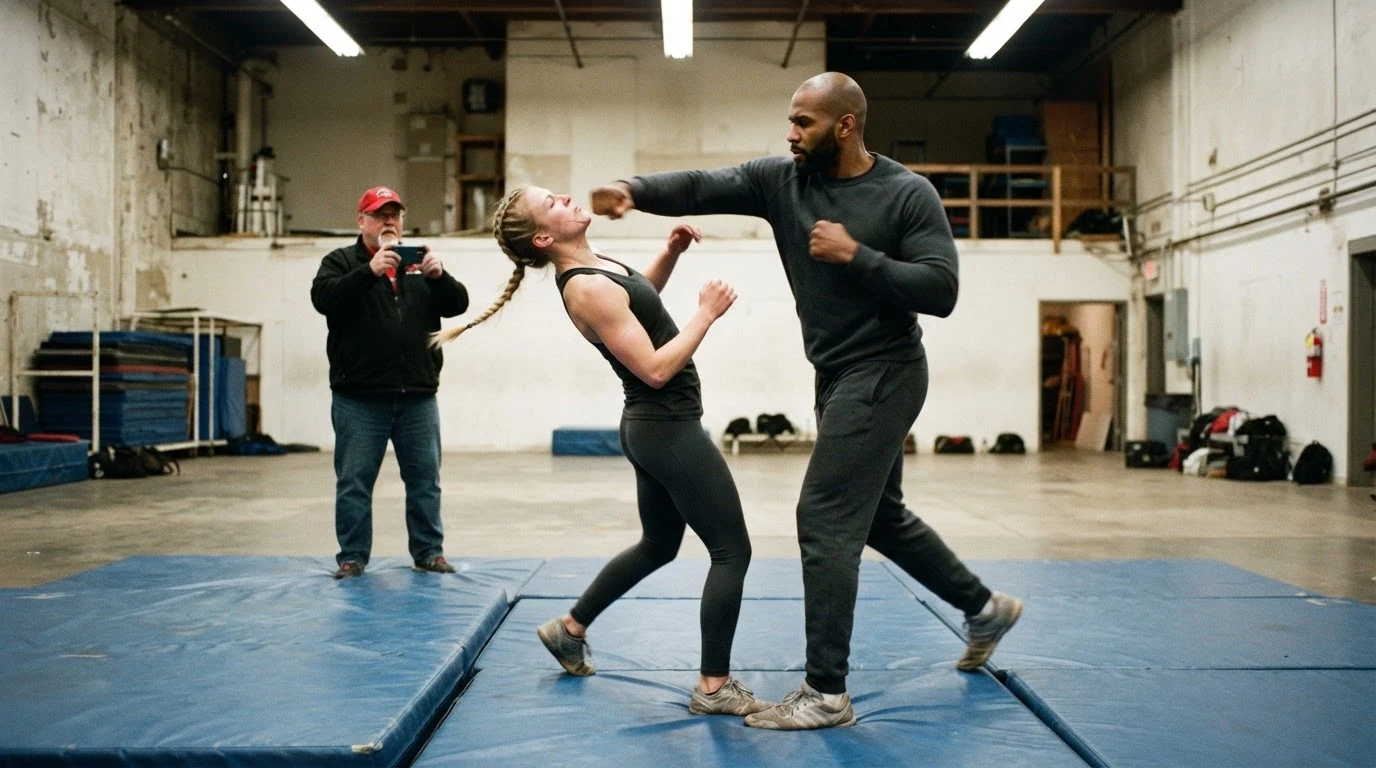
Past a hand's width in front of the jaw, snaps her head away and a clear gap of air describe a staged miss, the core of stunt fighting. Crash mats and a coordinator filming on a phone make it read as rehearsal, not a real fight.
Open FlashBoardsFilm set at night, wide shot from ground level: a fictional stunt double in a long brown leather coat, a lean woman with a dark bob and a bandaged left hand, falls backward off a loading dock toward a stack of cardboard boxes and a gray airbag at the bottom of the frame. A crew member in black stands at the dock edge. Sodium streetlights, wet concrete, light haze.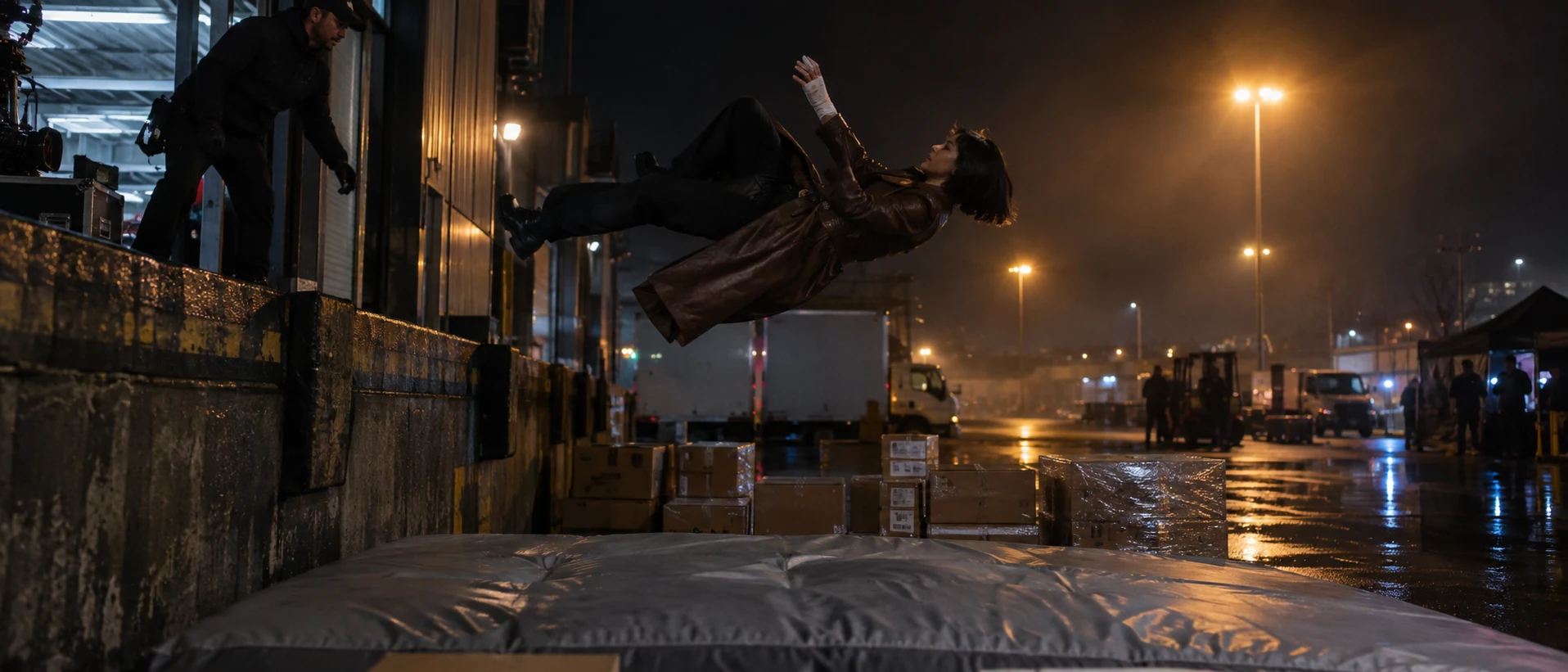
This take shows the safety work a final shot hides. Cardboard boxes and a gray airbag are how high falls are caught; ground level and 21:9 give the fall height and room.
Open FlashBoards{
"output": "Full-screen live-action stunt rehearsal from its very first frame: one continuous shot in a large empty gym, overhead fluorescent light, bare walls, blue crash mats.",
"characters": {
"S1": {
"name": "the fighter",
"look": "tall man, shaved head, short black beard, gray training clothes"
},
"S2": {
"name": "the stunt double",
"look": "wiry woman, blond braid, scar on her chin, gray training clothes"
},
"S3": {
"name": "the coordinator",
"look": "heavyset man in his fifties, white goatee, red cap, phone held sideways"
}
},
"shots": [
{
"shot": 1,
"camera": "locked off at chest height, holding still for the whole shot",
"action": [
"BEGINNING: alive from the first frame, S1's right hook is already swinging past S2's jaw and she whips her head away from it",
"THEN: S2 stumbles two steps back and drops sideways onto the blue crash mat, rolling once",
"THEN: S1 steps back and lowers his fists",
"END: behind them S3 keeps filming on his phone, then gives a thumbs up"
],
"dialogue": [],
"voice": "silence: nobody speaks in this shot, no voice at all"
}
],
"sound": {
"ambience": "gym room tone, the thud of a body on the mat, sneakers squeaking",
"speech": "no words in this video; the only human sounds are breaths and movement",
"never_spoken": "no narration and no voice-over: the descriptions, performance notes and step words of this prompt are never spoken aloud",
"music": "a film score under the scene, always below the voices: tight percussive drums with a low driving pulse",
"subtitles": "none"
}
}Already swinging puts motion in the first frame. A locked-off camera is how stuntvis is judged: the miss must still sell from a fixed angle. Rolls once ends the fall in a safe landing.
Open FlashBoardsCommon mistakes
- Punches connect. Write past the jaw and a head snapping away from the fist.
- Pads disappear. Name the crash mat or airbag and its color, or the fall lands on concrete.
- Coordinator becomes a spectator. Give them an action, like filming or signaling, so the role reads.
Keep the reference frames, prompts and every generated take side by side — images and video in one canvas.
FAQ
4 questionsWhat does a stunt coordinator do?
A stunt coordinator breaks the script into stunt beats, designs each fight, fall and car hit, casts stunt performers and doubles, specifies rigging and pads, and rehearses the action with the cast. On the day they run the safety meeting, stand by the camera during each stunt, and can stop the take if conditions change.
Is a stunt coordinator the same as a stunt director?
Mostly, yes. Stunt director and stunt supervisor are other titles for the head of the stunt department. On large productions a stunt supervisor may oversee several coordinators across units, and a veteran coordinator often directs the second unit's action. The core duty is the same: designing stunts and keeping them safe.
Is there an Oscar for stunt coordinators?
Not yet. The Emmys have long had a stunt coordination award, but the Oscars never had a stunt category. In 2025 the Academy announced an award for achievement in stunt design, starting with the 100th Oscars in 2028 for films released in 2027.
What is stuntvis?
Stuntvis is a rough previsualization of an action sequence made by the stunt team. Performers rehearse the choreography in a gym or on location, the coordinator films it from the intended camera angles, and the footage is cut into a draft of the scene. The director and DP use it to approve the action and plan coverage.
Related terms
6- Stunt PerformerActing & Casting
A stunt performer executes dangerous physical action on camera — falls, fights, car hits, fire burns — often doubling for an actor under the stunt coordinator's direction.
- Fight SceneDirecting & Staging
A fight scene is staged as choreography, camera and editing working together: clear geography, readable action–reaction beats and a rhythm of blows and pauses that tells who is winning.
- Car Chase SceneDirecting & Staging
A car chase is staged as a map of routes, speeds and obstacles: the director keeps screen direction and the distance between pursuer and pursued readable while stunt drivers, camera cars and editing build velocity.
- Second UnitFilmmaking Process & Crew
The second unit is a separate crew with its own director and DP that shoots material without the principal cast — establishing shots, inserts, stunts, car work, plates and crowds — in parallel with the main unit.
- Dance ChoreographyDirecting & Staging
Dance choreography on screen is built together with the camera: movement, framing and cutting are designed as one piece so the body, the rhythm and the emotion of the scene read in every shot.
- Film CrewFilmmaking Process & Crew
A film crew is everyone who makes the film behind the camera, organized into departments — directing, camera, grip, electric, art, costume, makeup, sound, production, post — each with a head and a chain of assistants.
Further reading
Hal Needham, Stuntman! (memoir) · American Cinematographer magazine (ASC) coverage of action productions