 FlashBoards Learn
- Learn
- Formats & Exhibition
- Bottle Episode
Formats & Exhibition · Film language
Bottle Episode
Also called: bottle show
A bottle episode is a TV episode set entirely on a show's existing standing sets with only the regular cast, made to save money. The constraint usually turns it into a pressure cooker: characters who cannot leave the room have to talk, and the episode becomes a dialogue-driven character study.
- What it does
- Trades locations, guest stars and effects for time spent with the regulars in one space, and banks budget for bigger episodes.
- Use it when
- A season needs to save money or days, or the characters have unfinished business that only forced proximity will surface.
- Watch out
- Without a reason to stay put and a clock running, one room reads as a cheap episode instead of a trap.
- Try this prompt
Wide shot, cramped back office after closing, two people facing off across a cluttered desk, one bare desk lamp, rain on a dark window, 35mm film still
What is a bottle episode?
A bottle episode keeps the whole story inside what the production already owns: the standing sets built on a stage for the run of the series, and the main cast already under contract. No locations, no new sets, few guest actors, little or no effects. The saving is spent elsewhere in the season.
The name is usually traced to 1960s Star Trek, where stories that never left the Enterprise were nicknamed "ship in a bottle" shows. "Bottle show" means the same thing.
On the page it looks like any other episode in TV script format. What gives it away is the scene headings: every slugline points to the same one or two interiors, often in continuous time, so the episode can play close to real time.
Why do shows make bottle episodes?
Money and schedule. A season has a fixed budget. Stunts, crowds and new locations have to be paid for somewhere, and an episode shot on existing sets with the regular cast is the cheapest one to make.
Pressure. Take away the exits and the characters have to deal with each other. Many bottle episodes are remembered as the best of their shows, not the cheapest:
- Breaking Bad, "Fly" (2010), directed by Rian Johnson, keeps Walt and Jesse in the superlab chasing a single fly. The pest hunt becomes a character study in miniature.
- Seinfeld, "The Chinese Restaurant" (1991), is Jerry, George and Elaine waiting for a table.
- Friends, "The One Where No One's Ready" (1996), stays in one apartment as Ross tries to get everyone out the door.
- Community, "Cooperative Calligraphy" (2010), locks the study group in their room over a missing pen, and Abed names it a bottle episode on screen.
- Mad Men, "The Suitcase" (2010), holds Don and Peggy in the office through one long night.
The room is familiar, so the novelty has to come from the people and their dialogue.
How to write and shoot a bottle episode
Give them a reason to stay. A locked door, a storm, a missing object, a meeting nobody can leave.
Start a clock. A deadline, a table that never frees up, a power cut until dawn. Continuous time keeps tension from leaking out between scenes.
Put the conflict in the room. Pair characters who have been avoiding each other, and let a scene run eight minutes.
Change the geometry, not the set. Variety comes from blocking and camera. Use corners of the set the show never shows, go lower and tighter as pressure rises: wide masters and two-shots early, 75–100mm singles late. Let the light age too, from practicals at dusk to one lamp at 3 a.m.
Plan it on one board. In FlashBoards, put the set's floor plan in the middle of the board and lay each scene's frames around it, to see where every beat is staged.
Bottle episode vs. single-location film and stranded episodes
A bottle episode is defined by what it reuses: the show's standing sets and regular cast, for budget reasons.
A single-location film is built around one space from the start: Rope (1948) in one apartment, 12 Angry Men (1957) in one jury room. People call these "bottle movies", but nothing is being saved for a larger season; the room is the concept.
A stranded episode isolates characters somewhere new. The Sopranos, "Pine Barrens" (2001), leaves Paulie and Christopher lost in snowy woods. It shares the pressure but not the economics: it was shot on location.
A pilot episode is the opposite extreme: it builds everything a bottle episode later reuses. More on how series are shaped in the formats and exhibition hub.
How to create a bottle episode with AI
4 promptsA bottle episode is a staging problem: one room, two people, forty minutes. Nano Banana 2 Lite gives the master frame of the set, GPT Image 2.5 a tighter late-night angle in the same room, and MiniMax H3 Max Turbo tests the blocking in motion. Keep all three beside the floor plan on one FlashBoards board. The fourth prompt re-shoots a real film shot from a text description alone, and the original plays next to the result so you can compare.
Wide master shot, 28mm lens, camera at chest height in the doorway of a cramped back office of a small hardware store after closing. Wood-paneled walls, metal shelves of paint cans, a cluttered desk with an old adding machine under one green desk lamp, rain on a dark window. Behind the desk sits a woman in her sixties with a silver buzz cut, wire reading glasses and a navy cardigan. Across from her stands a lanky man in his thirties with a short red beard and a paint-stained gray work shirt, arms crossed. Warm tungsten light, deep shadows in the corners, 35mm film still.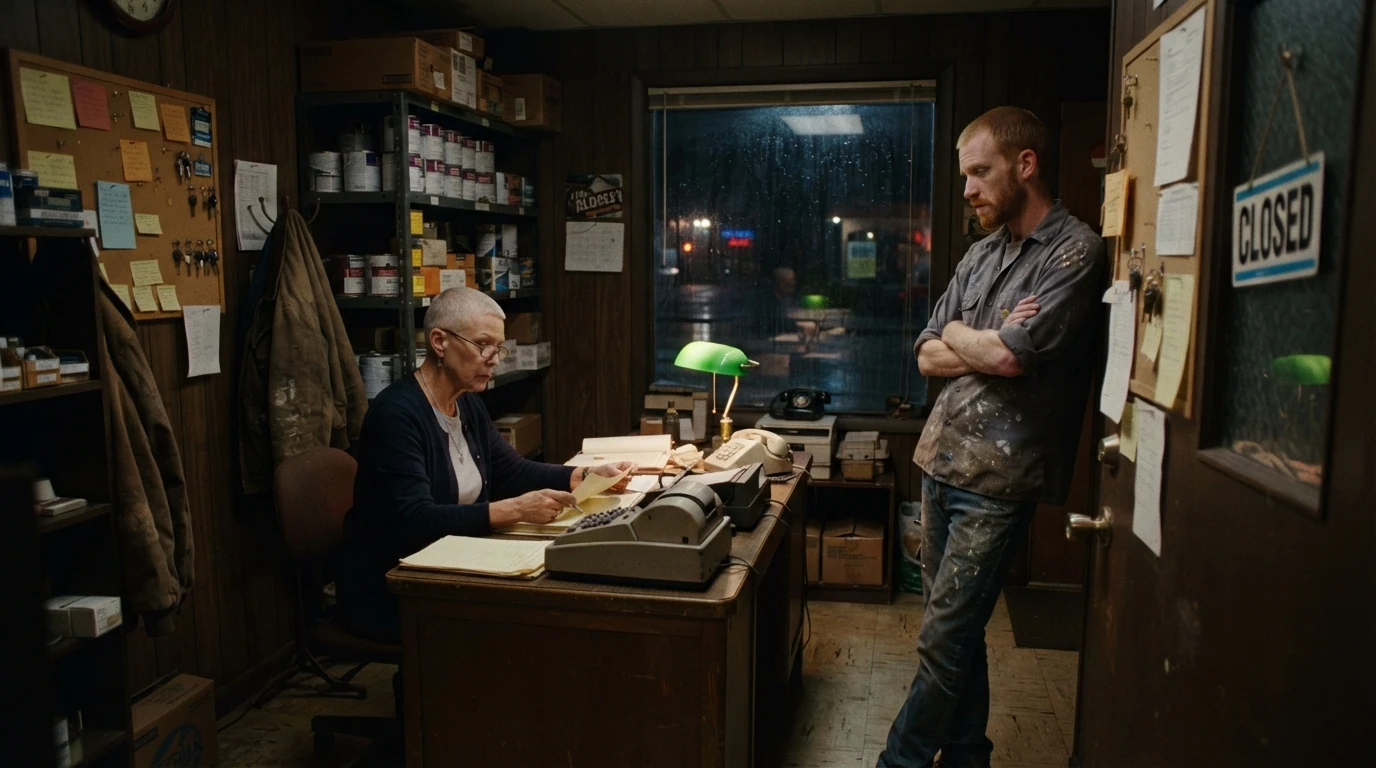
Wide master from the doorway shows the whole set, so the room reads as the boundary of the story. One green desk lamp and deep shadows in the corners keep the space small; specific set details make it reusable across takes.
Open FlashBoardsTight two-shot from low behind the desk, 85mm lens, same cramped hardware store back office at 3 a.m. Foreground left, out of focus, the shoulder of a woman in her sixties with a silver buzz cut. Sharp at frame right, a lanky man in his thirties with a short red beard leans on the desk with both hands, sleeves rolled up, exhausted. The green desk lamp is the only light, the window behind him black. Compressed space, 35mm film still.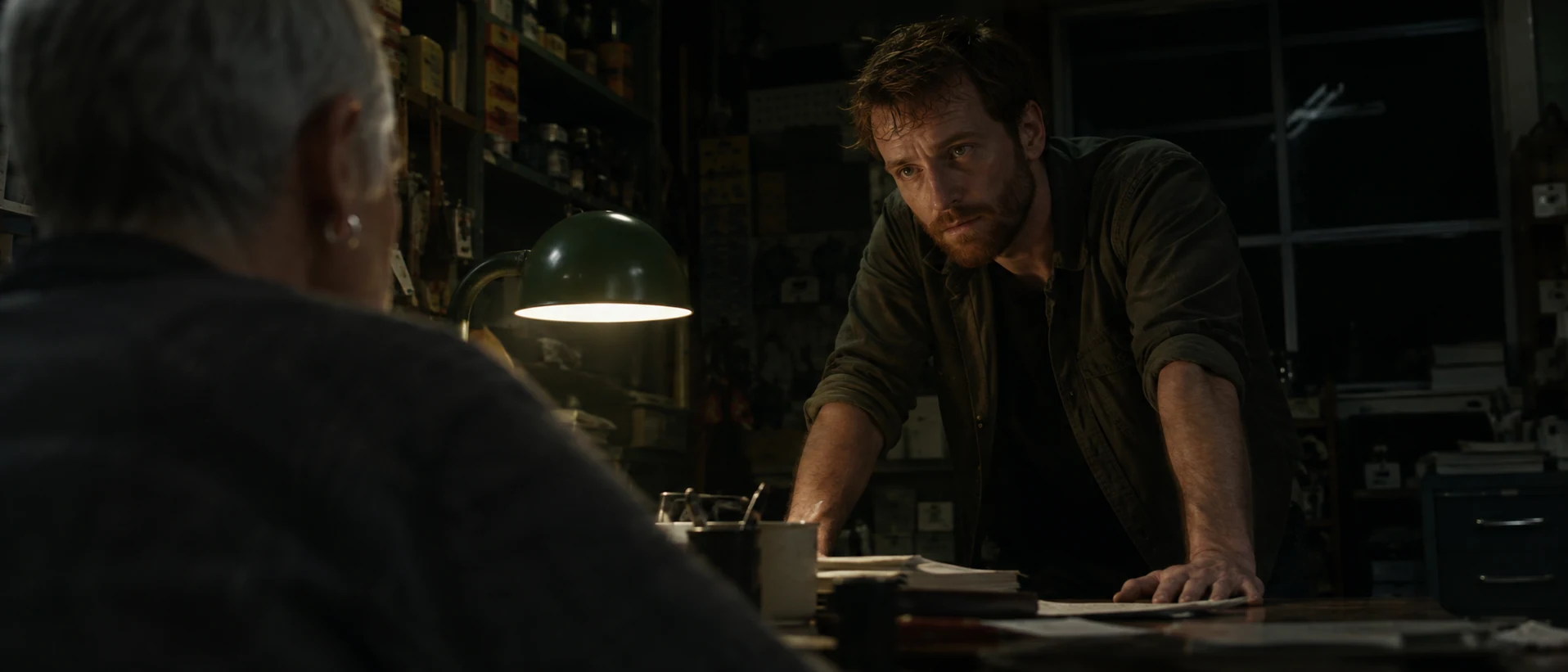
85mm and compressed space pull the walls in, and the foreground shoulder traps him. 3 a.m. with the only light shows time passing in a set that never changes.
Open FlashBoardsCamera: a slow, steady push-in from the doorway toward the desk, ending in a medium two-shot of the woman and the man. Action: Rain is already running down the window and the man is already pacing along the shelves. He stops, turns and puts both hands flat on the desk. The woman takes off her reading glasses, sets them on the adding machine and looks up at him without speaking.Already running and already pacing make the clip move from the first frame. The action uses only objects in the frame, so the model has nothing to invent.
Open FlashBoards{
"output": "Full-screen live-action scene from Deadpool (2016) from its very first frame: one continuous locked-off wide shot, no cuts. Modern 35mm look, a cramped one-room apartment packed floor to ceiling with junk: wooden shelves of bottles, books and boxes on the left wall, a tall bright window with small square panes at the back center blowing out to white, a radiator under it, a lit fabric lampshade on a standing lamp left of the window, a fan and stacked boxes in the right foreground, a worn rug on the floor, a big cardboard box and a tilted mattress leaning in the center, dark brown and gray palette lit only by the cold daylight from the window and the warm lamp.",
"characters": {
"S1": {
"name": "Deadpool, played by Ryan Reynolds",
"look": "tall athletic man in a full red and black tactical bodysuit that also covers his head and face, big white eye patches on the mask, blue sneakers, a small pale plastic bag hanging from his left hand, a black pistol in his right hand",
"voice": "bright, cocky, throwaway"
},
"S2": {
"name": "Blind Al, played by Leslie Uggams",
"look": "elderly Black woman with a gray afro and large dark sunglasses, gray tracksuit jacket over a blue top, dark trousers, white sneakers, slumped deep in a bentwood rocking chair next to the lamp",
"voice": "silent"
}
},
"shots": [
{
"shot": 1,
"camera": "locked-off tripod, eye level, 35mm lens feel, wide shot of the whole room from the far end; the camera never moves and never refocuses",
"action": [
"BEGINNING: alive from the first frame, S2 sits in the rocking chair in the left third, mid-depth, beside the glowing lamp, legs stretched out toward the right, hands resting on her lap; she does not move. S1 is already mid-stride in the center third, walking from screen right to screen left across the front of the window, upper body leaning forward, right hand holding the pistol pointed down-left, left hand swinging the small bag.",
"THEN: S1 keeps walking left at a brisk pace, crossing in front of the leaning mattress and the big box, passing between the camera and the window so his silhouette darkens against the white panes, his blue sneakers landing on the rug.",
"THEN: S1 passes directly in front of S2 and the lamp, blocking her for a moment, then clears her; S2 still does not turn her head or lift a hand.",
"THEN: S1 reaches the left edge of frame, his back to the camera, red suit catching the lamp light, and steps out of frame left past the shelves; his last leg vanishes behind the left foreground furniture.",
"END: the room is still. S2 sits alone in the chair exactly as before, sunglasses aimed straight ahead, hands on her lap, no nod; the lamp glows, the window burns white, nothing else moves for the rest of the shot."
],
"dialogue": [
{
"speaker": "S1",
"on_screen": true,
"when": "while he passes in front of the lamp and S2, just before he leaves the frame",
"delivery": "quick, cocky, thrown over his shoulder",
"line": "<d>[English] Hashtag driveby.</d>"
}
]
}
],
"sound": {
"ambience": "quiet apartment room tone, muffled city traffic heard from outside, floorboards creaking under S1's steps, the rustle of the plastic bag",
"speech": "exactly these spoken phrases, each said once, in this order",
"never_spoken": "no narration and no voice-over: the descriptions, performance notes and step words of this prompt are never spoken aloud",
"music": "a film score under the scene, always below the voices: a dry, playful low bass pluck with a light drum tick",
"subtitles": "none"
}
}Remakes the static wide shot of Blind Al's apartment from Deadpool (2016): the prompt keeps the locked camera, the cluttered one-room set with its blown-out window and lamp, Deadpool's right-to-left exit past the seated Al, and his single line.
The whole prompt is one locked-off wide shot of one cramped one-room apartment: the set is described down to the lamp, the window and the mattress, because in a bottle episode the room is the production. Two characters, one crossing, one line, and the listener who does not move is written as carefully as the walker.
Open FlashBoardsCommon mistakes
- Models open the room up: extra doors, bigger windows, more depth. Name the walls and keep cramped in every prompt.
- A second take redraws the set. Keep recipe 1 on the board as reference and repeat the set details word for word.
- Video models add a third person walking in. Describe exactly two people and what each does.
Keep the reference frames, prompts and every generated take side by side — images and video in one canvas.
FAQ
5 questionsWhat is a bottle episode?
A bottle episode is a TV episode confined to the show's existing sets and main cast, with few or no guest actors, locations or effects. Producers make them to save money for bigger episodes. Because the characters are stuck in one space, bottle episodes tend to be talky, tense and focused on relationships.
Why is it called a bottle episode?
The term is usually traced to the original Star Trek, where episodes that never left the Enterprise were nicknamed "ship in a bottle" shows. The story is sealed inside one container, the standing set. "Bottle show" is a common variant and means the same thing.
What are the best bottle episodes?
Frequently cited: Breaking Bad's "Fly", Seinfeld's "The Chinese Restaurant", Friends' "The One Where No One's Ready", Community's "Cooperative Calligraphy" and Mad Men's "The Suitcase". The Sopranos' "Pine Barrens" often appears too, though it was shot on location and strands its characters rather than reusing sets.
Is Fly a bottle episode?
Yes. "Fly", from season 3 of Breaking Bad (2010), plays almost entirely in the superlab with Walt and Jesse. It is the textbook example because a budget constraint produced one of the show's most intimate character studies.
Is a bottle episode the same as a filler episode?
No. Filler describes story value: an episode that does not move the main plot. A bottle episode describes production: one set, regular cast, low cost. A bottle episode can be filler, but the best ones push characters further than usual, because nothing else competes with the conversation.
Related terms
3- Pilot EpisodeFormats & Exhibition
A pilot episode is the first episode of a proposed series, made to sell the show to a network or platform — it must establish the world, characters, tone and the engine that will generate future episodes.
- Character StudyGenres
A character study is a film driven by the inner life of one person rather than by plot: events matter only as far as they reveal who the character is and how they change or fail to change.
- TV Script FormatScreenwriting
TV script format is how episodes are laid out on the page: one-hour dramas follow screenplay format split into acts or a teaser, while multi-camera sitcoms use double-spaced dialogue and capitalized action.
Further reading
Rian Johnson (dir.), Breaking Bad, "Fly" (AMC, 2010). Sidney Lumet (dir.), 12 Angry Men (1957).