 FlashBoards Learn
- Learn
- Formats & Exhibition
- CinemaScope
Formats & Exhibition · Film language
CinemaScope
Also called: Scope, CinemaScope 2.35:1, anamorphic widescreen
CinemaScope was 20th Century Fox's anamorphic widescreen system, launched with The Robe (1953). A lens squeezed a wide image sideways onto ordinary 35mm film, and a matching projector lens stretched it back to about 2.55:1, later 2.35:1. It made the wide frame standard, and "scope" still names every 2.39:1 film.
- What it does
- Puts a frame more than twice as wide as it is tall on standard 35mm film by squeezing it 2x in the camera and unsqueezing it in the projector.
- Use it when
- You want landscape, crowds or two faces far apart in one shot, and a big-screen feel instead of a TV-shaped image.
- Watch out
- The width punishes empty staging: a centered single face leaves dead space on both sides unless the composition uses it.
- Try this prompt
1950s CinemaScope 2.55:1 wide shot, Technicolor, a couple at opposite ends of a long diner counter, deep staging, soft studio light
What is CinemaScope?
CinemaScope is a trademarked widescreen process that 20th Century Fox introduced in 1953. Its core is an anamorphic lens that compresses the picture horizontally by a factor of 2 and leaves the vertical axis alone. On the negative everyone looks thin; a matching attachment on the projector stretches the image back out onto a wide screen. Ordinary 35mm gear could now deliver a picture far wider than the Academy frame.
The optics came from Henri Chrétien's Hypergonar lens of the 1920s; Fox bought the rights and had Bausch & Lomb build production lenses. The Robe (1953, dir. Henry Koster) opened the format. Fox then licensed it to other studios, so CinemaScope titles include A Star Is Born (1954), Rebel Without a Cause (1955) and Disney's Lady and the Tramp (1955), the first animated feature in the format.
What is the CinemaScope aspect ratio?
The aspect ratio changed twice, and all three numbers are right for their era:
- 2.55:1 — the 1953 original, with narrow perforations and four magnetic stereo stripes on the print.
- 2.35:1 — adding an optical soundtrack took some width. This is the classic CinemaScope figure.
- 2.39:1 — a 1970 revision of the projection standard made the frame slightly shorter. Often rounded to 2.40, it is simply called "scope" today.
Today a scope frame may come from anamorphic lenses or from a spherical image cropped to 2.39:1. On a 16:9 screen it plays with black bars, the letterboxing that replaced pan and scan. More screen shapes live in formats and exhibition.
Why did CinemaScope change the way films were staged?
Fox launched CinemaScope to give audiences what television could not: size. Cinerama had proved in 1952 that a huge wide picture sold tickets, but it needed three cameras and three projectors.
The new frame forced directors to rethink blocking. Early films often played scenes in long wide takes, actors spread out as on a stage. Directors such as Nicholas Ray and Elia Kazan soon used the width actively: a character isolated at one edge, two people separated by empty space. Fritz Lang, playing himself in Godard's Contempt (1963), dismisses the format as good only for snakes and funerals.
The early lenses had a flaw nicknamed the "CinemaScope mumps": in close-ups, faces could look slightly swollen. Panavision's anamorphic lenses corrected it, and by the late 1960s they had replaced CinemaScope lenses, even at Fox. The trademark faded; the frame shape stayed.
How to compose for a scope frame today
Whether you shoot anamorphic, crop or generate, CinemaScope's lessons still apply:
- Place faces off-center. A centered close-up in 2.39:1 wastes both sides. Put the eyes on a third and let the open side show where the character looks.
- Stage across the frame. Two characters at opposite edges can share one shot, so a scene plays without cutting.
- Protect for other screens. If the film will also play at 16:9, keep key action away from the far edges.
On a FlashBoards board, keep reference frames from 1950s scope films next to your generated shots and draft every setup at 21:9, so everyone judges compositions in the final shape.
CinemaScope vs. Cinerama
Both sold width, but differently. Cinerama filmed with three synchronized 35mm cameras and projected three strips side by side onto a deeply curved screen, with visible seams between panels. Only rebuilt theaters could show it. CinemaScope reached a similar shape on one strip of film with one lens attachment, so ordinary theaters could convert and every genre could use it. Cinerama was the event; CinemaScope became the standard.
CinemaScope examples in film
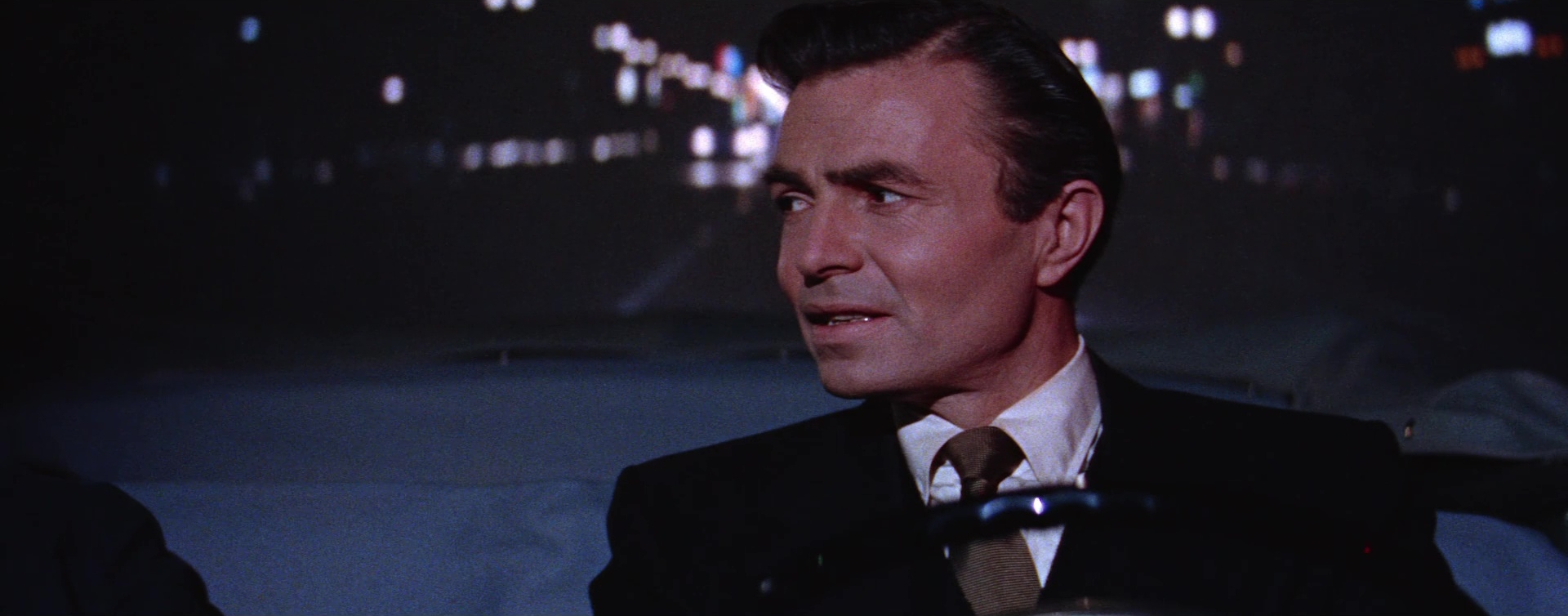
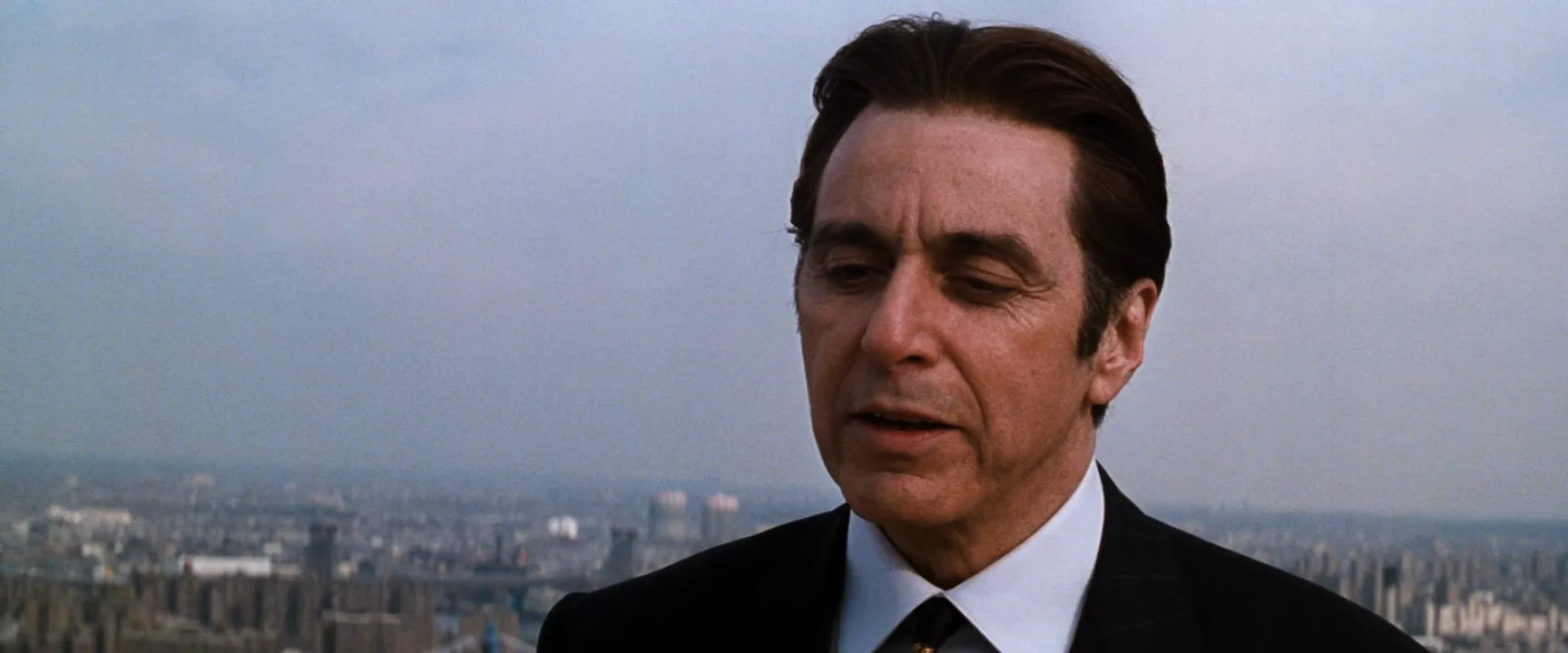
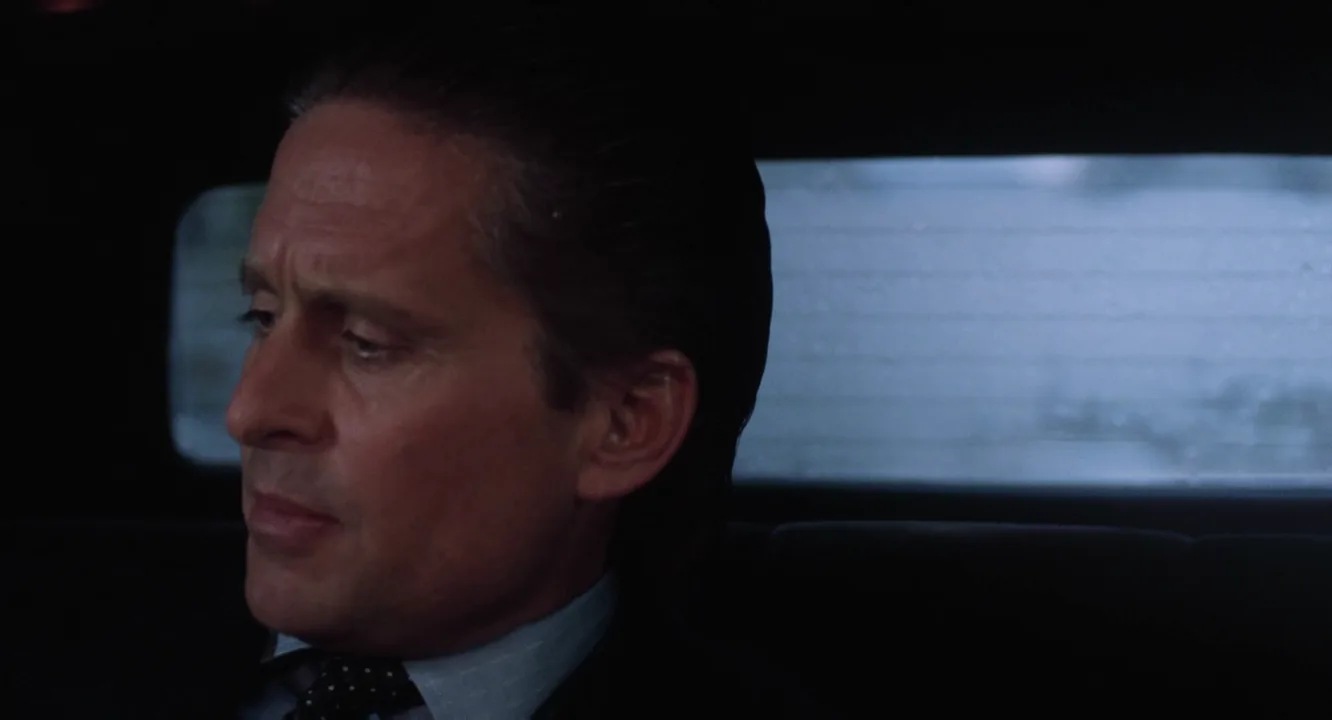
4 framesA 1950s CinemaScope frame, two later 2.39:1 frames and one flat 1.85:1 frame for contrast.
How to create a cinemascope with AI
4 promptsModels read "CinemaScope" as a vintage mood, not a frame shape. Generate at 21:9 and say how the width is used: who stands where, what fills the sides. Compare takes side by side on one board beside your references. The fourth prompt re-shoots a real film shot from a text description alone, and the original plays next to the result so you can compare.
1950s CinemaScope widescreen wide shot, Technicolor look. A long chrome diner counter runs the full width of the frame. At the far left, a young waitress with a red ponytail and a mint-green uniform leans on the counter; at the far right, a lanky trucker with a sunburned neck and a checked flannel shirt sits on a stool. Empty stools between them. Seated eye level, deep focus, soft studio light, saturated reds and teals, fine grain.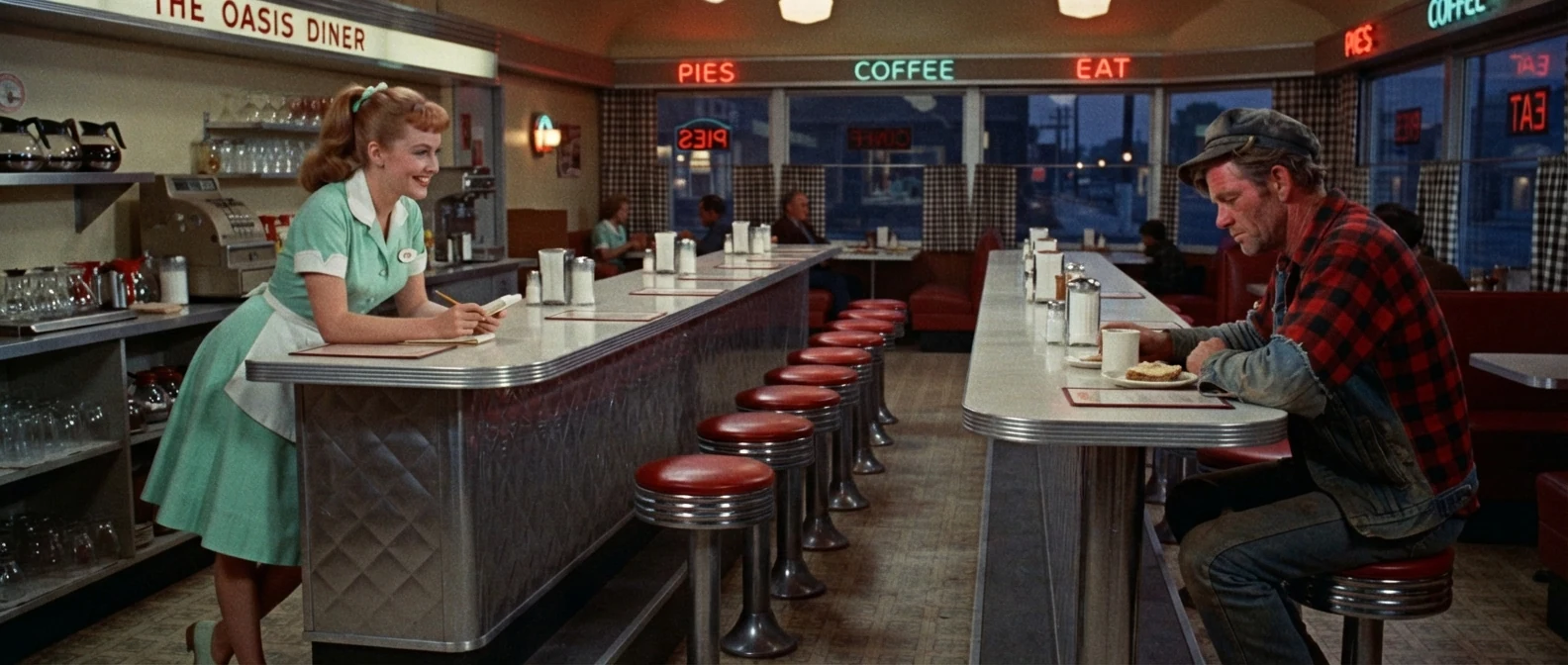
"Far left", "far right" and "empty stools between them" force the model to use the width the way 1950s staging did. This is the video's start frame.
Open FlashBoardsScope 2.39:1 close-up, 1950s western, Eastmancolor look. A weathered rancher in his sixties, clean-shaven with grey stubble, a crooked hawk nose and a thin scar across his left cheek, in a sweat-stained tan hat, fills the right third of the frame, looking left. The left two-thirds show a red mesa and a dusty trail under a hard blue sky, horizon in the lower third. Anamorphic lens, warm afternoon sun, fine grain.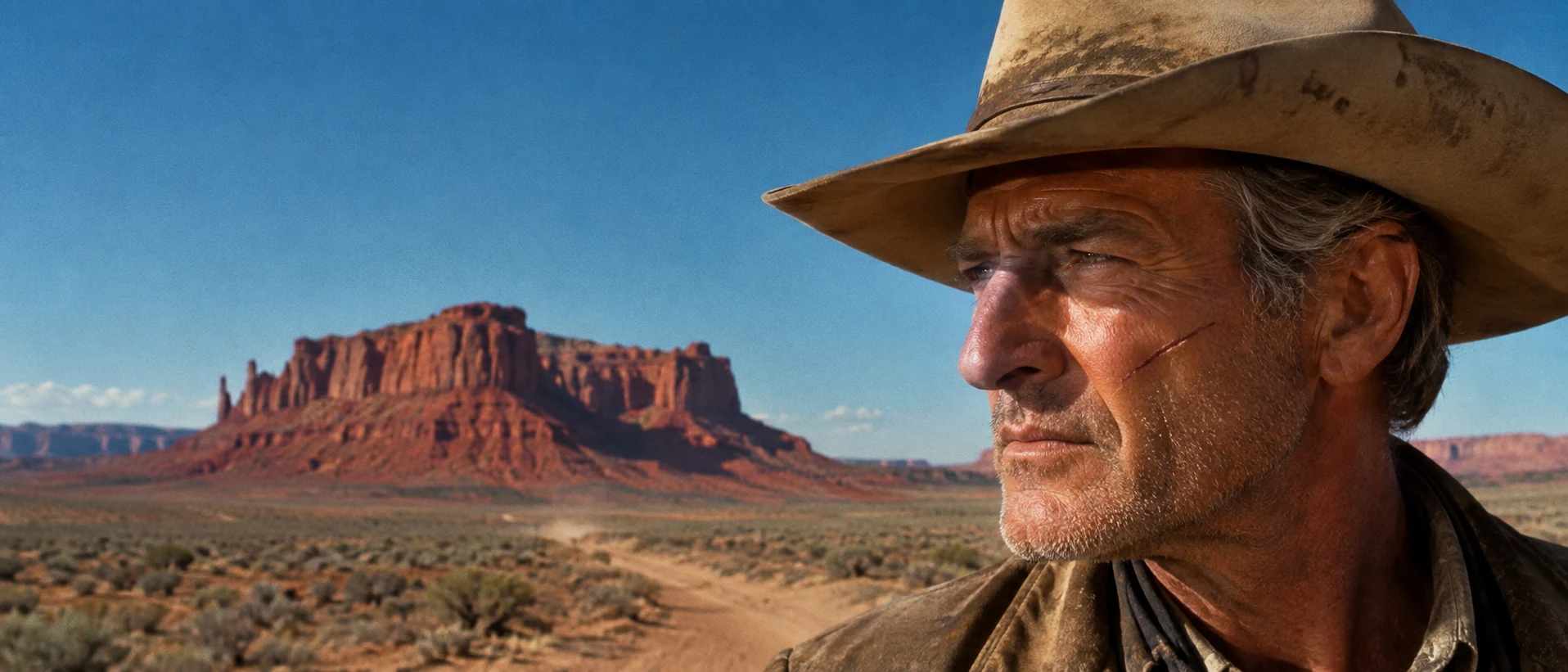
The scope close-up: the face on one third, the landscape in the open side. "Looking left" gives that space a purpose; "horizon in the lower third" stops the model centering everything.
Open FlashBoardsCamera: a slow, steady lateral dolly from left to right along the counter, moving from the first frame and ending closer to the trucker. Action: from the start the waitress is already wiping the counter and the trucker is turning his coffee cup. In the middle she looks up toward him. At the end he raises the cup slightly toward her, both still at their ends of the counter.A lateral move shows off a wide frame better than a push-in. "Already wiping" keeps the shot alive from frame one, and every object named is in the start frame.
Open FlashBoards{
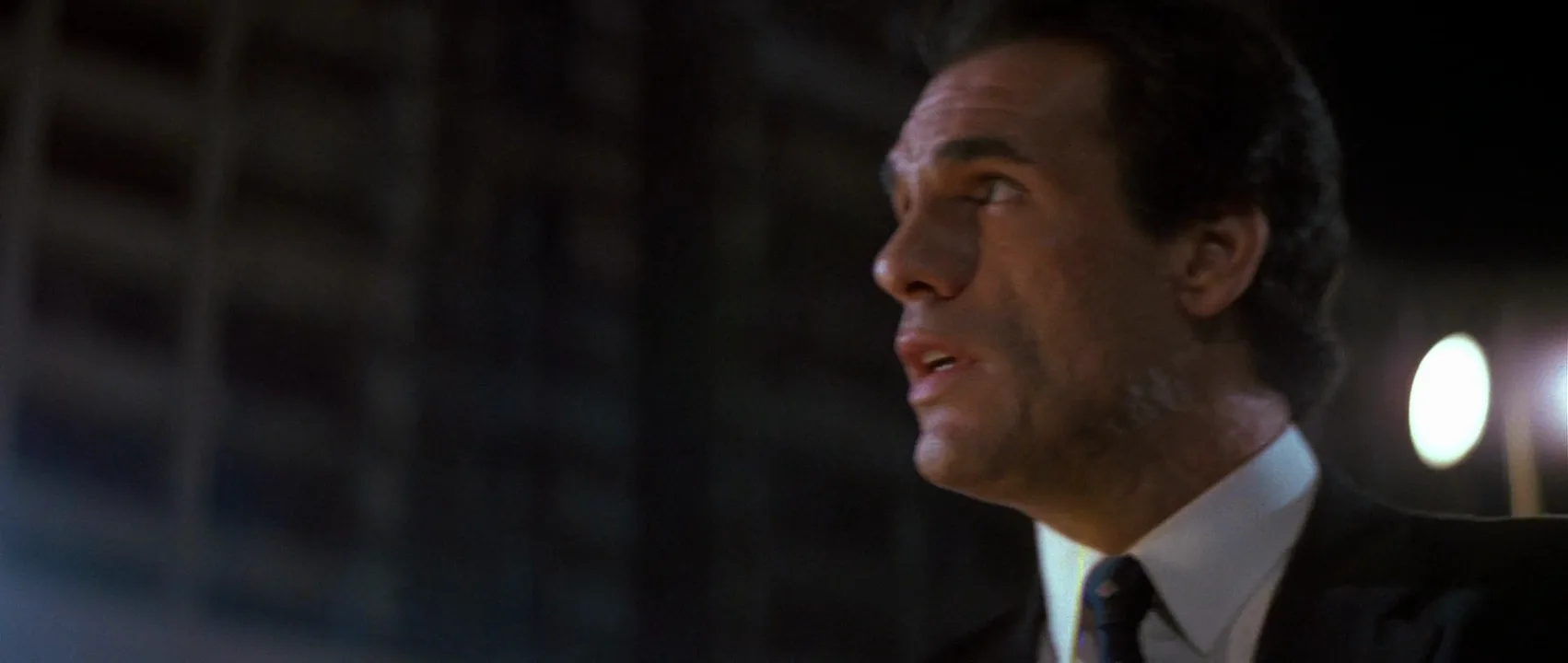
"output": "Full-screen live-action scene from Die Hard (1988), in a 2.39:1 CinemaScope frame from its very first frame: one continuous shot. Grainy late-1980s 35mm anamorphic, night, a dark office-tower facade with rows of dim blurred windows filling the whole background, two round white floodlights on poles glowing at the far right edge, emergency lights flashing blue and red across the face from screen left, shallow focus, oval anamorphic highlights.",
"characters": {
"S1": {
"name": "FBI Special Agent Big Johnson, played by Robert Davi",
"look": "man in his forties, gaunt pockmarked cheeks, dark hair combed back, heavy brow, charcoal suit, white shirt, dark tie with a small diamond pattern, a gold ring on his right hand",
"voice": "flat, clipped, official, into a radio"
}
},
"shots": [
{
"shot": 1,
"camera": "low angle looking up, long lens, near-static with a slow slight drift to the left; medium close-up with S1's head and shoulders right of center and the dark tower facade filling the left half of the wide frame; by the end S1 sits in the right third and the whole left two-thirds is dark blurred building",
"action": [
"BEGINNING: alive from the first frame, S1 right of center, head tilted down, eyes lowered to screen left; a blurred arm in a dark suit sleeve with a white shirt cuff reaches in from the left foreground and holds a black radio handset on a coiled cord up toward his chin; a blue light flashes on his left cheek.",
"THEN: the arm withdraws out of frame at lower left; S1 stays still, jaw set, lips closed, eyes on the hand as it leaves.",
"THEN: S1 lifts his head and turns it up and to screen left, eyes searching high on the tower off frame left; a red light washes over his cheek; he shifts toward the right third of the frame.",
"THEN: his right hand rises from below frame on the screen-left side of his face with the black handset, the coiled cord hanging down to the left, and presses it to his mouth.",
"END: handset held against his mouth, ring visible on his finger, he speaks into it, eyes up to screen left, dropping briefly, then back up; brow furrowed, no nod, his face in the right third of the wide dark frame."
],
"dialogue": [
{
"speaker": "S1",
"on_screen": true,
"when": "right after the handset reaches his mouth, through to the end of the shot",
"delivery": "flat, clipped, official, into the radio",
"line": "<d>[English] This is Special Agent Johnson.</d>"
}
]
}
],
"sound": {
"ambience": "distant sirens and idling engines heard from far away, radio static from the handset, a crowd murmur far off",
"speech": "exactly these spoken phrases, each said once, in this order",
"never_spoken": "no narration and no voice-over: the descriptions, performance notes and step words of this prompt are never spoken aloud",
"music": "a film score under the scene, always below the voices: low tense strings holding one note with a slow pulse and a soft brass swell",
"subtitles": "none"
}
}Remakes the low-angle night close-up of Robert Davi from Die Hard (1988): the prompt carried over the off-center face, the dark building filling the width, the handed-over radio, his real line and the drift to the right third.
The camera field carries the scope composition, not just the move: face right of center, the dark facade across the left two-thirds, drifting into the right third. Naming what fills the empty side keeps the model from centering the face.
Common mistakes
- "CinemaScope" alone can produce a theater or logo text; describe the frame, not the brand.
- Models center one subject and blur the sides; name what fills left and right.
- If a take has bars inside 21:9, add "image fills the full width".
- 21:9 is about 2.33:1; crop slightly for 2.39:1.
Keep the reference frames, prompts and every generated take side by side — images and video in one canvas.
FAQ
4 questionsWhat is CinemaScope?
CinemaScope was 20th Century Fox's widescreen system, introduced with The Robe in 1953. An anamorphic lens squeezed a wide image by a factor of 2 onto standard 35mm film, and a matching projector lens unsqueezed it onto a wide screen. Fox licensed it to other studios, and it made widescreen the norm in the 1950s.
What is the CinemaScope aspect ratio?
Originally 2.55:1, when prints carried only magnetic stereo sound. An added optical soundtrack reduced it to 2.35:1, the figure most associated with CinemaScope. A 1970 projection standard revision made it 2.39:1, often rounded to 2.40, the "scope" ratio of widescreen features today.
Is CinemaScope the same as anamorphic widescreen?
CinemaScope was one brand of anamorphic widescreen, the first to become an industry standard. Anamorphic widescreen is the general technique of squeezing a wide image onto film or a sensor and unsqueezing it later. Today "scope" means any 2.39:1 frame.
What was the first CinemaScope movie?
The Robe (1953), directed by Henry Koster, was the first feature released in CinemaScope. Fox sold it as a widescreen picture you could see without special glasses, a jab at that year's 3D craze, and other studios soon licensed the process.
Related terms
3- Aspect RatioFormats & Exhibition
Aspect ratio is the width of the frame relative to its height — 1.33:1 (Academy), 1.85:1 (flat), 2.39:1 (scope), 1.43:1 (IMAX), 16:9 (HDTV); it decides how much space surrounds a character and how a composition breathes.
- Anamorphic LensLenses, Focus & Exposure
An anamorphic lens squeezes a wide field of view horizontally onto film or a sensor, and the image is unsqueezed into widescreen later; its optical side effects — horizontal streak flares, oval bokeh and gently bending edges — became a signature of the big-screen look.
- Pan and ScanFormats & Exhibition
Pan and scan crops a widescreen film to fill a 4:3 TV screen, moving a narrow window across the wide frame shot by shot — losing up to half the composition and sometimes whole characters.
Further reading
John Belton, Widescreen Cinema (Harvard University Press, 1992). American Cinematographer Manual, sections on anamorphic formats and aspect ratios.