 FlashBoards Learn
Lenses, Focus & Exposure · Film language
Bokeh
Also called: bokeh effect, out-of-focus highlights
Bokeh is the character of the out-of-focus areas of an image, above all how point lights melt into soft discs or ovals. It is not the blur itself but the quality of that blur, shaped by the lens design, the aperture blades and how shallow the focus is. Good bokeh turns a busy background into mood.
- What it does
- Turns background lights and clutter into soft shapes that carry color and mood while the subject stays readable.
- Use it when
- Night exteriors, bars, traffic, casinos, candles: any scene with small bright points behind or in front of a sharp face.
- Watch out
- Blur is not bokeh; a flat wall behind the actor gives no discs, and stopping down turns circles into hard polygons.
- Try this prompt
85mm at f/1.4, man's eyes in sharp focus, city lights thirty meters behind him melting into large soft round bokeh discs
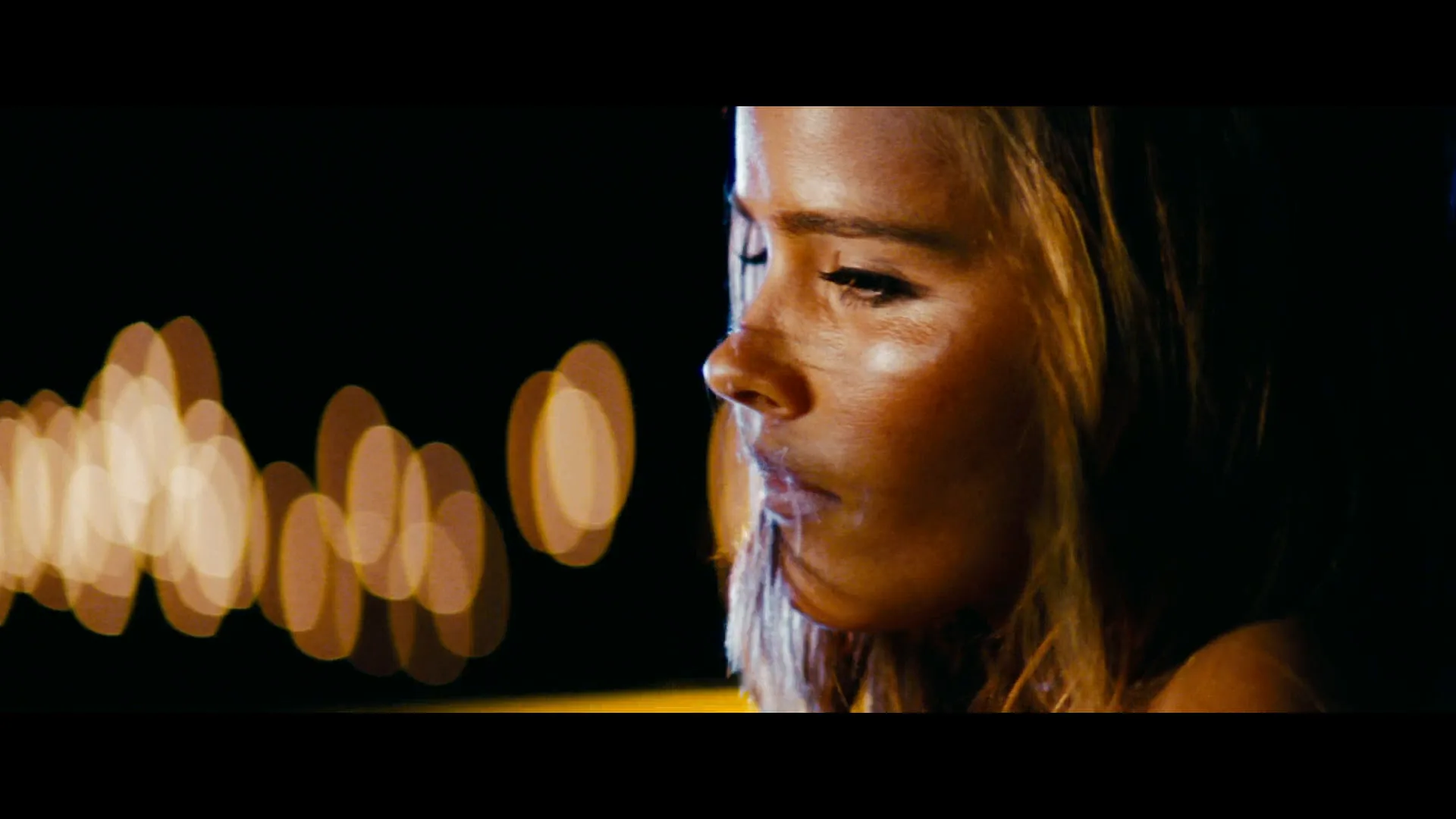
What is bokeh?
The word comes from the Japanese boke, roughly "blur" or "haze", but in cinematography it names something narrower: how a lens renders what is out of focus. Two lenses at the same stop and distance blur a background equally and still look different. One draws clean, evenly filled circles; another gives bright rims, rings or a swirl toward the edges.
Every point of light off the focal plane spreads into a patch shaped like the lens opening, so round aperture blades give circles and a six-blade iris gives hexagons. The patch grows with the light's distance from the focal plane and with how thin the depth of field is. That is why bokeh shows best on small bright sources: bulbs, headlights, reflections. A flat wall behind an actor gives blur, but almost no bokeh to judge.
Why do filmmakers use bokeh?
Bokeh lets a background speak without competing. A night street reduced to colored discs still says "city, late, traffic", but as color and rhythm instead of detail, so the eye goes straight to the face.
It also sets tone. Large, smooth, warm discs feel romantic or dreamy; a field of small, hard-edged points feels restless. And bokeh is part of a lens's signature: swirling vintage glass, clean modern primes and the oval discs of an anamorphic lens each give a film a different feel.
How to shoot bokeh
Like most lens and focus choices, bokeh is a question of distances more than gear:
- Open up. Shoot at T1.4–T2.8. Every stop you close makes the discs smaller and often more polygonal.
- Go longer. An 85mm, 135mm or a telephoto lens magnifies the background and its discs. A 24mm at f/2 barely blurs a street.
- Subject close, lights far. Actor one to two meters from the camera, light sources ten meters or more behind. The bigger the ratio, the bigger the discs.
- Use small, bright points. String lights, traffic, windows, candles. Dress practical lights into the deep background on purpose.
- Expose for the face so the sources glow a few stops over, and use ND in daylight to stay wide open.
For foreground bokeh, hang lights or a glass a few centimeters from the lens, between it and the actor.
Round, oval and shaped bokeh
Round discs come from spherical lenses with curved blades, wide open. Polygons appear when the iris closes. Cat's eye discs at the frame edges come from vignetting inside the lens. Tall ovals are the anamorphic signature: the lens squeezes the image horizontally, so every blurred point stretches vertically once the picture is unsqueezed.
Bokeh vs. shallow depth of field
Shallow depth of field is the amount of the scene that is sharp: a thin slice, often just the eyes. Bokeh is the look of everything outside that slice. Shallow focus creates the blur; the lens decides whether it is creamy, busy, round or oval. You can have shallow focus with dull bokeh (a plain wall behind the actor), and strong bokeh in a fairly deep shot if bright lights sit far behind the focal plane.
Bokeh examples in film
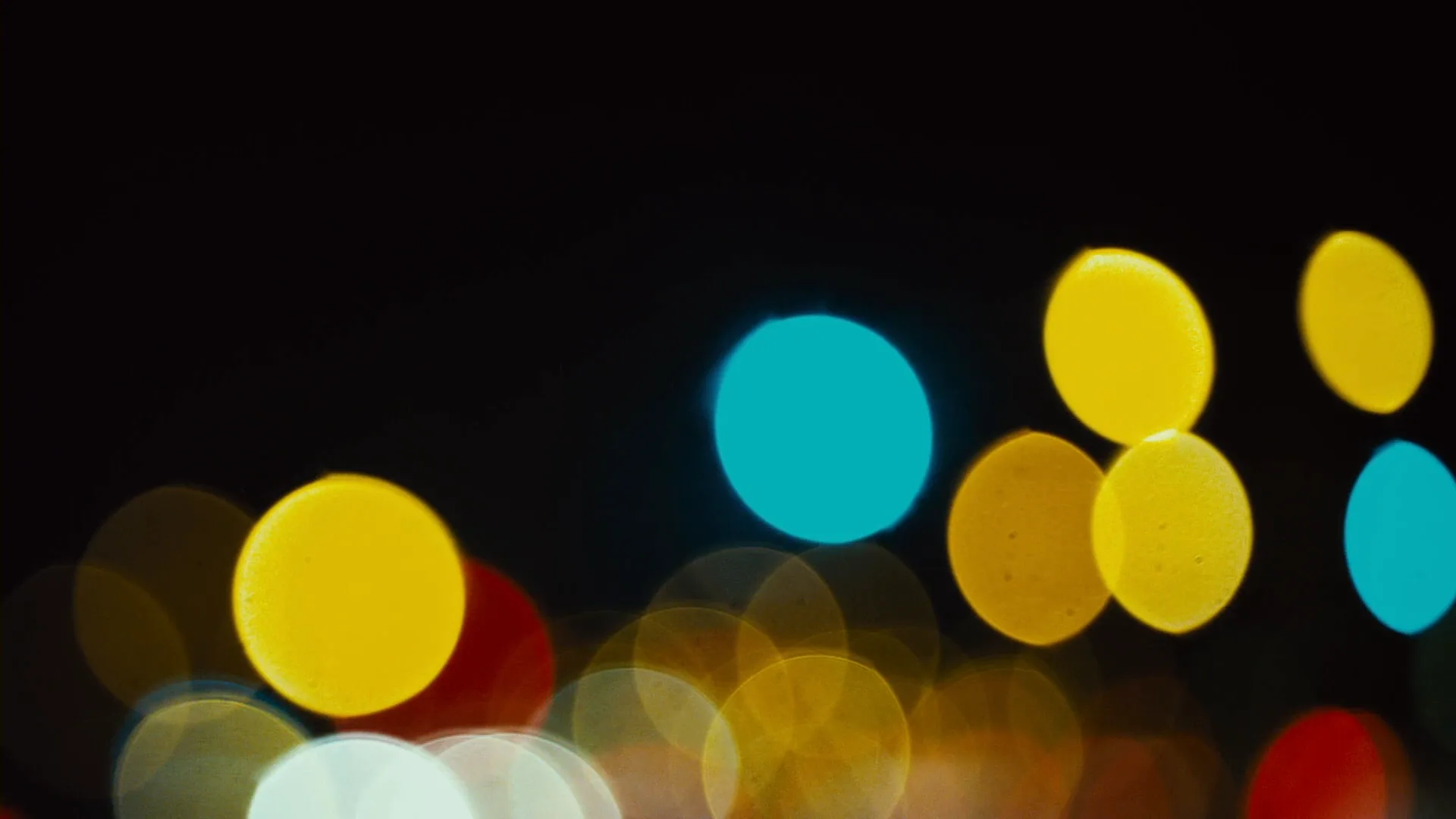
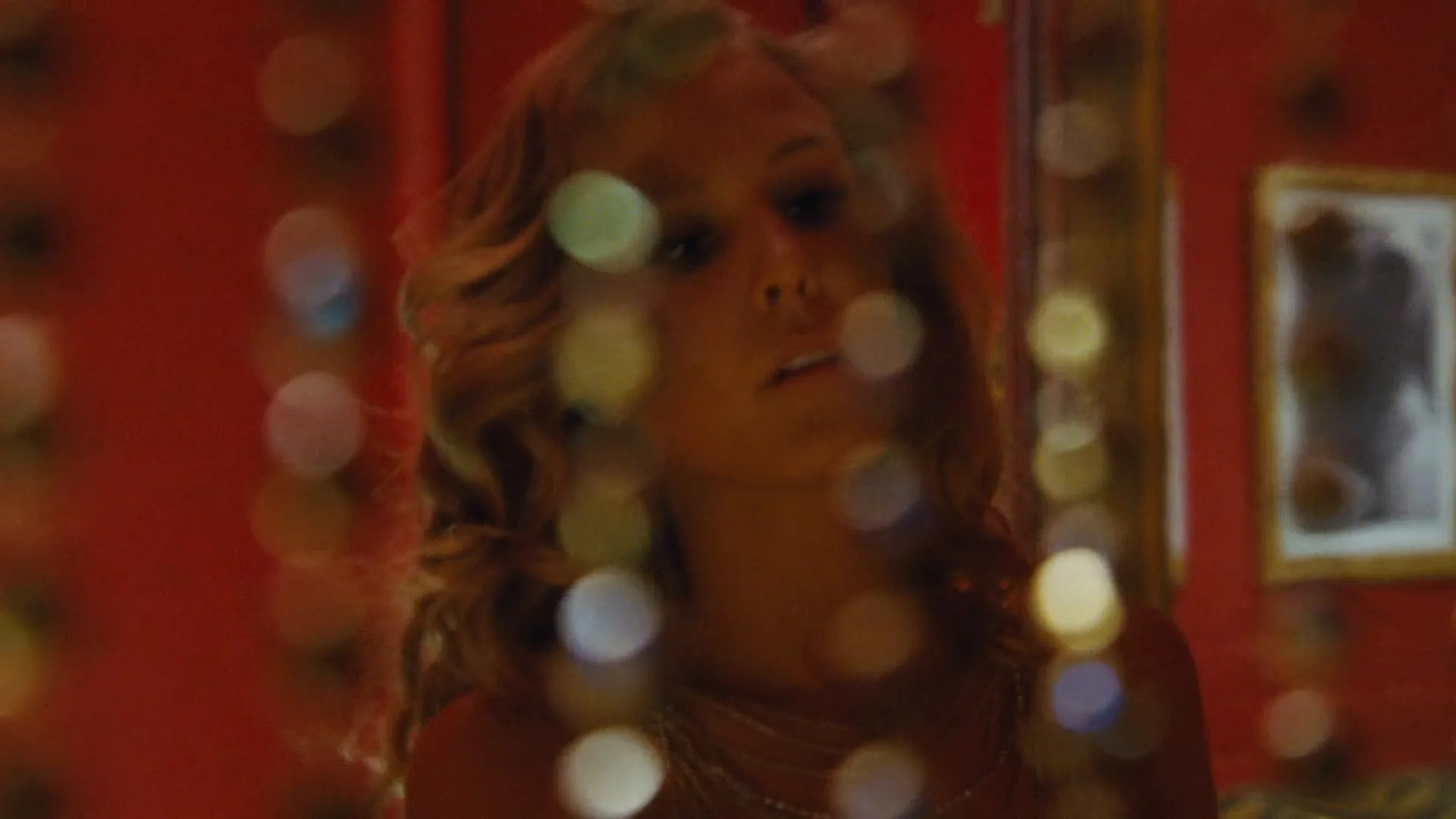
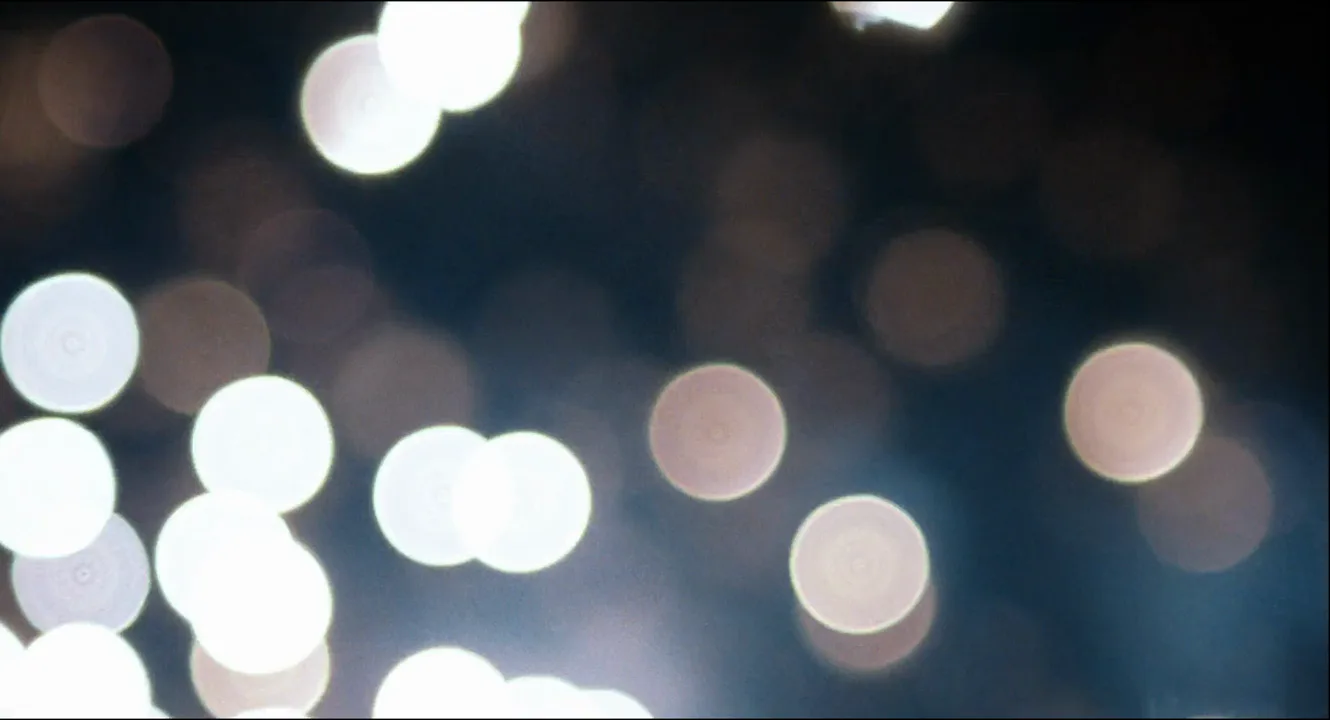
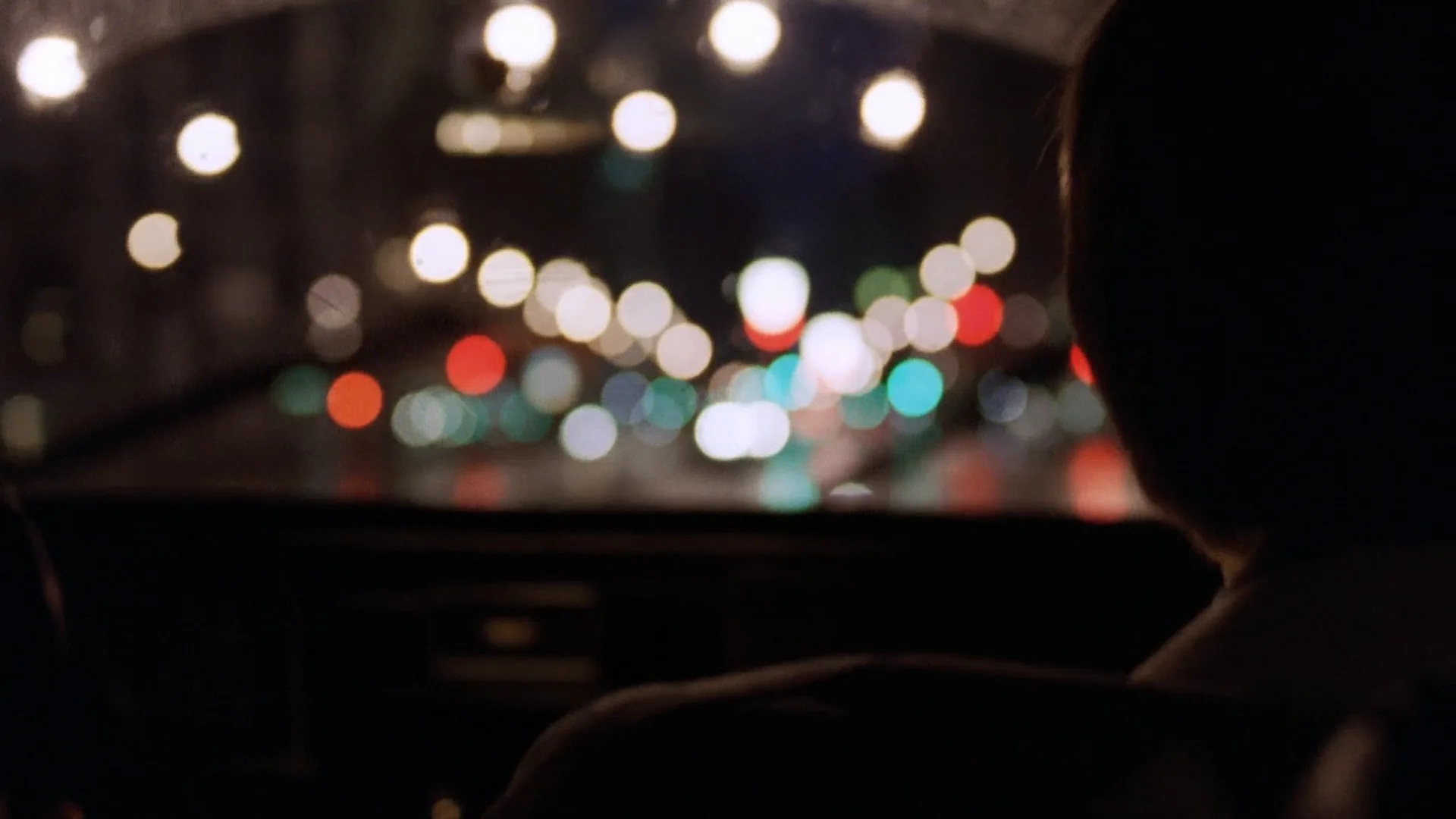
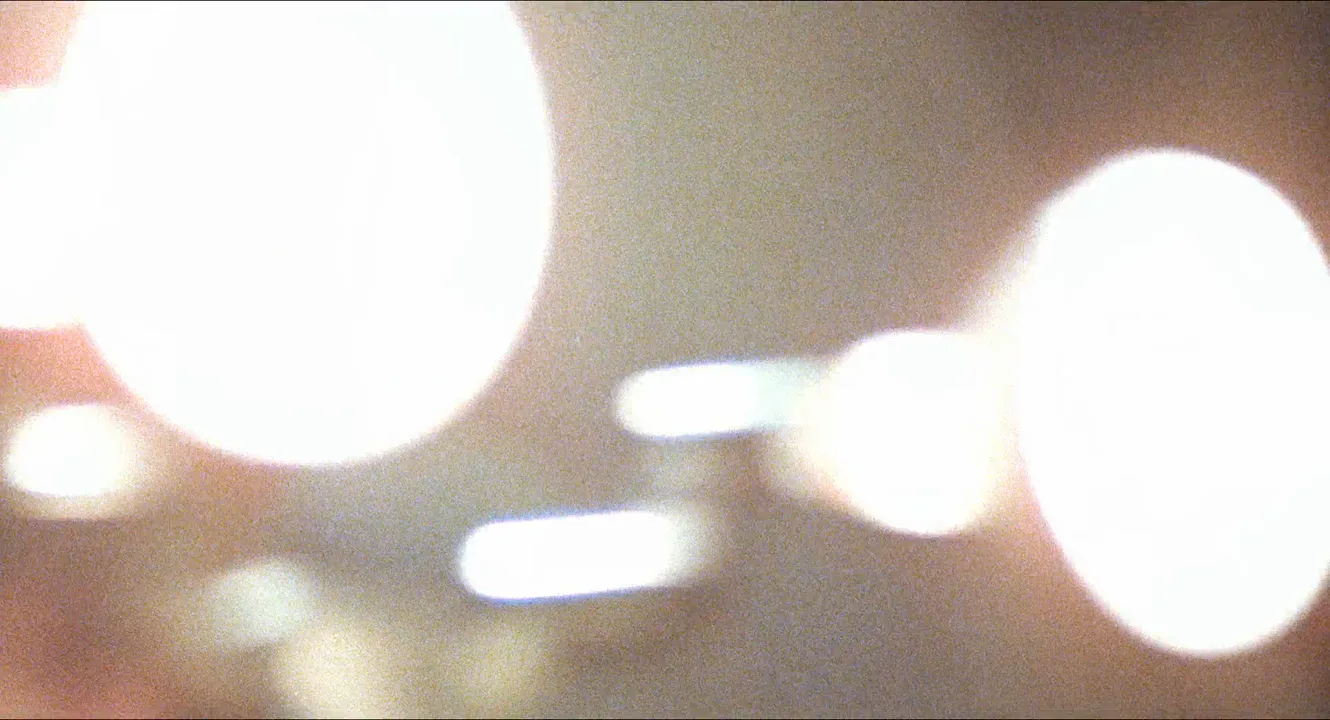
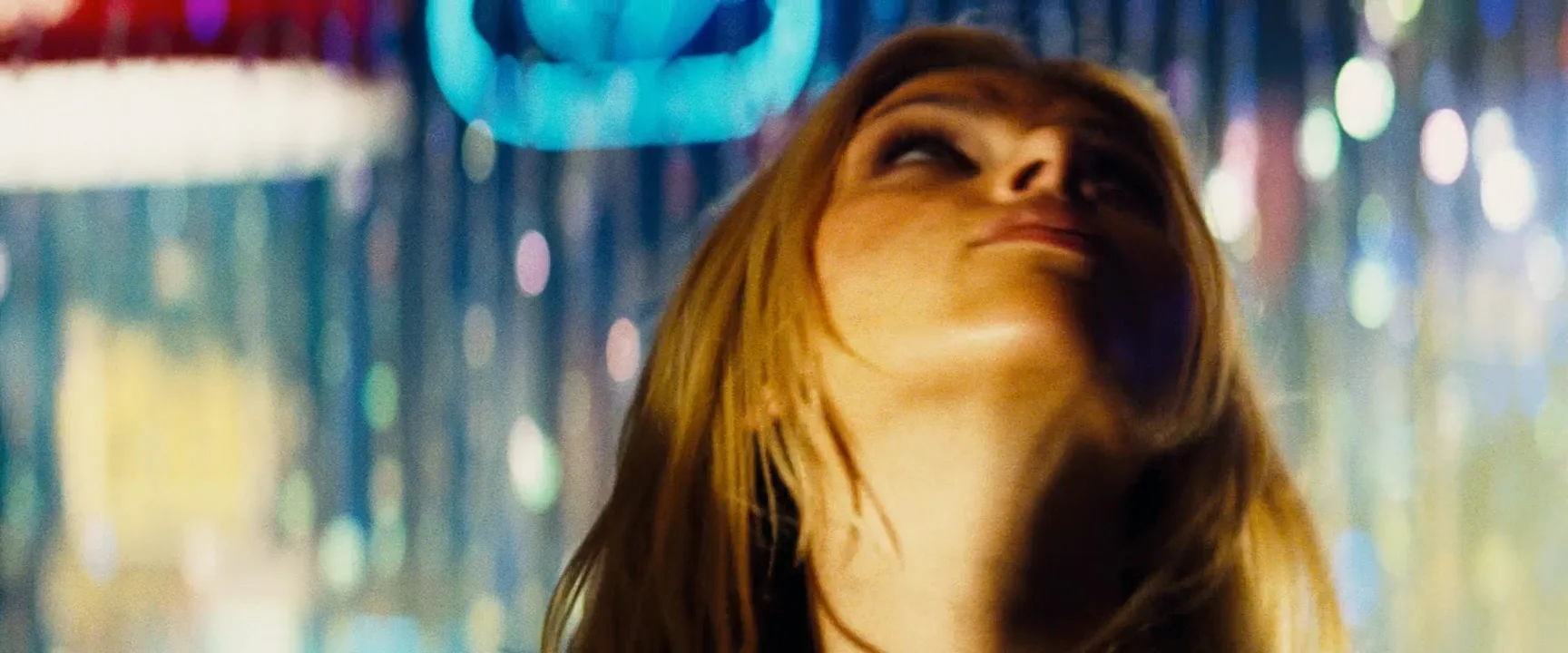
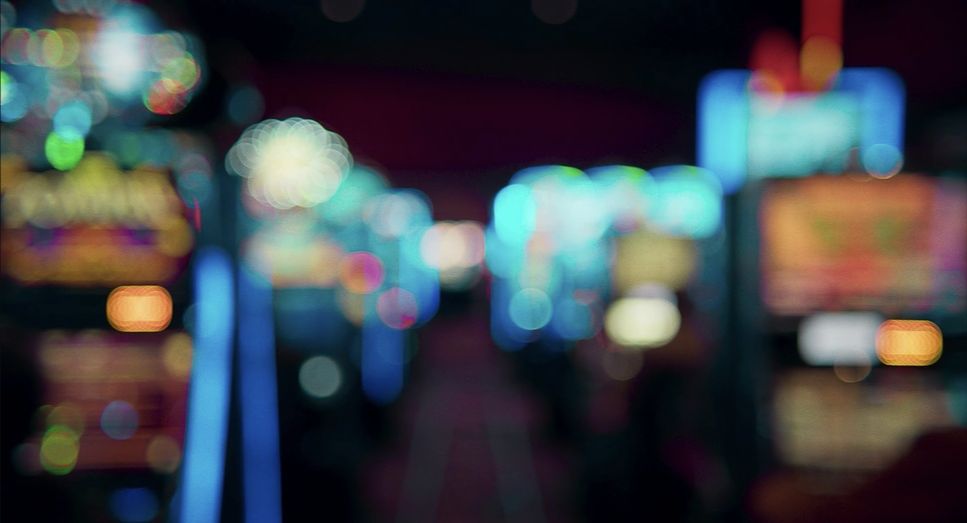
8 framesFrames where the out-of-focus lights carry the image: watch the shape, size and fill of the discs, and where they sit.
How to create a bokeh with AI
4 promptsModels add background blur by default but rarely shape it. Name the lens and stop, where focus sits, how far away the lights are and what the discs should look like. On one FlashBoards board you can line the takes up against the film frames above and pick the bokeh that fits. The fourth prompt re-shoots a real film shot from a text description alone, and the original plays next to the result so you can compare.
Cinematic close-up at night, 85mm lens at f/1.4. A man in his fifties with a shaved head, a short grey goatee, a small gold hoop in his left ear and a dark green corduroy jacket sits at a rooftop bar holding a glass tumbler; focus is locked on his eyes. Thirty meters behind him, strings of bare bulbs and lit office windows melt into large, soft, perfectly round bokeh discs in amber and pale blue, with smooth even fill. Warm key light from the left, subtle film grain.
Focus is locked on his eyes names the sharp plane; thirty meters behind him gives the distance that makes discs big. Bare bulbs and lit office windows supply point sources, and perfectly round, smooth even fill describes the bokeh, not just the blur.
Open FlashBoardsAnamorphic widescreen medium close-up, 75mm anamorphic lens wide open. A young woman with a teal-dyed undercut, freckles across her nose and a yellow raincoat waits at a rainy tram stop at night; her face is sharp. Behind her, traffic lights, tram headlights and shop signs dissolve into tall vertical oval bokeh in red, green and white, with a thin horizontal blue lens flare. Wet asphalt reflections, cool streetlight.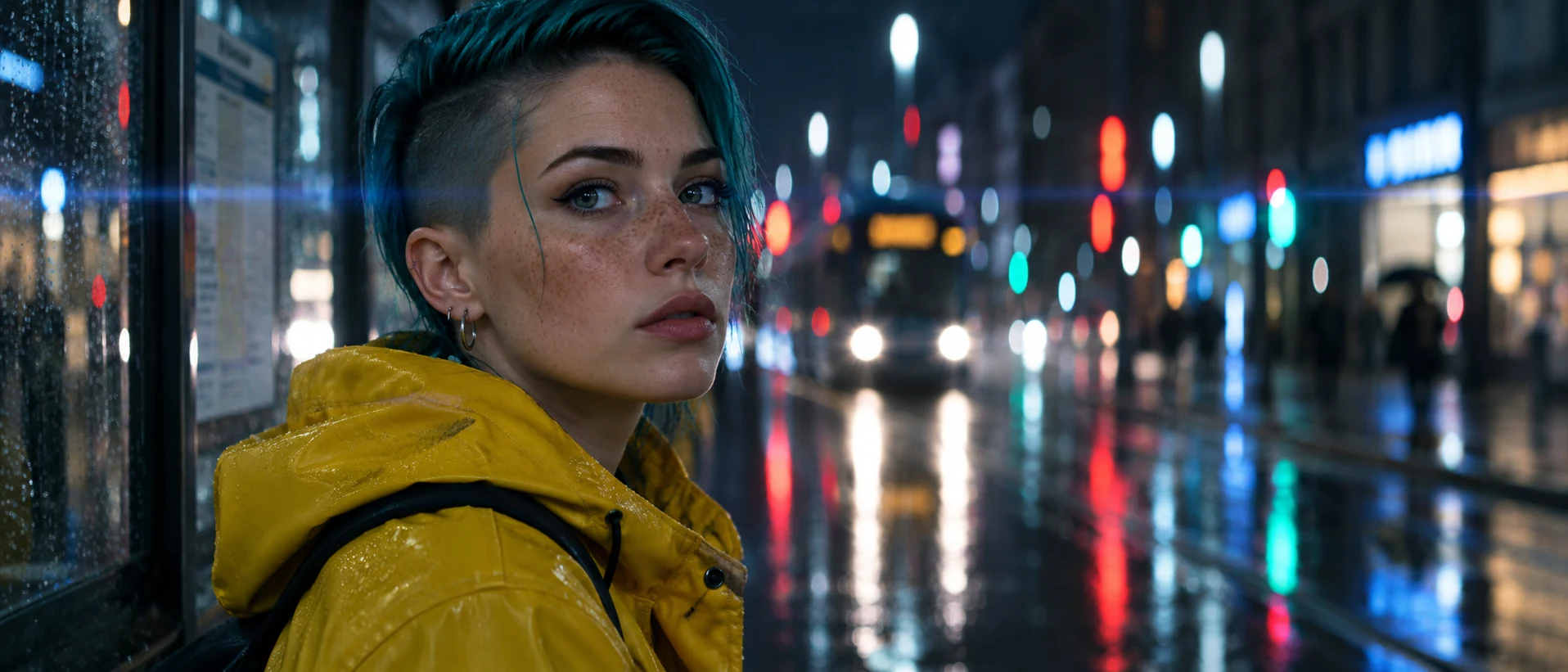
Anamorphic lens plus tall vertical oval bokeh asks for stretched discs spherical glass never makes; the horizontal blue lens flare reinforces the read. Many named light sources give the model points to turn into ovals.
Open FlashBoardsCamera: a slow lateral move to the left of about half a meter across the whole shot, same height, focus staying on his eyes. Action: from the first frame he raises the glass tumbler and takes a sip while the round bokeh discs behind him slide gently to the right. In the middle he lowers the glass and turns his head slightly toward the lens. At the end he holds still as the amber and blue discs keep drifting behind him.The sip starts motion immediately, so the model doesn't just creep in on a still. The slow lateral move makes the far discs slide, which sells depth, and focus staying on his eyes keeps them soft.
Open FlashBoards{
"output": "Full-screen live-action shot from Margin Call (2011), from its very first frame: one continuous shot. 35mm night photography, a long lens wide open with focus set far too close, so the whole frame is pure out-of-focus light: big, perfectly round, evenly filled bokeh discs in saturated yellow, cyan, red and warm white on deep black. The top half of the frame is empty black; the discs sit in the lower half and overlap.",
"characters": {},
"shots": [
{
"shot": 1,
"camera": "locked-off static frame, the framing never changes, focus stays soft for the whole shot",
"voice": "silence: nobody speaks in this shot, no voice at all",
"action": [
"BEGINNING: alive from the first frame, about fifteen large discs, each about a third of the frame height: a big yellow disc left of centre, a red disc just right of it, a bright cyan disc in the centre, two overlapping yellow discs and a second cyan disc on the right, a row of fainter white and amber discs along the bottom edge.",
"THEN: the upper discs start to float slowly upward together while the bottom row stays low; the gaps of black between them widen.",
"THEN: the two white discs at the bottom left and bottom centre dim and sink out of the lower edge; the right-hand cyan disc slides out of the right edge.",
"THEN: the top-right yellow disc brightens to a hot white core with a thin yellow rim as it rises.",
"END: the centre cyan disc reaches the top edge and is cut in half by it; the big yellow disc on the left and a pair of yellow discs on the right hang in the black middle, a soft amber cluster glows along the bottom."
],
"dialogue": []
}
],
"sound": {
"ambience": "muffled night city hum heard from far away, faint distant traffic",
"speech": "no words in this video; the only human sounds are breaths and movement",
"never_spoken": "no narration and no voice-over: the descriptions, performance notes and step words of this prompt are never spoken aloud",
"music": "a film score under the scene, always below the voices: a low sustained synth pad with a slow, uneasy pulse",
"subtitles": "none"
}
}Remakes the fully defocused night-city shot from Margin Call (2011): the prompt keeps the static frame, the big yellow, cyan and red discs under black, and the cyan disc rising to the top edge.
Focus set far too close turns the whole frame into bokeh, so the discs are the subject. Sizing them at a third of the frame height stops the model drawing a fine glitter of dots, and the locked-off camera lets their slow rise carry the shot.
Open FlashBoardsCommon mistakes
- Blur with no discs. Give the background small light sources and say large, soft, round bokeh discs.
- Tiny discs. Lights too close to the subject stay small; state a distance such as thirty meters behind him.
- Soft face. Always name the sharp plane: focus locked on his eyes.
- Smeared video. Fast moves or focus changes turn discs into streaks; keep the camera slow.
Keep the reference frames, prompts and every generated take side by side — images and video in one canvas.
FAQ
4 questionsWhat is bokeh in simple terms?
Bokeh is the way a lens draws the out-of-focus parts of a picture. It is easiest to see in lights behind or in front of the subject, which turn into soft discs, ovals or polygons. Blur is the amount of softness; bokeh is its character, smooth or busy.
How do you get a bokeh effect in video?
Open the lens to around T1.4–T2.8, use a longer focal length such as 85mm, keep the subject close to the camera and put small bright lights far behind them. The larger that distance, the bigger the discs. Expose for the face so the lights glow.
Why is anamorphic bokeh oval?
An anamorphic lens squeezes the image horizontally onto the sensor, and it is stretched back out in post. Out-of-focus points are squeezed with everything else, so after unsqueezing they appear as tall vertical ovals instead of circles, one of the easiest ways to recognize anamorphic footage.
Is bokeh the same as a blurry background?
No. A blurry background comes from shallow depth of field: the focus zone is thin and the background falls outside it. Bokeh is the quality of that blur, meaning the shape, edges and texture of out-of-focus highlights. A plain wall can be blurred and show almost no bokeh.
Related terms
6- Shallow Depth of FieldLenses, Focus & Exposure
Shallow depth of field keeps only a thin slice of the scene sharp — often just the eyes — while everything nearer and farther dissolves into blur, isolating the subject and steering attention.
- ApertureLenses, Focus & Exposure
Aperture is the adjustable opening inside a lens that controls how much light reaches the film or sensor; opening it up brightens the image and makes depth of field shallower, stopping down does the opposite.
- Depth of FieldLenses, Focus & Exposure
Depth of field is the zone in front of and behind the point of focus that looks acceptably sharp; aperture, focal length, focus distance and format size decide whether it is razor-thin or stretches to the horizon.
- Anamorphic LensLenses, Focus & Exposure
An anamorphic lens squeezes a wide field of view horizontally onto film or a sensor, and the image is unsqueezed into widescreen later; its optical side effects — horizontal streak flares, oval bokeh and gently bending edges — became a signature of the big-screen look.
- Telephoto LensLenses, Focus & Exposure
A telephoto (long) lens has a narrow angle of view that magnifies distant subjects; used from far away it compresses space, stacking the background onto the subject — the look of long-lens crowd shots, heat-haze chases and isolated faces.
- Practical LightingLighting
Practical lighting uses light sources visible in the shot — table lamps, neon signs, candles, TV screens — either as the real illumination or as the visible motivation for hidden film lights.
Further reading
Blain Brown, Cinematography: Theory and Practice (3rd ed., 2016). American Society of Cinematographers, American Cinematographer Manual (lens and depth-of-field chapters).