 FlashBoards Learn
- Learn
- Lenses, Focus & Exposure
- Exposure Triangle
Lenses, Focus & Exposure · Film language
Exposure Triangle
The exposure triangle is the balance between aperture, shutter speed and ISO that sets how bright an image is. Change one and you must compensate with another, and every trade has a visible cost: aperture changes depth of field, shutter speed changes motion blur, and ISO changes noise and highlight room.
- What it does
- Turns brightness into a set of trade-offs: focus depth, motion rendering and noise are all paid for in stops of light.
- Use it when
- You plan a look before lighting: decide which side of the triangle carries the image, then balance the other two.
- Watch out
- On a cinema camera the shutter is usually locked; ND filters and lights do the balancing that photographers do with shutter speed.
- Try this prompt
night street close-up shot wide open at T1.5, 180-degree shutter, ISO 3200, thin focus on her eyes, fine grain, headlights smeared behind
What is the exposure triangle?
Three settings control how much light builds each frame, and all three are counted in the same unit, the stop: one stop doubles or halves the light.
- Aperture, the iris opening in the lens. T2 to T2.8 is one stop less light.
- Shutter speed, how long each frame is exposed. 1/48 s to 1/96 s is one stop less.
- ISO, how strongly the camera amplifies the signal. ISO 800 to ISO 1600 is one stop brighter.
Because the units match, settings trade freely. Start from T2.8, 1/48 s and ISO 800 and each of these gives the same brightness:
| Aperture | Shutter | ISO | What changes | |---|---|---|---| | T2.8 | 1/48 | 800 | the baseline | | T4 | 1/48 | 1600 | deeper focus, more noise | | T2 | 1/48 | 400 | thinner focus, cleaner image | | T2.8 | 1/96 | 1600 | crisper motion, more noise |
Same exposure in every row; different pictures. That difference is the point of the triangle.
What does each setting change besides brightness?
Aperture buys light with focus. Opening up brightens the frame and thins depth of field. See aperture for f-stops and T-stops. For the candlelit scenes of Barry Lyndon (1975), Kubrick and John Alcott used Zeiss 50mm f/0.7 lenses and paid with paper-thin focus; Gregg Toland's deep focus in Citizen Kane (1941) went the other way and demanded a lot of light.
Shutter speed buys light with motion. A longer exposure smears movement; a shorter one freezes it into sharp, strobing steps (see shutter speed).
ISO buys brightness with image quality. Raising it lifts the picture and the noise together and shifts the balance of highlight and shadow detail.
When none of the three can give more, the image slides into underexposure; when they cannot give less, highlights clip into overexposure.
How the triangle works on a cinema camera
On a film set one side is usually fixed. Frame rate and shutter follow the 180-degree shutter rule: at 24 fps the shutter sits at 1/48 or 1/50 s, because that amount of motion blur is what audiences read as cinema. Narrowing it is an effect, not an exposure fix.
ISO is semi-fixed too. Cinema cameras have a base exposure index where the sensor holds its widest range, and many DPs stay near it for a whole show.
That leaves the stop, chosen for the look, plus two more tools:
- Neutral density filters remove light without changing anything else. ND 0.3 is one stop, ND 0.9 three, ND 1.8 six.
- Lighting. Adding or cutting light is the cleanest way to hit a stop, which is why gaffers ask for the working stop first.
How to balance exposure on set, step by step
- Lock frame rate and shutter. 24 fps, 180 degrees, unless the scene calls for a different motion feel.
- Pick the stop for the story. T1.5 to T2 isolates a face at night; T4 to T5.6 keeps two actors at different distances sharp; T8 and beyond is for deep staging.
- Set ISO at the camera's base. Move it only when the other sides are out of room.
- Fill the gap with ND or light. A sunny exterior at ISO 800 and 1/48 s would need roughly f/64; to shoot it at T2.8 you add about nine stops of ND.
- Trust false color or a waveform, not a bright on-set screen, to place skin and protect highlights.
Common exposure triangle mistakes
- Using shutter speed to fix brightness. 1/200 s in daylight darkens the image but makes every walk stutter. Reach for ND first.
- Treating ISO as free light. It amplifies what the sensor caught and adds no shadow detail.
- Stopping down for safety. f/11 on every shot keeps focus easy but flattens the space. Choose depth on purpose, as the lenses, focus and exposure guides explain.
How to create a exposure triangle with AI
3 promptsModels do not calculate exposure, so name the result of each setting: how thin the focus is, what motion blurs, how much grain sits in the shadows. Build the low-light, wide-open frame in Nano Banana 2 Lite, a bright stopped-down take with a fast shutter in GPT Image 2.5, and animate recipe 1 with MiniMax H3 Max Turbo. Keep both corners of the triangle side by side on one FlashBoards board.
Cinematic medium close-up on a wet city street at night, 50mm lens wide open at T1.5, 180-degree shutter, ISO 3200. A woman in her late forties with cropped silver hair, a thin scar through her left eyebrow and a mustard raincoat walks toward the camera; focus holds on her eyes, her collar already soft. Behind her, the headlights of passing cars are smeared into short horizontal streaks, shop windows blurred into soft blocks of color. Light rain, fine visible grain in the shadows, deep blacks, highlights just holding.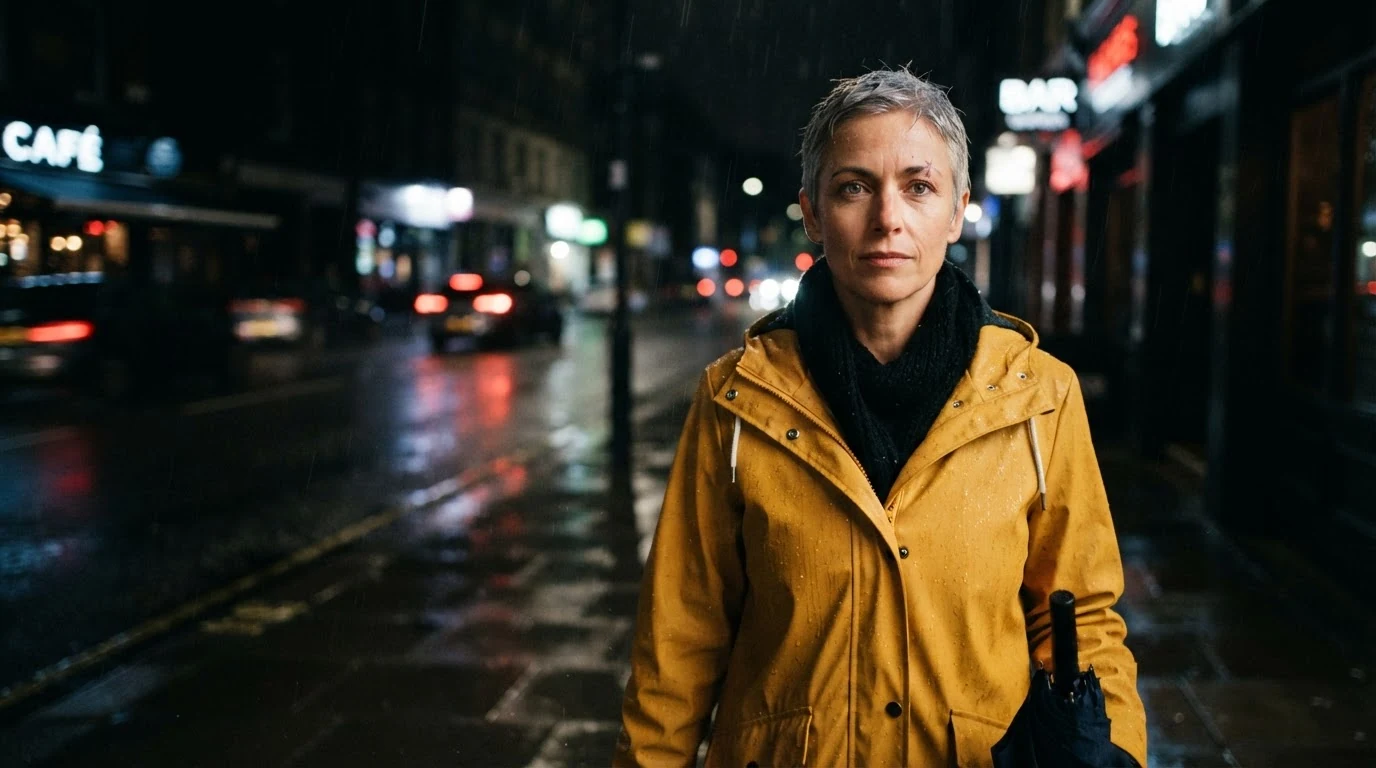
The words that carry the settings are their costs: collar already soft for the open aperture, headlights smeared into short streaks for the 180-degree shutter, fine visible grain in the shadows for the high ISO. Highlights just holding keeps the headlights from clipping to flat white.
Open FlashBoardsWide shot on a sunlit harbor quay at noon, 28mm lens stopped down to f/11, shutter 1/1000 s, ISO 200. A boy of about eleven with curly red hair and a green windbreaker is caught mid-leap over a puddle, every droplet frozen as a sharp bead in the air. Everything sharp from the puddle two meters away to the white lighthouse at the end of the quay. Hard sun, clean noise-free image.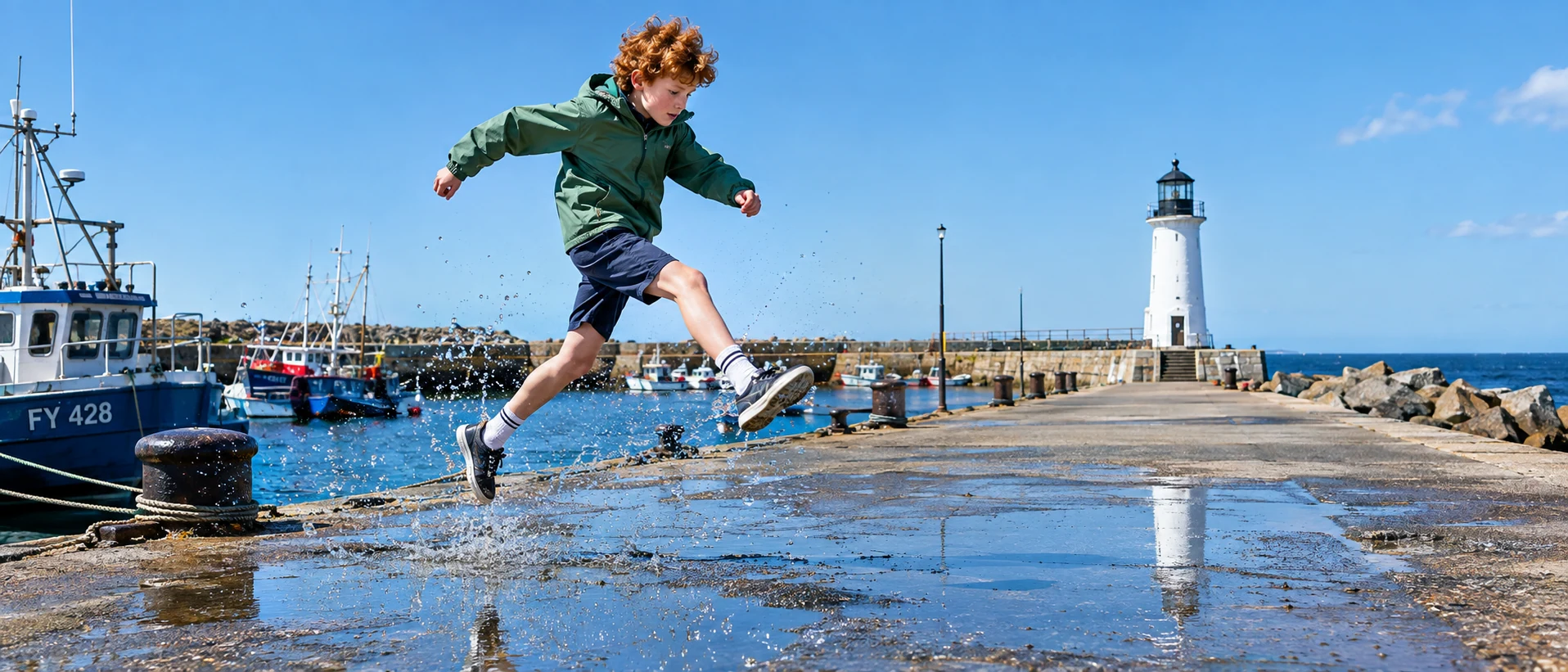
The opposite corner. Every droplet frozen as a sharp bead is how a fast shutter shows up; sharp from two meters to the lighthouse states depth as distance, which models follow better than f/11; clean noise-free reads as low ISO.
Open FlashBoardsCamera: slow backward tracking move at her walking pace from the first frame to the last, keeping her in the same medium close-up. Focus stays on her eyes throughout. Action: she is already walking toward the camera as the shot begins, rain falling through the frame. In the middle a car passes behind her, its headlights streaking softly. At the end she glances to her left, then back toward the lens, still walking.Already walking and rain put motion in the first frame; the passing car gives the 180-degree blur something to render; repeating the focus plane keeps the wide-open look.
Open FlashBoardsCommon mistakes
- Numbers without results. ISO 3200 alone rarely adds grain; write fine visible grain in the shadows.
- Everything too clean at night. Models brighten dark scenes; say deep blacks, lit only by the shop windows and headlights.
- Mixed signals. T1.5 beside everything sharp gives a compromise; one depth per prompt.
- Wrong motion in video. Name the blur, such as soft streaks behind moving cars, not a shutter angle.
Keep the reference frames, prompts and every generated take side by side — images and video in one canvas.
FAQ
5 questionsWhat are the three parts of the exposure triangle?
Aperture, shutter speed and ISO. Aperture is the lens opening and sets depth of field. Shutter speed is how long each frame is exposed and sets motion blur. ISO is the camera's amplification and affects noise and highlight room. All three are counted in stops, so a stop lost on one side is won back on another.
Which setting should you choose first?
In filmmaking, lock the shutter first, since frame rate and a 180-degree shutter set the motion feel of the whole film. Then choose the aperture for the depth of field the scene needs, keep ISO near the camera's base, and hit the exposure with ND filters and lighting.
Does raising ISO make the sensor more sensitive?
Not really. A digital sensor catches the same light at any setting; ISO changes how much that signal is amplified and where the camera places middle gray. Raising it brightens the picture and the noise together and usually shifts range from highlights toward shadows. So many cinematographers stay at base and add light instead of gain.
Is the exposure triangle the same for video and photography?
The physics is identical, but video fixes one side. A photographer can use 1/2000 s to control brightness; a filmmaker keeps the shutter tied to the frame rate so motion looks natural from shot to shot. Video balances aperture, ISO, ND and light instead.
Where do ND filters fit in the exposure triangle?
ND filters act like a fourth side. They cut light by a fixed number of stops without changing depth of field, motion blur or noise, so you can keep a wide aperture and a 180-degree shutter in bright daylight. ND 0.3 removes one stop, ND 0.6 two and ND 0.9 three.
Related terms
5- ApertureLenses, Focus & Exposure
Aperture is the adjustable opening inside a lens that controls how much light reaches the film or sensor; opening it up brightens the image and makes depth of field shallower, stopping down does the opposite.
- Shutter SpeedLenses, Focus & Exposure
Shutter speed is how long each frame is exposed to light; on cine cameras it is often set as a shutter angle, and it controls both brightness and how much blur movement leaves.
- OverexposureLenses, Focus & Exposure
Overexposure happens when too much light reaches the film or sensor: highlights clip to pure white and lose detail; used on purpose it reads as heat, memory, the afterlife or a dreamlike glare.
- UnderexposureLenses, Focus & Exposure
Underexposure is when too little light reaches the film or sensor: shadows sink into black and noise rises; controlled, it hides information and builds dread in night, thriller and horror scenes.
- 180-Degree Shutter RuleCameras & Capture
The 180-degree shutter rule sets the shutter speed to roughly double the frame rate — 1/48 or 1/50 s at 24 fps — which gives the natural motion blur audiences associate with cinema; breaking it makes movement stuttery (narrow shutter) or smeary (wide shutter).
Further reading
American Cinematographer Manual (ASC Press) — exposure, filter and lens tables. Blain Brown, Cinematography: Theory and Practice (Routledge) — chapters on exposure and camera settings.