 FlashBoards Learn
- Learn
- Camera Angles
- High Angle Shot
Camera Angles · Film language
High Angle Shot
Also called: high angle, high-angle view
A high angle shot places the camera above the subject's eye line and points it down at them. The viewer looks down on the character, who appears smaller, lower in status and more exposed — which is why the angle is used for vulnerability, defeat, surveillance and moments when a person is overwhelmed by the space around them.
- What it does
- Shrinks the subject, lowers their status and shows the ground or space that surrounds them.
- Use it when
- A character is losing control, being watched, trapped, or dwarfed by a place or a situation.
- Watch out
- A few degrees above eye level reads as a mistake; commit to a clear downward angle or stay level.
- Try this prompt
high angle shot, camera 2 m above, looking down 40° at a boy crouched on a stone floor looking up into the lens
What is a high angle shot?
A high angle shot is any shot where the lens sits above the subject's eyes and tilts down toward them. It is one of the basic camera angles, defined by the vertical relationship between camera and subject rather than by shot size — a high angle can be a close-up of a face or an extreme wide of a figure in a courtyard.
The angle works on a scale. Tilt down 10–15° from a camera just above head height and you get a slight high angle: the subject still feels close to us, only a little diminished. At 30–60° the effect is strong — the floor fills the background, the head becomes large relative to the body, and the character is pinned inside the frame. Keep going until the lens points straight down and you have an overhead shot, which stops reading as a point of view and becomes a map.
The opposite position is the low angle shot, which looks up and makes a subject loom. Between them sits the neutral eye-level shot. Because most coverage is at eye level, a deliberate move above it registers even with viewers who could not name it.
What does a high angle shot convey?
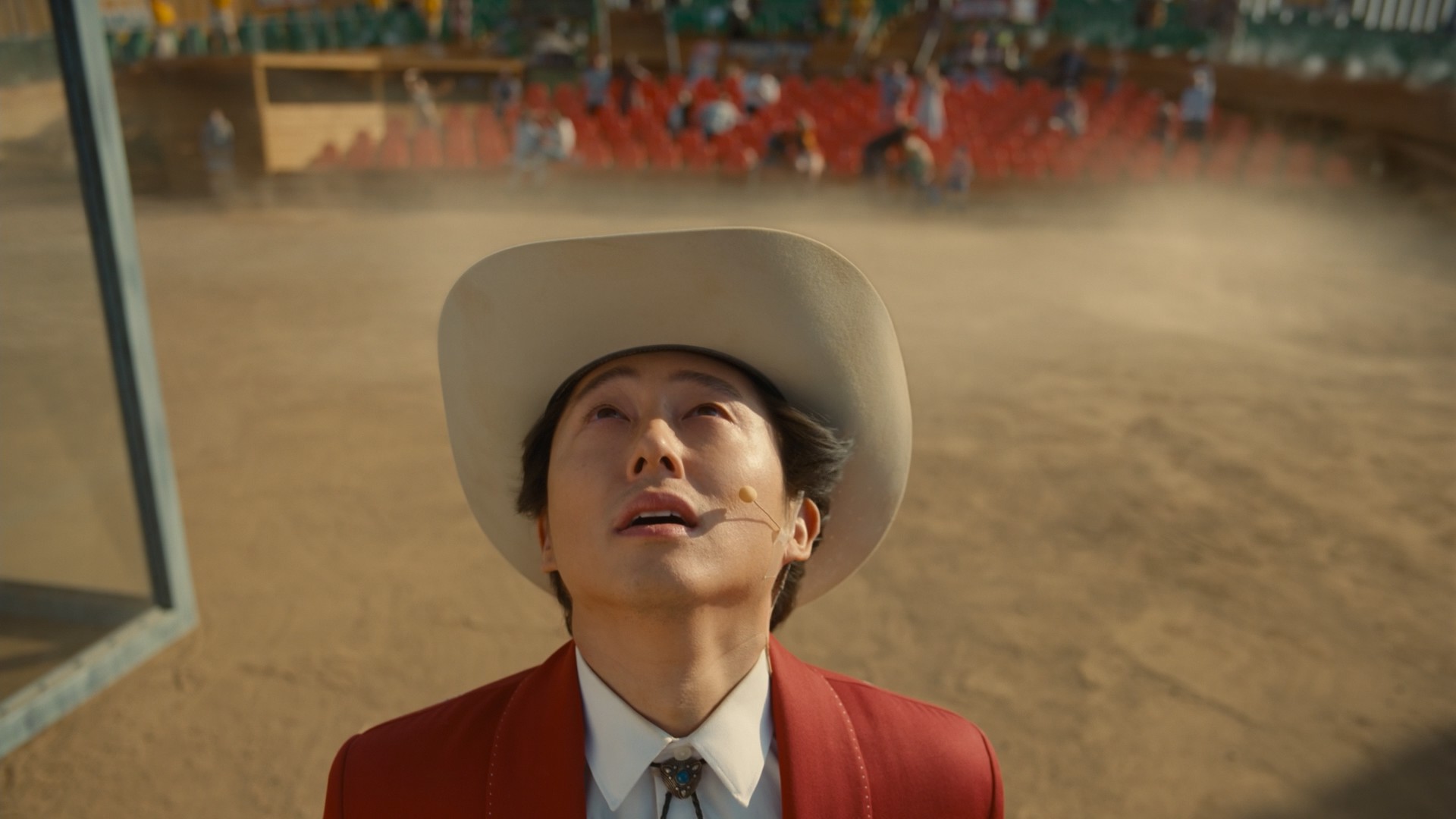
The first reading is power: we look down on the character, so the frame places them below us. When the subject lifts their face to the lens, the effect sharpens into pleading or dependency.
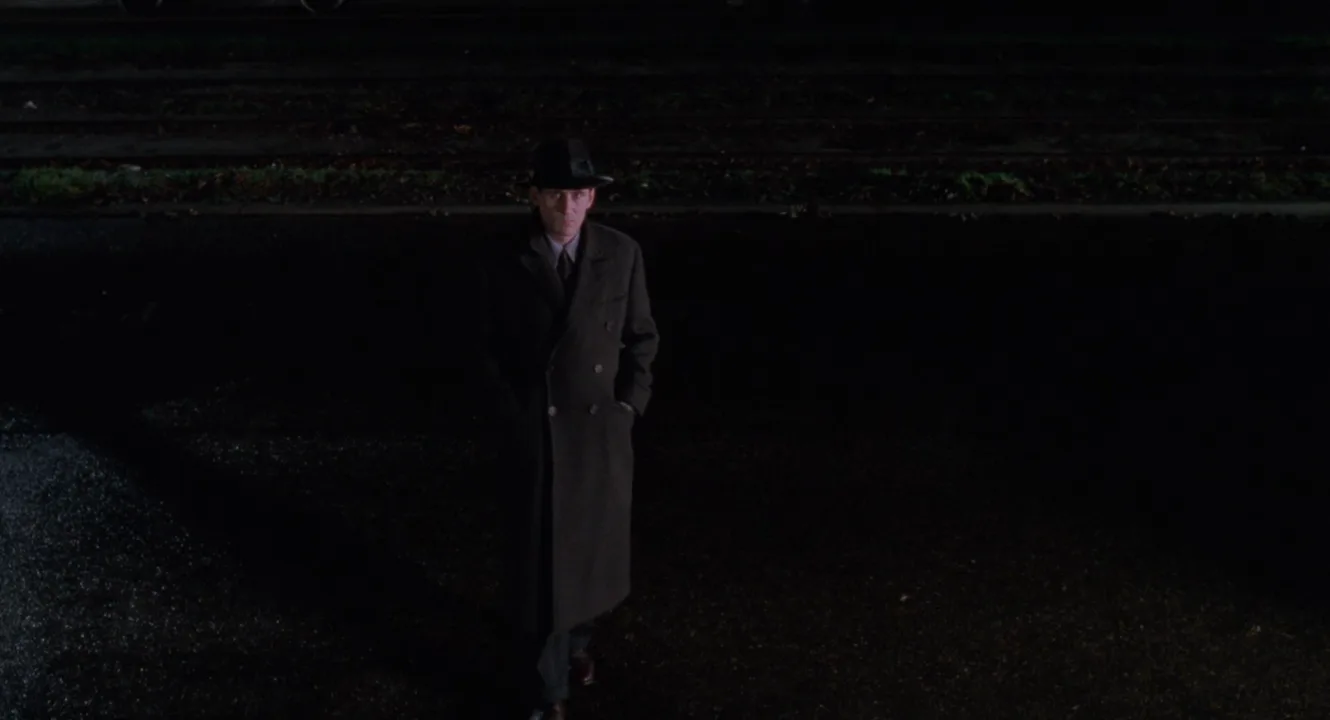
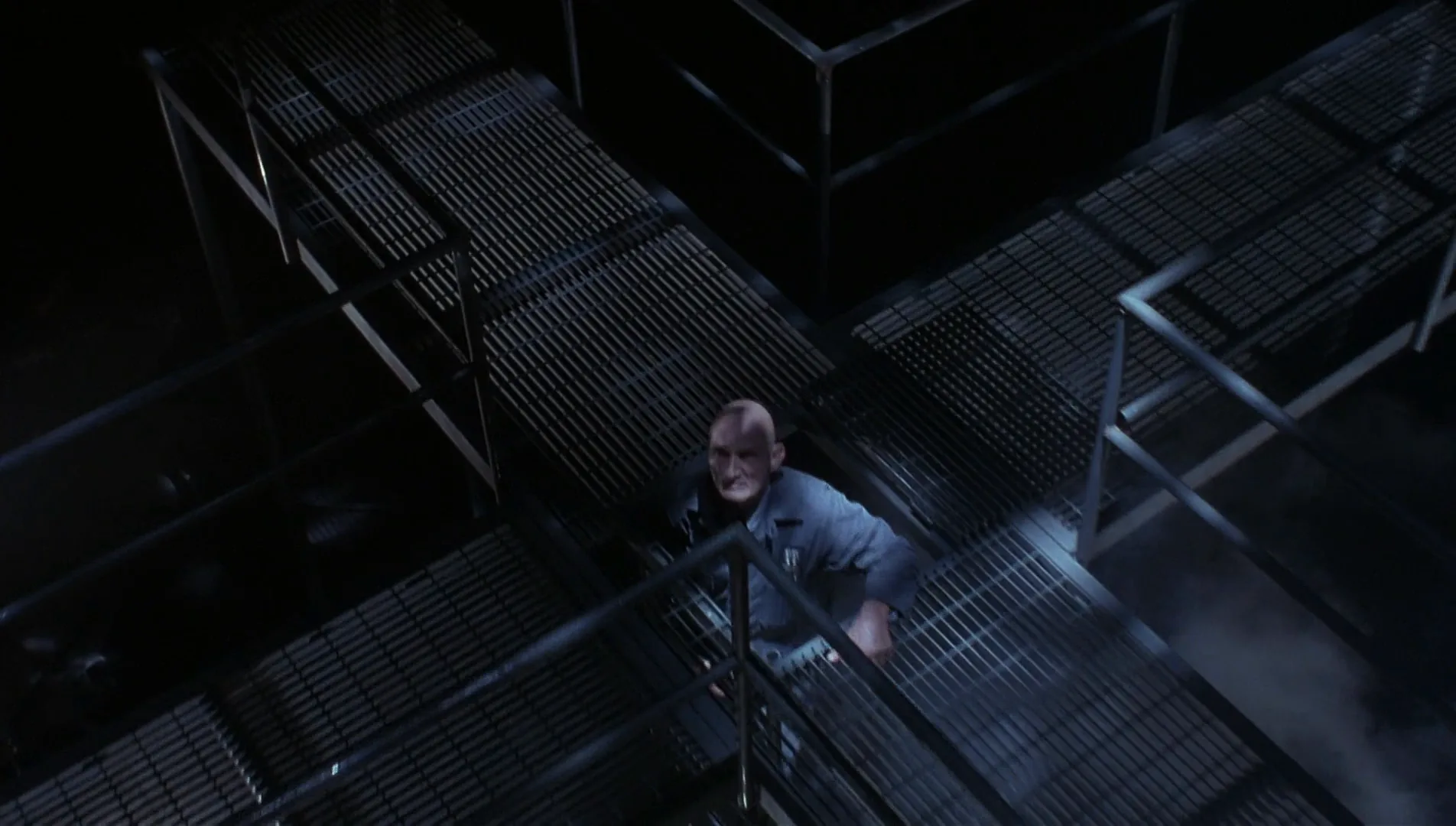
The second reading is exposure. From above, a character has nowhere to hide — the ground around them is visible, and so is the absence of anyone else. That is why high angles serve isolation and entrapment so well.
The third reading is observation. A high camera suggests a watcher: a security camera, a neighbor at a window, an omniscient narrator. Hitchcock used it constantly; in Notorious (1946) a crane moves down from a high view of a whole party to the key hidden in Ingrid Bergman's hand, turning the audience into the one who knows. Used as a POV shot, a high angle tells us someone is up there looking down.
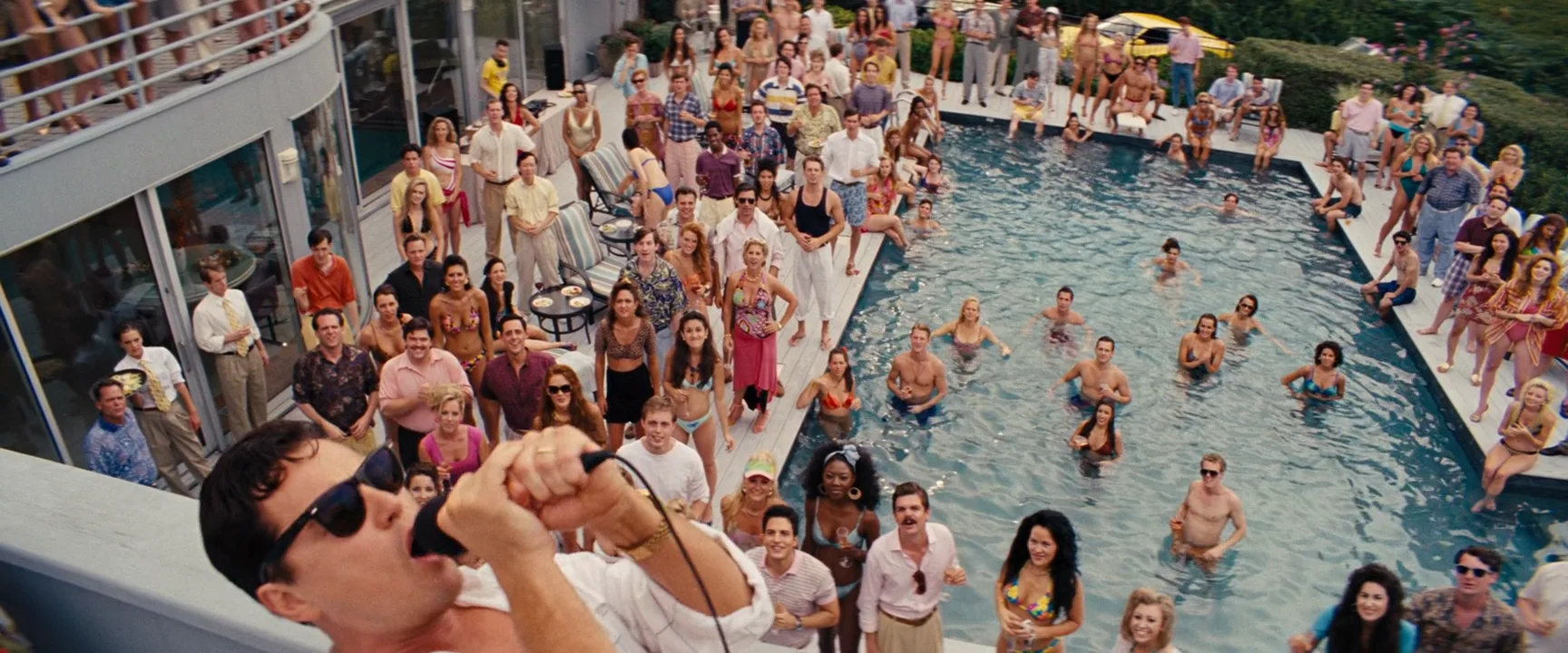
Finally there is scale and geography. A high wide shot explains a space in one frame — the floor plan of a room, the shape of a crowd, the pattern of a dance. In Gone with the Wind (1939) the camera rises over the wounded soldiers at the Atlanta rail yard until Scarlett becomes a speck in a field of bodies; the angle turns one woman's search into a catastrophe. That upward move is a classic crane shot.
How to shoot a high angle shot
Height and angle. For a slight high angle on a standing adult, the lens is around 1.9–2.1 m, tilted 10–20° down — a tall tripod or apple boxes are enough. For a strong high angle, the lens goes to 2.5–4 m and tilts 30–60°: a ladder with a combo stand, a scaffold, a balcony, a mezzanine, a jib or a telescopic crane. Above that, drones and cherry pickers take over and you are close to aerial shot territory.
Lens. A wide-angle lens (18–28 mm on Super 35) exaggerates the effect: the head grows, the feet shrink, and the floor stretches away in steep perspective. Useful for fear and childhood, but it can look comic on faces. A normal or longer lens (40–85 mm) from further up keeps proportions natural and makes the subject look small because of the space around them rather than because of optical distortion.
Blocking and eyeline. Eyes down or away read as surveillance or defeat; eyes up into the lens acknowledge someone above — a parent, a captor, a god. If the shot is a reverse of a standing character, match the height of the lens to that character's eyes so the geometry cuts.
Lighting and the floor. In a high angle the floor becomes your background; texture, tiles, rugs and pools of light on the ground do the work a wall would do at eye level. Watch toplight: a hard source above the subject burns the top of the head and shoulders, and a high camera sees every flag and stand placed on the floor.
Converging verticals. Tilting down makes walls lean inward toward the bottom of the frame. To keep them straighter, go higher and tilt less, or use a longer lens from further away.
Moving into it. A camera that rises on a pedestal move or a jib while keeping the subject in frame makes the high angle happen in front of the audience: the character shrinks as we pull away.
High and low angles in dialogue
The high angle rarely works alone in a conversation. Its natural partner is the low angle on the other character: the dominant figure is shot from below, the weaker one from above, and every cut restates who has the upper hand. Interrogations, custody hearings and parent–child confrontations often cut between a camera near the ceiling and one near the table.
The pattern gets more interesting when it shifts inside a scene. Start both characters at eye level; as one gains power, drop their coverage lower and raise the other's. Audiences feel that change without noticing it.
Keep the angles motivated by eyelines. If one character stands and the other sits, the high angle on the seated one is simply where the standing character's eyes are. The stylized version comes when the angle exceeds what any eyeline could justify.
High angle vs. overhead shot
The difference is the angle of the lens. A high angle tilts down at the subject from somewhere between a few degrees and roughly 60–70°; you still see the subject's face or front, and you still feel a point of view with a position in space. An overhead shot points straight down at around 90°, so the subject becomes a shape on a flat plane — the top of a head, the pattern of a floor, the geometry of bodies on a table.
The emotional reading changes with it. A high angle is about a relationship: someone is small relative to someone or something. An overhead shot is about design and fate: the world as a board game seen by something detached. In Psycho (1960) Hitchcock cuts to a camera near the ceiling for the staircase attack on Arbogast, which both hides the attacker and makes the moment feel ordained.
In practice many shots sit between the two. If you can see a face, call it a steep high angle. If the image flattens into a graphic pattern and top and bottom of the frame could be swapped, it is overhead. The worm's-eye view is the matching extreme at the other end of the scale, looking straight up.
High Angle Shot examples in film
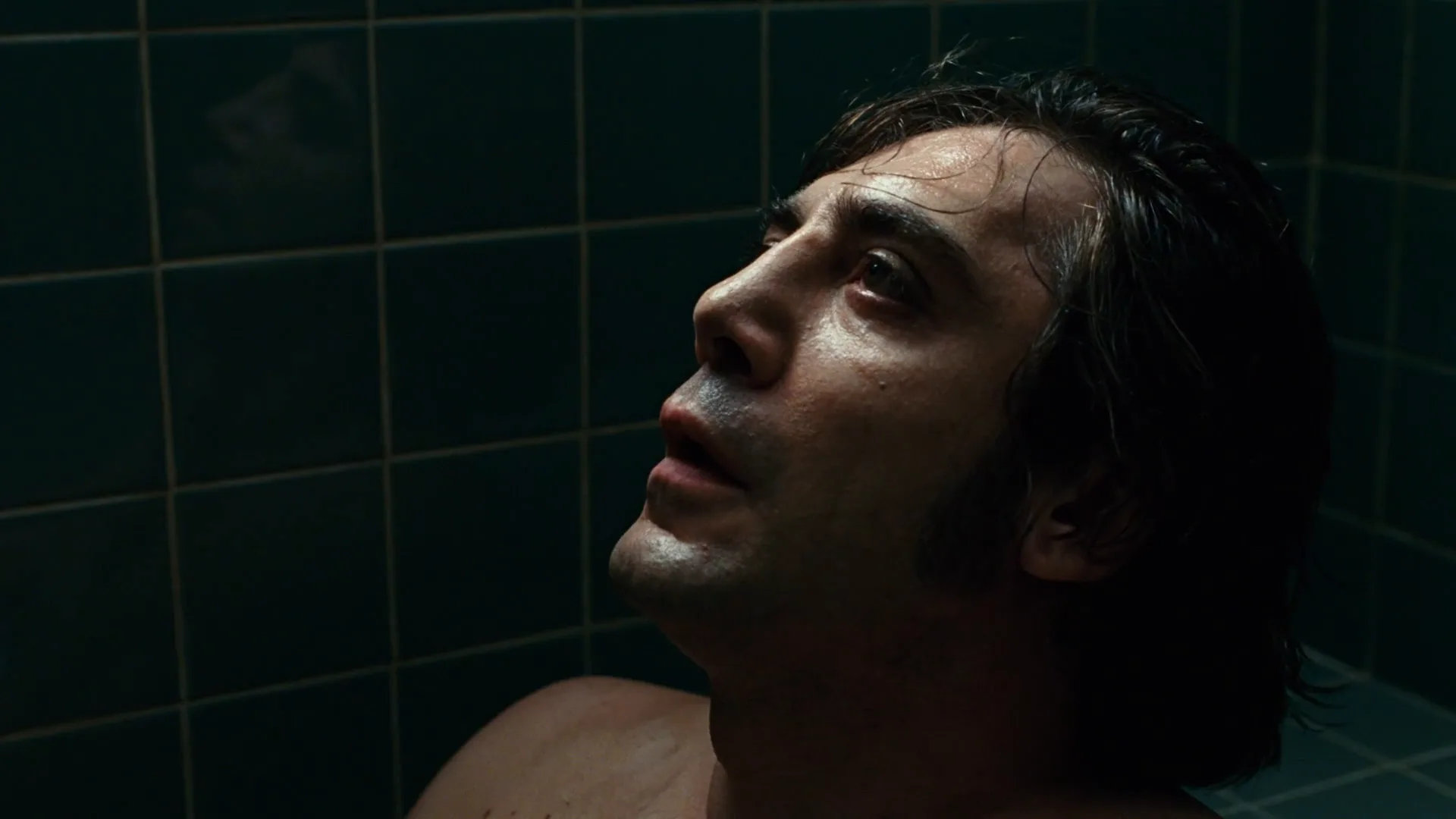
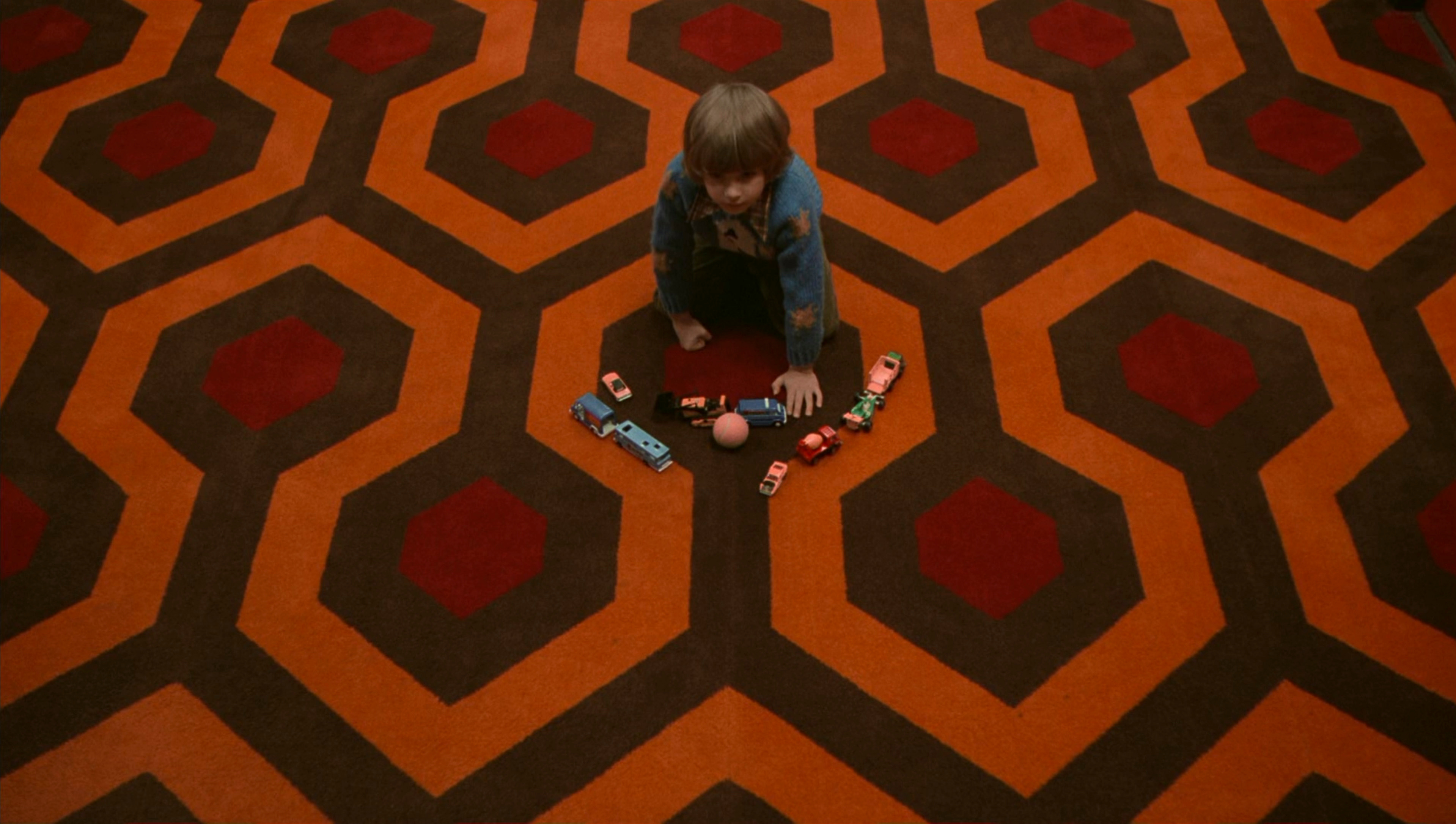
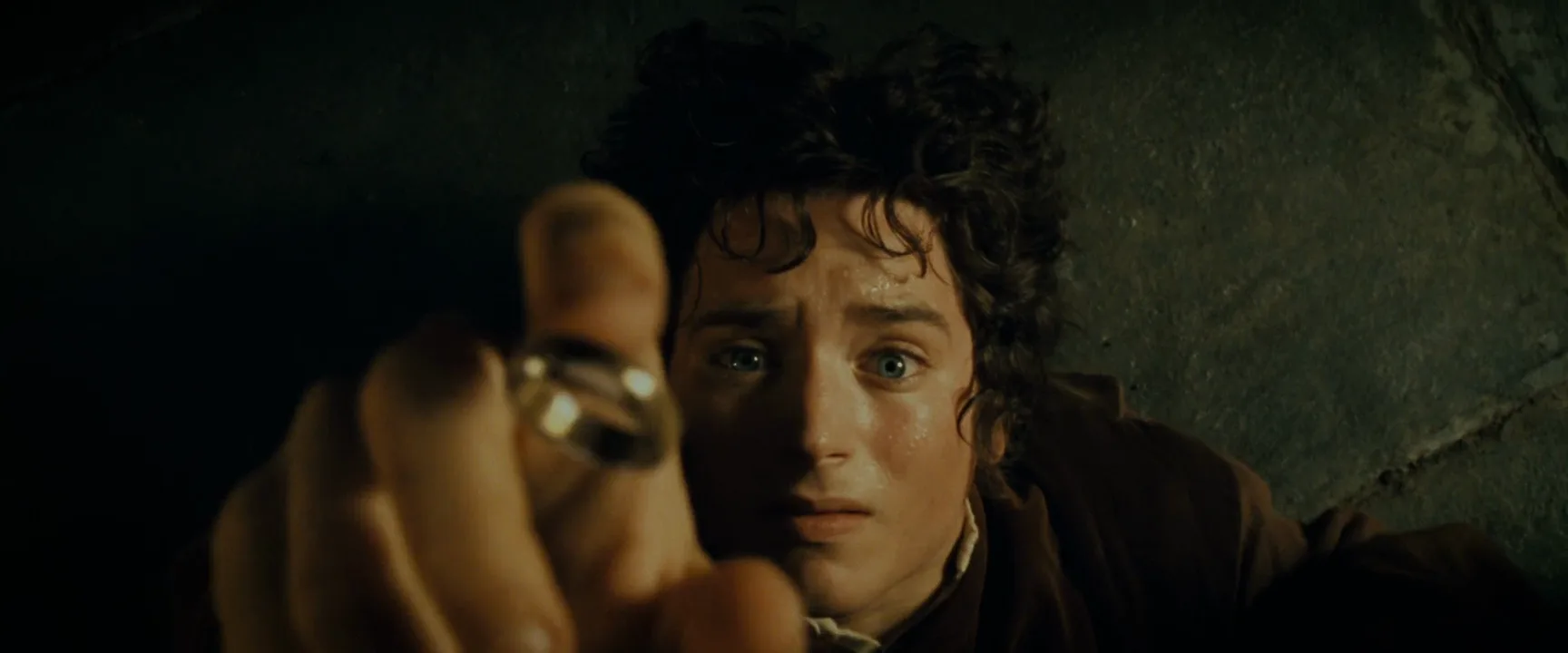
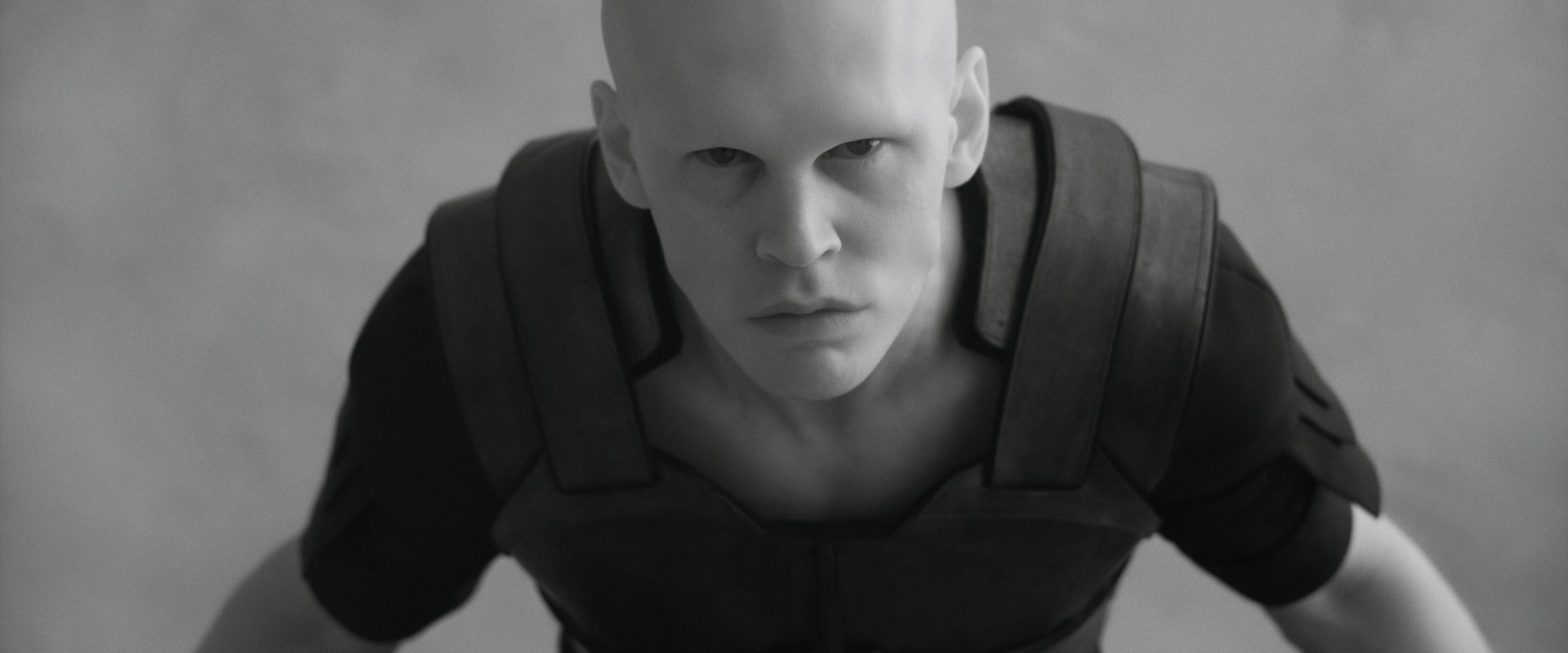
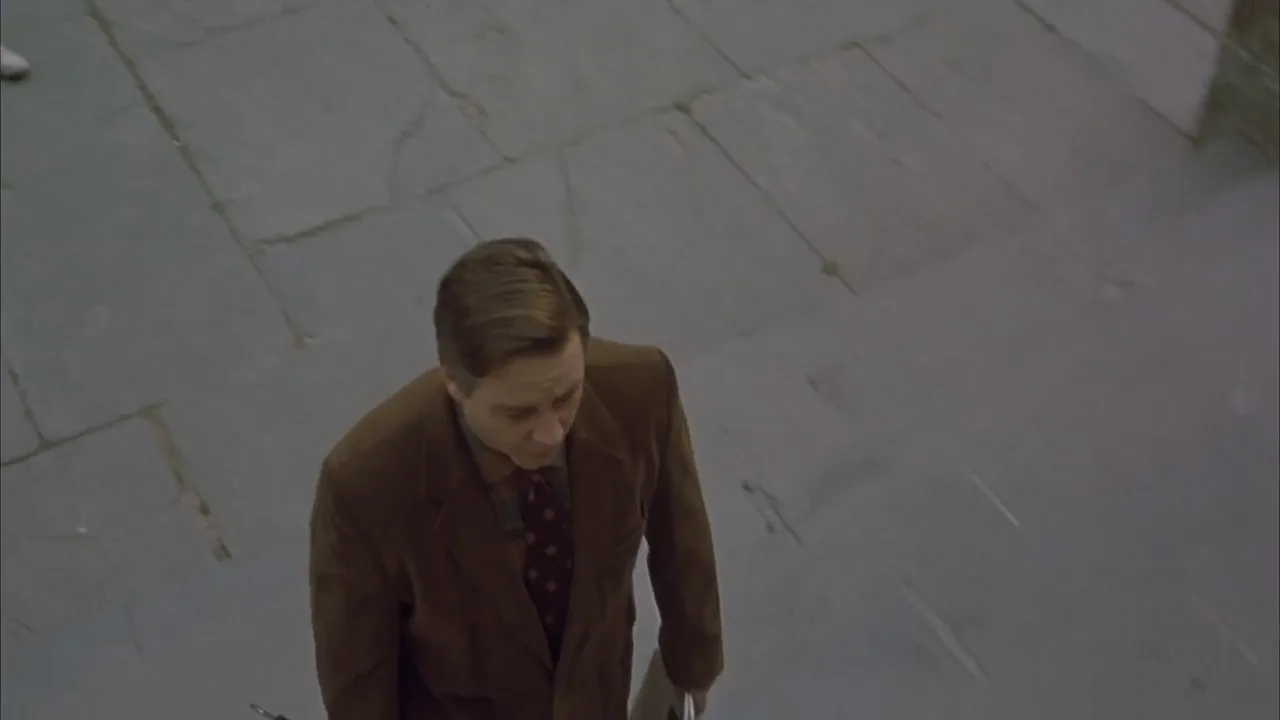
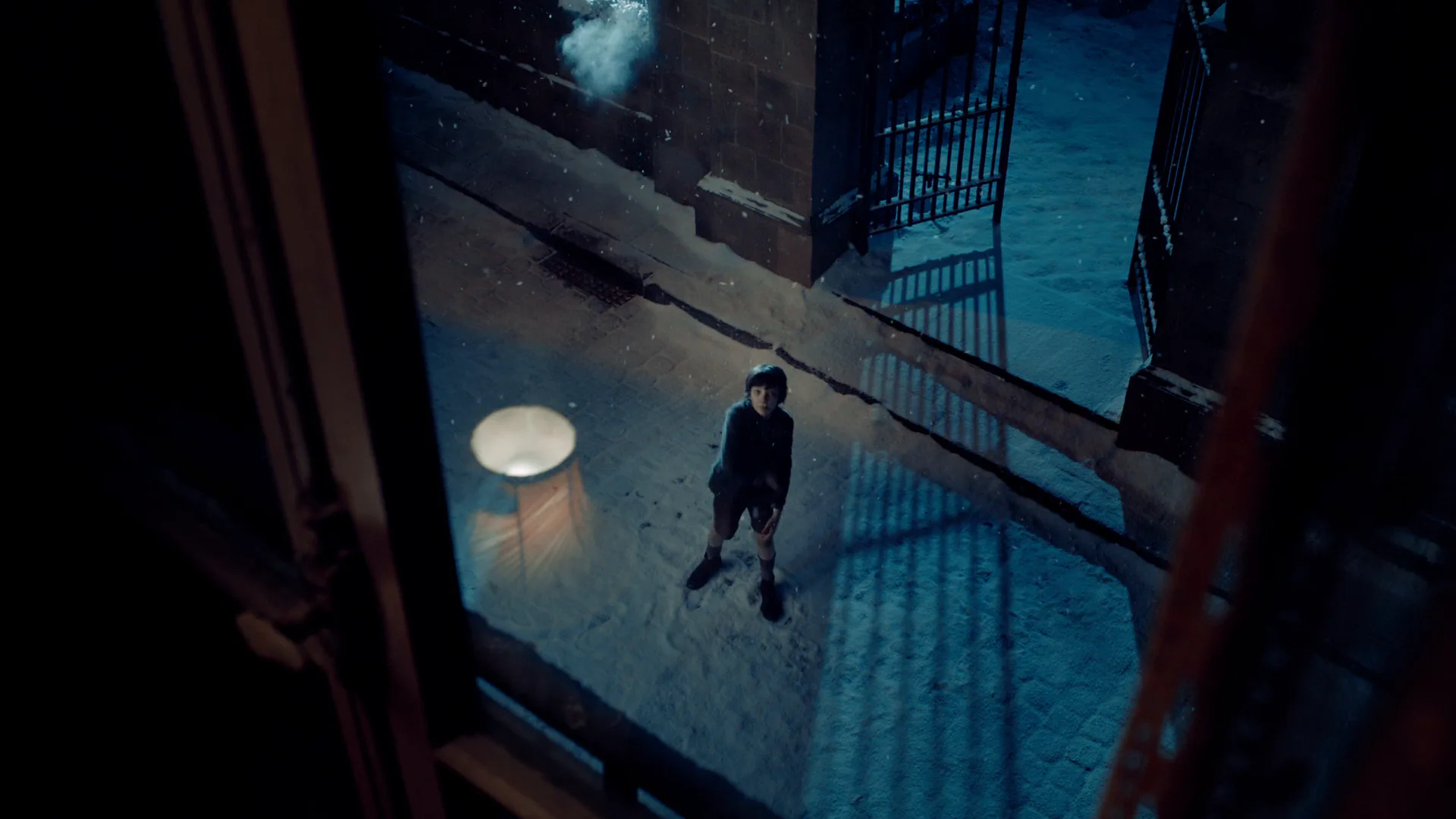
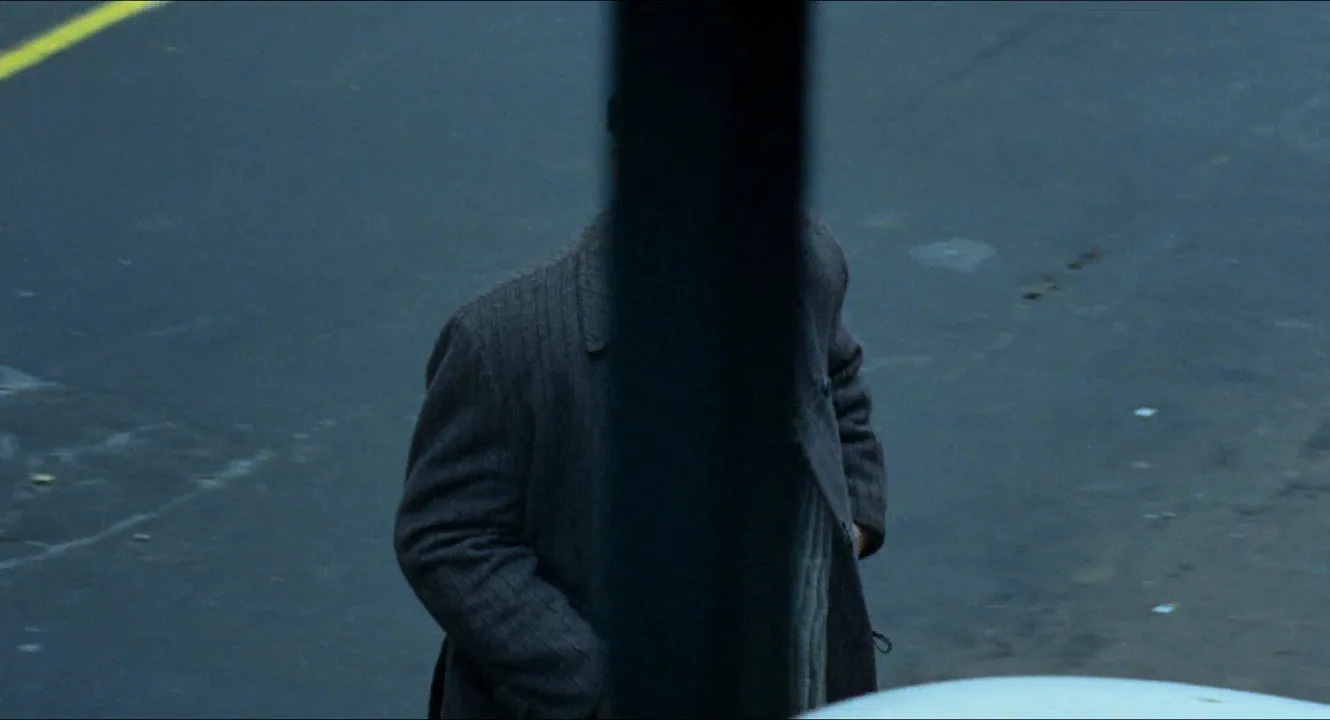
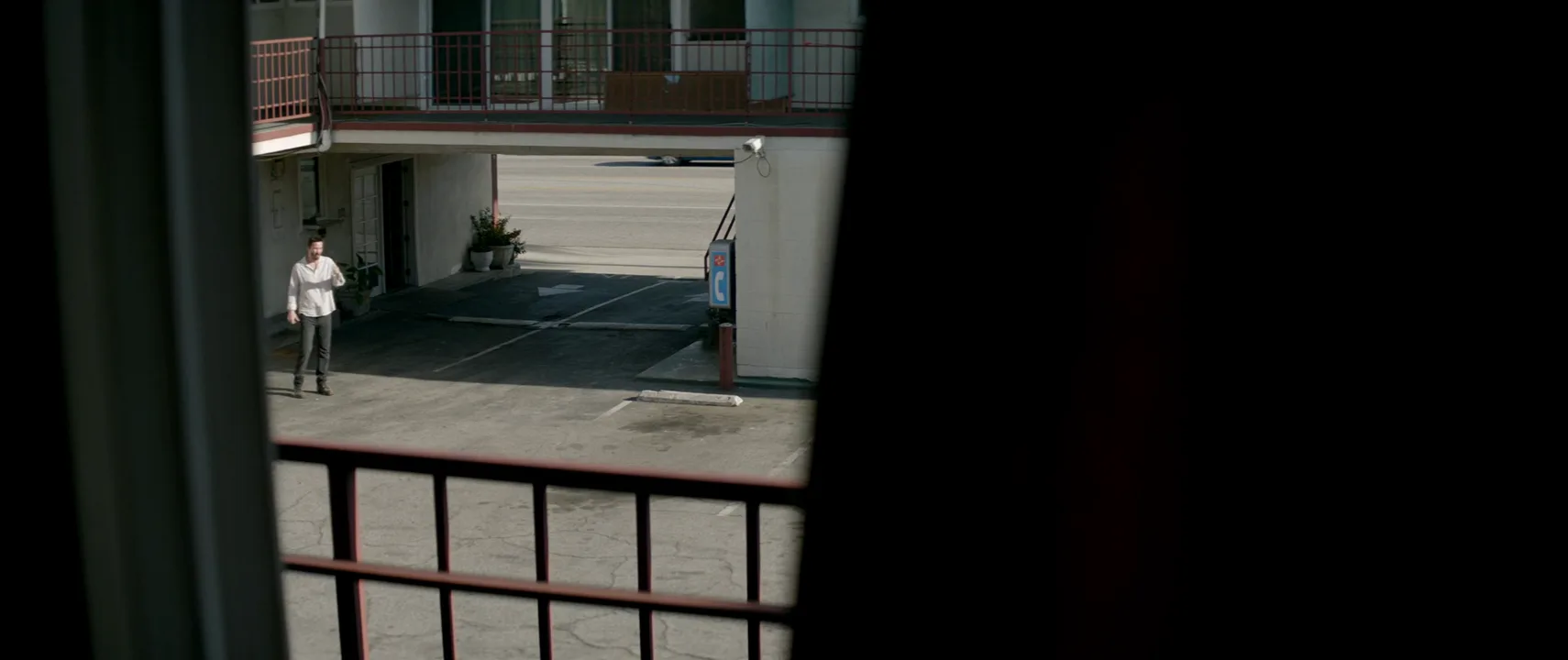
13 framesThirteen frames from slight to steep high angles, close-ups to extreme wides. Notice how often the subject looks up toward the lens, how much of each frame is floor, and how many are framed from a window or a ledge.
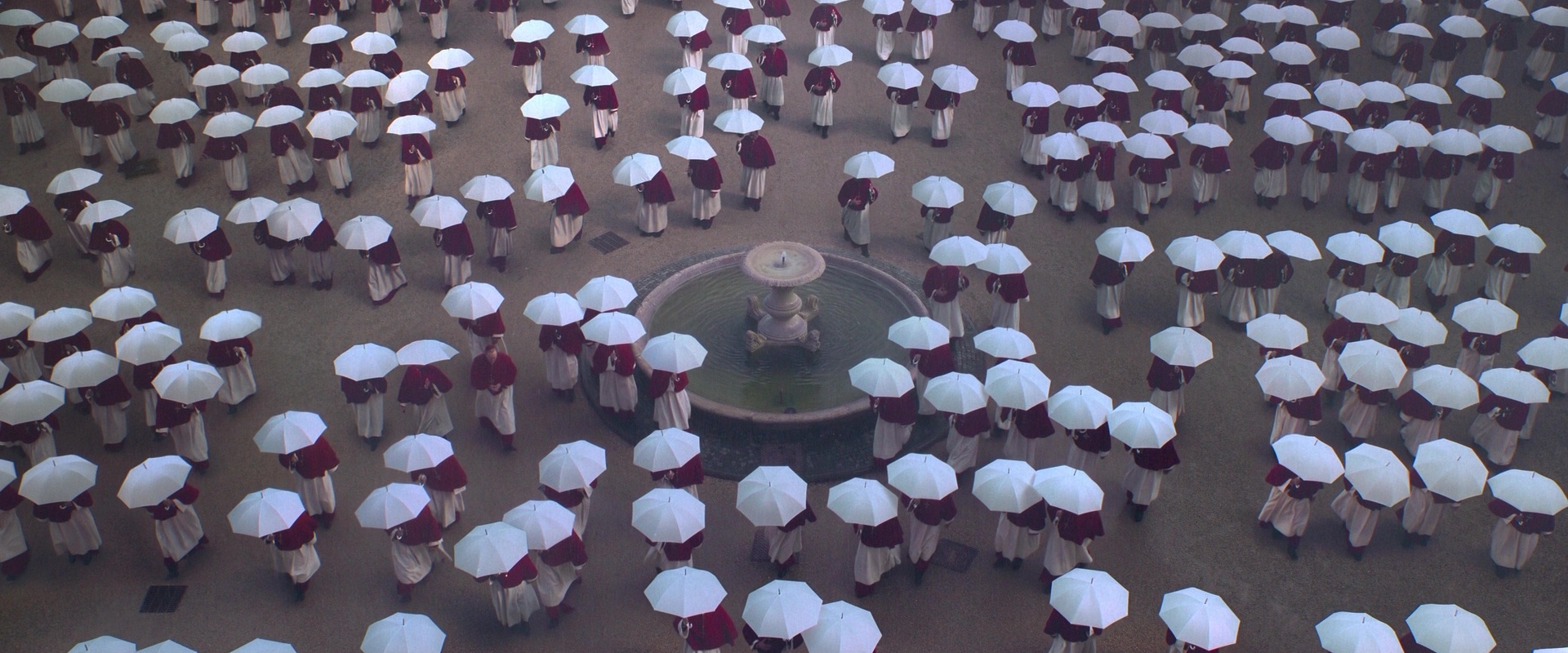
How to create a high angle shot with AI
4 promptsImage and video models default to eye level, so a high angle has to be spelled out as a camera position, not a mood. In FlashBoards, lock the angle in a start frame with Nano Banana 2 Lite, try a second take with GPT Image 2.5, then hand the best frame to MiniMax H3 Max Turbo to animate it — all on one board next to the reference frames above, so you can compare takes side by side until the height, tilt and eyeline match your coverage. The fourth prompt re-shoots a real film shot from a text description alone, and the original plays next to the result so you can compare.
High angle shot, camera 2.5 meters above the floor looking down at 45 degrees, a ten-year-old boy crouching alone on the worn stone floor of an empty train station hall, clutching a notebook, face turned up toward the lens, lots of empty floor around him, soft window light from the side, 28mm lens, muted warm palette, cinematic film still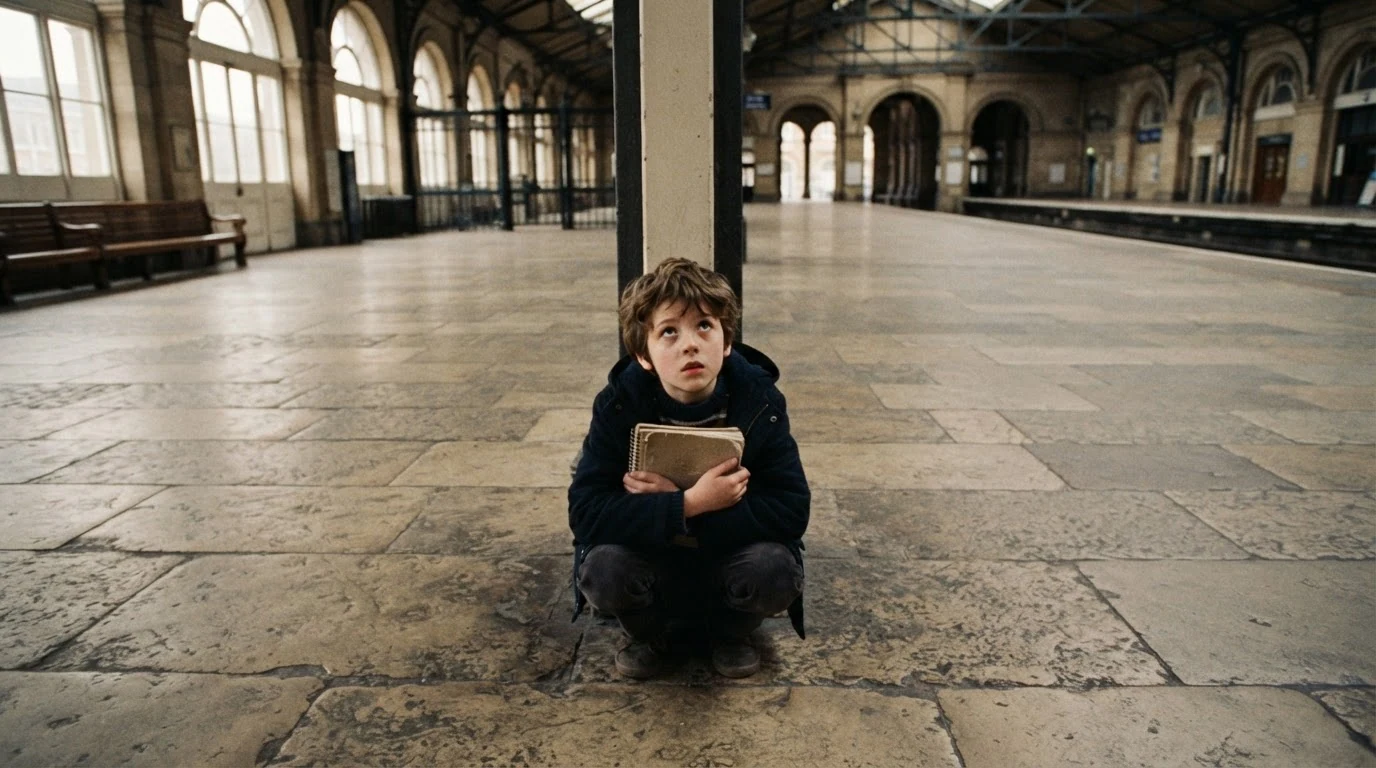
"Camera 2.5 meters above the floor looking down at 45 degrees" fixes the geometry; "face turned up toward the lens" gives the pleading reading; "lots of empty floor around him" forces the model to show the space that makes him small. The 28mm adds the head-heavy perspective. This frame is the start frame for the video recipe below.
Open FlashBoardsCinematic high angle medium shot from a second-floor window looking down into a narrow backyard, a woman in a grey hoodie standing by a plastic chair, unaware of the camera, edge of the window frame soft in the foreground, overcast daylight, 50mm lens, surveillance mood, film grain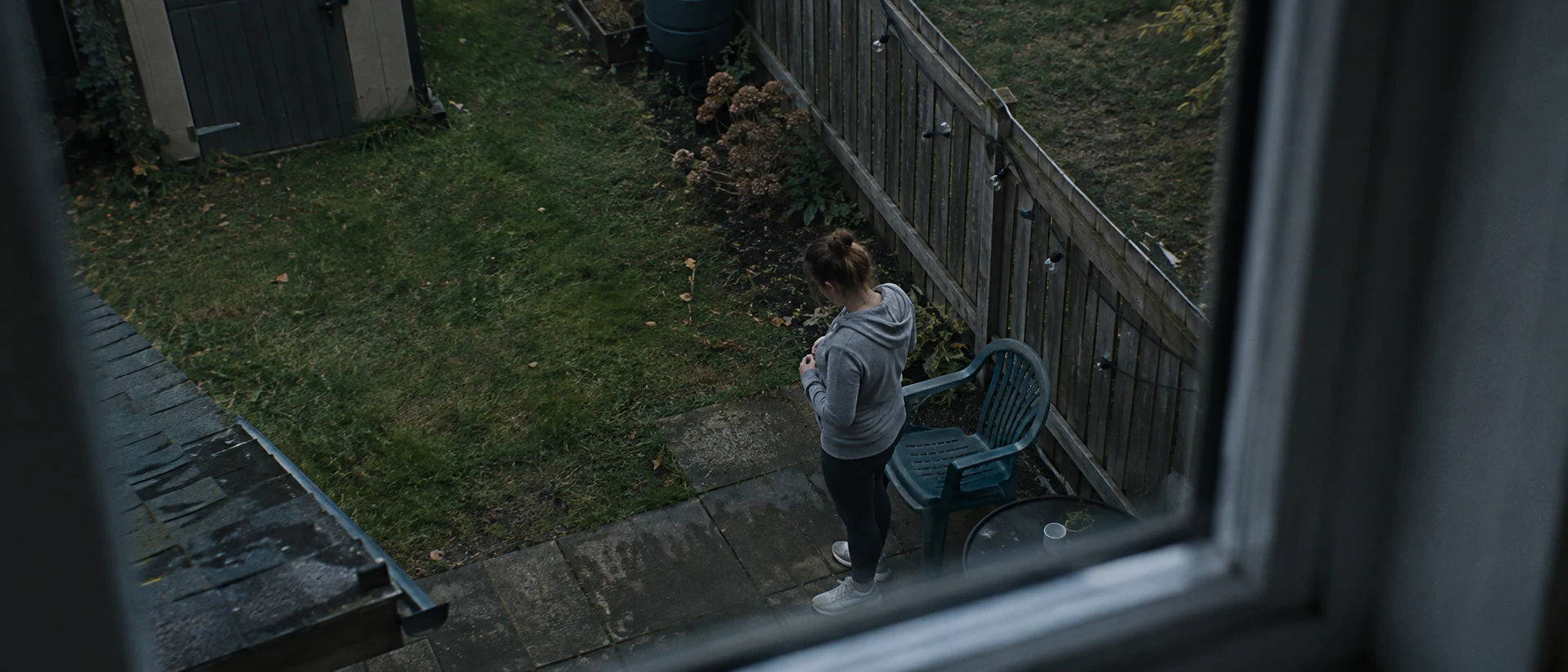
A second take on the angle: naming a concrete vantage point — "from a second-floor window looking down" — works better than the abstract words "high angle" alone. "Unaware of the camera" and the foreground window edge turn the angle into observation rather than weakness, and the 50mm keeps her proportions natural.
Open FlashBoardsCamera: slow, steady crane up, rising straight above the boy while tilting down to keep him centered, ending about twice as high with the stone floor filling the frame around him. Action: from the first frame the boy is already lifting his head and pressing the notebook to his chest, eyes on the lens. In the middle he pushes himself up from the floor and stands. At the end he stands still and small in the middle of the empty floor, still looking up as the camera keeps rising. The side window light stays soft and steady.The video starts from recipe 1's frame, so the angle and lens are already set; the prompt only describes what changes. "Rising straight above the boy while tilting down to keep him centered" names both axes, so the move steepens the high angle instead of drifting sideways, and "ending about twice as high" gives it an end point. "Already lifting his head" makes the shot alive from the first frame, and the three beats — look, stand, hold — let him shrink as the camera climbs.
Open FlashBoards{
"output": "Full-screen live-action scene from A Beautiful Mind (2001) from its very first frame: one continuous shot. Late-1940s Princeton campus on 35mm, flat overcast daylight with no hard shadows, a wide courtyard of large pale-gray flagstones that ends in a few shallow stone steps, cool desaturated gray palette with the brown of one tweed jacket as the only warm color, fine film grain.",
"characters": {
"S1": {
"name": "John Nash, played by Russell Crowe",
"look": "man around thirty, short dark-blond hair combed back, rust-brown tweed jacket buttoned once, white shirt, dark tie with a small red pattern, dark trousers; a closed black umbrella with a curved wooden handle hangs from his right hand (screen left), a few folded papers in his left hand (screen right)",
"voice": "silent in this shot"
},
"S2": {
"name": "a passing student, an extra",
"look": "young man with dark wavy hair, light-gray jacket over a dark V-neck sweater, white shirt and tie, a book held against his side",
"voice": "silent in this shot"
}
},
"shots": [
{
"shot": 1,
"camera": "steep high angle from about two floors up, looking down about 60 degrees onto the flagstones, normal lens; at the start a medium-wide shot with S1 left of centre, seen from the knees up, flagstones filling the frame to the top edge with no horizon. The camera follows S1 as he walks toward it: a slow tilt up that keeps him mid-frame while he grows larger, and in the last beat a pan right that follows his turn, ending on a high-angle medium shot where the top of his head and his shoulders fill the lower frame. The camera never drops toward eye level.",
"action": [
"BEGINNING: alive from the first frame, S1 is already walking straight toward the camera across the flagstones, head raised, eyes lifted up toward the lens, lips slightly parted; umbrella hanging from his right hand, papers in his left, arms loose at his sides. S2 is already entering at the right edge of frame close to the lens, head bowed, book under his arm.",
"THEN: S1's gaze drops to the stones a few steps ahead of him and stays down; S2 hurries down and out through the lower right corner of the frame, turning his head slightly to screen left as he goes.",
"THEN: S1 walks alone, steady pace, head bowed, the empty gray stone around him on every side; hands stay still at his sides, the umbrella tip swinging slightly with each step.",
"THEN: two people are seen only from the waist down, a dark brown coat and gray trousers, crossing the top of frame from right to left and leaving over the top edge as the camera tilts up.",
"THEN: the edges of shallow stone steps slide into the bottom of frame and S1 climbs them toward the camera, still looking down.",
"END: S1 is almost beneath the camera, we look down onto the top of his head and his shoulders; he turns his head to screen right and glances down-right, and the camera pans right with him, still looking down on him."
],
"voice": "silence: nobody speaks in this shot, no voice at all",
"dialogue": []
}
],
"sound": {
"ambience": "leather soles on stone and on the steps, faint distant voices across the courtyard, a light breeze",
"speech": "no words in this video; the only human sounds are breaths and movement",
"never_spoken": "no narration and no voice-over: the descriptions, performance notes and step words of this prompt are never spoken aloud",
"music": "a film score under the scene, always below the voices: a quiet, searching piano line over soft sustained strings, wistful and lonely",
"subtitles": "none"
}
}Remakes John Nash's walk across the Princeton courtyard in A Beautiful Mind (2001), dir. Ron Howard, DP Roger Deakins, keeping the steep angle, the student brushing past on the right, the legs crossing the top of frame, the steps and the final pan right.
The camera line does the work: two floors up, tilted down about 60 degrees, flagstones filling the frame to the top edge, and a promise that it never drops toward eye level. The six action phases then track Nash's gaze falling to the stones as he walks alone until we look down on the crown of his head.
Open FlashBoardsCommon mistakes
- The angle collapses to eye level. Add the camera height in meters, the tilt in degrees, and "we see the floor behind the subject, no horizon visible."
- It jumps to overhead. "Bird's-eye" or "from above" can produce a top-down map. If you need the face, say "looking down at about 40 degrees, face visible."
- Faces distort. Wide lenses at a high angle give big foreheads and tiny chins; specify 40–50mm unless distortion is the point.
- The eyeline is wrong. State "eyes down at the floor" or "looking up into the lens" depending on the meaning you want.
- Frozen start in video. Given a still and a vague prompt, the video model slowly pushes in on a figure that barely moves. Put motion in the first line of
Action:and give the crane a direction, a speed and an end height, or it may orbit or push in instead. - Invented extras. Describe only what is already in the start frame; a background detail named in the video prompt tends to get drawn in. Say what is there — "empty stone floor" — rather than listing what should be absent.
Keep the reference frames, prompts and every generated take side by side — images and video in one canvas.
FAQ
5 questionsWhat is a high angle shot in film?
A high angle shot is a shot where the camera sits above the subject's eye line and points down at them. It can be any shot size, from a close-up to an extreme wide. Because the viewer looks down on the character, the angle tends to make them seem smaller, weaker or more exposed, and it shows more of the ground and space around them.
What does a high angle shot mean or convey?
Most often it conveys vulnerability and lower status: the character is small relative to the viewer, another person or the setting. It can also suggest being watched, since a high camera implies an observer, or it can simply explain geography and scale. The meaning depends on the eyeline and context — a character glaring up at the lens reads as defiant rather than weak.
What is the difference between a high angle and a low angle shot?
A high angle looks down on the subject from above eye level; a low angle looks up at the subject from below. The high angle diminishes, isolates and exposes, while the low angle enlarges, empowers or threatens. In dialogue scenes the two are often paired, cutting between a low angle on the dominant character and a high angle on the one who is losing control.
Is a high angle shot the same as a bird's-eye view?
No. A bird's-eye or overhead view points straight down at about 90 degrees and flattens the scene into a pattern. A high angle tilts down at a steep but partial angle, so you still see the subject's face or front and feel a camera position in space. Many shots sit between the two; once the image reads as a map, call it overhead.
How high should the camera be for a high angle shot?
For a slight high angle on a standing adult, put the lens around 1.9–2.1 meters and tilt it 10–20 degrees down. For a strong effect, go to 2.5–4 meters and tilt 30–60 degrees, using a ladder, scaffold, balcony or jib. Commit to the angle: a camera only a few centimeters above eye level usually looks like a framing mistake rather than a choice.
Related terms
5- Overhead ShotCamera Angles
An overhead shot looks straight down on the scene from directly above, at about 90 degrees, flattening it into a map-like graphic pattern — also called a bird's-eye or god's-eye view.
- Low-Angle ShotCamera Angles
A low-angle shot looks up at the subject from below eye level, making them loom larger against the ceiling or sky — used for power, menace or heroism, or to make a space feel monumental.
- Aerial ShotCamera Shots
An aerial shot is filmed from a camera in the air — a helicopter, drone or plane — high above the scene, revealing geography, scale and movement across a landscape or city that no ground position could show.
- Eye-Level ShotCamera Angles
An eye-level shot places the camera at the height of the subject's eyes, looking straight on, producing a neutral, natural view that neither empowers nor diminishes the character.
- Crane ShotCamera Movement
A crane shot is filmed from a camera on a crane or jib arm that can rise, descend and sweep through the air — often lifting away from an intimate moment to a wide view of the whole place, or swooping down to open a scene.
Further reading
Joseph V. Mascelli, The Five C's of Cinematography (1965) — chapter on camera angles. Blain Brown, Cinematography: Theory and Practice, 3rd ed. (Routledge, 2016).