 FlashBoards Learn
Lighting · Film language
Day for Night
Also called: day-for-night shot, nuit américaine, American night
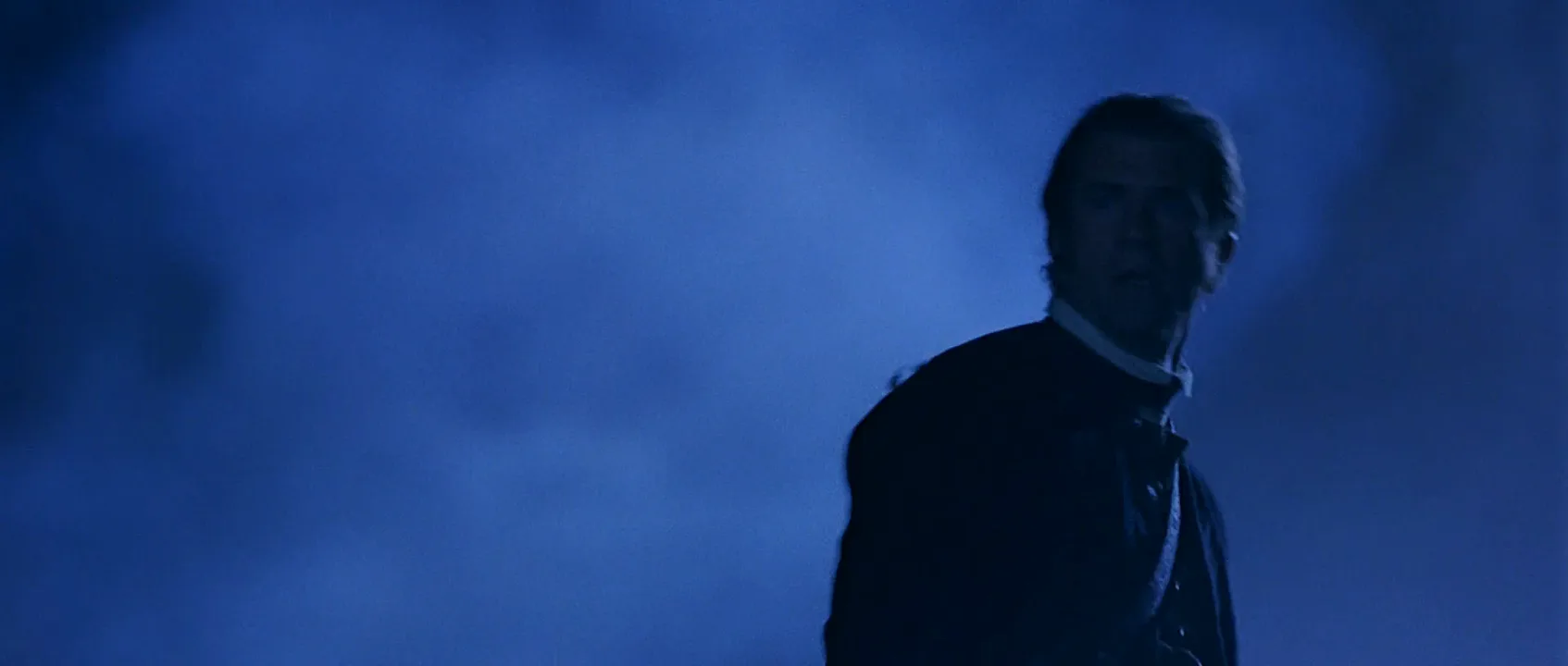
Day for night is the technique of shooting a night scene in daylight and making it read as night. The crew underexposes, keeps the sun behind the actors so it plays as moonlight, keeps the bright sky out of frame and grades the image dark and cool. The audience sees night; the set never went dark.
- What it does
- Turns a sunlit exterior into a moonlit night without lighting a whole landscape after dark.
- Use it when
- The night exterior is too big, too remote or too dangerous to light: deserts, open water, long roads, wide battlefields.
- Watch out
- A bright sky, unlit windows and headlights that don't glow give the trick away instantly.
- Try this prompt
day-for-night desert road, low sun behind a lone driver, underexposed two stops, deep blue grade, sky out of frame, headlights glowing
What is day for night?
Day for night is a way of faking darkness. In film lighting it runs backwards: instead of adding light to a dark location, you start with far too much light and take it away with exposure, filtration and color. The French call it la nuit américaine, "American night", after the Hollywood westerns that used it constantly; François Truffaut borrowed the name for his 1973 film released in English as Day for Night.
Four moves sell it:
- Underexposure of about two stops, so midtones sink. This is controlled underexposure, not a mistake.
- The sun as a moon, behind or high beside the actors, rimming hair and shoulders.
- No bright sky, because real night skies are the darkest part of the frame.
- A cool, desaturated grade with crushed blacks.
Why do filmmakers shoot day for night?
Scale. Lighting a mile of desert or a lake at night takes cranes, generators and hours of rigging, and the distance still falls into black. Daylight already lights everything to the horizon; the crew only has to bring it down. That is why classic westerns rode through so many blue nights, and why Mad Max: Fury Road (2015) shot much of its night chase in daylight and built the night in the grade.
Time and safety. Stunts, vehicles and water work are slower and riskier in the dark.
A look of its own: detail to the horizon and crisp "moon" shadows, a stylized night audiences accept as convention.
How to shoot day for night
Sun behind the actors. Schedule for a lower sun in backlight or three-quarter back. Frontally lit faces read as daytime at any exposure; backlighting gives the rim and throws shadows toward the camera like moon shadows.
Keep the sky out or bring it down. Shoot slightly high looking down, block the horizon with hills or buildings, crop with longer lenses. A polarizer darkens blue sky at 90° to the sun, a graduated ND pulls down the top of frame, and in black-and-white a red lens filter turns blue sky nearly black. White overcast skies can't be saved in camera.
Underexpose and cool it. About two stops under, judged on a calibrated monitor. Setting white balance to 3200K in daylight pushes the image blue in camera; on digital, most cinematographers shoot neutral and build the night in the grade: lower exposure, cooler balance, less saturation, a mask darkening the sky.
Boost every practical. Headlights, lanterns and windows must be several stops hotter than normal. Dim headlights are the classic giveaway.
Day for night vs. moonlight lighting
Both aim for one picture: a cool, dim scene lit by a single source from above and behind. Moonlight lighting builds it at night with real lamps, usually a big gelled source on a crane plus haze; practicals glow naturally, but the image ends where the lamps stop reaching. Day for night covers any distance for free, while the sky, shadows and windows fight you all day.
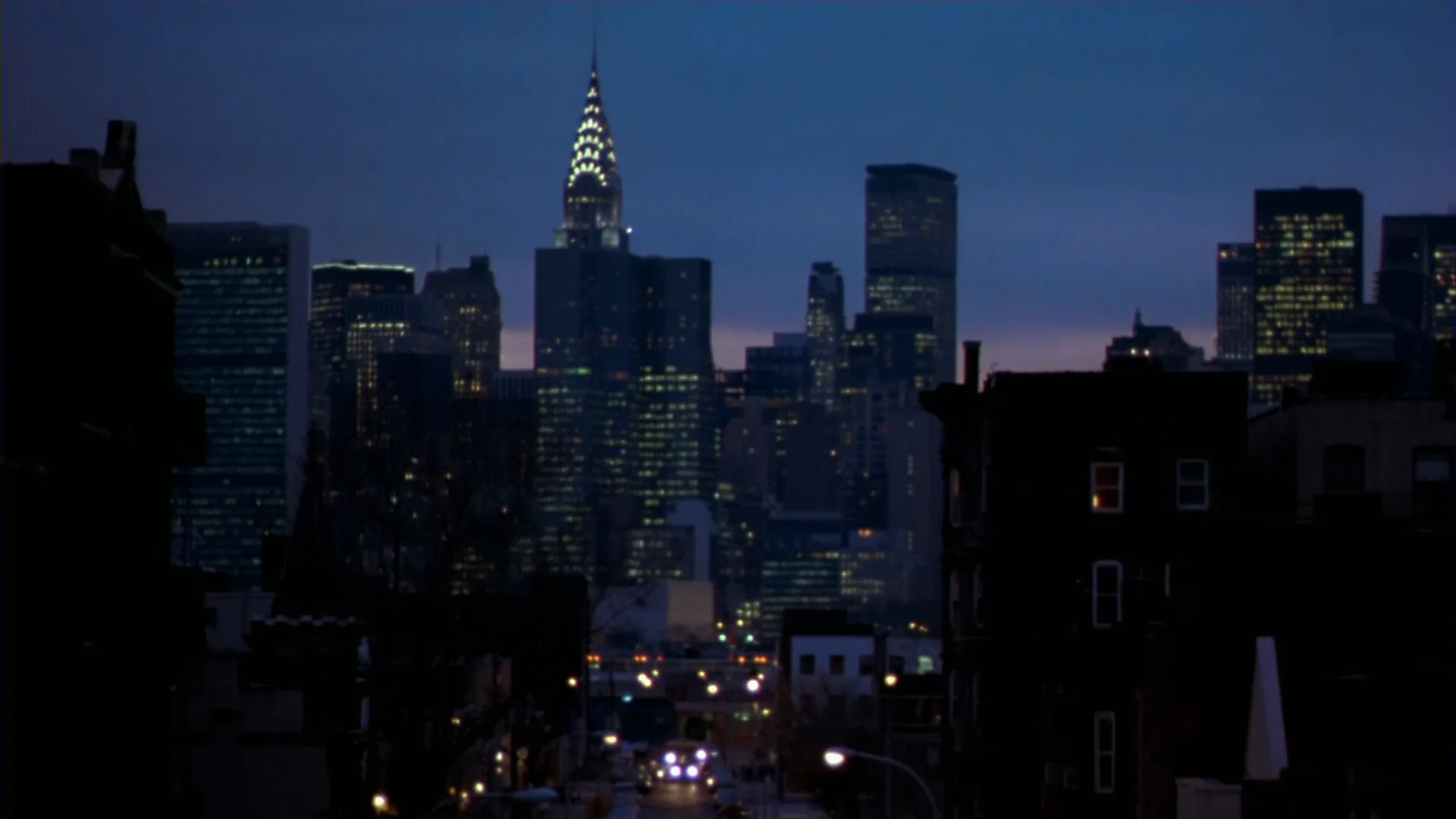
A third option is the blue minutes after golden hour, when city lights are on and the sky still holds color.
Day for Night examples in film
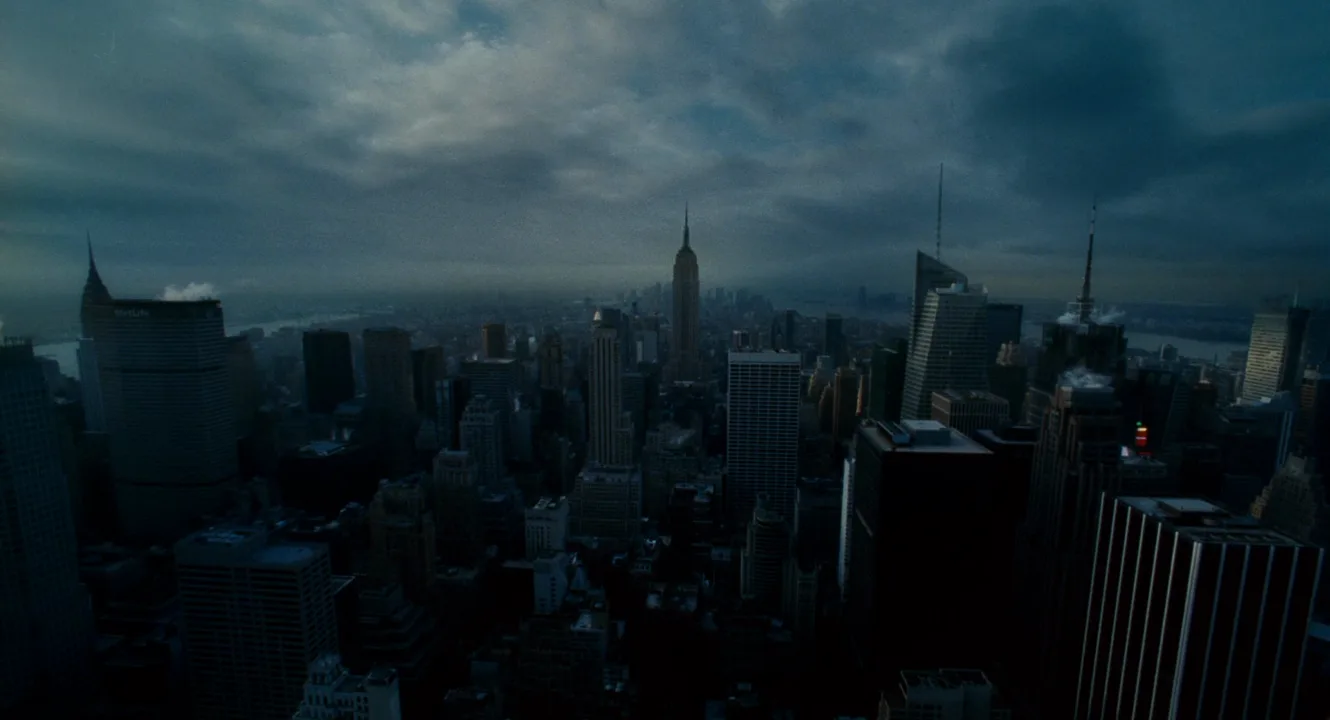
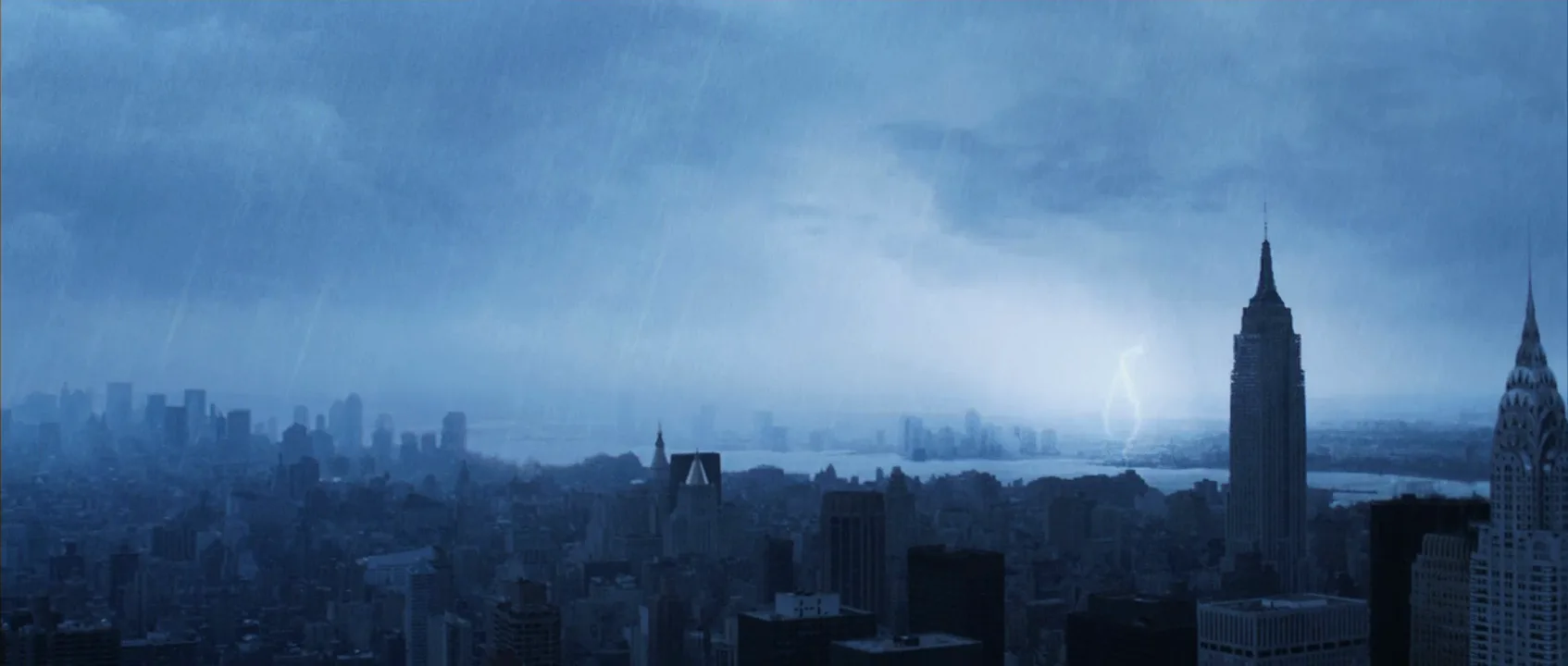
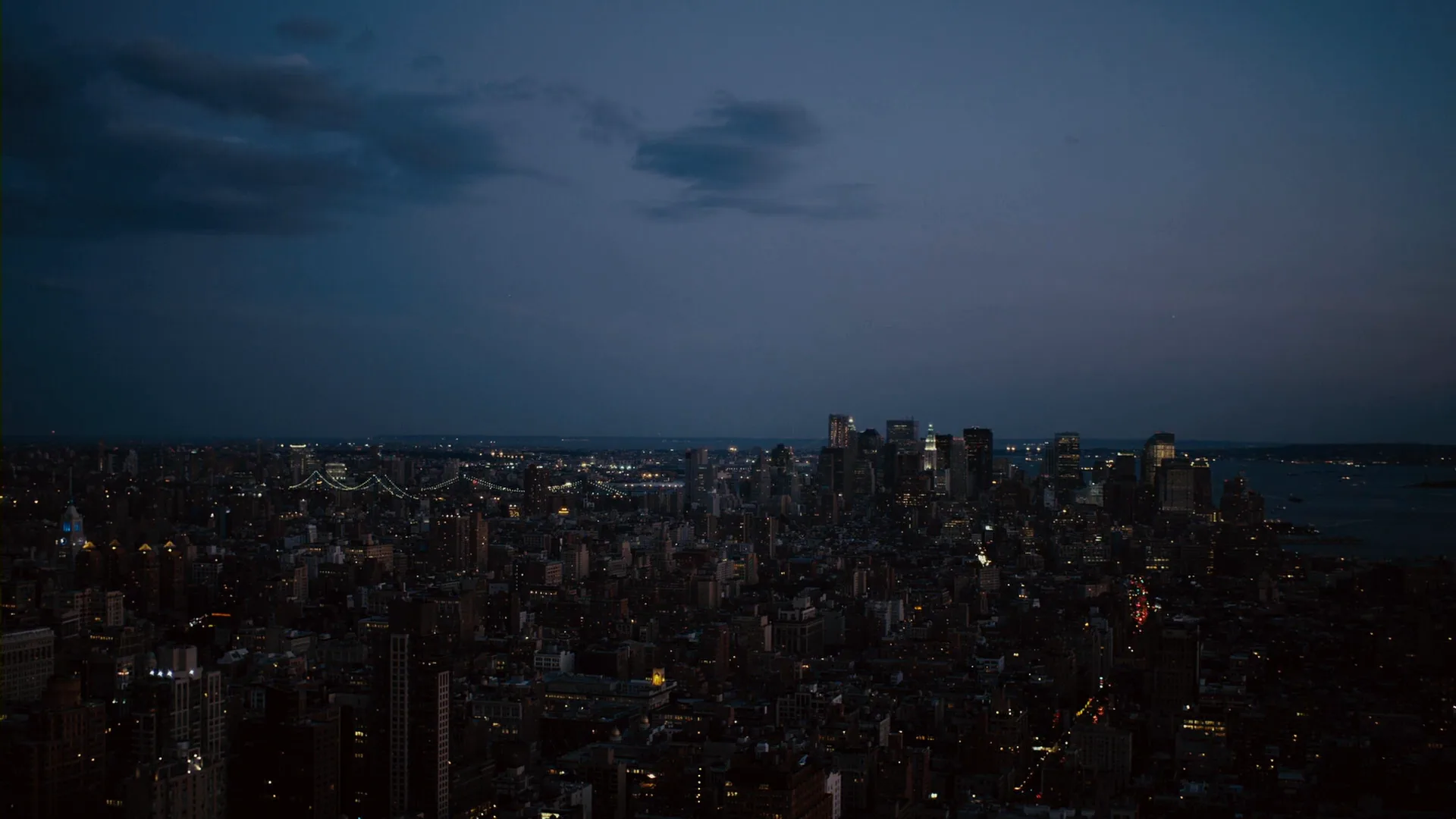
8 framesThe building blocks of a screen night, and two skylines showing what breaks it.
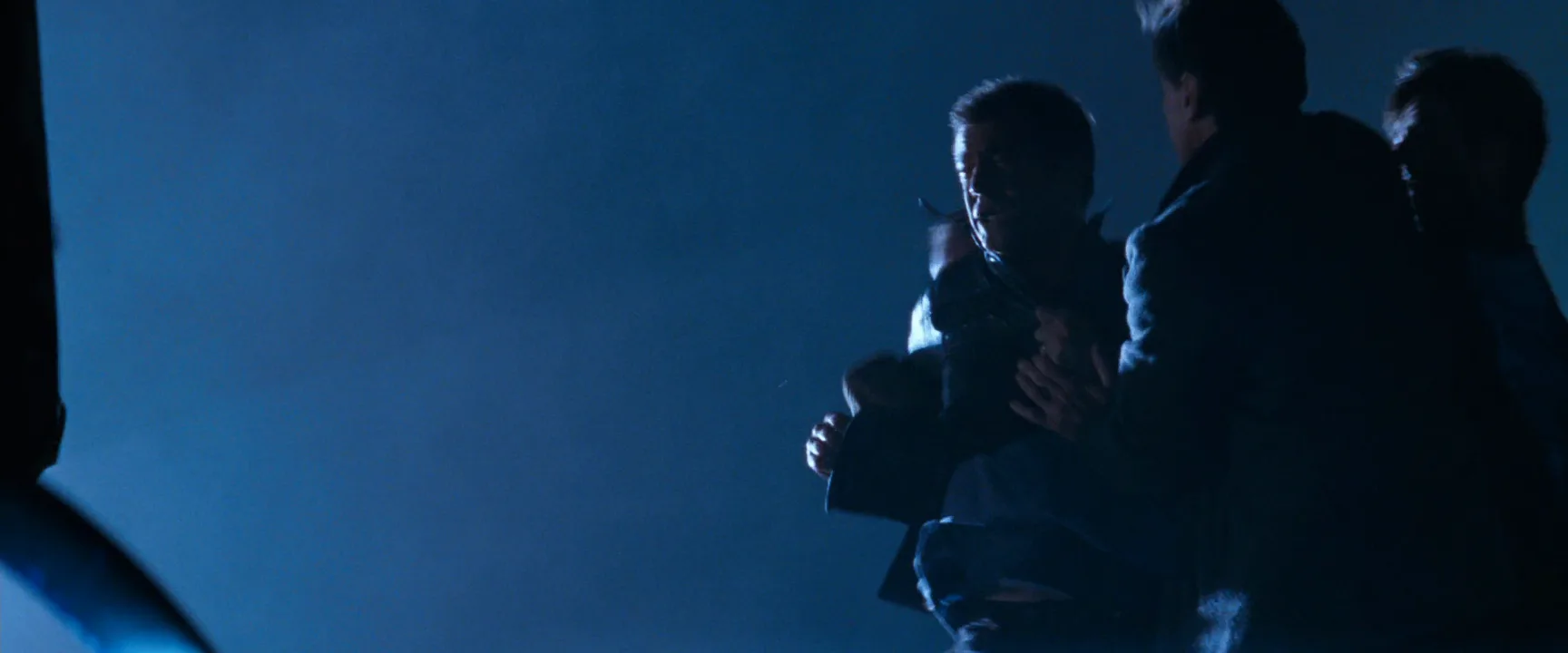
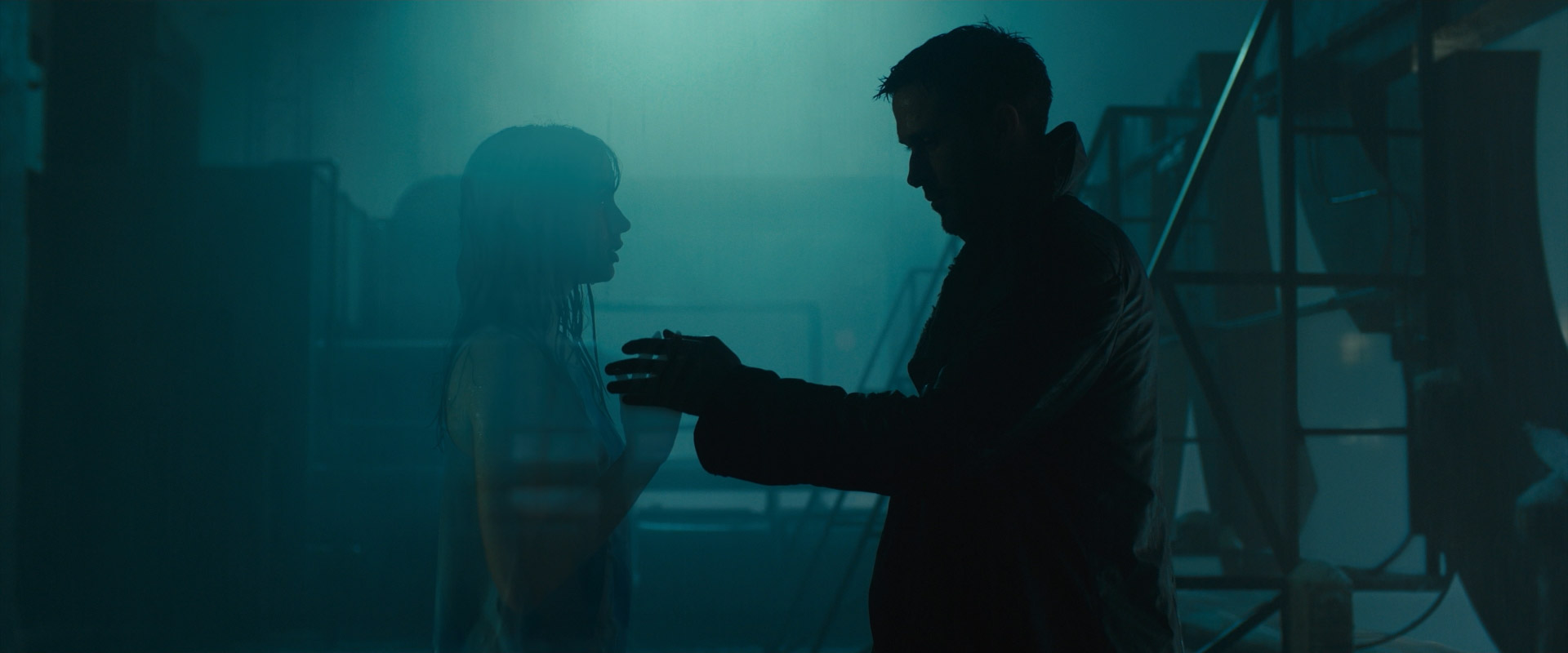
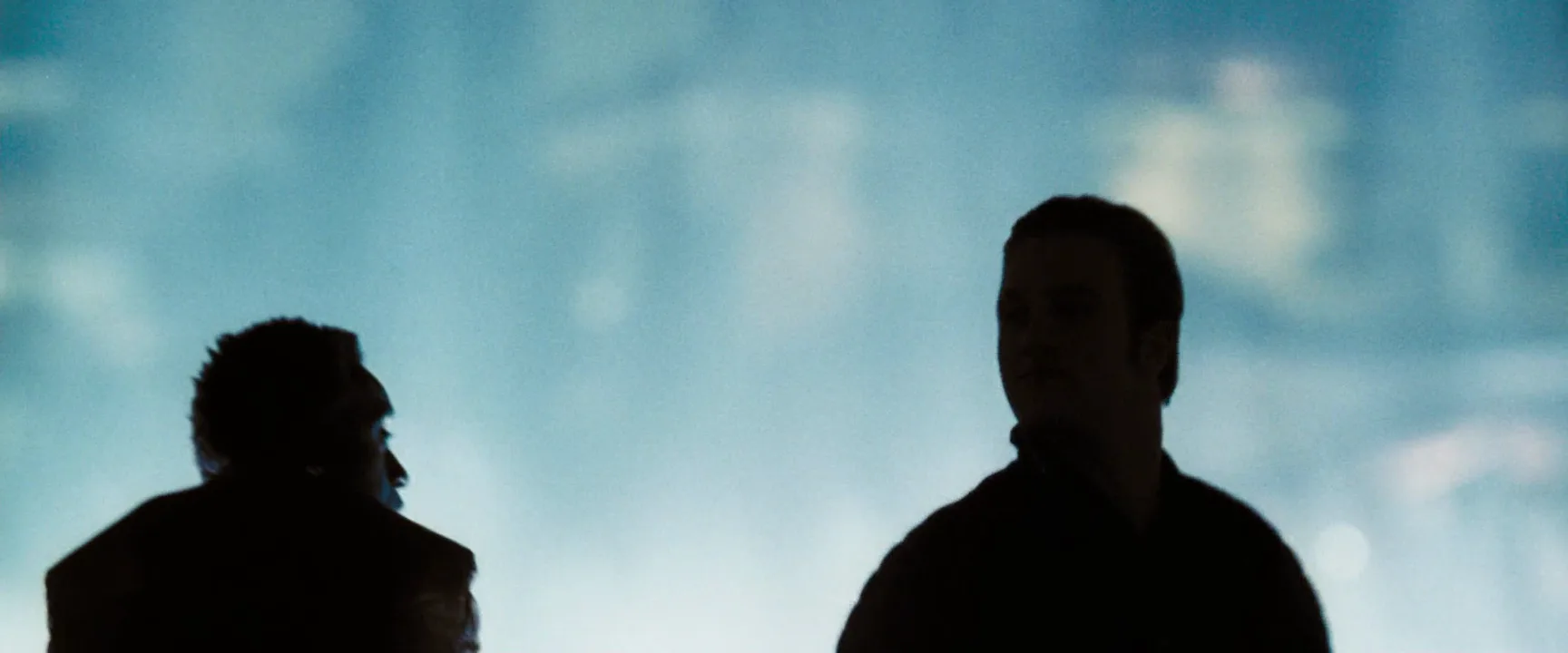
How to create a day for night with AI
4 promptsLeft alone, image models paint either true black night with a big moon or a sunny scene tinted blue. Describe the mechanics: sun position, how far under the exposure sits, what the sky does, which practicals glow. Keep references and takes on one FlashBoards board to compare which sells the night. The fourth prompt re-shoots a real film shot from a text description alone, and the original plays next to the result so you can compare.
Cinematic film still, day-for-night look, wide shot on a cracked dry lakebed. A fictional stocky woman in her fifties with a long gray braid, a round freckled face, wire-rimmed glasses and a sheepskin coat stands beside an old unbranded motorbike, looking left. Low sun directly behind her, just out of frame, rims her head, shoulders and the bike in thin silver; long shadows fall toward the camera. Camera slightly high looking down, horizon near the top edge, only a thin strip of dark navy sky above it. Underexposed two stops, graded deep blue-cyan, low saturation, crushed blacks. The bike's round headlight glows warm and bright. 35mm lens, film grain.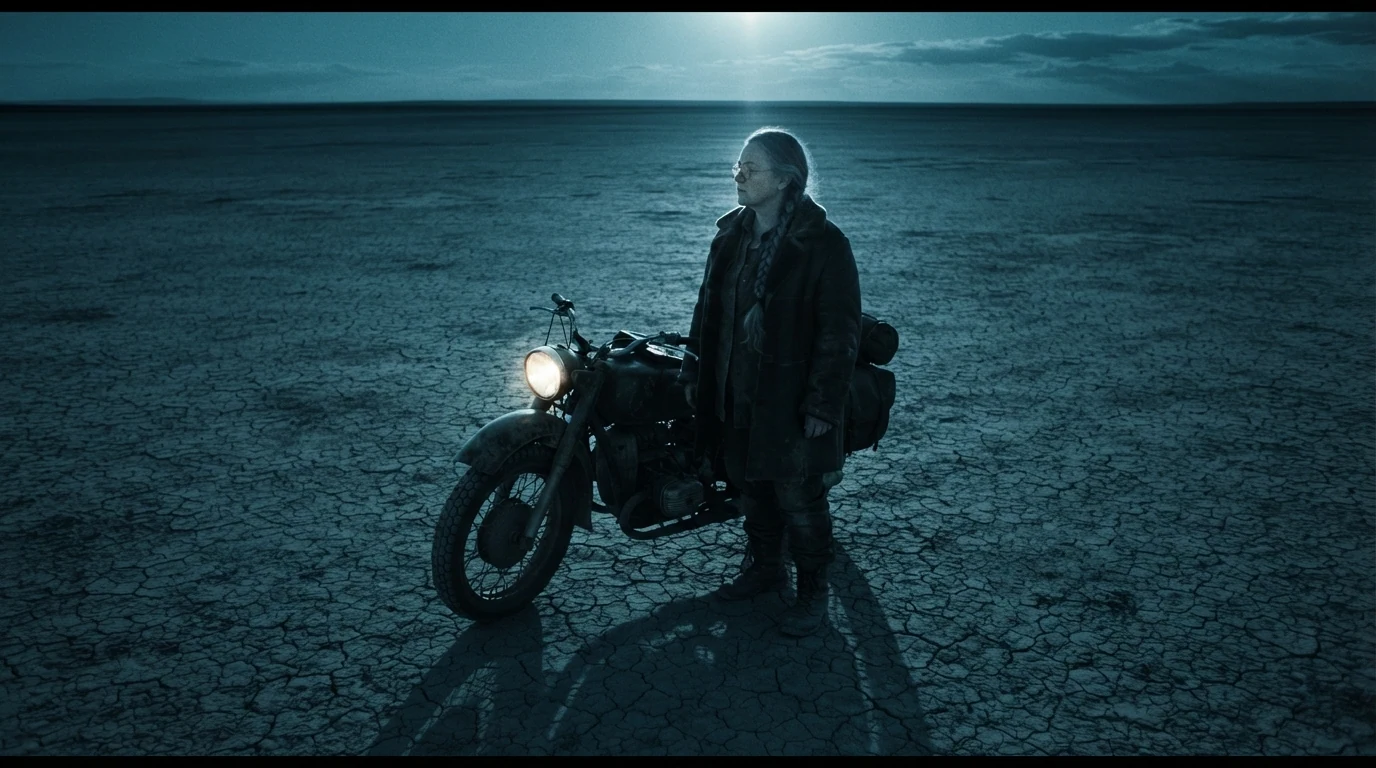
"Low sun directly behind her" and the silver rim turn the sun into a moon. "Camera slightly high looking down" handles the sky like a crew would; the warm headlight proves it is night.
Open FlashBoardsBlack-and-white 21:9 western frame shot day for night. Two fictional riders on a rocky ridge, seen from below: a heavyset old man with a white walrus mustache and a flat-crowned hat, and a thin young rider with a bandaged left hand. Hard sun from high behind outlines hats, shoulders and manes in white. Sky printed almost black by a red filter, darker than the riders. Faces in deep gray shadow. A small campfire glows bright on the slope below. Anamorphic lens, heavy grain, high contrast.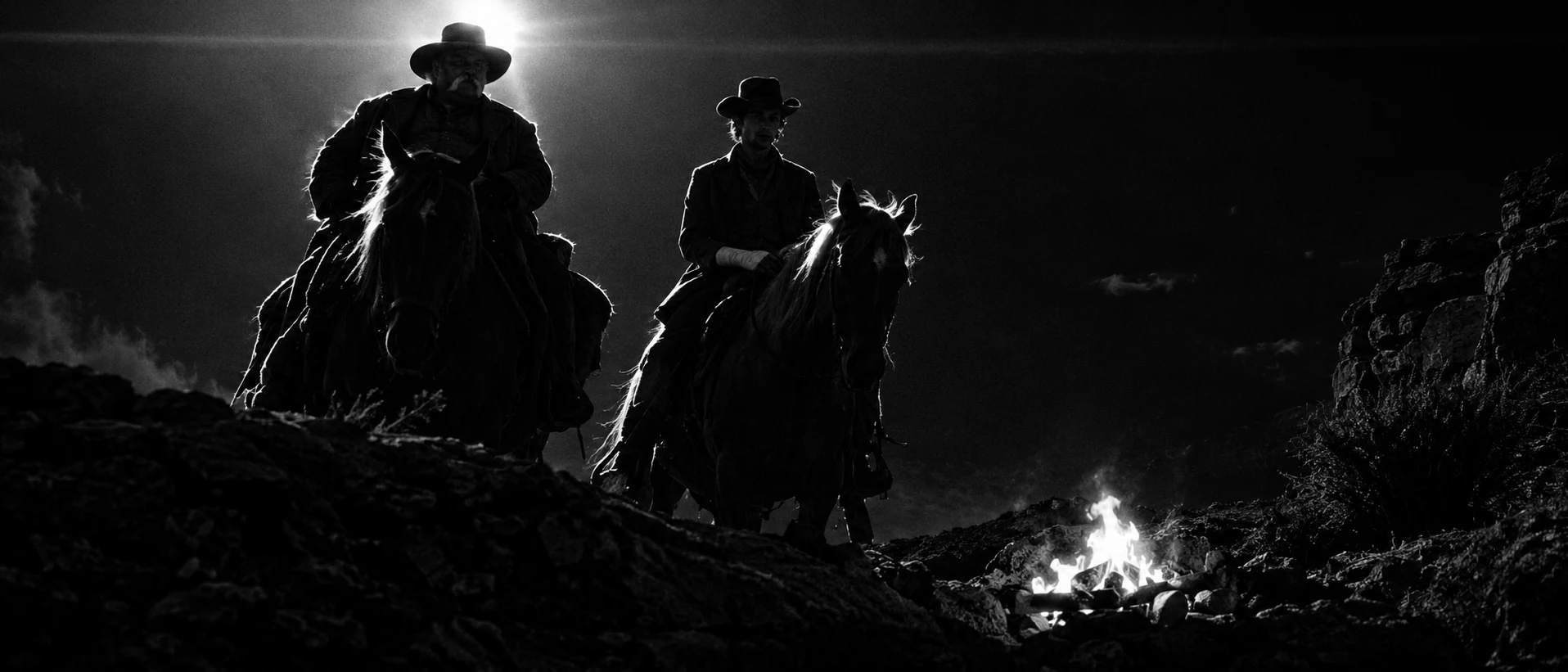
A return to the technique's black-and-white origins: "printed almost black by a red filter" makes the sky darker than the riders, the opposite of daylight, and the campfire anchors the hour.
Open FlashBoardsCamera: a slow pan to the left, staying slightly high and looking down, following the woman as she rides off. Action: From the first frame she is already swinging her leg over the motorbike, coat moving in the wind, dust drifting over the cracked ground. She settles on the seat and the headlight flares brighter. She rolls forward and rides away to the left, the beam sweeping the dark blue ground, her silver-rimmed silhouette shrinking toward the frame edge.Motion starts at once, so the model animates rather than pushing in on the still. The high pan keeps the sky strip small, and "silver-rimmed" and "dark blue ground" hold the grade through the move.
Open FlashBoards{
"output": "Full-screen live-action shot from The Adjustment Bureau (2011), alive from its very first frame: one continuous shot, no cuts. Day for night: overcast daylight photographed about two stops under and graded deep teal-blue, low saturation, building faces crushed toward black, only the rooftops and the cloud undersides keep soft gray daylight detail; fine 35mm film grain. Place: Midtown Manhattan seen from a very high rooftop, the Empire State Building's spire standing small at the centre of the frame.",
"characters": {},
"shots": [
{
"shot": 1,
"camera": "locked-off static aerial wide from a very high rooftop, slightly downward, 24mm lens feel, deep focus; the camera never moves; horizon a little above mid-frame, a heavy low cloud ceiling filling the top half",
"action": [
"BEGINNING: alive from the first frame, the dark city is already in place: a dense field of towers runs to a hazy horizon, the Empire State Building's thin spire at the centre, a broad dark tower with a slanted crown at the left edge, a glassy tower with a tall mast right of centre, a black striped office block filling the lower right corner, a pale river strip glinting on the far left and far right horizon.",
"THEN: a small rooftop light on a dark building just right of centre, lower third, cycles through colours, blue, then red, then orange, then green, changing about twice a second.",
"THEN: a white plume of rooftop steam puffs up from the crown of the dark tower at the left edge and thins out; a second, smaller steam plume drifts from a roof on the right.",
"THEN: the brooding clouds churn slowly and roll gently to the left, a paler patch of daylight sky shifting across the upper left while the right side of the sky stays slate-dark.",
"END: the camera still has not moved; the towers stay black and motionless, the steam keeps rising, the little rooftop light keeps changing colour: a daytime city printed as a cold, dark night."
],
"dialogue": [],
"voice": "silence: nobody speaks in this shot, no voice at all"
}
],
"sound": {
"ambience": "high-altitude wind across the rooftop, a faint low city hum and distant traffic heard from far below",
"speech": "no words in this video; the only human sounds are breaths and movement",
"never_spoken": "no narration and no voice-over: the descriptions, performance notes and step words of this prompt are never spoken aloud",
"music": "a film score under the scene, always below the voices: low brooding strings with a slow, uneasy pulse",
"subtitles": "none"
}
}Remakes the locked-off high view over Midtown Manhattan in The Adjustment Bureau (2011), carrying over the daylight sky printed dark teal, the black tower faces, the colour-cycling rooftop light, the steam plumes and the slowly rolling clouds.
The output line carries the whole technique: overcast daylight photographed about two stops under and graded deep teal-blue, so the model starts from day and takes light away, and the clouds keep daytime detail while the tower faces sink toward black. The BEGINNING/THEN/END steps pin the only things that move in the original, the colour-cycling rooftop light, the steam plumes and the slow clouds, while the silent shot, wind ambience and low strings keep it a quiet establishing view.
Common mistakes
- A moon and stars appear. Describe "low sun behind her, out of frame" instead of night.
- Daytime tinted blue. The light is frontal; say the sun is behind and faces are in shadow.
- Bright horizon. Frame from above or say the sky is darker than the subject.
- Dead practicals. Say headlights "glow warm and bright".
Keep the reference frames, prompts and every generated take side by side — images and video in one canvas.
FAQ
4 questionsWhat does day for night mean in film?
Day for night means filming a scene in daylight that the audience reads as night. The sun sits behind the actors, the bright sky stays out of frame, and the image is underexposed about two stops and graded dark, blue and desaturated, so big night exteriors need no lighting after dark.
Why is day for night called American night?
In French it is la nuit américaine, "American night", because Hollywood studios used it so widely on westerns shot in bright exterior locations. François Truffaut took the phrase as the title of his 1973 film about a film shoot, released in English as Day for Night.
How do you shoot day for night?
Put the sun low and behind the actors so it rims them like moonlight. Avoid the sky or darken it with a polarizer or graduated ND. Underexpose roughly two stops, keep a little bounce for the eyes, make headlights and lanterns much brighter than normal, and finish with a cool, desaturated grade.
Can you make day for night in editing?
Yes, in the grade: lower exposure, cool the white balance, pull saturation and mask the sky darker. It only works if the footage cooperates. Backlit shots with little sky become convincing night; frontally lit midday shots with bright skies and unlit windows still look like day.
Related terms
6- MoonlightLighting
Moonlight lighting imitates the moon with a single high, directional source — usually cool or neutral, often from behind — plus controlled underexposure, so the scene reads as night while faces and space stay legible.
- UnderexposureLenses, Focus & Exposure
Underexposure is when too little light reaches the film or sensor: shadows sink into black and noise rises; controlled, it hides information and builds dread in night, thriller and horror scenes.
- Golden HourLighting
Golden hour — which filmmakers call magic hour — is the short window after sunrise and before sunset when the low sun gives warm, soft, raking light and long shadows; crews often keep shooting into the blue twilight that follows.
- White BalanceCameras & Capture
White balance tells the camera which color of light to treat as neutral white — about 3200K for tungsten, 5600K for daylight — so skin and whites look natural, or are pushed deliberately warm or cool.
- Lens FilterLenses, Focus & Exposure
A lens filter is glass placed in front of (or behind) the lens to change the image in camera: ND filters cut light, polarizers remove reflections, diffusion and mist filters soften detail and bloom highlights, color filters shift the tone.
- Film LightingLighting
Film lighting is the craft of shaping light for the camera — its direction, quality, color and contrast — to model faces, build space, set the time of day and carry the mood of a scene.
Further reading
Blain Brown, Cinematography: Theory and Practice (Focal Press). Blain Brown, Motion Picture and Video Lighting (Focal Press). Kris Malkiewicz, Film Lighting (Touchstone).