 FlashBoards Learn
Lighting · Film language
Haze
Also called: atmospheric haze, atmosphere, smoke
Haze is a fine artificial smoke pumped onto the set so that light itself becomes visible. Hard sources turn into beams and shafts, blacks lift, contrast drops and the background recedes into a soft glow. The audience rarely notices the haze. What they notice is air, depth and mood.
- What it does
- Makes light visible as beams, lowers contrast and pushes the background back into soft, layered depth.
- Use it when
- You want shafts of light through windows, glowing headlights or flashlights, a smoky room, or more depth in a flat interior.
- Watch out
- Haze drifts and settles; keep the density even between takes or the shots will not cut together.
- Try this prompt
cinematic wide shot, dim warehouse filled with thin haze, hard sunlight beams slanting through high windows, lifted blacks, 35mm
What is haze in film?
On a film set, haze is not a soft look or a lens effect. It is a thin, even mist of tiny droplets made by a machine called a hazer and spread through the space with fans. The eye barely sees it, but the camera sees three things:
- Light becomes visible. A hard source cutting through hazy air leaves a solid-looking beam.
- Contrast drops. Scattered light fills the shadows, so blacks turn smoky gray and highlights bloom.
- Distance fades. The farther something is from the lens, the more haze sits in front of it, so space reads deeper.
In film lighting haze is a lighting tool, as much as a flag or a diffusion frame.
Why do filmmakers use haze?
To draw with light. Without particles in the air, a beam is invisible until it hits a surface. Haze gives it a body, and it glows brightest when the light travels toward the lens, which is why backlighting and haze go together. Blade Runner (1982) is the classic case.
To lower contrast on purpose. A light pass lifts the blacks and softens clean digital images, a way to control contrast without flattening the lighting.
To build depth. Foreground stays dense, the middle softens, the back wall drops toward gray: aerial perspective compressed into a set, helping foreground, midground and background separate without extra lights.
To set a mood. Thick smoke reads as danger, heat or dream; a faint haze just makes windows glow. Either way it gives a scene an atmosphere the viewer feels before naming it.
How to shoot with haze on set
Machine. A hazer makes a fine, long-hanging mist from water- or oil-based fluid. A fog machine makes thick clouds that roll and clear fast. Use a hazer for even air, fog or smoke for visible billows.
Fill, then wait. Run the hazer before the take, let fans mix the air, then turn them down so no swirls show.
Match density between takes. Haze leaks out and settles. Pick a reference, such as how visible the window beam is on the monitor, and top up before each take, or the wide and the close-up will not cut together.
Light for it. Put a hard light behind the subject, 135° to 180° from the lens, and keep the background dark. Windows, blinds and grates split it into shafts, and flashlights, headlights or a practical light in frame bloom into cones and halos. Front light on haze only gives a milky veil.
Expose for it. Haze raises the black level. Watch the waveform; if shadows go too gray, cut front fill or thin the haze.
Lens and distance. A 100mm across a big room looks through more air than a 24mm up close, so thin the haze for close-ups. Outdoors, wind strips it in seconds.
Haze vs. fog, smoke and diffusion filters
| | Haze | Fog / smoke | Diffusion filter | |---|---|---|---| | Where it is | Evenly in the air | Clouds in the air | On the lens | | Visible to the eye | Barely | Clearly | No | | Main effect | Beams, lower contrast, depth fade | Visible shapes, hidden background | Softer highlights, lower contrast | | Changes with distance | Yes | Strongly | No |
A diffusion filter softens the whole frame equally. Haze grows with distance and glows only where light passes through it, so a hazed set looks deeper than a filtered one. Many cinematographers use both.
Haze in motion
1 clipsThese loops show haze in motion, where a still frame can't: watch how the effect plays out over a few seconds.

Haze stills
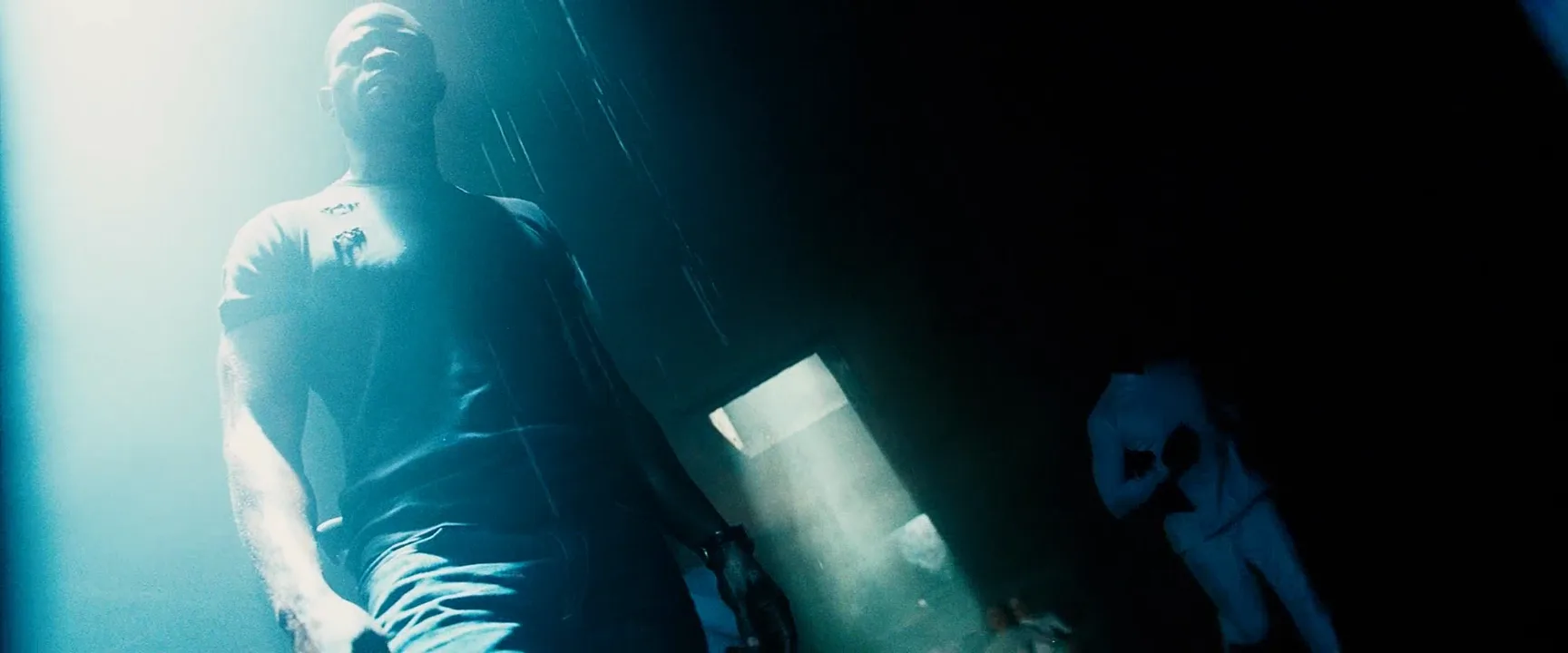
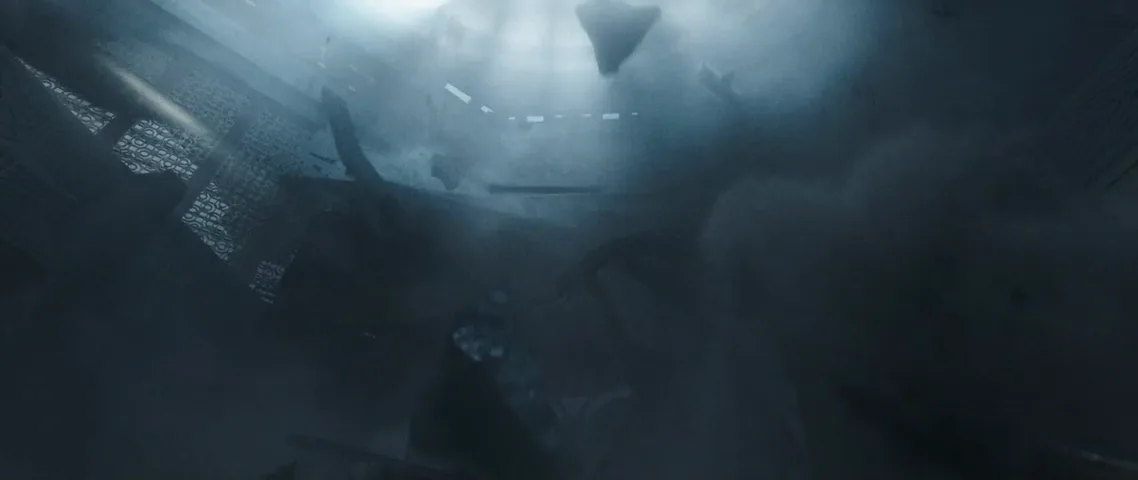
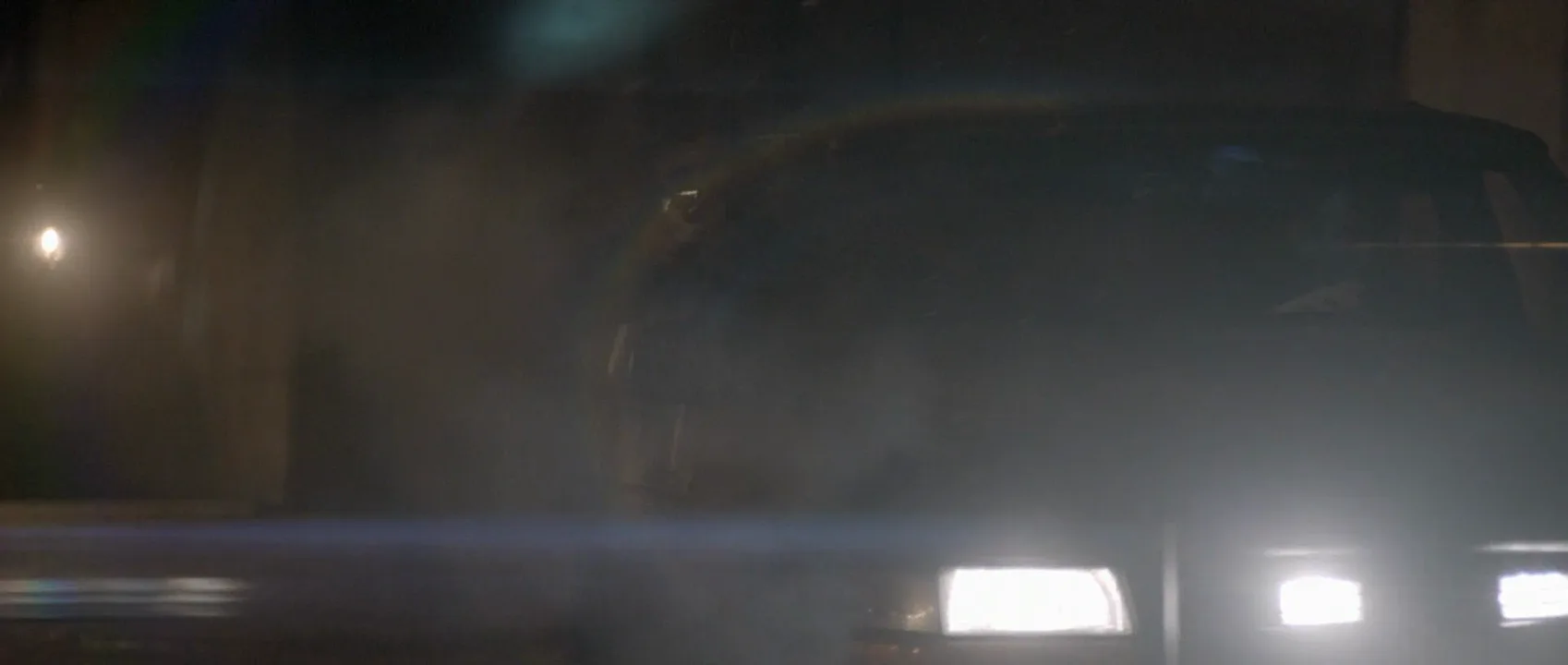
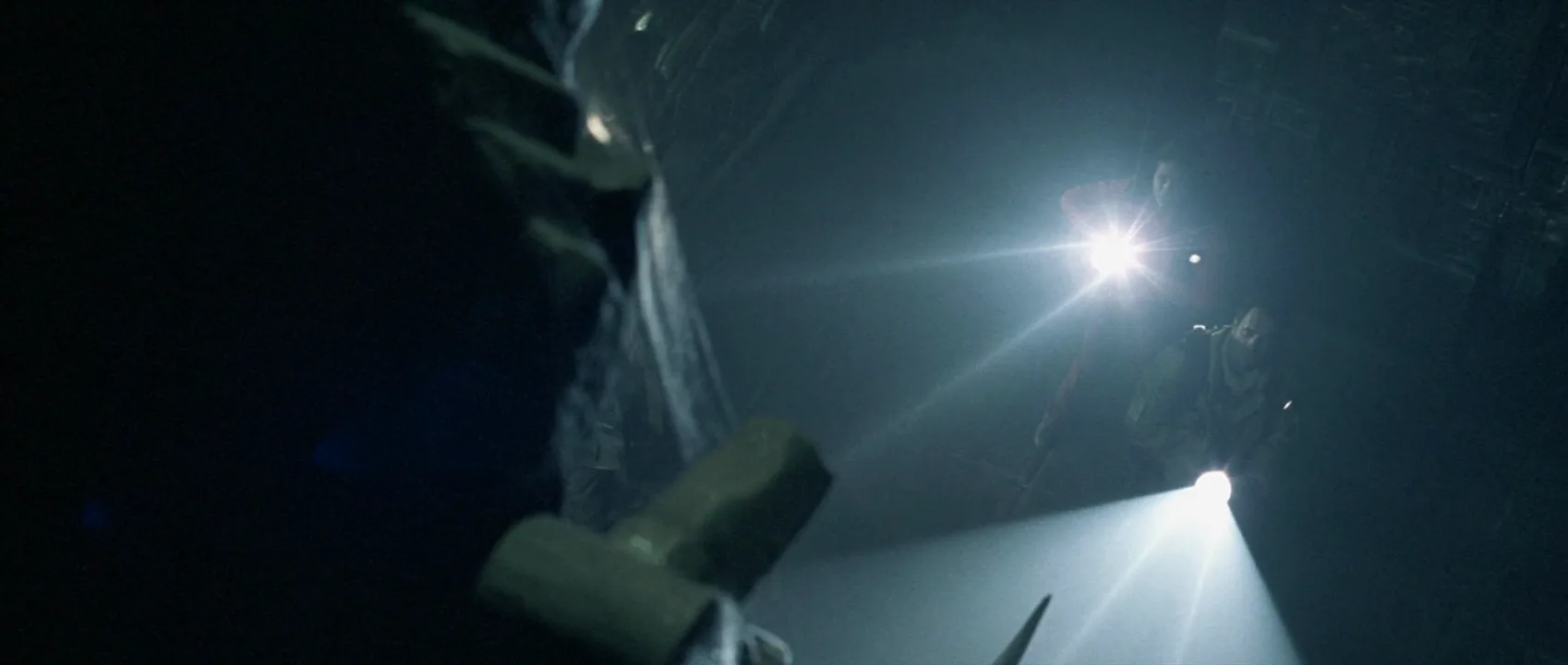
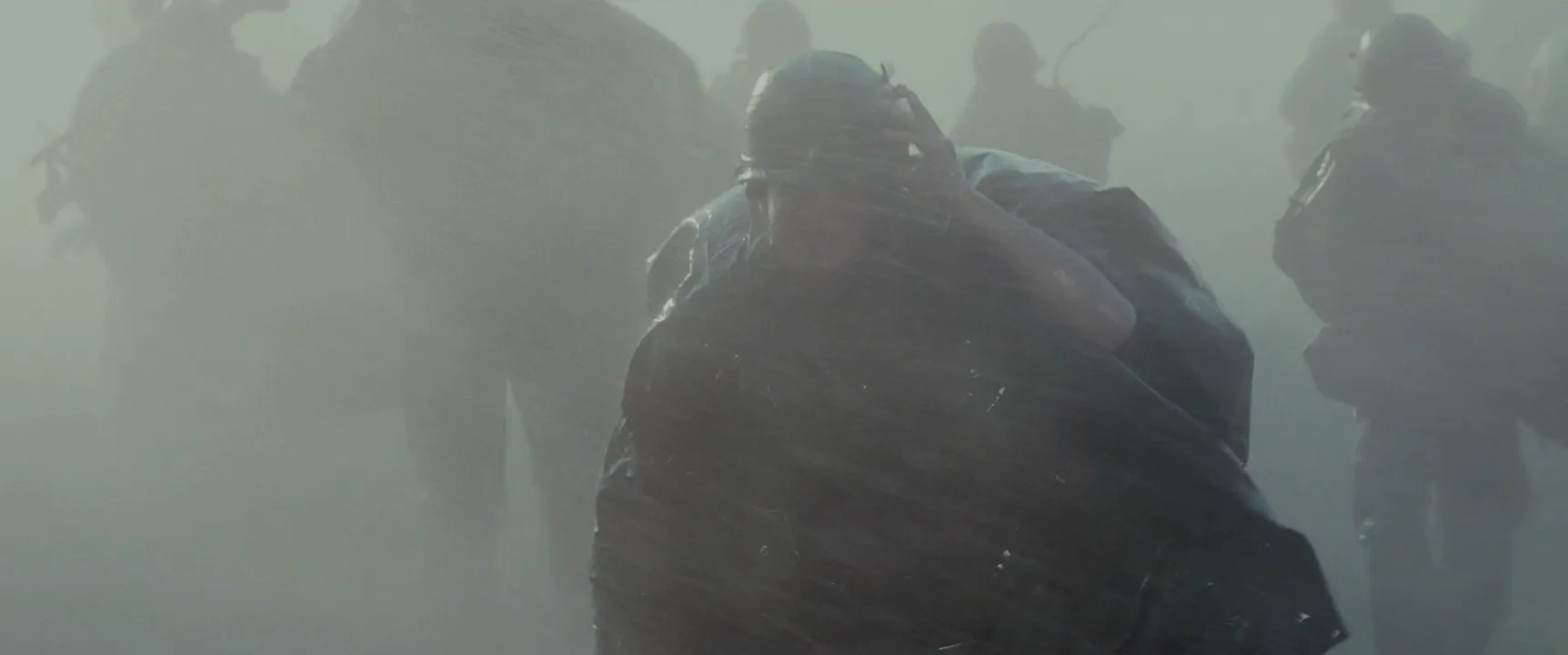
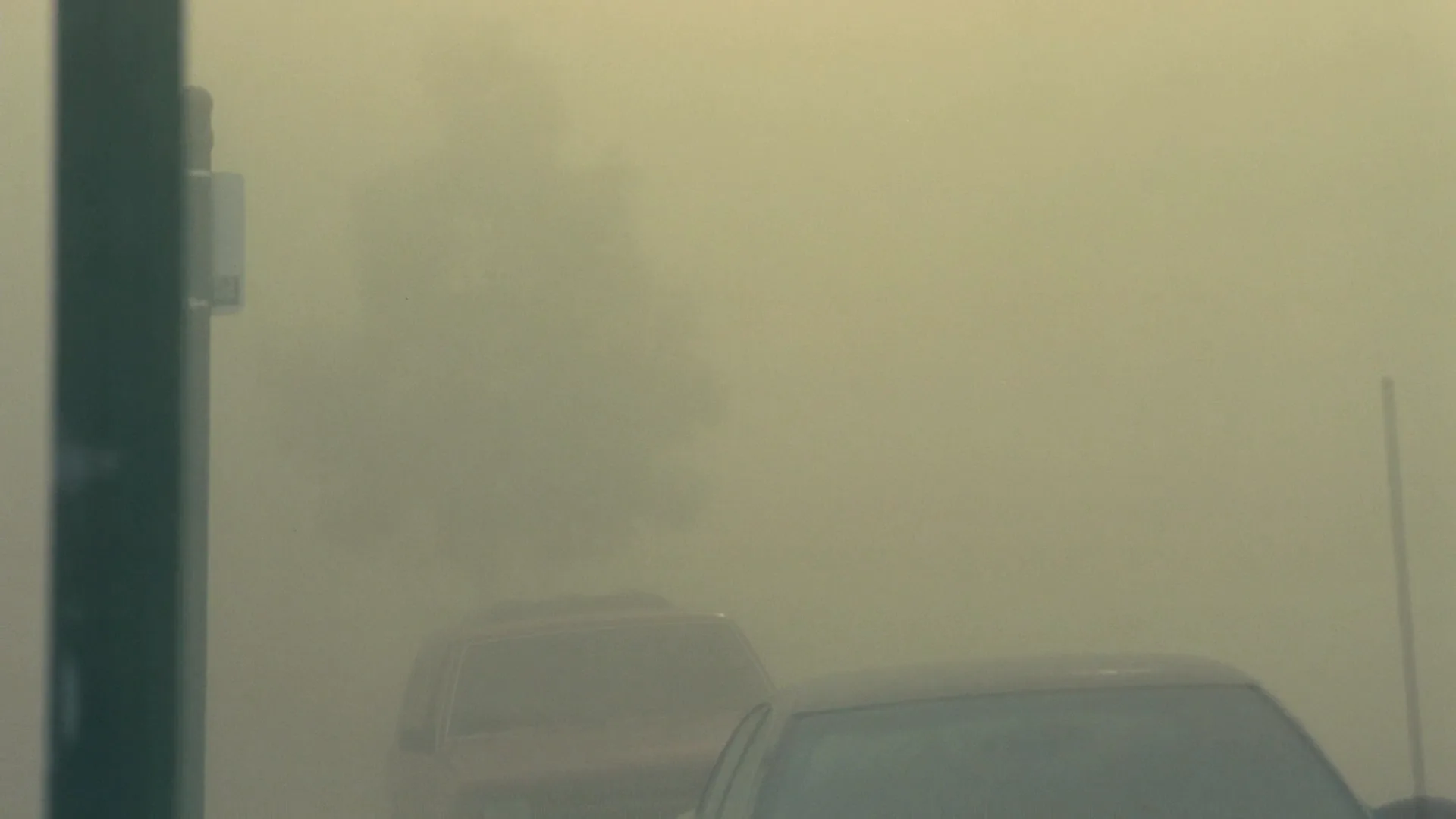
8 framesFrames where the air does the work: beams with visible edges, blooming highlights and backgrounds that fade with distance.
How to create a haze with AI
4 promptsModels draw haze well when you say where the light comes from and what it passes through: "hazy" alone gives a flat gray wash. Keep references and every take on one FlashBoards board to compare haze density side by side. The fourth prompt re-shoots a real film shot from a text description alone, and the original plays next to the result so you can compare.
Cinematic wide shot inside a dim, empty warehouse filled with thin, even haze. Hard afternoon sunlight enters through tall dusty windows high on the left wall and forms sharp parallel beams slanting to the concrete floor. A fictional man in his 50s with a shaved head, thick gray beard and rust-colored work jacket stands in the middle beam, outline glowing. Back wall fades into soft gray haze, blacks lifted, warm beams against cool shadows. Camera at chest height looking toward the windows, 35mm lens, film grain.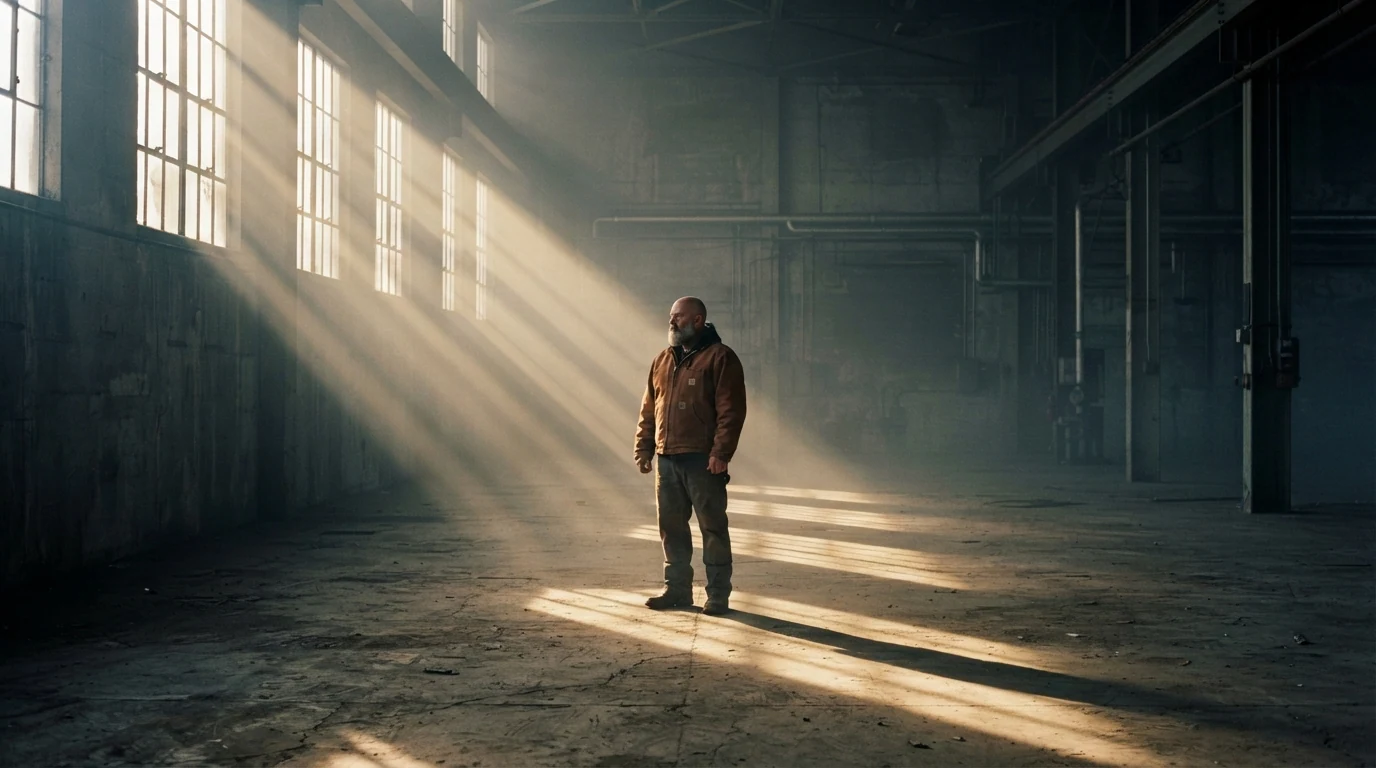
"Thin, even haze" sets density, "hard sunlight through tall windows" gives it something to show, and "looking toward the windows" puts the camera into the light. "Back wall fades" and "blacks lifted" ask for the depth and contrast drop.
Open FlashBoardsAnamorphic night wide shot of an empty rain-wet side street in still, light haze. Sodium streetlights cast visible orange cones down through the haze; a parked van's headlights face the camera, blooming into soft halos. A fictional young woman with short copper curls, freckles and a long olive raincoat walks away down the middle of the street, a silhouette against the glow. Far buildings fade into gray. Low contrast, smoky shadows, 40mm anamorphic at waist height.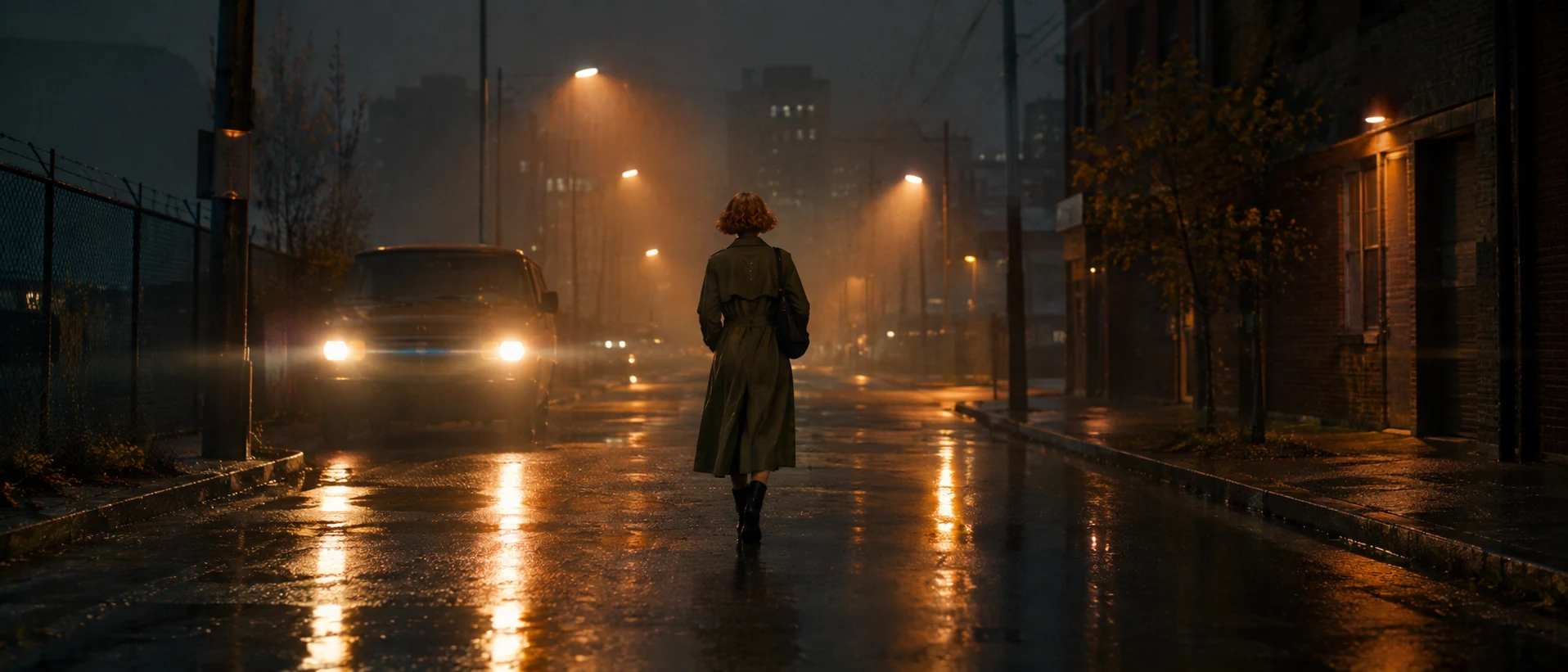
The variation moves haze outdoors with practical sources. "Cones down through the haze" and "headlights face the camera, blooming" name both beam directions; "still, light haze" prevents rolling fog.
Open FlashBoardsCamera: a slow, steady push forward at chest height toward the man, from wide to medium-wide, moving the whole shot. Action: from the first frame, haze drifts slowly through the sunlight beams, particles glittering. The man lifts his head toward the windows and takes two slow steps into the brightest beam. The beams stay sharp and still while the haze keeps moving inside them."From the first frame, haze drifts" makes the shot alive at once. Only what is in the start frame is named, and "beams stay still while the haze moves" keeps the shafts from flickering.
Open FlashBoards{
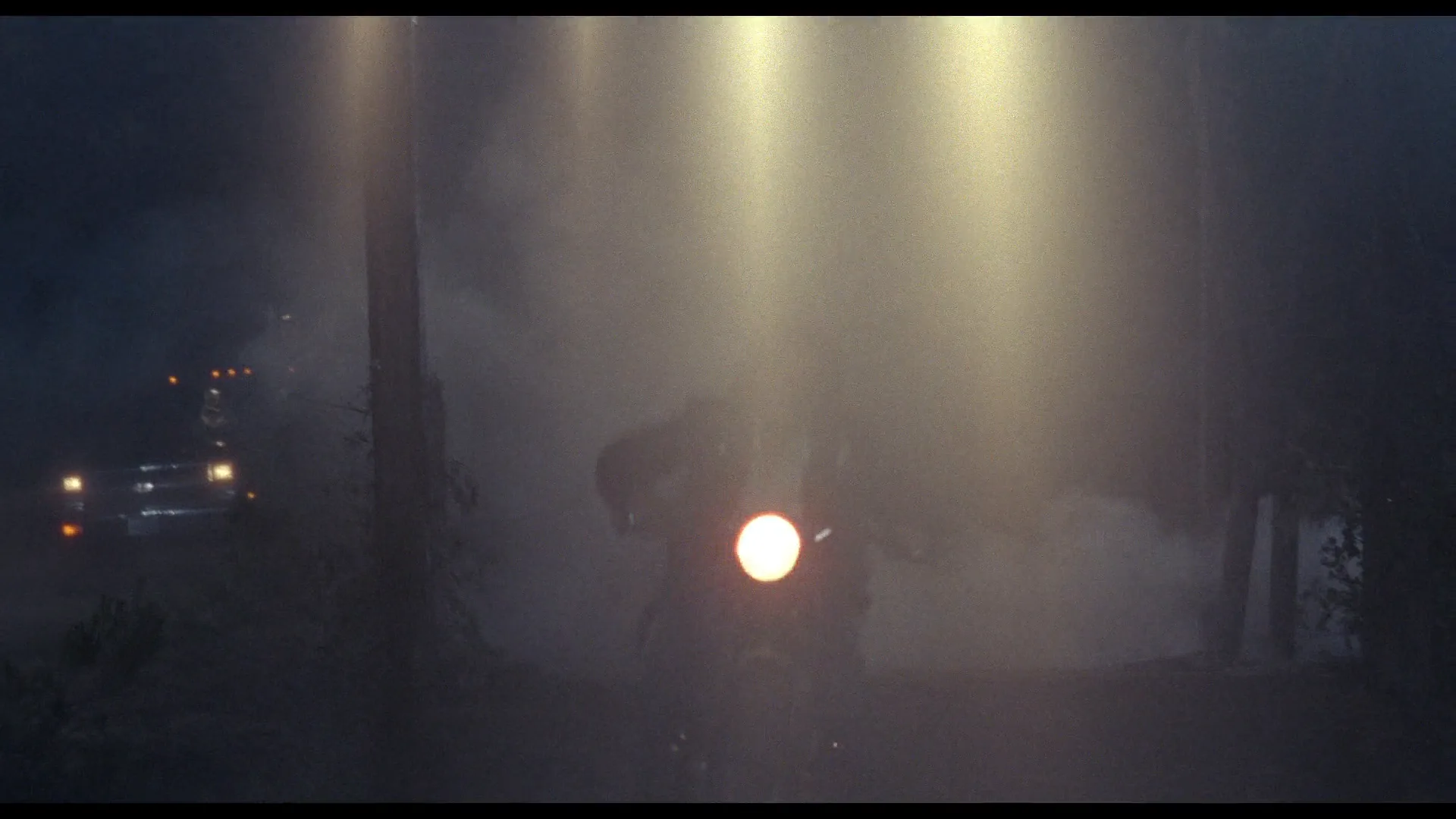
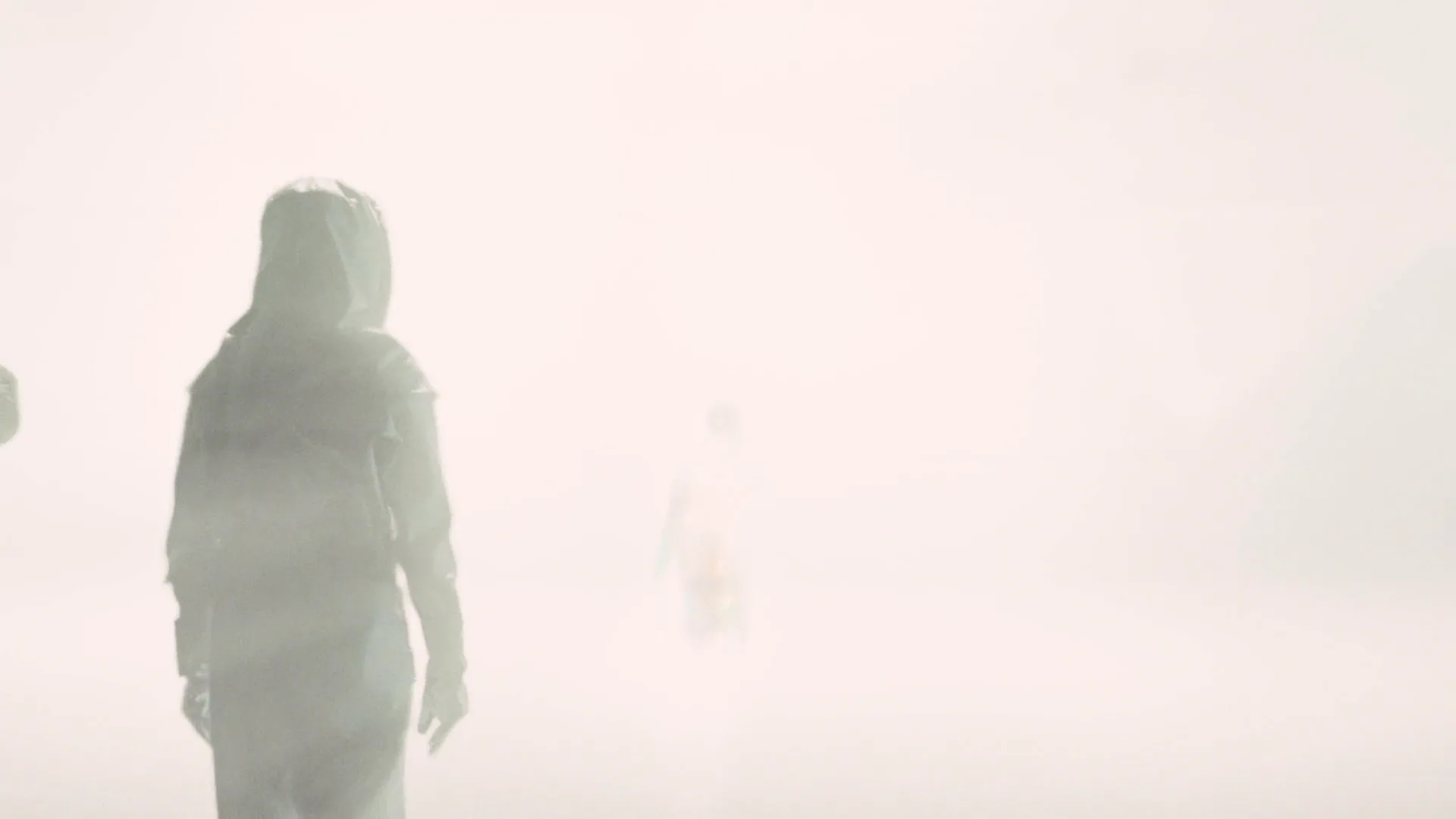
"output": "Full-screen live-action shot from The Day the Earth Stood Still (2008) from its very first frame: one continuous take, no cuts. Glossy 35mm, 16:9. An open field swallowed by extremely dense, still white haze, backlit by a huge floodlight hidden far ahead inside it, so the whole air glows a bright milky cream-white; the ground melts into glowing white a few steps from the camera. Blacks lifted to pale sage gray, contrast almost gone, cream and pale green-gray palette with one small warm orange-red glow far away in the centre.",
"characters": {
"S1": {
"name": "a responder in a hooded protective suit",
"look": "seen only from behind, loose pale gray-green hooded coverall with the hood up, a dark harness across the back, gloved hands",
"voice": "silent"
},
"S2": {
"name": "a soldier with a rifle",
"look": "seen from behind, helmet and body armor, rifle raised to the shoulder",
"voice": "silent"
},
"S3": {
"name": "a hooded soldier",
"look": "seen from behind, hooded olive jacket over body armor, a pistol holster on the belt",
"voice": "silent"
},
"S4": {
"name": "the visitor",
"look": "a small, faint standing silhouette deep in the haze, glowing soft orange-red, featureless",
"voice": "silent"
},
"V1": {
"name": "an army officer, off screen",
"look": "never seen",
"voice": "male, clipped and urgent, a little breathless"
},
"V2": {
"name": "a police radio dispatcher, off screen",
"look": "never seen",
"voice": "male, flat and crackly through a small handheld radio"
}
},
"shots": [
{
"shot": 1,
"camera": "steady dolly moving straight backward at chest height, normal lens, locked horizon; starts as a close shot with S1's back filling the left edge of frame, ends as a medium-wide with three figures spread across the frame and S4 small in the centre distance",
"action": [
"BEGINNING: alive from the first frame, the white haze drifting slowly; only S1's gloved arm and side show at the far left edge, dark gray-green; S4 is a tiny orange-red glow in the exact centre of frame, far away, standing still.",
"THEN: as the camera pulls back, S1's whole back slides into view from the left edge, hood up, facing away toward S4; S1 stands still, arms hanging at the sides, gloved hands open, head held level, looking straight ahead at S4, no turn of the head.",
"THEN: S1 settles in the left-centre of frame and fades to a pale washed-out gray ghost, the haze between S1 and the lens softening every edge; S4 stays a faint glowing shape in the centre behind S1's right shoulder.",
"THEN: the dark back of S3 slides in from the right edge of frame, very close to the lens and much darker than S1; S3's left arm is raised, elbow pointing to screen-left, the hand pressed on top of the hood.",
"THEN: S2 slides in from the left edge, close to the lens, rifle raised to the shoulder and pointed ahead toward S4, standing still.",
"END: three layers in depth: dark gray foreground soldiers at the left and right edges, a pale ghostly S1 standing still in the middle ground, and S4 almost dissolved into the glowing white; nobody walks, the haze keeps drifting slowly across all of them."
],
"dialogue": [
{
"speaker": "V1",
"on_screen": false,
"when": "shortly after the first frame, while S1 slides into view",
"delivery": "urgent, clipped, raised over the wind",
"line": "<d>[English] I need the rules of engagement now.</d>"
},
{
"speaker": "V2",
"on_screen": false,
"when": "right after that, as the soldiers slide in at the edges",
"delivery": "flat, crackling through a radio speaker",
"line": "<d>[English] Target is advancing.</d>"
}
]
}
],
"sound": {
"ambience": "low wind across open ground, a faint deep electrical hum from far ahead, soft rustle of jackets",
"speech": "exactly these spoken phrases, each said once, in this order: I need the rules of engagement now. Target is advancing.",
"never_spoken": "no narration and no voice-over: the descriptions, performance notes and step words of this prompt are never spoken aloud",
"music": "a film score under the scene, always below the voices: a low sustained string drone with a slow, uneasy pulse",
"subtitles": "none"
}
}Remakes the pull-back through white haze in The Day the Earth Stood Still (2008), keeping the backward dolly, the soldiers entering at both edges, the two off-screen radio lines and the contrast that fades with distance.
The haze does the staging: the prompt makes the air glow from a hidden backlight, then ranks the figures by distance, dark soldiers at the edges, a pale suited figure in the middle, a faint glow far away. The backward dolly reveals the layers one by one, under the film's own radio lines.
Open FlashBoardsCommon mistakes
- Gray wash instead of beams. Name a hard source, where it enters and that the camera looks toward it.
- Beams from nowhere. Put the window or lamp in the prompt and frame.
- Fog instead of haze. Write "thin, even haze in still air" to keep the room readable.
- Crushed blacks. Ask for "blacks lifted to smoky gray".
Keep the reference frames, prompts and every generated take side by side — images and video in one canvas.
FAQ
4 questionsWhat is haze in film?
Haze is a fine, even mist released on set by a hazer so that light becomes visible on camera. It turns hard light into beams, lifts the shadows, lowers contrast and makes distant parts of the set fade. The eye barely notices it; the image reads as air and depth.
What is the difference between a hazer and a fog machine?
A hazer makes a thin, long-lasting mist that spreads evenly and shows only where light passes through it. A fog machine heats fluid into thick white clouds that roll and clear quickly. Use a hazer for beams and gentle contrast, fog when you want visible clouds.
How do you get light beams in film?
Fill the space with even haze, then aim a hard, distant source such as the sun or an HMI through a window or blinds. Point the camera roughly toward the light, because beams glow brightest when they travel toward the lens, and keep the background dark so the shafts stand out.
Can you add haze in post-production?
Yes. Compositors add haze, beams and depth fog in many effects shots, but it takes work to look real, because true haze reacts to every light and every distance. On most live-action shoots, practical haze is faster and blends light, lens and actor in one pass.
Related terms
5- BacklightingLighting
Backlighting places the light behind the subject, facing the camera: it outlines hair and shoulders, separates the figure from the background, makes smoke and dust glow and, with no light from the front, turns people into silhouettes.
- Practical LightingLighting
Practical lighting uses light sources visible in the shot — table lamps, neon signs, candles, TV screens — either as the real illumination or as the visible motivation for hidden film lights.
- ContrastLighting
Contrast is the difference between the brightest and darkest parts of an image — set on set by the ratio between key and fill — and ranges from flat, gentle low contrast to hard, graphic high contrast.
- AtmosphereDirecting & Staging
Atmosphere is the sensory mood of a film's world — built from light, weather, color, sound design, pacing and production design — that the audience feels before it understands the story.
- Film LightingLighting
Film lighting is the craft of shaping light for the camera — its direction, quality, color and contrast — to model faces, build space, set the time of day and carry the mood of a scene.
Further reading
Blain Brown, Motion Picture and Video Lighting (Focal Press). Harry C. Box, Set Lighting Technician's Handbook (Focal Press).