 FlashBoards Learn
Lighting · Film language
Contrast
Also called: lighting ratio, contrast ratio, tonal contrast
Contrast is the difference between the brightest and darkest parts of an image. On set it is built mostly by the ratio between key and fill; in post it is shaped by the grade. High contrast feels hard, graphic and tense; low contrast feels soft, hazy, tender or tired.
- What it does
- Sets how hard or gentle the image feels and where the eye goes first — to the brightest, most isolated tone.
- Use it when
- You want the light itself to carry mood: tension and isolation (high) or memory, fatigue and calm (low).
- Watch out
- Push too far and you lose detail — crushed blacks or clipped highlights can't be recovered in the grade.
- Try this prompt
Close-up, single hard window light from the side, no fill, 16:1 lighting ratio, deep black shadows, bright skin highlights
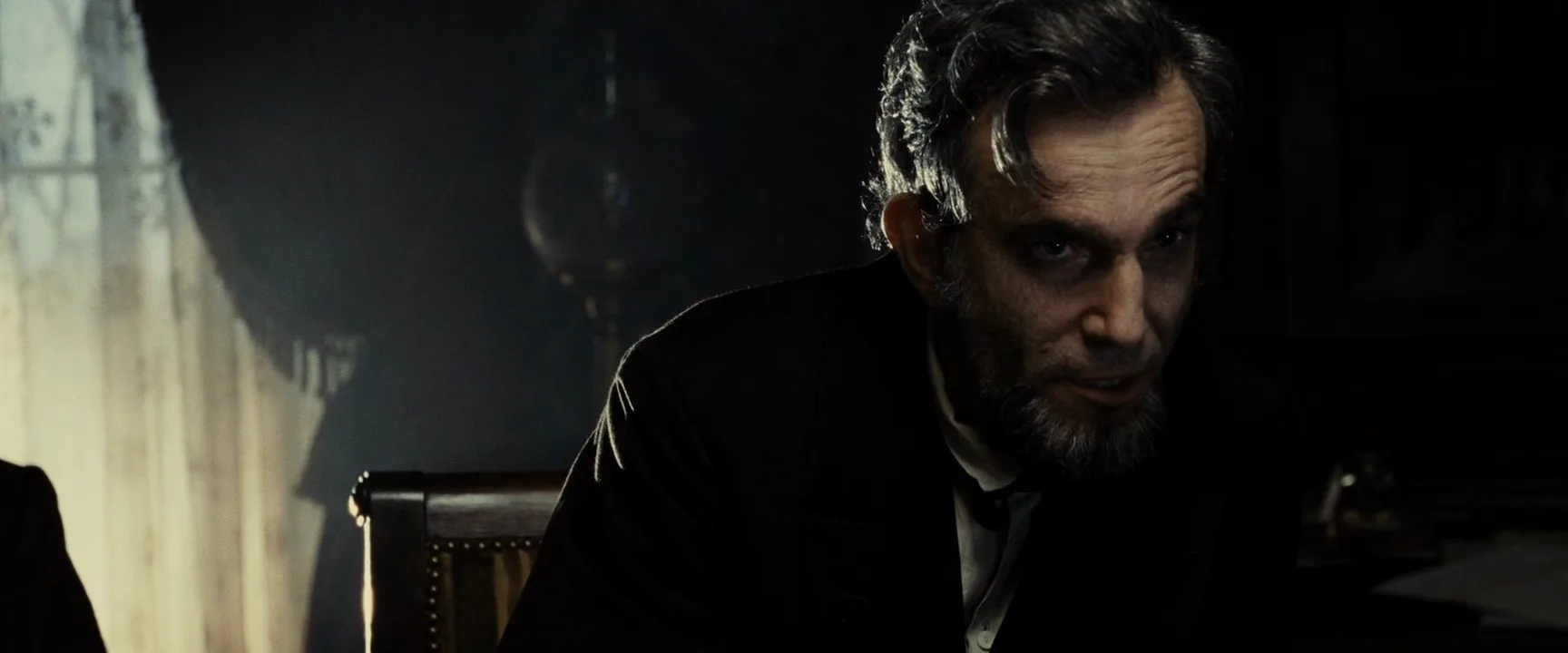
What is contrast in film?
Contrast is the spread of tones in a frame, from the deepest black to the brightest highlight, and how quickly the image travels between them. A high-contrast frame jumps from black to white with few mid-tones; a low-contrast frame lives in the middle grays.
Three things create it: the lighting (how much brighter the lit side is than the shadow side), the scene (a white shirt against a black wall is contrasty under any light) and the image pipeline — haze, exposure and the grade. Contrast is not brightness: a dark frame can be soft, a bright one very hard. It is one of the core levers of film lighting.
Lighting ratio: how contrast is measured on set
Cinematographers talk about contrast as a lighting ratio — key plus fill on the lit side versus fill light alone on the shadow side. Every doubling is one stop.
| Ratio | Stops | How it reads | |---|---|---| | 2:1 | 1 | Open and even — comedy, commercials | | 4:1 | 2 | Natural modeling — most drama | | 8:1 | 3 | Moody, sculpted — thrillers, night | | 16:1+ | 4+ | Shadow side near black — noir, horror |
Scene contrast also counts: a face at 4:1 in front of a black background still reads as a high-contrast image.
High contrast
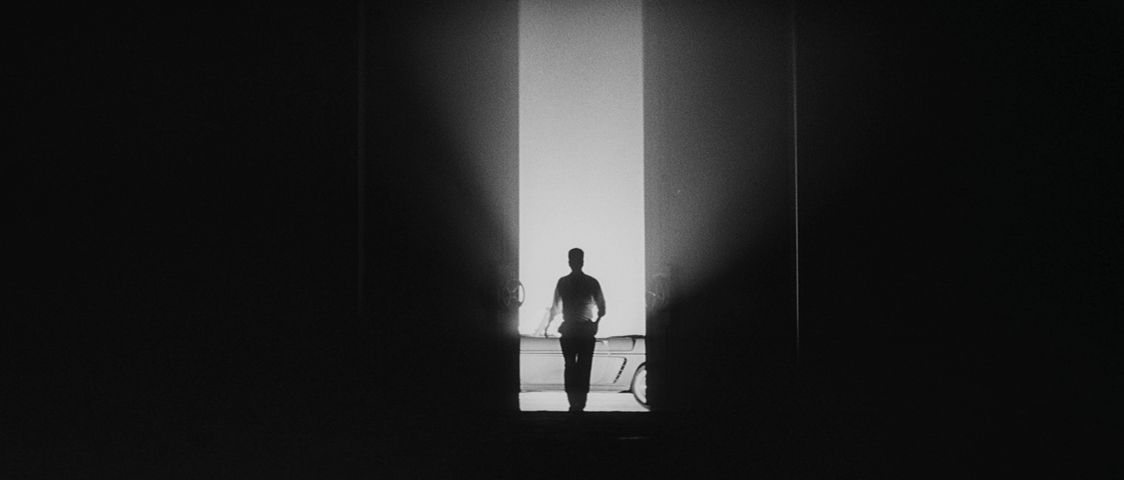
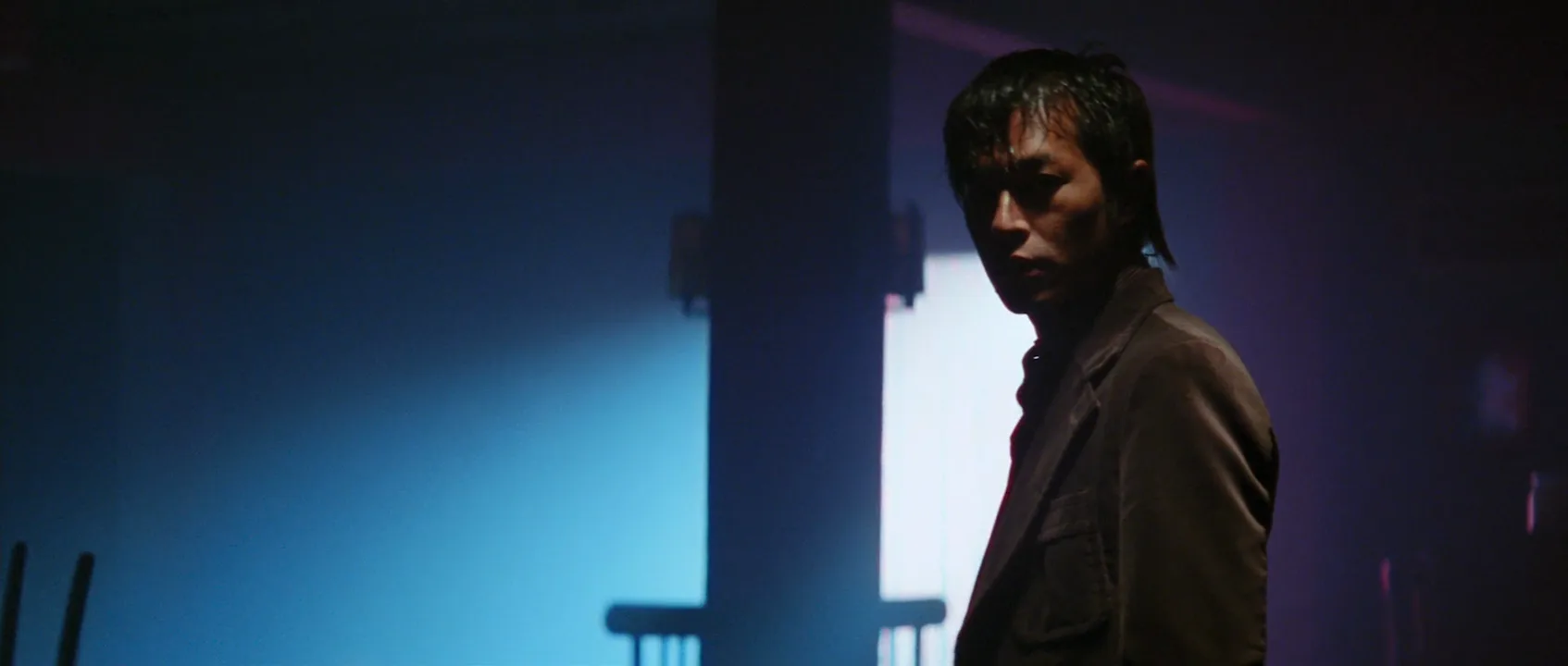
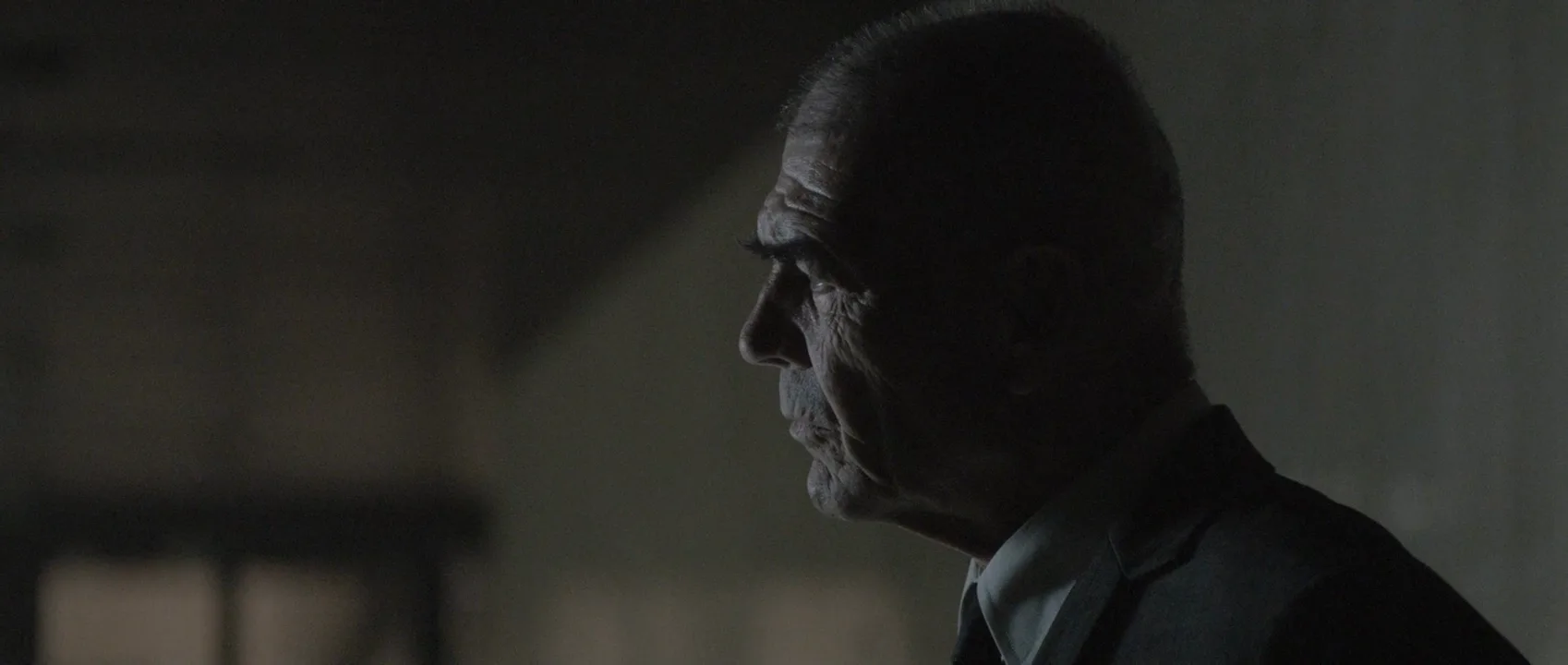
High contrast means deep blacks, bright highlights and a short journey between them. It usually comes from hard light, one dominant source and little or no fill. The eye goes straight to the bright island — a face, a doorway — and the rest is erased.
It is the base of low-key lighting and of film noir. Use it for tension, secrecy, isolation and power; decide in advance what may go black, because detail dies at both ends.
Low contrast
Low contrast compresses the range: shadows stay open, highlights stay soft, and there are few true blacks. Sources are big and diffused, fill is generous, and fog or backlit haze lift the blacks further.
It reads as gentle, nostalgic or exhausted. Vilmos Zsigmond famously flashed the negative on McCabe & Mrs. Miller (1971) for a faded, old-photograph feel. Low contrast is not high-key lighting: high-key is bright and soft, while low contrast can be dark and murky.
How to control contrast on set
- Raise contrast: kill the fill, add negative fill (black flags on the shadow side), use a harder or smaller source, keep light off the background, choose darker walls.
- Lower contrast: bounce or diffuse the key, add a large fill near the lens, add haze, choose lighter wardrobe and walls, or use a low-contrast filter.
- Measure it: meter the key and shadow sides, or read false color and the waveform — the gap in stops is your ratio.
- Leave room for the grade. Light slightly flatter than the final look; crushed shadows can't be brought back.
Contrast vs. dynamic range
Contrast describes the scene or image; dynamic range describes what the camera can record. When scene contrast exceeds the sensor's range, highlights clip or shadows go empty. A wide-range camera doesn't make images flat — it captures a hard scene with detail and lets you choose in the grade how much contrast to show.
Contrast examples in film
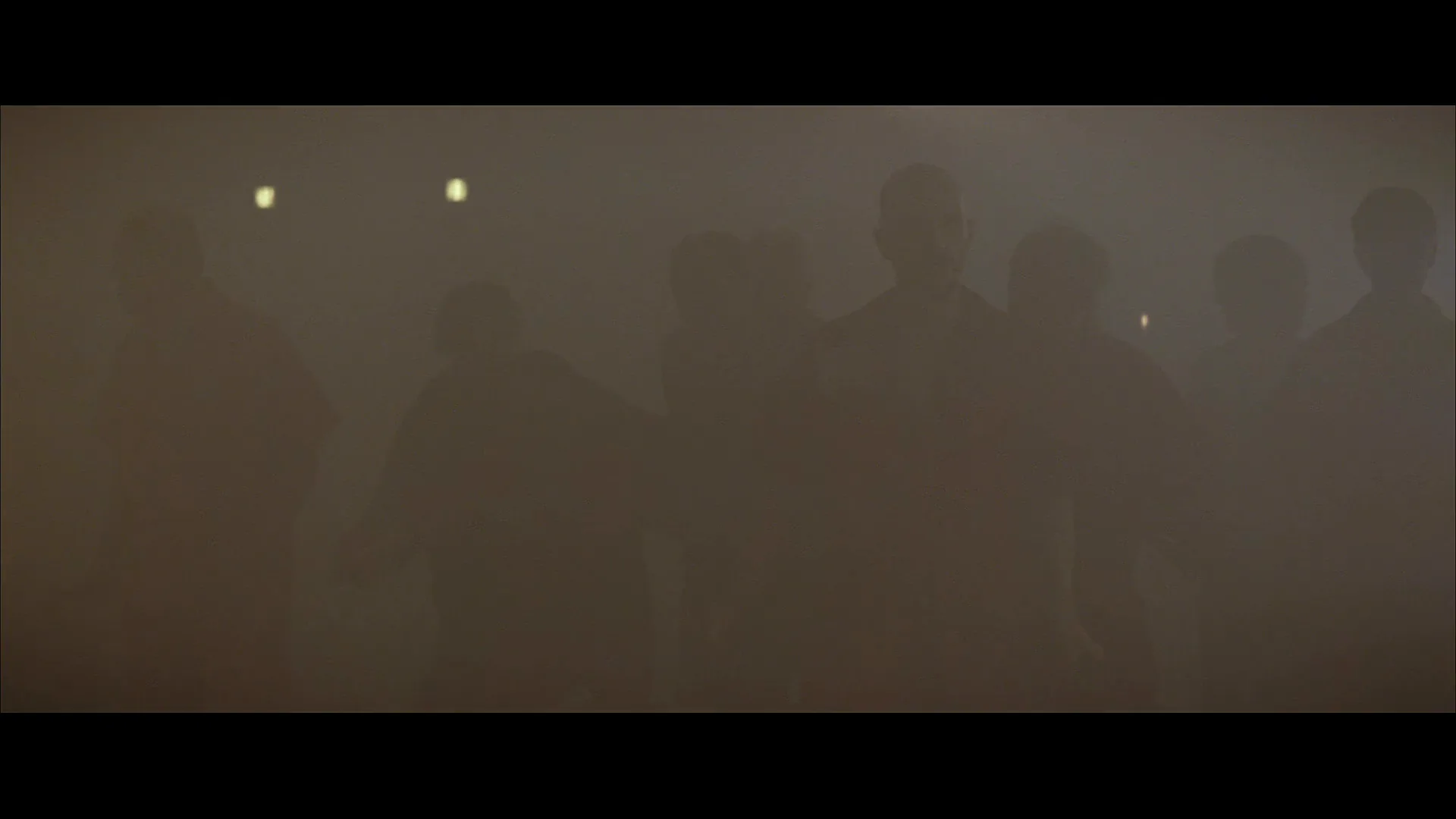
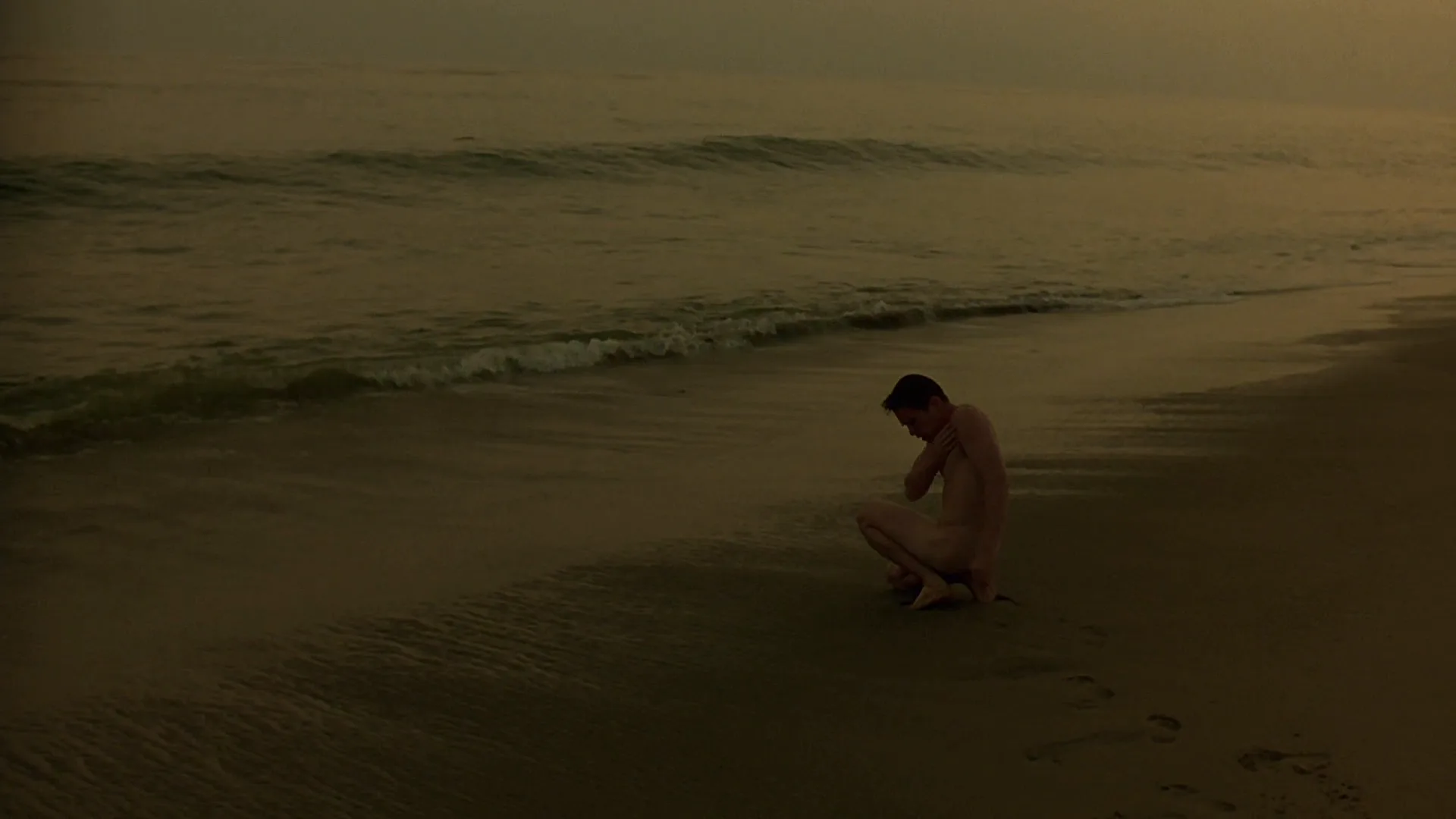
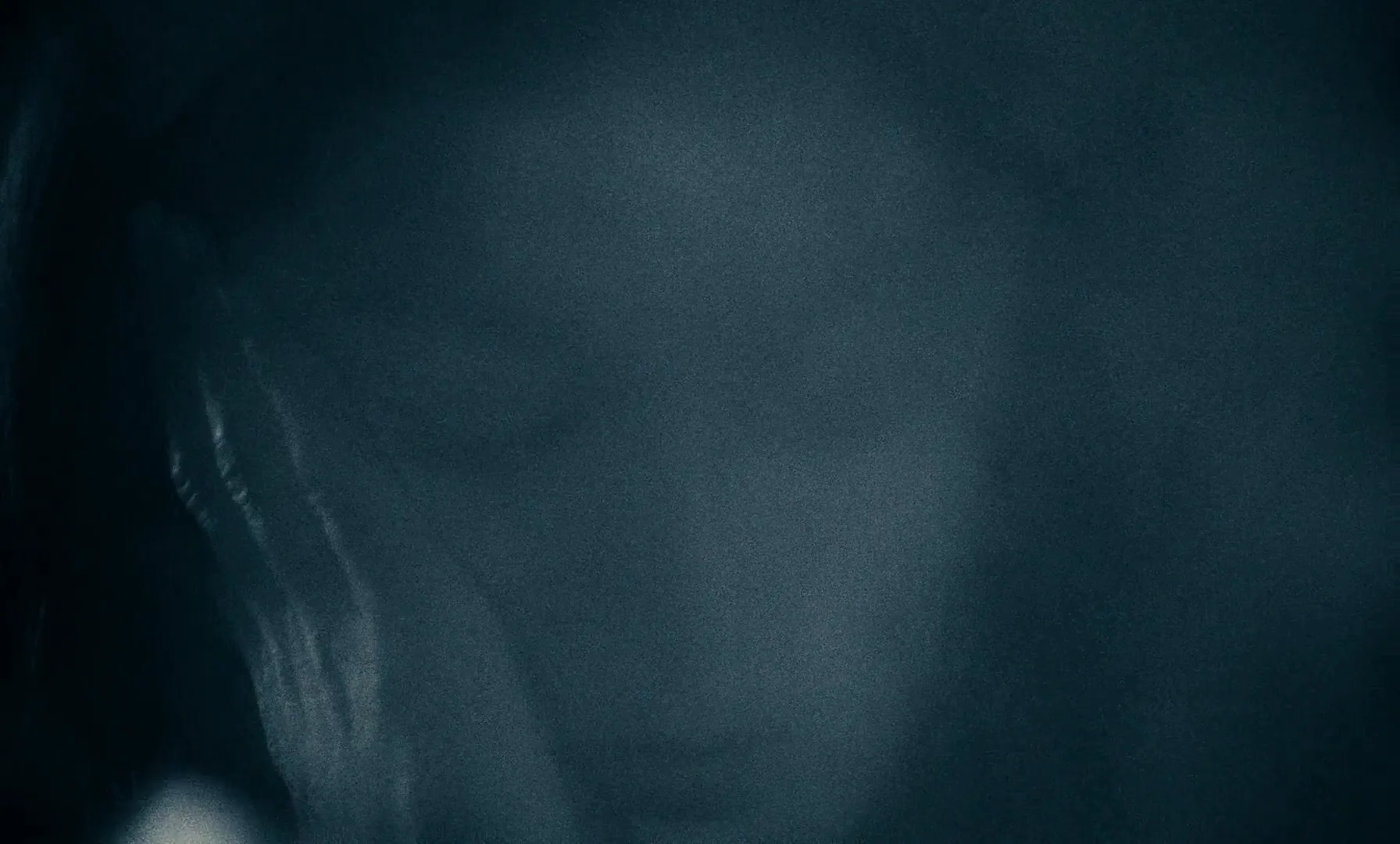
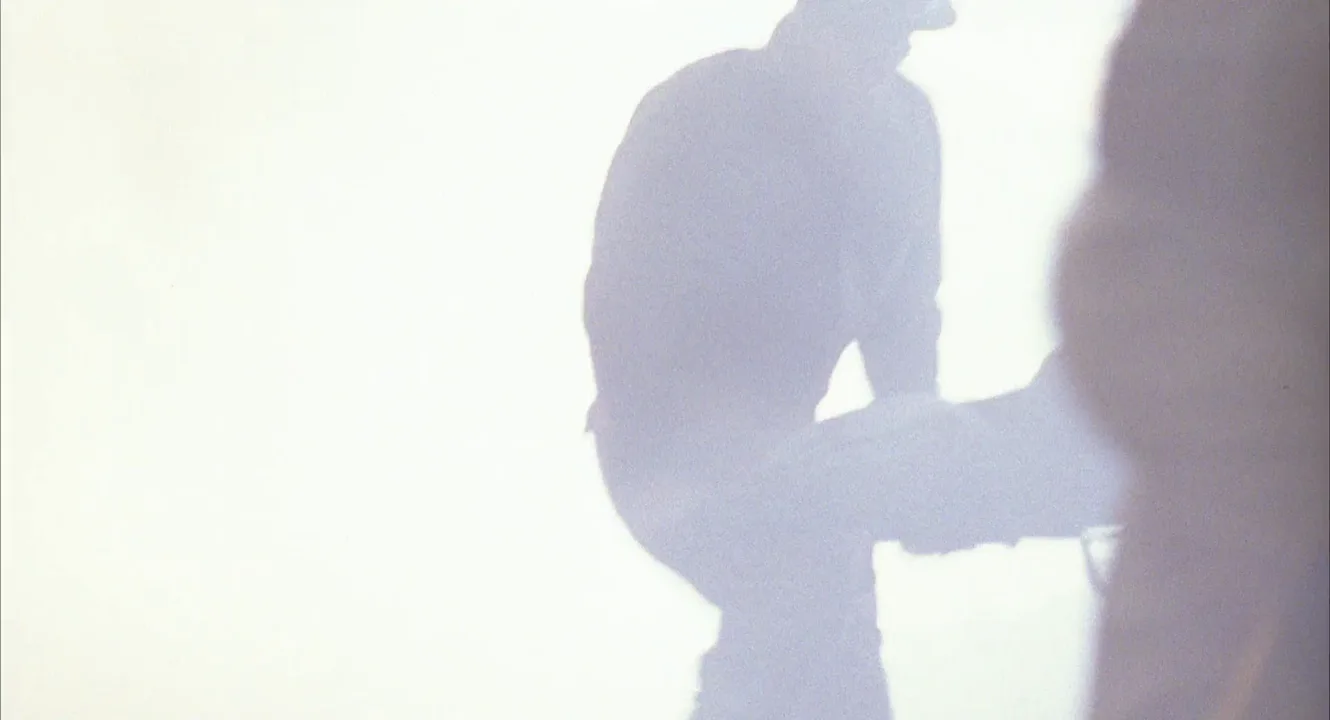
8 framesThe first four frames sit at the hard end of the scale, the last four at the soft end.
How to create a contrast with AI
4 promptsImage models default to a medium, commercial contrast. To move them, describe both ends: where the light comes from, how dark the shadow side goes and what is still visible there. In FlashBoards you can keep the film frames, a hard take and a flat take on one board and compare their tonal range before animating the one that works. The fourth prompt re-shoots a real film shot from a text description alone, and the original plays next to the result so you can compare.
Cinematic medium close-up of a man in his fifties with a shaved head, a broad flat nose, a gray stubble beard and a small silver hoop in his left ear, wearing a dark wool coat, seated at a bare table in a dark apartment at night. One hard narrow beam of white light from a window at camera right cuts across his face and hands; the shadow side of his face falls to near black, 16:1 lighting ratio, deep black background, crisp specular highlights on his scalp and cheekbone, strong high contrast. 50mm lens at eye level, 35mm film grain.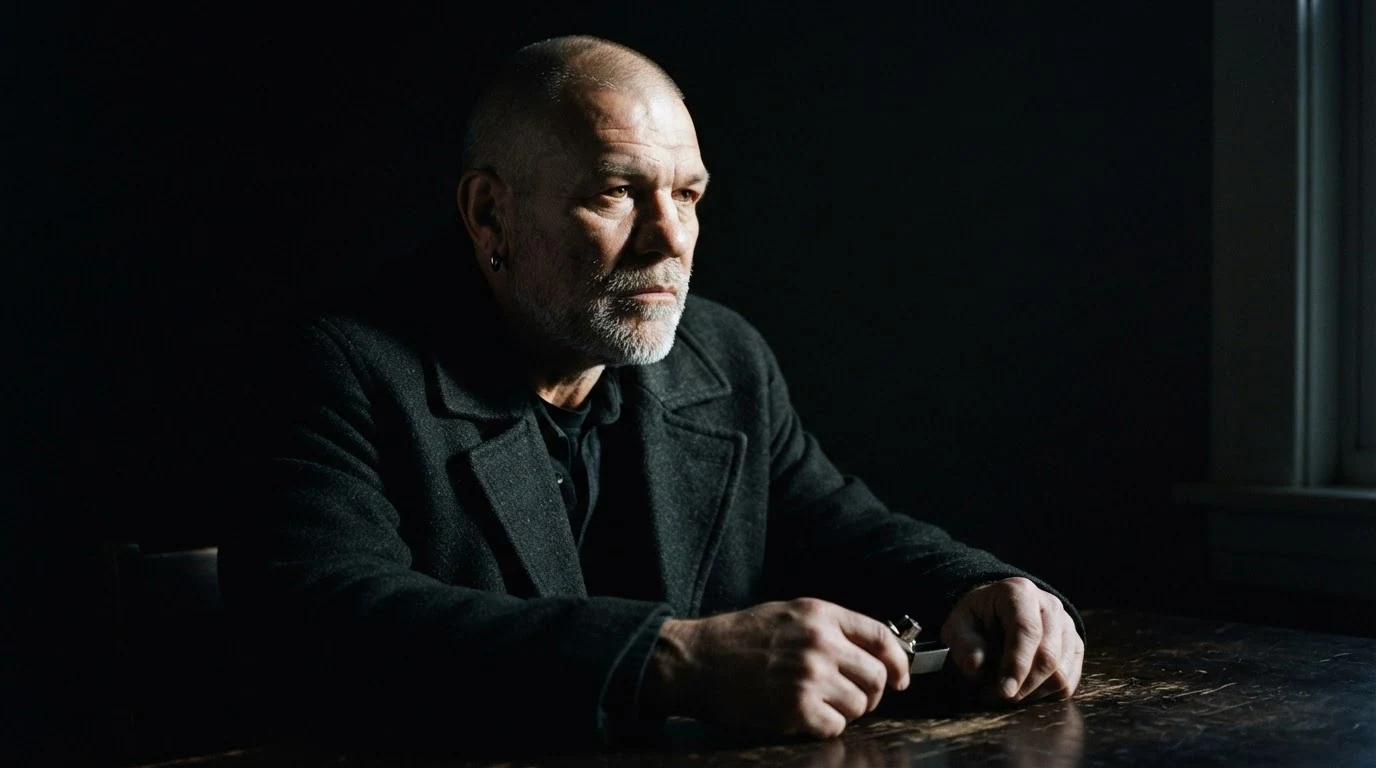
"One hard narrow beam" and "shadow side falls to near black, 16:1" set the ratio; "deep black background" adds scene contrast; "crisp specular highlights" fills the top end, so the image spans the full range instead of just going dark.
Open FlashBoardsAnamorphic widescreen wide shot of a woman in her thirties with short copper-red curls, a freckled pale face and a long mustard raincoat, standing at the end of a wooden pier in thick morning fog. Soft shadowless overcast light, low contrast, milky gray-green tones, no true blacks and no bright highlights, the water, sky and pier almost the same value, fine detail visible in her dark boots. 40mm lens at eye level, muted film look.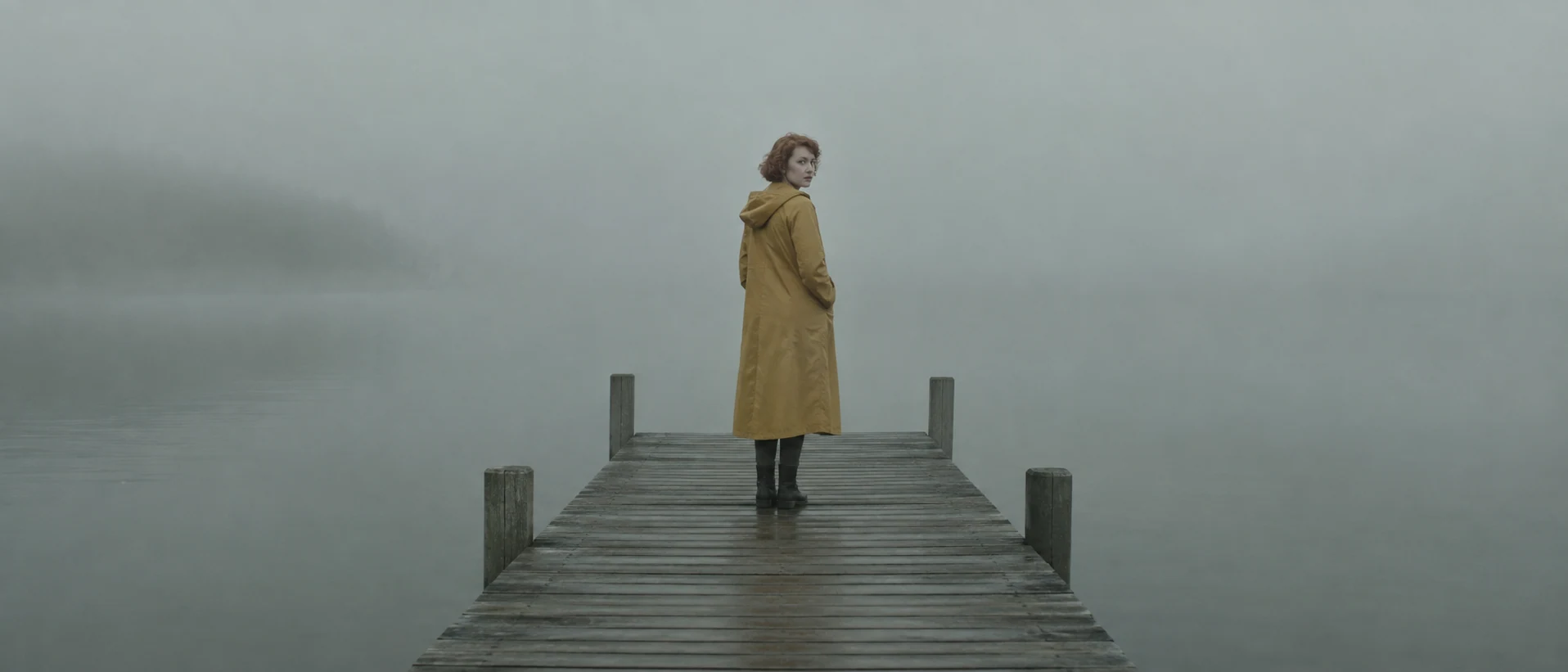
The opposite end: "soft shadowless overcast", "no true blacks and no bright highlights" and "almost the same value" compress the range. Naming a dark object that still shows detail (the boots) keeps the model from sneaking a black back in.
Open FlashBoardsCamera: static, locked-off medium close-up for the whole shot. Action: he is already leaning forward into the hard beam of window light; his lit cheek and scalp brighten as he moves, then he slowly sits back until most of his face sinks into the dark and only the edge of his nose and one eye stay lit. The single hard light from the right stays constant, the room stays black.The motion starts in the first words, so the shot is alive at once. The actor travels through a fixed hard beam, so contrast plays out in time; "the room stays black" stops the model from lifting the shadows.
Open FlashBoards{
"output": "Full-screen live-action scene from Gattaca (1997), from its very first frame: one continuous shot. Grainy 1990s 35mm, an empty ocean beach at dusk under a thick overcast sky, soft shadowless light, very low contrast: one muted sepia-olive tone across sand, sea and sky, milky dark tones and dim soft highlights, every value sitting in the gray middle.",
"characters": {
"S1": {
"name": "Vincent, played by Ethan Hawke",
"look": "slim, short dark hair, bare shoulders and back, dark swim trunks, barefoot, skin the same dull olive as the sand",
"voice": "silence: he never speaks"
}
},
"shots": [
{
"shot": 1,
"camera": "near-static wide shot from slightly above, 40mm lens feel, with only a very slow, barely noticeable drift to the right; wet rippled sand with a trail of footprints fills the lower half, the waterline runs diagonally across the frame, the sea and a hazy horizon fill the top third; S1 is small in the mid-ground just right of centre",
"action": [
"BEGINNING: alive from the first frame, S1 already crouches on his heels at the waterline just right of centre, body side-on, facing frame left along the shore, head bowed, both hands raised in loose fists in front of his chin; a thin sheet of foam slides up the sand at frame left.",
"THEN: he lowers his hands; one arm folds across his chest and the other hand grips his far shoulder, hugging himself, head bowed to his chest.",
"THEN: the hand nearer the camera slides up to the back of his neck, his head turns slightly toward the camera and drops again, eyes on the sand in front of his feet; he rocks gently on his heels.",
"THEN: behind him, the swells rise into a long dark ridge moving in from frame left.",
"END: the wave breaks from left to right in a wide band of dull gray foam that rushes up the beach behind him; S1 stays crouched, arms wrapped around himself, head bowed, and even the foam keeps the soft muted value of the sky."
],
"dialogue": [],
"voice": "silence: nobody speaks in this shot, no voice at all"
}
],
"sound": {
"ambience": "steady surf, a wave breaking and hissing up the sand, soft wind",
"speech": "no words in this video; the only human sounds are breaths and movement",
"never_spoken": "no narration and no voice-over: the descriptions, performance notes and step words of this prompt are never spoken aloud",
"music": "a film score under the scene, always below the voices: a slow, sparse melancholy piano over soft sustained strings",
"subtitles": "none"
}
}Remakes the dusk beach shot from Gattaca (1997), with Vincent (Ethan Hawke) crouched at the waterline: the prompt carries over the high, near-static angle, his self-hugging gestures, the wave that breaks behind him and the flat sepia-olive range.
Low contrast has to be written into the look line, not left to chance: "shadowless light", "one muted tone across sand, sea and sky" and "every value in the gray middle" compress the range. The breaking wave is the test, so the END beat says the foam keeps the sky's soft value instead of flaring to white, and the score and the explicit silence keep the mood without a word spoken.
Open FlashBoardsCommon mistakes
- "Dramatic" isn't a ratio. It often just darkens the frame. Name the source, the ratio and what stays bright.
- Low contrast turns into glow. Say overcast, shadowless, no true blacks, not only foggy, or you get bloom.
- Video lifts the shadows. In motion, models brighten dark areas; repeat that the light and background stay constant.
Keep the reference frames, prompts and every generated take side by side — images and video in one canvas.
FAQ
4 questionsWhat is contrast in film?
Contrast is the difference between the brightest and darkest tones in a frame. It comes from the lighting ratio between key and fill, the tones of set and wardrobe, exposure and the grade. High contrast feels hard and tense; low contrast feels soft, hazy or nostalgic.
What is the difference between high contrast and low contrast?
High contrast has deep blacks, bright highlights and few mid-tones, usually from hard light with little fill. Low contrast compresses the range — open shadows, soft highlights, few true blacks — usually from big diffused sources, heavy fill or haze. The first isolates and dramatizes; the second calms.
What is a lighting contrast ratio?
The lighting ratio compares the lit side of a subject (key plus fill) with the shadow side (fill only). Each doubling is one stop: 2:1 is open, 4:1 natural drama, 8:1 moody, and 16:1 or more pushes the shadow side toward black.
How do you make contrast in photography or film lower?
Add fill near the lens, bounce or diffuse the key, light the background, use lighter walls and wardrobe, add haze or a low-contrast filter. Lighting a little flatter than the final look also keeps options open in the grade.
Related terms
7- High-Key LightingLighting
High-key lighting is bright and even, with plenty of fill and a low key-to-fill ratio, so the frame is dominated by light tones and gentle shadows — the look of sitcoms, comedies, commercials and dreamlike heavens.
- Low-Key LightingLighting
Low-key lighting keeps most of the frame in shadow, with a strong key, little or no fill and a high lighting ratio, so only fragments of faces and objects emerge from the dark — the language of noir, thrillers and horror.
- ChiaroscuroLighting
Chiaroscuro, borrowed from Renaissance and Baroque painting, is dramatic modelling with strong light and deep shadow — usually one hard side or top source carving faces out of darkness — the backbone of German Expressionism and film noir.
- Fill LightLighting
Fill light is a softer, weaker source on the side opposite the key that lifts the shadows the key creates; its level relative to the key — the lighting ratio — decides whether a face looks open and bright or moody and sculpted.
- Key LightLighting
The key light is the main light on a subject: it sets the direction, hardness and color of the illumination, and every other source — fill, back, practicals — is balanced against it.
- Color TheoryColor
Color theory in film is the practical knowledge of how hue, saturation and brightness interact and how filmmakers use palettes, contrasts and color changes to guide the eye and shape emotion.
- Film LightingLighting
Film lighting is the craft of shaping light for the camera — its direction, quality, color and contrast — to model faces, build space, set the time of day and carry the mood of a scene.
Further reading
Blain Brown, Motion Picture and Video Lighting (Focal Press). · Harry C. Box, Set Lighting Technician's Handbook (Focal Press). · American Cinematographer magazine, ASC.