 FlashBoards Learn
- Learn
- Post-Production & VFX
- Altered State Effect
Post-Production & VFX · Film language
Altered State Effect
Also called: altered state, psychedelic sequence, trip sequence, intoxication POV
An altered state effect makes the image act like a drugged, drunk or feverish mind: lenses warp, motion smears, faces double, colors drift and time stretches. Instead of watching a character lose control, the audience loses it with them, feeling the high, the hangover or the panic through the frame itself.
- What it does
- Turns a character's intoxication or delirium into something the viewer perceives directly.
- Use it when
- The story depends on what a character feels while their grip on reality slips: a high, a blackout, a fever, a bad trip.
- Watch out
- Every effect at once reads as a music video; pick two or three distortions and let them build.
- Try this prompt
Close-up of a swaying man in a neon bar, face sharp, background smeared into streaks of magenta light, faint doubled ghost of his head, tilted frame, film grain
What is an altered state effect?
It is a family of techniques, not one trick. The camera and the edit stop recording the world neutrally and imitate a nervous system that is misfiring:
- Optics: wide or bent glass, lens distortion, prisms, drifting focus.
- Time: slow shutter, step printing, speed ramps, loops.
- Layering: ghosted doubles and double exposure.
- Color and light: one sick hue, hue cycling, blown-out highlights.
- Camera: sway, roll, rigs that lock the face while the room lurches.
- Sound: muffled dialogue, a heartbeat, a ringing tone.
It is the most extreme branch of subjective cinema, usually finished in post-production.
Why do filmmakers use altered state sequences?
Because describing a high is weak drama and showing it is strong. A trip scene hands the audience the character's experience without explanation, and it can flip tone in one cut: euphoric, comic, then frightening.
Dumbo (1941) turns a drunk elephant's night into "Pink Elephants on Parade." Easy Rider (1969) shot its cemetery acid trip handheld on 16mm. Fear and Loathing in Las Vegas (1998) fills a hotel bar with lizards, and Enter the Void (2009) stages a whole trip in first person.
How to shoot an altered state effect
Build most of it in camera; post pushes it further.
- Lens. A 14–18mm close to the face bends features. Vaseline on the edges of a clear filter leaves only the center sharp.
- Shutter. Shoot 6–12 fps with a 180–360° shutter, then repeat frames to play at 24 fps: the smeared stutter of step printing and heavy motion blur.
- Rig. A Snorricam locks the actor's face while the world swings; a loose shoulder rig with a slow 5–15° roll reads as sway.
- Light. One gelled source, practical flicker, or two stops of overexposure for a head rush.
- Post. Frame blending, a delayed ghost layer at 20–40% opacity, displacement warps, chromatic fringing, hue shifts.
Drug trip scene: psychedelic sequences
A drug trip scene renders intoxication as a changing world: color rotates, patterns breathe, objects melt, time loses rhythm. Match the drug. Psychedelics suit morphing textures and color cycling; stimulants suit speed and hard cuts, like the rapid close-up montage of each hit in Requiem for a Dream (2000); depressants suit sinking and muffled sound.
Structure it as a curve: start almost normal with one wrong detail, peak, then land hard. A cut back to clean coverage becomes the comedown.
How is the drunk effect done?
The drunk effect imitates inebriation: the horizon never settles, vision doubles, focus lags, sound smears. Its simplest form is a handheld camera swaying on a slow pendulum. The classic upgrade is a rig strapped to the actor, as in the party scene of Mean Streets (1973), where Harvey Keitel stumbles with the camera fixed to him.
In post, a copy of the shot offset by a few frames makes double vision. Keep it lighter than a trip so the scene still plays.
Altered state effect vs. subjective cinema
Subjective cinema is the broad idea: the film shows what a character sees or feels through POV, focus, editing and sound. An altered state effect is the case where perception itself is damaged. A clean POV through a keyhole is subjective but sober; the same shot swimming in ghosts is an altered state.
Altered State Effect in motion








11 clipsWatch how each clip and loop damages perception in a different way: spinning and smearing, stumbling handheld, rotoscoped faces, flashing color. Notice what stays readable in each, usually one face, which keeps the effect watchable.

How to create a altered state effect with AI
3 promptsImage models default to clean, sober photography, so write the distortion as physical causes: slow shutter, a doubled layer, a tilted horizon, a named color cast, and keep one sharp anchor. Pin film references beside each take on a FlashBoards board to compare how far each distortion goes.
Medium close-up of a fictional man in his thirties with a shaved head, short copper beard and chipped front tooth, teal bowling shirt, in a crowded neon bar at night; frame tilted 12 degrees, 24mm lens close to his face at eye level; his face sharp in the center, the bar behind him smeared into long horizontal streaks of magenta and teal light, a faint transparent double of his head offset right, red-blue fringes at the edges, dark vignette, slow-shutter look, 35mm film grain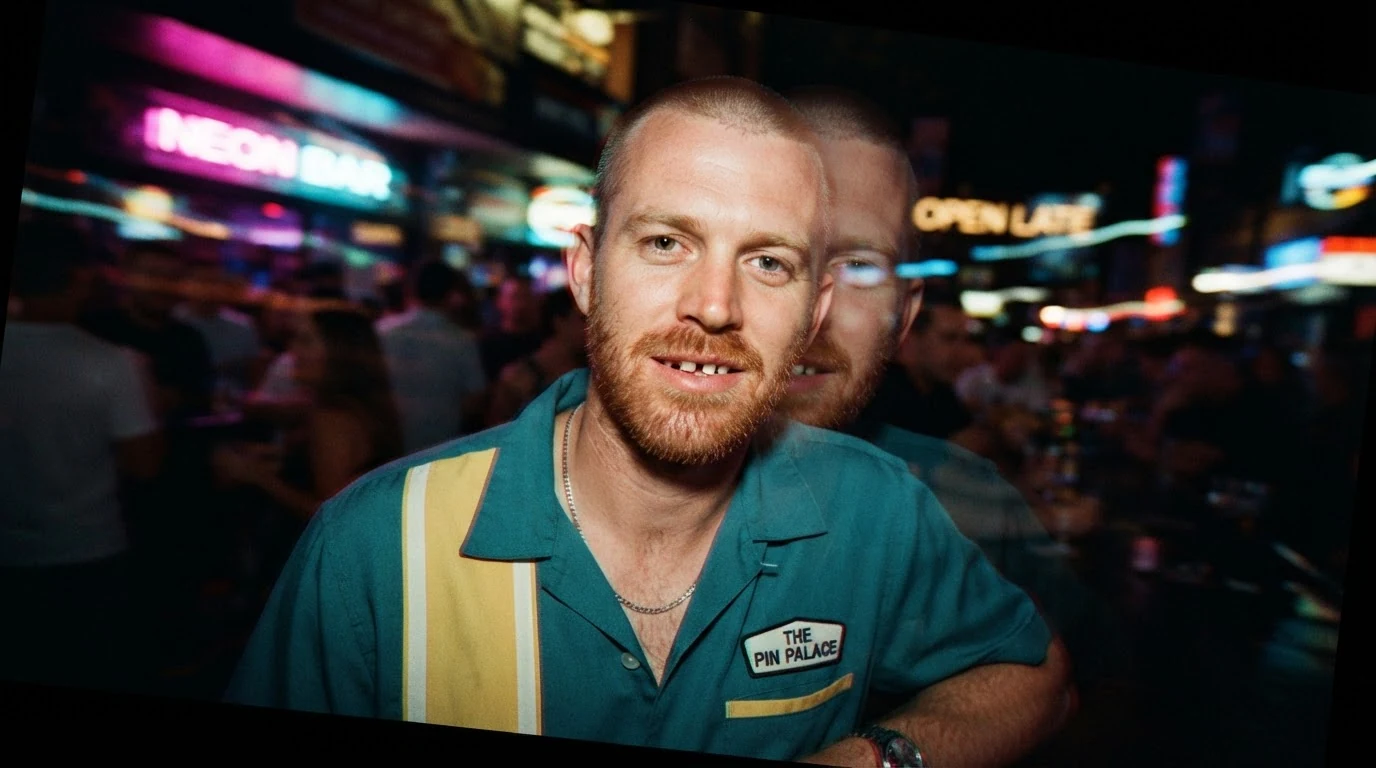
"Face sharp in the center" is the anchor; "horizontal streaks" and "slow-shutter look" add motion to a still. "Transparent double" gives double vision, "tilted 12 degrees" an unsteady horizon.
Open FlashBoardsOverhead shot of a fictional young woman with a shaved undercut, silver nose ring and freckles, lying on a patterned orange rug, arms spread, eyes wide open; the rug and floral wallpaper melt and flow in slow waves, colors shifted to violet, lime and hot pink, a prism effect repeating her face in three soft kaleidoscope copies, her real face crisp in the center, 16mm wide lens, warm lamp light, 1970s film grain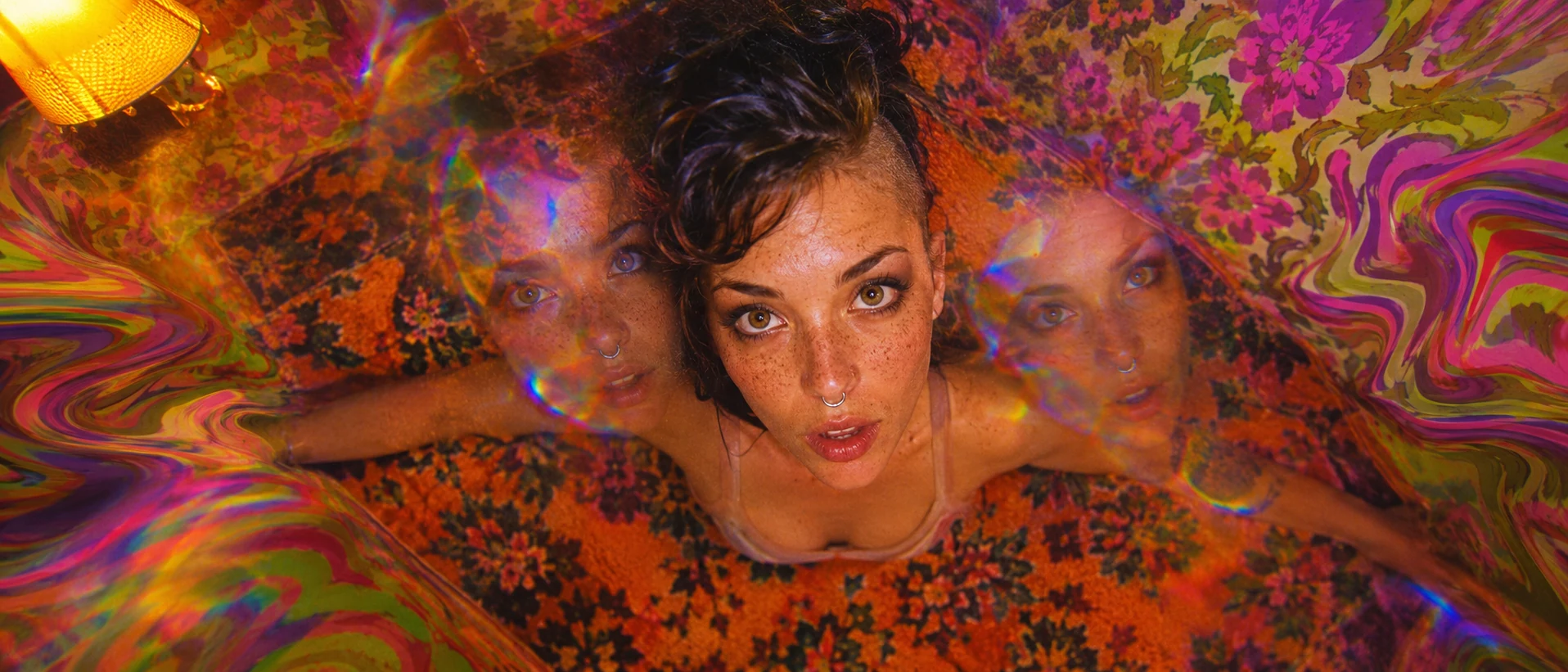
The psychedelic variant. "Melt and flow in slow waves" and "prism effect" push past realism, while "her real face crisp in the center" keeps a readable subject.
Open FlashBoardsCamera: handheld, swaying from the first frame in a slow pendulum, rolling about 10 degrees left then right, drifting slightly closer to his face. Action: The man sways out of rhythm with the camera as the magenta and teal streaks behind him stretch. His transparent double trails half a second behind each head movement. He blinks slowly, lifts his chin, and his eyes lose focus.Sway and roll start immediately, so the model animates motion instead of pushing in on a still. Every element named already exists in the start frame.
Open FlashBoardsCommon mistakes
- Everything goes soft. Name one sharp anchor: face, eyes, a glass.
- Random glitch artifacts appear. Describe optical causes: shutter streaks, a transparent double.
- "Trip" becomes rainbow wallpaper. Name specific colors and one material that melts.
- In video the distortion freezes. Start the sway in the first sentence.
Keep the reference frames, prompts and every generated take side by side — images and video in one canvas.
FAQ
4 questionsHow do you make a drug trip scene in a film?
Match distortions to the drug and the beat: morphing color for psychedelics, fast cuts and harsh light for stimulants, sinking and muffled sound for depressants. Capture what you can in camera with wide lenses, slow shutter and colored light, then add echo, warps and hue shifts in post. Build it as a curve: subtle, peak, then a hard cut back to clean coverage.
How do you make a drunk effect in a video?
Shoot handheld with a slow pendulum sway and a few degrees of roll, or rig the camera to the actor so the room lurches around a steady face. In editing, layer a copy of the shot a few frames late at low opacity for double vision, then add edge blur and muffled sound. Keep the scene readable.
What is a psychedelic effect in film?
A psychedelic effect imitates a hallucinogenic experience: saturated or cycling color, breathing patterns, kaleidoscopic repetition, melting surfaces and elastic time. Filmmakers have used prisms, liquid light projection and optical printing, and now digital warps and hue shifts, so the audience feels the character's senses change.
What is the difference between an altered state effect and a dream sequence?
A dream sequence shows a different reality, often clean and staged, entered while asleep. An altered state effect distorts the real, present scene as an awake character perceives it: the same bar and people, but smeared, doubled or discolored. Dreams change the world; altered states change the eyes looking at it.
Related terms
5- Subjective CinemaFilm History & Theory
Subjective cinema puts the audience inside a character's perception — literal point-of-view shots, but also distorted focus, sound and editing that mirror what the character feels (Enter the Void, Lady in the Lake).
- Lens DistortionLenses, Focus & Exposure
Lens distortion is the way a lens bends lines that should be straight — outward like a barrel on wide and fisheye lenses, inward like a pincushion on some long lenses; filmmakers either correct it or push it to make a space feel warped and unstable.
- Motion BlurLenses, Focus & Exposure
Motion blur is the smear a moving subject leaves when it travels during the exposure of a frame; its amount depends on shutter speed or shutter angle, and it makes movement feel smooth, fast or, when exaggerated, frantic.
- Double ExposureCameras & Capture
Double exposure records two images on the same piece of film — or blends them in post — so both show through at once, often a face merging with a landscape; in camera it was the classic way to create ghosts and visions.
- SnorricamCamera Movement
A Snorricam is a rig strapped to the actor's body with the camera aimed back at them, so their face stays locked in the frame while the world lurches around — a staple for drunkenness, panic or euphoria.
Further reading
Bruce Block, The Visual Story (Focal Press). Mascelli, Joseph V., The Five C's of Cinematography (Silman-James Press).