 FlashBoards Learn
- Learn
- Post-Production & VFX
- Dailies
Post-Production & VFX · Film language
Dailies
Also called: rushes, daily rushes
Dailies are the unedited takes from one shooting day, synced with sound and delivered fast, usually overnight, so the director, cinematographer and editor can check performance, focus, exposure and coverage while the set still stands. In Britain the same footage is called rushes. Dailies are the production's first honest look at what it actually got.
- What it does
- Shows the crew what was really recorded yesterday, while there is still time to reshoot.
- Use it when
- Every shooting day: review before the next call time, flag problems, circle the takes the editor should start with.
- Watch out
- A phone or laptop screen hides soft focus and noise; judge sharpness and exposure on the biggest calibrated screen you have.
- Try this prompt
Medium close-up, a clapper loader's hand holding a film slate in front of an actress's face, set lights behind, 50mm, documentary set photo
What are dailies in film?
Dailies are the raw material of a shooting day: every take that was rolled, with picture and production sound synced, a basic look applied and nothing cut. Each clip runs from the slate to "cut", often with timecode, scene and take numbers burned into the frame so notes can point to an exact moment.
They are not a cut and not a preview of the final look. Dailies answer practical questions: is it sharp, is it exposed where the DP wanted, did the actor land the moment, is there enough to edit. The film editor starts the assembly from the same material, so dailies sit at the hinge between shooting and post-production.
Dailies vs. rushes: is there a difference?
No. Rushes is the British term, dailies the American one, for the same unedited footage from a shooting day. "Rushes" comes from the film era, when the lab rushed the negative through overnight processing so a print could be screened the next day. "Dailies" describes the rhythm: a new batch every shooting day. On film shoots the printed rushes the editor physically cut were also called the workprint.
Why do directors and DPs watch dailies?
Because the monitor on set lies a little. A 17-inch field monitor hides soft focus, a clipped window or a boom dipping into frame that a cinema screen makes obvious. Each viewer watches for something different:
- Director: performance across takes, and whether a pickup is needed before the location wraps.
- Cinematographer: exposure, contrast, the LUT, focus on the critical takes.
- Editor: whether the scene cuts together. Missing coverage or an eyeline that doesn't match shows up here first.
- Script supervisor and departments: continuity of props, wardrobe and hair.
The value is timing. A problem found the next morning costs one extra setup on a standing set; the same problem found in the rough cut means a reshoot with everything rebooked.
How dailies are made: from camera card to screening
On film. The negative went to the lab at wrap and was developed overnight. Only the circled takes, marked "print" on the camera report, were printed as a one-light workprint, with one average printer-light setting for the whole roll. An assistant editor synced the transferred sound by lining up the frame where the clapper closes with the spike of the clap.
On digital:
- Offload and verify. The DIT copies each card to at least two drives with checksum verification.
- Sync. Picture and sound are married by jam-synced timecode or by the slate clap.
- Color. A show LUT plus per-scene CDL values set with the DP gives a "best-light" look.
- Transcode. Light editorial files (DNxHD 36 or ProRes Proxy class) go to the cutting room; H.264 streams go to the director and producers.
- Metadata. Scene, take, circled takes and camera, sound and script notes travel with each clip.
Turnaround is usually overnight; near-set systems can deliver within hours.
What to look for when you watch dailies
Watch with a checklist:
- Focus. Eyes on close-ups, the critical plane on long lenses. Soft focus is the pickup that small screens hide best.
- Exposure. Are highlights holding in windows and skin? Judge log footage only through the DP's LUT.
- Frame edges. Boom, flags, crew reflections, a stand in a mirror.
- Performance and coverage. Which take has the moment, and is there enough overlap of action between angles to cut on movement.
- Sound. Plane noise, lav rustle, overlaps that won't separate.
Note timecode, not descriptions: "Sc 24 tk 3, 01:02:14, soft on her eyes" is a note the editor and DP can act on.
Dailies on an AI film
An AI production generates takes instead of shooting them, but the discipline holds. Review each day's generations on a large screen: melting hands, drifting faces, props that change between shots, eyelines that won't cut. Circle the keepers and write the fix into the next prompt. On a FlashBoards board, generations placed beside their storyboard frames work like an annotated dailies reel.
How to create a dailies with AI
3 promptsYou can't generate dailies, but you can stage the moments that define them: the slate at the head of a take and the room where the take gets judged. Use them for a behind-the-scenes sequence or a pitch deck, and keep all three results on one FlashBoards board to compare like takes.
Medium close-up on a film set, 50mm lens at eye level: a clapper loader's hand holds a black-and-white film slate with its clapstick raised, just in front of a fictional actress in her thirties with a short silver bob, freckles and a dark green wool coat, who looks past the slate toward the lens. Behind her, a softly out-of-focus kitchen set lit by a large window light, a C-stand and a boom pole edge visible at frame right. Natural documentary set-photo look, slight film grain.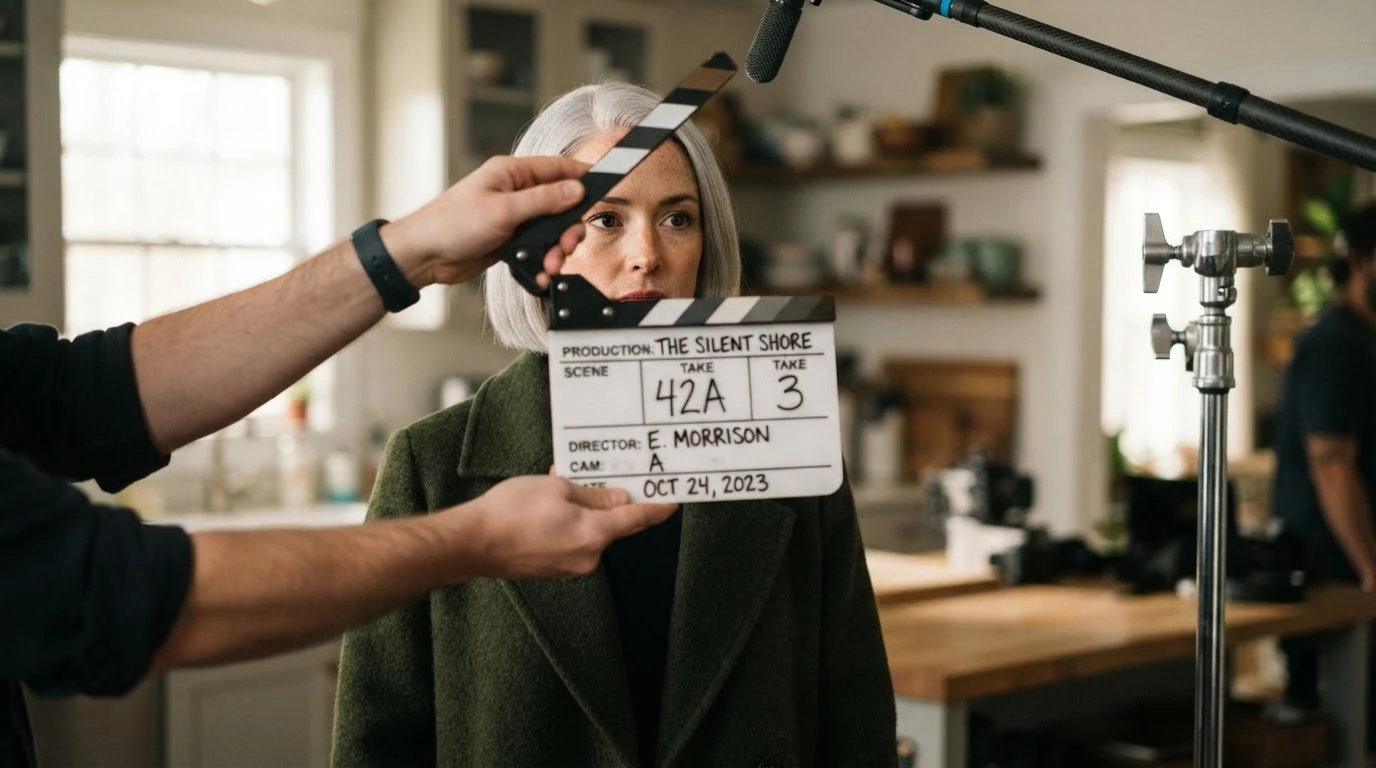
Clapstick raised, just in front of the actress puts the viewer at the first frame of a take, where every dailies clip begins. A visible C-stand and boom pole edge tells the model this is a working set, not a finished scene.
Open FlashBoardsWide shot of a small dark screening room during dailies: a projected film frame fills a screen at the far end, showing an actress in a green coat in a kitchen. In the second row, a fictional director, a tall man in his fifties with a shaved head and round tortoiseshell glasses, leans forward with a notebook; beside him a fictional cinematographer, a woman in her forties with long gray braids and a denim jacket, points at the screen. Only the projector beam and the screen light their faces, dust visible in the beam, deep blacks around them.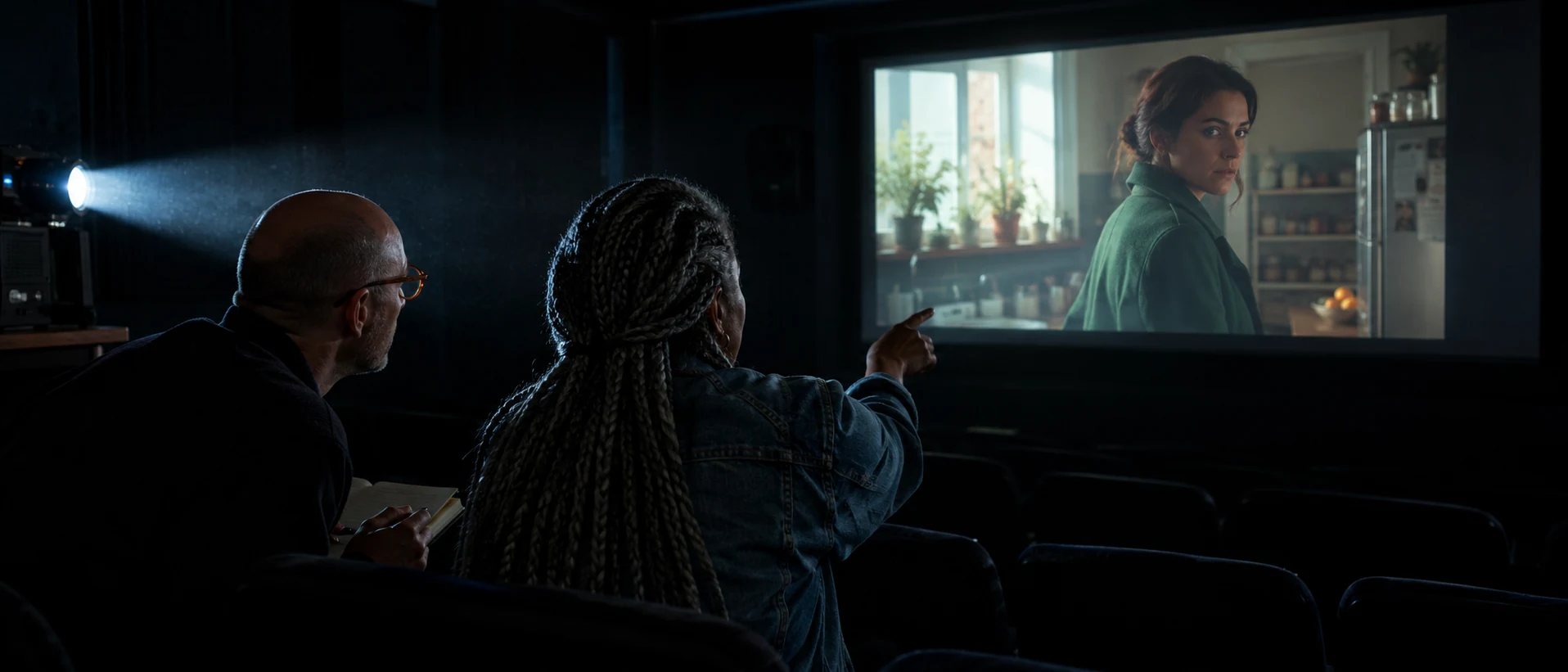
The second take shows the people judging the shot. Only the projector beam and the screen light their faces gives the reflected light of a real screening room, and dust visible in the beam sells the projection. 21:9 holds screen and audience in one frame.
Open FlashBoardsCamera: static on a tripod, eye level, 50mm, holding the medium close-up for the whole shot. Action: the clapstick snaps shut at once and the hand pulls the slate quickly out of frame to the left. The actress breathes out, lowers her eyes, then lifts them again and starts to speak quietly to someone just off camera right. Her silver hair moves slightly as she turns her head. The window light behind her stays steady.Snaps shut at once makes the shot alive from the first frame, so the model doesn't drift into a slow push on the still. Static on a tripod keeps all the motion in the performance, like the head of a real take.
Open FlashBoardsCommon mistakes
- Slates come out with garbled numbers. Call the slate "hand-chalked" and keep it partly turned or motion-blurred.
- Screening rooms get lit like offices. State that the screen and projector beam are the only light.
- Video models leave the slate hovering. Say when it claps and where it exits.
- "Film set" alone produces a finished scene. Name gear at the frame edge to keep it behind the scenes.
Keep the reference frames, prompts and every generated take side by side — images and video in one canvas.
FAQ
5 questionsWhat are dailies in film?
Dailies are all the unedited takes from one shooting day, synced with production sound and given a basic color look, delivered quickly, usually overnight. The director, cinematographer and editor watch them to check focus, exposure, performance and coverage, choose favorite takes and catch problems while the cast and set are still available for a pickup.
What is the difference between dailies and rushes?
None in meaning. Dailies is the American term and rushes the British one for the same unedited footage from a shooting day. "Rushes" dates from the film era, when labs rushed the negative through overnight processing so prints could be screened the next morning or evening.
Who watches dailies on a film?
The core viewers are the director, the cinematographer and the editor with their assistants. Producers and studio executives usually follow the shoot through streamed dailies. Costume, makeup and production design check their work, and the script supervisor checks continuity. Actors are sometimes invited, though many prefer not to watch themselves mid-shoot.
Are dailies color graded?
Only lightly. Dailies get a working look, not a final grade: on film a one-light print, on digital a show LUT with per-scene adjustments agreed with the DP, often called best-light dailies. The final color is set much later in the grading suite from the original camera files.
How fast are dailies delivered?
Traditionally overnight: what is shot today is screened tomorrow, hence the name. On digital productions a near-set dailies system can sync, color and transcode footage within a few hours, so the editor may cut a scene the same day it is shot.
Related terms
5- TakeFilmmaking Process & Crew
A take is one uninterrupted recording of a particular setup, from 'action' to 'cut'; a shot may need dozens of takes, and the editor chooses the best one or combines several.
- CoverageDirecting & Staging
Coverage is the full set of shots filmed for one scene — master, singles, over-the-shoulders, inserts, reactions — that gives the editor choices of pace, emphasis and performance.
- Film EditorFilmmaking Process & Crew
The film editor shapes the footage into the finished film: reviewing dailies, building the assembly and later cuts with the director, and deciding rhythm, performance choices and structure.
- Rough CutEditing
The rough cut is the first shaped version of the film after the assembly: scenes are trimmed and ordered for story, but pacing, sound, music and effects are still temporary.
- Post-ProductionPost-Production & VFX
Post-production is everything after the shoot that turns footage into a finished film: editing, sound design and mix, music, VFX, color grading, titles and delivery masters.
Further reading
Walter Murch, In the Blink of an Eye (Silman-James Press). American Society of Cinematographers, American Cinematographer Manual.