 FlashBoards Learn
- Learn
- Storytelling
- Climax
Storytelling · Film language
Climax
Also called: story climax, final confrontation
The climax is the decisive peak of a story: the moment the protagonist meets the central conflict head-on and the main dramatic question gets its answer. Everything before it builds pressure; everything after it shows the consequences. In a feature film it usually lands in the last fifth of the running time.
- What it does
- Answers the story's central question and forces the protagonist into the choice that defines them.
- Use it when
- The stakes, the setups and the character's inner conflict can all be paid off in one sequence.
- Watch out
- A climax the hero watches instead of drives, or one that pays off nothing planted earlier, feels hollow.
- Try this prompt
Two figures face each other at the end of a storm-lashed pier at dawn, a soaked ledger on the planks between them, wide shot, 35mm film still.
What is the climax of a story?
Every story poses a dramatic question early: will the soldier deliver the message in time, will the detective catch the killer, will the grieving man come home. The climax is where that question is answered for good. It is the highest point of tension in the story structure, reached through the rising action and followed by the falling action.
In the three-act structure the climax sits inside act three, usually around 85–90% of the running time, followed by a short denouement.
One terminology trap: in Gustav Freytag's pyramid, drawn for five-act plays, the climax is the turning point in the middle. Screenwriters use the word for the final peak near the end, and that is what people mean by a film's climax.
What makes a climax work?
- It answers the dramatic question clearly, in a way the audience can see.
- It forces a choice. The outer fight and the inner conflict collide, and the protagonist's decision proves the character arc.
- It pays off what was planted. Skills, objects and fears set up earlier return with full weight; good foreshadowing makes the ending feel inevitable, not convenient.
- It releases tension into the catharsis the audience has waited for: relief, grief or a laugh.
It does not have to be loud. In Manchester by the Sea (2016) the peak is a quiet admission: Lee tells his nephew he cannot get past what happened and cannot stay. The question of whether he can come home is answered with a no, and it lands harder than a fight would.
Climax examples in film
The Godfather (1972) crosscuts a baptism with the killing of the rival family heads. Michael renounces Satan at the font while his men carry out his orders: victory and moral fall in one sequence.
Se7en (1995) ends in an empty field with a delivered box. The killer's plan completes itself through the detective's rage, and the villain wins by losing.
1917 (2019) makes its climax a sprint across the front line as the attack begins. The dramatic question is literally whether Schofield gets there in time.
Zero Dark Thirty (2012) plays its climax, the night raid on the compound, nearly in real time after two hours of dead ends.
Raiders of the Lost Ark (1981) is the famous exception: when the Ark is opened, Indy's big move is to close his eyes and tell Marion to do the same.
How to stage and shoot a climax
The climax is where a director spends saved-up resources:
- Build the geography early. If the final fight happens in the flooded mill, show its exits and broken stairs in act one.
- Save a visual card. Hold back the tightest close-up or the first handheld shot, so the change in camera language signals the peak.
- Tighten the cutting, then break it. Shots shrink as the confrontation escalates; one held shot or a sound drop at the decisive moment makes the choice land.
- Keep the antagonist and the hero in one frame at the decisive beat, so the confrontation reads as real rather than assembled in the edit.
In FlashBoards, plan the climax backwards on one board: climax frames on the right, then a line from each setup it pays off back to the scene where it was planted, with reference frames and notes. A setup with no line to the climax is a candidate to cut.
Climax vs. anticlimax vs. plot point
An anticlimax is a payoff that falls flat, on purpose or by accident. Monty Python and the Holy Grail (1975) builds to a grand battle, then has the police arrest the knights before it starts. No Country for Old Men (2007) denies the promised showdown: the hunted man dies offscreen, and the film ends on the sheriff recounting a dream. Used deliberately, an anticlimax comments on the story; by accident, it reads as a failed climax.
A plot point turns the story in a new direction; the climax closes it. The second plot point sends the hero into act three, and the climax is where act three peaks. More on how tension is shaped across a film in the storytelling hub.
How to create a climax with AI
3 promptsA climax frame shows the confrontation and the stakes at once: both forces in one frame, the object or choice between them. In FlashBoards, generate it next to the setup frames it pays off and check that objects and locations match.
End of a long wooden pier in a storm at dawn. A woman in her early thirties with cropped copper hair, freckles and a torn grey wool coat faces a gaunt bald man in his sixties with a hooked nose, a short white goatee and a black oilskin coat, three meters apart. A soaked leather ledger lies on the wet planks between them. Waves crash over the edge, slanting rain. Wide shot, 35mm lens, chest height, both in profile. Cold blue dawn, one warm swinging lantern. Cinematic film still, film grain.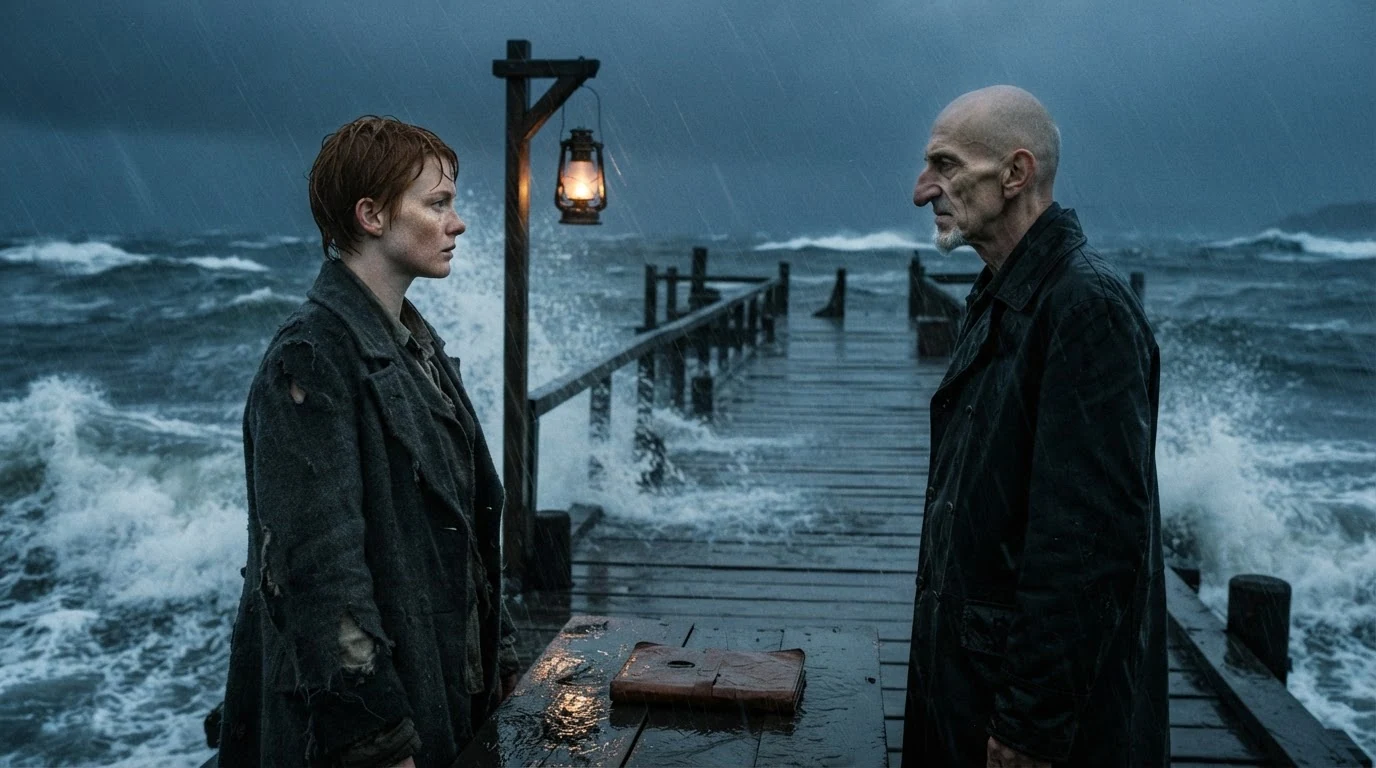
"Faces," "three meters apart" and "both in profile" put hero and antagonist in one frame; the ledger "between them" is the payoff object. Storm and dawn mark the peak. This is the start frame for the video.
Open FlashBoardsA quiet climax on a dark concert stage: a violinist in his early twenties with a shaved head, thick black eyebrows and a white shirt stands alone in a hard spotlight, bow an inch from the strings. In the dim, full front row one seat is empty, a folded red scarf on it. Wide shot, 40mm anamorphic, camera at stage height, warm spotlight against a dark blue hall. Cinematic film still.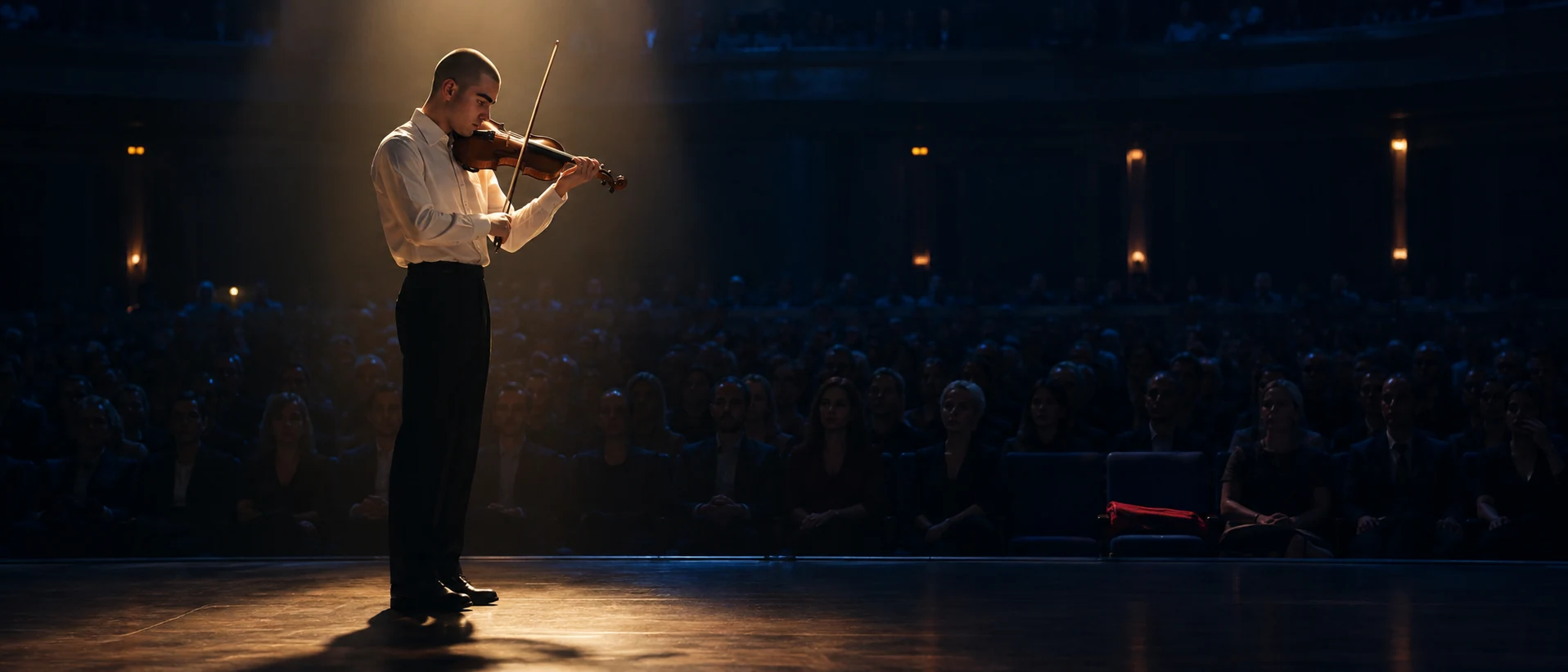
A climax without a fight: "bow an inch from the strings" freezes the decisive instant, and the empty seat with the scarf is the emotional payoff of a setup. The 21:9 frame holds both in one composition.
Open FlashBoardsCamera: slow, steady push in from the wide shot, ending on a medium wide of both figures with the ledger in the center. Action: from the first frame rain lashes the pier and the lantern swings hard. The woman lunges forward and grabs the ledger from the planks. The bearded man steps toward her, one hand out. She holds the ledger out over the crashing waves, facing him, and he stops.Rain and the lantern move from the first frame, so the shot never freezes. One decisive beat in three steps (grab, advance, standoff), with only objects from recipe 1.
Open FlashBoardsCommon mistakes
- Models split a confrontation into two portraits. Say both characters "face each other" at a stated distance in one wide shot.
- The stakes object vanishes or turns generic. Name it and place it between them.
- In video, characters posture and nothing is decided. Give one action that changes the situation.
Keep the reference frames, prompts and every generated take side by side — images and video in one canvas.
FAQ
4 questionsWhat is the climax of a story?
The climax is the point of highest tension, where the protagonist confronts the central conflict directly and the story's main question is answered. The whole plot builds toward it; the falling action and resolution show its consequences. A good climax joins the external showdown with the character's inner decision.
Where does the climax happen in a movie?
In most feature films the climax falls in the third act, around 85–90% of the running time. In a two-hour movie that is roughly the last 15 to 25 minutes, followed by a short resolution. Thrillers often run the climax almost to the final shot; dramas may leave a longer denouement.
What is the difference between the climax and the resolution?
The climax is the peak: the confrontation or decision that answers the dramatic question. The resolution, or denouement, comes after and shows the new normal. In The Godfather, the baptism crosscut with the killings is the climax; the door closing on Kay belongs to the resolution.
Does a climax have to be a fight?
No. A climax is defined by the decisive answer, not by action. It can be a confession, a refusal, a performance or a choice to walk away, as in the quiet peak of Manchester by the Sea. What matters is that the protagonist's choice resolves the central conflict and changes them.
Related terms
8- AnticlimaxStorytelling
An anticlimax is a payoff that falls deliberately (or accidentally) flat: the build-up promises a big confrontation, and the story delivers something small, abrupt or absurd instead.
- Plot PointStorytelling
A plot point is a turning event that spins the story in a new direction; in the three-act model, plot point one and two close the first and second acts.
- Rising ActionStorytelling
Rising action is the chain of complications between the inciting incident and the climax, where obstacles pile up and stakes rise.
- Falling ActionStorytelling
Falling action is the stretch right after the climax where the consequences play out and tension winds down toward the resolution.
- Three-Act StructureStorytelling
The three-act structure splits a story into setup, confrontation and resolution, turned by plot points at roughly the quarter and three-quarter marks — the default blueprint of feature screenwriting.
- CatharsisStorytelling
Catharsis is the emotional release an audience feels when a story's built-up tension breaks — through tears, relief or laughter — usually at or right after the climax.
- DenouementStorytelling
The denouement is the final part of the plot after the climax, where loose threads are tied up and the new balance of the characters' world is shown.
- Story StructureStorytelling
Story structure is the order and shape of the events that carry a story from setup to resolution; models like the three-act structure, Freytag's pyramid, the hero's journey or Save the Cat are different maps of it.
Further reading
Gustav Freytag, Technique of the Drama (1863). Robert McKee, Story (1997), on the climax of the last act.