 FlashBoards Learn
- Learn
- Storytelling
- Flash-Forward
Storytelling · Film language
Flash-Forward
Also called: prolepsis, flashforward
A flash-forward (prolepsis) cuts from the story's present to an event that hasn't happened yet, then returns. It trades surprise for suspense: once the audience has seen where things end up, the question stops being what will happen and becomes how and why the characters get there.
- What it does
- Shows a piece of the future early, so every scene after it plays as a countdown.
- Use it when
- The ending matters less than the road to it, or the story is about fate, dread or inevitability.
- Watch out
- Show too much and you spend the payoff. Show a fragment that raises a question, not one that answers it.
- Try this prompt
Night, flooded two-lane road in rain, overturned red pickup in headlights, woman in green field jacket standing beside it, cold bleached grade, handheld 35mm still
What is a flash-forward in film?
A flash-forward is a jump ahead in story time: a shot, a scene or a whole sequence set later than the story's present, after which the film returns and carries on. It is the mirror image of the flashback, and together they are the basic tools of the nonlinear narrative.
Literary theory calls it prolepsis, Gérard Genette's word for narration that tells a later event ahead of time. On screen it is rarer than the flashback. A memory can belong to a character, but a glimpse of the future has to come from somewhere: a vision, a premonition, or the storyteller openly showing their hand. It can last a single frame, an opening sequence or a whole season.
Why do filmmakers use flash-forwards?
To turn surprise into suspense. Show an outcome early and the audience watches for the moment it arrives. In Michael Clayton (2007) a car explodes on a hillside at dawn, then a title card jumps back four days. Every scene in between plays against that image.
To frame a story as fate. In Don't Look Now (1973) John glimpses his wife on a passing funeral boat in Venice with two strange sisters, a sight that makes no sense until it comes true. The future is fixed; he just can't read it.
To mislead, then reveal. Arrival (2016) cuts in images of the heroine and her daughter the way films present memories. Learning where they really sit in time changes the meaning of the whole film.
Types of flash-forward
- Opening flash-forward. A late moment plays first, often as a cold open. Breaking Bad's second season (2009) opens episodes with black-and-white fragments of a pool and a charred pink teddy bear, paid off in the finale.
- Premonition. A character sees the future: the plane explosion that opens Final Destination (2000).
- Disguised flash-forward. It looks like a flashback until the reveal, as in Arrival or the Lost season 3 finale (2007).
- Epilogue flash-forward. The Six Feet Under finale (2005) jumps ahead to show how each main character dies.
- Structural flash-forward. Each season of Damages opens on a crime months ahead and walks the present toward it.
How to shoot and cut a flash-forward
Give the future its own look. The audience should feel the shift before they understand it: black-and-white, a bleached or cold grade, handheld against a locked-off present, or a card like "Six months later." Use the same signal every time.
Hide the key fact. Frame the fragment so it raises a question: a crash with no driver, a character alone where there should be two. Close-ups, backs to camera and partial frames do the withholding.
Plant anchors. A costume, a prop or a car links the future image to the present, so when it turns up in a calm scene the audience's dread does the work. Unlike foreshadowing, which only hints, a flash-forward shows the event itself.
Pay it off exactly. When the story catches up, repeat the fragment's framing and grade, then show what the first glimpse left out.
Plan it on one board. In FlashBoards, pin the flash-forward frame at the far end of the board and lay the present-day panels out toward it, so every anchor and color choice sits next to the moment it must match.
Flash-forward vs. flashback
A flashback goes back to explain the present: backstory, motive, a wound. A flash-forward goes ahead to make the present tense. One answers why is this happening?; the other asks how will we get there?
Both differ from in medias res, which starts mid-action and never has to leave the present. An opening that shows the climax and then cuts to "Four days earlier" is a flash-forward, because the film later catches up to it. More devices that reorder time are in the storytelling hub.
How to create a flash-forward with AI
3 promptsA flash-forward is an edit, not an image, so generate a pair: the future fragment and a present-day frame that shares its anchors. Nano Banana 2 Lite makes the future shot, GPT Image 2.5 the calm present, and MiniMax H3 Max Turbo animates the fragment. Keep both side by side on one FlashBoards board.
Wide shot, 28mm lens, handheld, eye level. Night on a flooded two-lane country road in heavy rain. A red pickup truck lies flipped over on its side in the water, headlights still on, glowing through the rain. Standing beside it, her back to camera and her face hidden, a woman in her early thirties with a shaved head, a small silver hoop in her left eyebrow and a mud-streaked green canvas field jacket. Cold bleached color grade, crushed blacks, desaturated except the red of the truck, 35mm film still.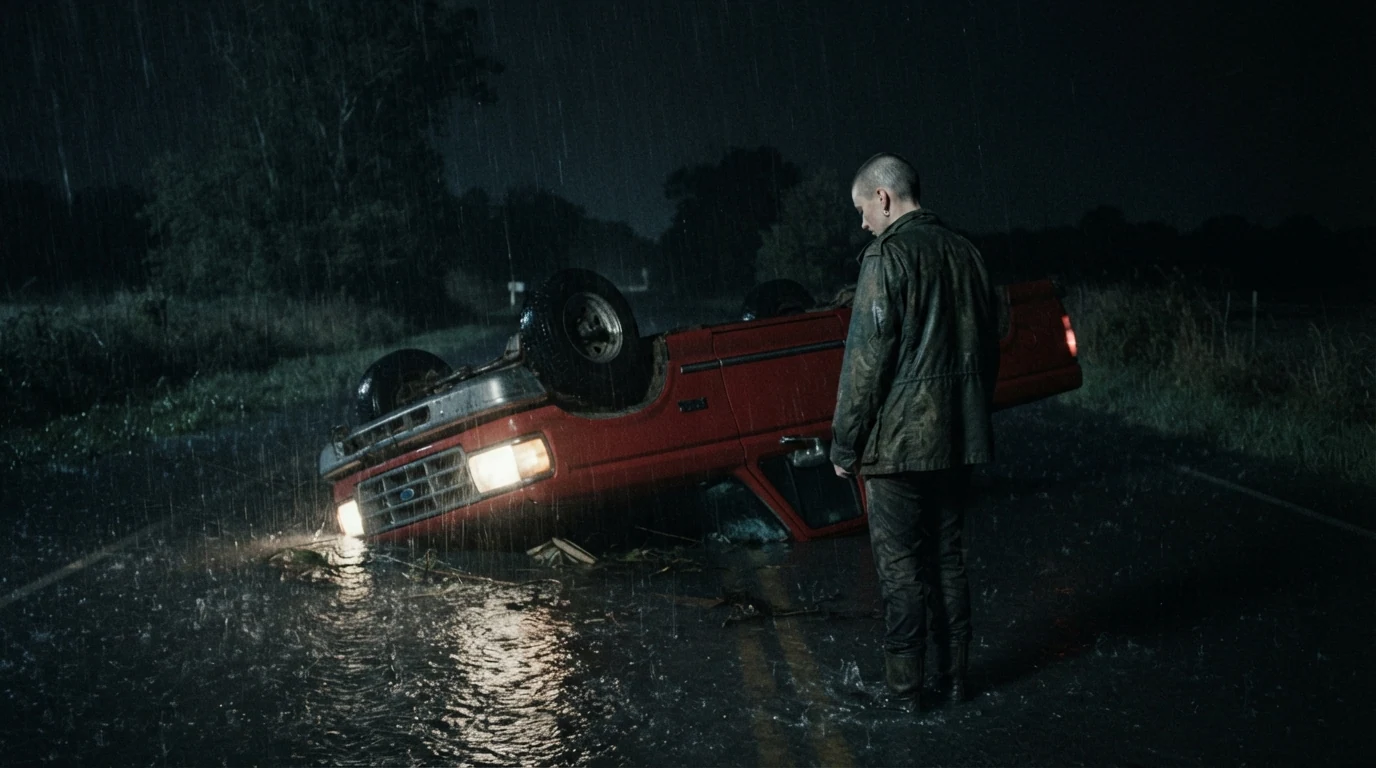
The cold bleached grade and handheld mark the future, a look the present won't share. Her back to camera hides her face and the cause of the crash. The red pickup and green field jacket are the anchors.
Open FlashBoardsMedium wide shot, 40mm lens, locked-off tripod, eye level. A sunny gravel driveway in late morning. A woman in her early thirties with a shaved head, a small silver hoop in her left eyebrow and a clean green canvas field jacket laughs as she loads camping gear into the bed of a red pickup truck. Beside her, a man in his sixties with a white beard and a flannel shirt hands her a cooler. Warm golden grade, soft natural light, 35mm film still.
The same red pickup and field jacket tie this frame to the crash, while the warm golden grade and locked-off tripod reverse the future's look. The man, missing from the flash-forward, is a new question. Repeat her features word for word to keep her consistent.
Open FlashBoardsCamera: handheld, unsteady, drifting slowly to the left around the woman, ending on her profile. Action: Rain is already pouring and the truck's headlights flicker in the water. The woman takes one step toward the truck, stops, and slowly turns her head to look back down the dark road behind her.Already pouring and flicker give H3 motion from the first frame. Ending on her profile and a glance back down the road points at what happened without showing it. Five seconds keeps it a fragment.
Open FlashBoardsCommon mistakes
- A model has no idea a frame is "the future." The effect comes from contrast between two frames, so write the grade and camera style into both prompts.
- Characters drift between takes. Repeat the exact physical features and costume, and keep the first frame on the board as a reference.
- Video models like to explain. End the clip on a look or a gesture, the point where you would cut back to the present.
Keep the reference frames, prompts and every generated take side by side — images and video in one canvas.
FAQ
4 questionsWhat is a flash-forward in film?
A flash-forward is a scene or shot that jumps ahead to an event later in the story, then returns to the present. Showing part of the outcome early makes the rest of the film build suspense about how the characters get there. Michael Clayton, Arrival and the second season of Breaking Bad are well-known examples.
What is the difference between a flashback and a flash-forward?
Direction in time. A flashback shows something that already happened, usually to explain motive or history. A flash-forward shows something that hasn't happened yet, to create suspense or a sense of fate. Both break chronological order and need a clear visual or sound cue so the audience knows the timeline has shifted.
What is prolepsis?
Prolepsis is the literary term for a flash-forward: telling a later event before its turn in the chronology. Gérard Genette paired it with analepsis, the flashback, in his study of narrative time. Critics use both words, but filmmakers and screenwriters mostly just say flash-forward.
Is starting a movie at the end a flash-forward?
Usually, yes. If a film opens on a late event and then cuts to "Four days earlier," the opening is a flash-forward the story later catches up to. In medias res is different: it drops the viewer into the middle of the action and simply continues forward.
Related terms
4- FlashbackStorytelling
A flashback interrupts the present story to show an earlier event, usually signalled by a dissolve, a change of color or grade, or a sound cue, to reveal backstory or motive.
- Nonlinear NarrativeStorytelling
A nonlinear narrative tells events out of chronological order — through flashbacks, parallel timelines or reshuffled chapters — so meaning comes from how the pieces are arranged.
- In Medias ResStorytelling
In medias res (Latin for 'into the middle of things') opens the story mid-action, then fills in how we got there through dialogue or flashback.
- ForeshadowingStorytelling
Foreshadowing plants hints — an object, a line, an image — that prepare the audience for what comes later, so the payoff feels both surprising and inevitable. Chekhov's gun is its strictest form.
Further reading
Gérard Genette, Narrative Discourse: An Essay in Method (1980). David Bordwell and Kristin Thompson, Film Art: An Introduction.