 FlashBoards Learn
- Learn
- Storytelling
- Flashback
Storytelling · Film language
Flashback
Also called: analepsis, flashback sequence, memory sequence
A flashback interrupts the present story to show something that happened earlier. Filmmakers use it to reveal backstory, motive or a hidden truth at the moment it matters most. The audience recognizes the jump through cues: a dissolve, a change in grade or texture, a sound that bridges the two times, or a younger face.
- What it does
- Puts a past event next to a present one, so the viewer reads each in light of the other.
- Use it when
- The past explains a choice the character is about to make, or changes what we believe about the present.
- Watch out
- A flashback that only repeats what we already know stalls the story. Every trip back should answer a question or raise a new one.
- Try this prompt
Memory shot, a small girl with a copper-red bob in a yellow raincoat running through a lawn sprinkler, 16mm film texture, warm halation, faded colors, 4:3.
What is a flashback in film?
A flashback is a scene or sequence set earlier in time than the story's present, cut into that present. Literary theory calls it analepsis. Gérard Genette uses the term for any move backward in the order of telling. A flashback does more than show the past. It shows the past from a particular moment in the present, and that moment gives it its meaning.
Most flashbacks follow the same four beats:
- Anchor. A present-day scene sets up a need: a question, a guilty look, an object on a table.
- Trigger. Something carries us over. It can be a line of dialogue, a sound, an object, or a slow push-in on a face.
- The past. The earlier event plays out, sometimes as a single shot, sometimes as half the film.
- Return. We come back to the present, and the scene now plays differently because we know more.
This device is the basic building block of nonlinear narrative. With enough of them, a film stops feeling linear and becomes a puzzle the viewer assembles. A flashback is also the most direct way to put backstory on screen. It is also the easiest to overuse, so many writers try dialogue, props and behavior first.
Types of flashbacks
Flashbacks differ in how long they run, whose memory they belong to, and whether the audience can trust them.
Memory flashback
This is the most common kind. A character remembers, and we see what they see. In Casablanca (1942), Rick drinks alone while Sam plays “As Time Goes By,” and the film dissolves into his Paris affair with Ilsa. The memory carries his longing and his bias.
Framing flashback
Here the whole film, or most of it, is a flashback told from a present-day frame. Sunset Boulevard (1950) opens on a body floating in a pool, and the dead man narrates how he got there. Double Indemnity (1944) is an insurance man's confession recorded into a dictaphone.
Testimony flashback
Several characters recount the same past, and each account becomes its own flashback. Citizen Kane (1941) builds a portrait from interviews with people who knew Kane. Rashomon (1950) gives four contradictory versions of one crime and never tells us which is true. The Social Network (2010) cuts between two legal depositions and the Harvard years they argue about.
Fragmented or recurring flashback
A traumatic event returns in short pieces, and each return shows a little more. The full event arrives late, often at the climax. This form sits close to the flash cut: at first the past appears for only a few frames, then it grows.
False or lying flashback
The flashback shows events that did not happen the way we see them. Hitchcock's Stage Fright (1950) opens with one, and Hitchcock later called it a mistake. The Usual Suspects (1995) builds its ending on the question of how much of Verbal Kint's story was invented. Big Fish (2003) stages a father's tall tales as storybook flashbacks. Any of these makes the flashback's narrator an unreliable narrator.
Why do filmmakers use flashbacks?
To delay a reveal. Manchester by the Sea (2016) lets us watch Lee Chandler's cold, flat present for a long stretch before a flashback shows why he lives that way. Told in order, it would be a tragedy with a long aftermath; held back, it becomes a mystery we solve by watching Lee closely.
To explain motive at the moment of decision. The flashback lands just before, or just after, a character makes a choice that would otherwise feel unmotivated. Slumdog Millionaire (2008) uses the quiz-show format itself as the trigger: each question sends Jamal back to the street experience that taught him the answer.
To create contrast. A warm memory makes the cold present colder. It's a Wonderful Life (1946) spends most of its running time on a review of George Bailey's life, so we feel how much is at stake on the bridge on Christmas Eve.
To make one moment carry the whole film. In Ratatouille (2007), the critic Anton Ego takes one bite and is sent back to his mother's kitchen as a boy. A few seconds turn the character around, and because the trigger is sensory, we believe the jump at once.
To build a mystery. Investigation plots and courtroom dramas use flashbacks as evidence: the present asks, the past answers one piece at a time. Once we've seen the past, we often know more than the characters, which is dramatic irony.
When not to use one. If a character's history can be shown by how they act now, through what they avoid or flinch at, that's usually stronger than cutting away. Two long flashbacks back to back can stall the present plot.
How to signal and shoot a flashback
Viewers should know where they are in time within a second of the cut. Choose one or two cues and use them consistently. Stacking every cue at once looks like parody.
Transitions. The classical signal is a slow dissolve, 1–2 seconds (24–48 frames at 24 fps), often from a push-in on the character's eyes. A match cut is sharper: a hand, a door or an object in the present cuts to the same shape in the past. Manchester by the Sea uses plain hard cuts and trusts the viewer to catch up.
Grade and texture. Give each timeline its own look. Common choices are a warmer, softer past against a cooler, crisper present, or a desaturated past against a full-color present. You can also use a separate format for each. Memento (2000) runs one timeline in black and white and the other in color. On set, a 1/8 or 1/4 diffusion filter or a different stock sets the past apart without VFX.
Frame shape. An aspect ratio change is an unmistakable cue. The Grand Budapest Hotel (2014) gives its 1930s story a near-square frame, its 1960s scenes anamorphic widescreen and its 1980s scenes a standard widescreen frame. Switching from 2.39:1 in the present to 4:3 in the past instantly suggests old home movies.
Camera language. A locked-off present against a handheld past, or the reverse, is a signal audiences feel without noticing. Memory sequences often use slight slow motion (30–48 fps), shallower focus or longer lenses, so the past feels less solid.
Sound. A sound bridge lets the past come in before the image does. We hear a train, a song or a voice from the past under the present-day close-up, and then we cut. Narration in voice-over is the most explicit bridge, the one Sunset Boulevard and Double Indemnity rely on.
Casting, hair and production design. When the gap is decades, the actor changes, and the younger actor needs to share a trait with the older one: hair color, a scar, a way of standing. A costume or prop that appears in both times ties the two together. A title card (“Twelve years earlier”) is a last resort for jumps no image can make clear.
Planning it on a board. In FlashBoards, lay out the present-day scenes in one row and the flashbacks beneath, with each trigger frame pinned next to its matching past frame and grade references beside the generated tests, so the DP, editor and colorist agree on both looks before the shoot.
How to write a flashback
Earn the jump. Before the flashback, the present-day scene should raise a specific question that only the past can answer. Why won't she open the letter? Why does he freeze at the sound of a siren? If the audience isn't already asking, the flashback plays as exposition.
Enter late, leave early. Start the flashback as close to its key moment as you can, and cut back to the present as soon as it has delivered. Long flashbacks need their own shape: a goal, an obstacle and a turn.
Change something when you return. The present-day scene after a flashback should play differently from the one before it. The character acts on what we saw, or we now read the same behavior in a new way.
Keep one clear point of view. A memory flashback should show what that character could know. Showing what they couldn't have witnessed makes it an objective flashback, so make that a deliberate choice.
Formatting in a screenplay. In a screenplay, add the time to the slugline, for example INT. FARMHOUSE KITCHEN – NIGHT (FLASHBACK) or EXT. PIER – DAY (1994). When the present resumes, mark it with BACK TO PRESENT or a new slugline. Whatever convention you pick, use it every time: the page has no grade or dissolve to do the job.
Watch for the cheat. Saving Private Ryan (1998) opens by pushing in on an old veteran's face and cutting to Omaha Beach, but the man isn't the soldier whose story we then follow. Viewers still argue whether that's a twist or a broken promise. If you bend whose memory it is, the ending has to justify it.
Flashback vs. flash-forward vs. flash cut
A flashback goes back. A flash-forward goes ahead, showing events that haven't happened yet in the story's present. One explains the present; the other creates suspense about how we'll get there. Arrival (2016) plays on the difference: it presents images of the heroine's daughter the way films usually present memories, and the audience only later learns where those images sit in time.
A flash cut is a matter of length, not direction. It's an insert of a few frames, too short for a scene. A flash cut can go back, as with a half-second image of an accident that keeps intruding on a character's day. It can go forward, too, or show something that never happened at all.
A flashback is also different from cross-cutting between two timelines. The Godfather Part II (1974) alternates young Vito and Michael, but neither is framed as a memory: they are two stories moving forward in parallel. For more devices that shape story order, see the storytelling hub.
How to create a flashback with AI
3 promptsA flashback is a relationship between two shots, so generate both ends: the memory and the present moment that triggers it. Give each timeline its own texture, grade and frame shape, then cut or dissolve between them in the edit instead of asking one generation to perform the jump. In FlashBoards, keep the present-day row and the flashback row on one board next to your reference frames.
Childhood memory shot: a seven-year-old girl with a copper-red bob haircut, freckles and a gap in her front teeth, wearing a bright yellow raincoat, laughing as she runs through the arc of a lawn sprinkler in a small suburban backyard, late summer afternoon, low sun behind her. Camera at her eye height, 35mm lens, shallow depth of field. 16mm film texture with visible grain, warm overexposed highlights with red halation, lifted milky blacks, faded pastel colors, slightly soft edges. Cinematic film still.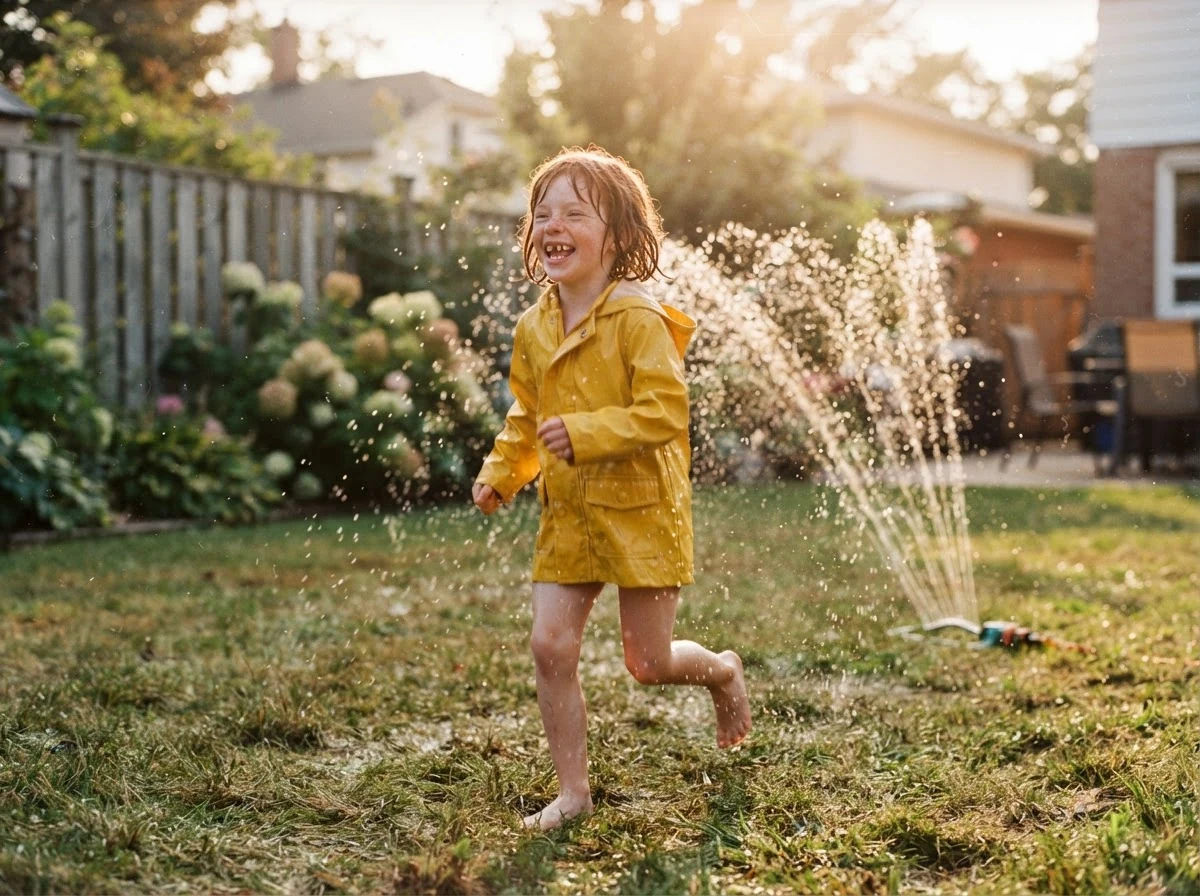
The texture words carry the flashback: “16mm film texture,” “halation,” “lifted milky blacks” and “faded pastel colors” set this past apart from a crisp digital present, and 4:3 adds a home-movie cue. The yellow raincoat is the prop that will link the two timelines; the copper-red bob and gap tooth make her a specific, invented child. This is the start frame for the video recipe.
Open FlashBoardsPresent-day anchor shot for a flashback: a woman in her early forties with short copper-red hair streaked with grey at the temples and a small scar through her left eyebrow, standing at a rain-streaked kitchen window at night, holding a small faded yellow child's raincoat folded in both hands, looking down at it. Medium close-up, 50mm lens, eye level. Cool blue-green grade, crisp digital image, deep shadows, practical light from a single hanging lamp, rain reflections moving across her face. Cinematic film still, anamorphic widescreen.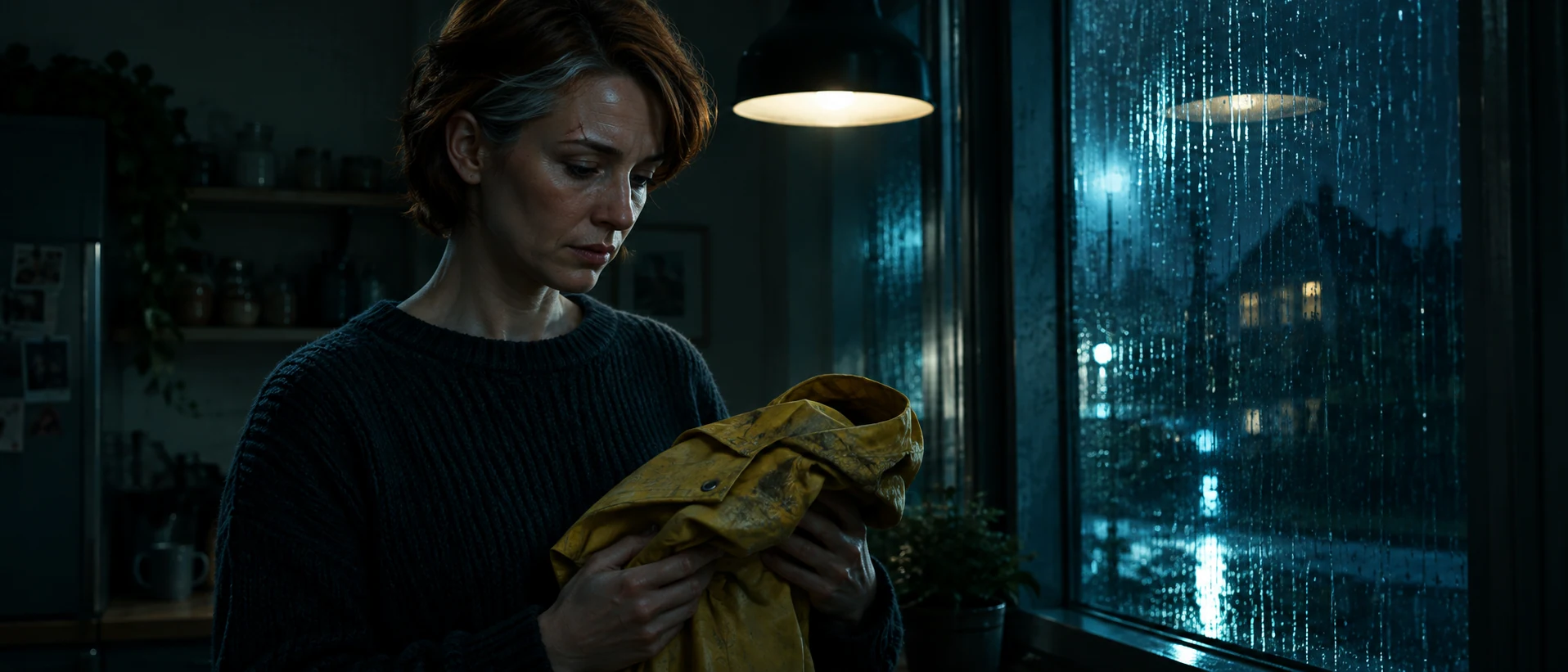
The other end of the cut: the trigger frame. It flips every cue from recipe 1: cool against warm, crisp against grainy, 21:9 against 4:3, night rain against summer sun. Only the red hair and the yellow raincoat are shared, and that shared detail is what makes the audience accept the jump. “Looking down at it” gives the editor a natural moment to dissolve.
Open FlashBoardsCamera: handheld at the girl's eye height, drifting slowly to the left at a walking pace and gently swaying, as if a parent is filming. Action: from the first frame the girl is already running through the sprinkler's arc, water spraying across her yellow raincoat and catching the low sun. In the middle she spins around once, laughing, her copper-red hair flicking out with droplets. At the end she slows, turns toward the camera and looks straight into the lens, still smiling, while the sprinkler keeps sweeping behind her and the sun flares in the lens.“Already running” keeps the shot alive from the first frame instead of a slow push on a still. The handheld sway “as if a parent is filming” adds a home-movie feel, and the look into the lens gives the editor a cut point back to the present. Everything named is already in recipe 1's frame.
Open FlashBoardsCommon mistakes
- Writing “flashback” and nothing else. Models read it literally and add a heavy vignette, blurred edges or a double exposure. Name the cues instead: film stock, grain, halation, grade, aspect ratio.
- “Vintage” becomes sepia. For a memory from a few decades ago, specify the palette (“faded pastel colors, warm highlights”) and the era's objects.
- Two timelines that look the same. Change at least two variables between the ends, such as grade and texture, or ratio and lens.
- Younger and older selves don't match. Give both the same one or two distinctive features, like hair color or a scar, and compare the chosen frames side by side on the board.
- Asking the video to do the transition. “The present dissolves into the past” usually produces a morph. Generate each shot separately and make the dissolve or match cut in the edit.
Keep the reference frames, prompts and every generated take side by side — images and video in one canvas.
FAQ
6 questionsWhat is a flashback in film?
A flashback is a scene or sequence that interrupts the story's present to show something that happened earlier. It usually reveals backstory, a motive or a hidden truth right when the present needs it. Films signal the jump with a dissolve, a change in color or texture, a sound bridge, a caption, or a younger actor, and then return to the present with new meaning.
What is the difference between a flashback and a flash-forward?
A flashback shows events earlier than the story's present; a flash-forward shows events that haven't happened yet. Flashbacks usually explain why something in the present is happening. Flash-forwards create suspense, because the audience has seen an outcome and waits to learn how the story gets there. Some films deliberately blur which one we're watching.
What are some famous flashback examples in movies?
Citizen Kane (1941) builds a life from flashbacks told by people who knew Kane. Sunset Boulevard (1950) is narrated in flashback by a dead man. Casablanca (1942) dissolves into Rick's memories of Paris. Rashomon (1950) shows contradictory flashbacks of one crime, and Manchester by the Sea (2016) holds back its central flashback to explain why its hero is so shut down.
How do you write a flashback in a screenplay?
Mark it in the slugline, such as INT. KITCHEN – NIGHT (FLASHBACK) or EXT. PIER – DAY (1994), and signal the return with BACK TO PRESENT or a new slugline. Before the flashback, make the present-day scene raise a question only the past can answer. Enter the flashback late, leave it as soon as it has delivered, and make sure the next present-day scene plays differently because of it.
What is analepsis?
Analepsis is the narratological term for a flashback: any point where a story goes back to tell events from before the moment it has reached. Gérard Genette distinguished external analepsis, which reaches back before the story begins, from internal analepsis, which fills a gap inside the story's own timeline.
Are flashbacks bad storytelling?
No, but they are easy to misuse. A flashback weakens a film when it repeats what the audience already knows or stops the present plot for too long. It strengthens a film when it answers a question the present has raised, changes how we read the next scene, or lands the reveal at the moment it hurts most.
Related terms
5- Flash-ForwardStorytelling
A flash-forward jumps ahead to show events that will happen later, creating suspense about how the story will get there.
- BackstoryStorytelling
Backstory is everything that happened to the characters and their world before the film begins; it shapes their motives and is revealed through hints, dialogue or flashbacks rather than dumped on the audience.
- Nonlinear NarrativeStorytelling
A nonlinear narrative tells events out of chronological order — through flashbacks, parallel timelines or reshuffled chapters — so meaning comes from how the pieces are arranged.
- DissolveEditing
A dissolve blends one shot into the next: the first fades out while the second fades in over the same frames, briefly overlapping — often to mark passing time or link two ideas.
- Unreliable NarratorStorytelling
An unreliable narrator is a storyteller — through voice-over or a point-of-view protagonist — whose account the audience can't fully trust because they lie, misremember or misread what happens.
Further reading
Gérard Genette, Narrative Discourse: An Essay in Method (Cornell University Press) · Maureen Turim, Flashbacks in Film: Memory & History (Routledge) · David Bordwell, Narration in the Fiction Film (University of Wisconsin Press)