 FlashBoards Learn
- Learn
- Storytelling
- In Medias Res
Storytelling · Film language
In Medias Res
Also called: starting in the middle
In medias res (Latin for "into the middle of things") opens a story mid-action, with the conflict already under way. The audience catches up as the scene plays, and the missing past arrives later through dialogue, behavior or flashback. It trades orientation for momentum: questions first, answers when they matter.
- What it does
- Replaces the warm-up with stakes, so the viewer spends the opening working out who these people are and how it came to this.
- Use it when
- The setup is slower than the situation it leads to, or the genre promises action and the first scene has to prove it.
- Watch out
- Unexplained chaos is not intrigue; the viewer must read the goal and the danger from the first shots, even without the backstory.
- Try this prompt
Night rail yard in the rain, a woman in a torn green evening dress sprinting between freight cars clutching a leather satchel, flashlight beams behind her, handheld 35mm film still
What does in medias res mean?
The phrase comes from Horace's Ars Poetica, which praises Homer for carrying the listener straight into the middle of events. The Odyssey finds Odysseus already stranded; his earlier wanderings come later, in his own voice.
In film, the first scene is not the first event of the story. Two forms are common:
- Straight in medias res. The film starts mid-situation and runs forward in order; the past comes out through exposition.
- The jump-back opening. The film shows a tense moment from later, cuts to "earlier" and catches up to it. Most of the film becomes a long flashback, one of the simplest forms of nonlinear narrative.
Why do filmmakers start in the middle?
Momentum. Starting in the middle puts stakes in the first shot; the ordinary world can be sketched in once the viewer cares.
Questions as an engine. Who is running, from whom, and why that bag? The film controls exactly when each answer lands.
Character through action. What a person grabs, protects or lies about under pressure says more than a biography.
Suspense about how, not what. In the jump-back form the audience knows where the story ends up, so every earlier scene plays with a clock over it. Sunset Boulevard (1950) opens on its narrator floating dead in a pool.
In medias res examples in movies
- Star Wars (1977). After the opening crawl, a small rebel ship is already fleeing a Star Destroyer under fire.
- Raiders of the Lost Ark (1981). Indiana Jones is first seen mid-expedition in a South American jungle; his nerve and his rival come across through action, not a briefing.
- Saving Private Ryan (1998). After a brief present-day scene at a cemetery, the viewer is dropped into the Omaha Beach landing with no introduction to the soldiers.
- Mission: Impossible - Ghost Protocol (2011). Ethan Hunt is introduced inside a Moscow prison while his team breaks him out; why he was there comes later.
- Zombieland (2009). The apocalypse has already happened; the narrator lists his survival rules instead of the film showing the outbreak.
- Fight Club (1999) and Goodfellas (1990) use the jump-back form: a gun in the narrator's mouth high in an office tower, a body in a car trunk on a night road, then a cut back.
How to write and stage an in medias res opening
Pick the latest readable entry point. Start where the physical stakes still read without context. Test it with the sound off: we should see that she is running, that the lights are hunting her and that the bag matters.
Enter in motion. Open on a body mid-stride or an argument mid-sentence, in a medium or close shot rather than a static wide. Let geography arrive in pieces. Handheld at shoulder height sells a story that began before the camera arrived.
Plant two or three visible clues. An evening dress in a rail yard, a hospital bracelet on a driver.
Hold back the backstory. Reveal each piece of the past when it changes the present scene, not in the first ten minutes.
Make the return legible. In the jump-back form, repeat the opening's framing, sound and costume when the story catches up, and add something the opening withheld.
In FlashBoards, put the opening frame at the left of the board and the chronological beats in a row beneath it, with notes on where each withheld fact is revealed.
In medias res vs. cold open
A cold open is defined by position: it plays before the title card, whatever it contains. In medias res is defined by entry point: the story starts after the trouble has begun. They often overlap, as in the Breaking Bad pilot (2008), but a cold open can be a quiet linear setup.
A prologue is the opposite instinct: it starts before the main story, often years earlier. A flash-forward jumps ahead from an established present; the jump-back opening is a flash-forward placed at the very start. More devices live in the storytelling hub.
How to create a in medias res with AI
4 promptsAn in medias res opening lives on one frame that is clearly the middle of something. Nano Banana 2 Lite gives the opening shot, GPT Image 2.5 a jump-back take, and MiniMax H3 Max Turbo animates the opening frame. Keep them on one FlashBoards board beside the timeline they will explain. The fourth prompt re-shoots a real film shot from a text description alone, and the original plays next to the result so you can compare.
Medium wide shot, 35mm lens, handheld at shoulder height, a rain-soaked freight rail yard at night. A woman in her early thirties with a shaved head, a silver eyebrow hoop and a torn emerald evening dress sprints barefoot between two rusted boxcars toward camera, clutching a brown leather satchel, looking back over her shoulder mid-stride. Three white flashlight beams cut through the rain behind her. Sodium-orange reflections on wet gravel, 35mm film still.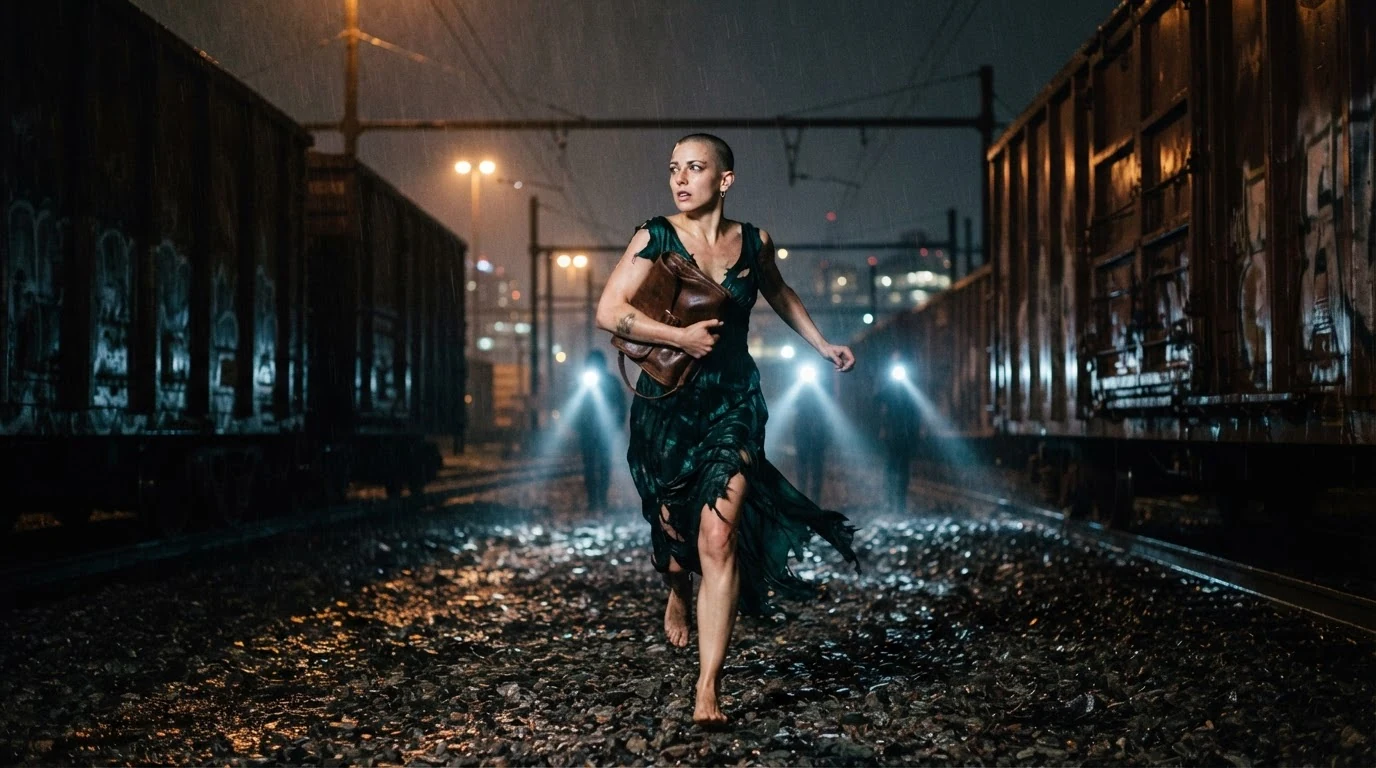
Mid-stride and looking back make this a moment inside a chase. The clues do the backstory's job: an evening dress in a rail yard, a guarded satchel, flashlight beams hunting her.
Open FlashBoardsMedium close-up, 50mm lens, eye level, a bare police interview room under one fluorescent tube. A heavyset man in his fifties with a ginger beard, a split lip and a torn white tuxedo shirt sits handcuffed to a steel table, staring off camera. On the table: a paper cup, a muddy high-heeled shoe in an evidence bag, a wristwatch with a cracked face. Cold green-white light, 35mm film still.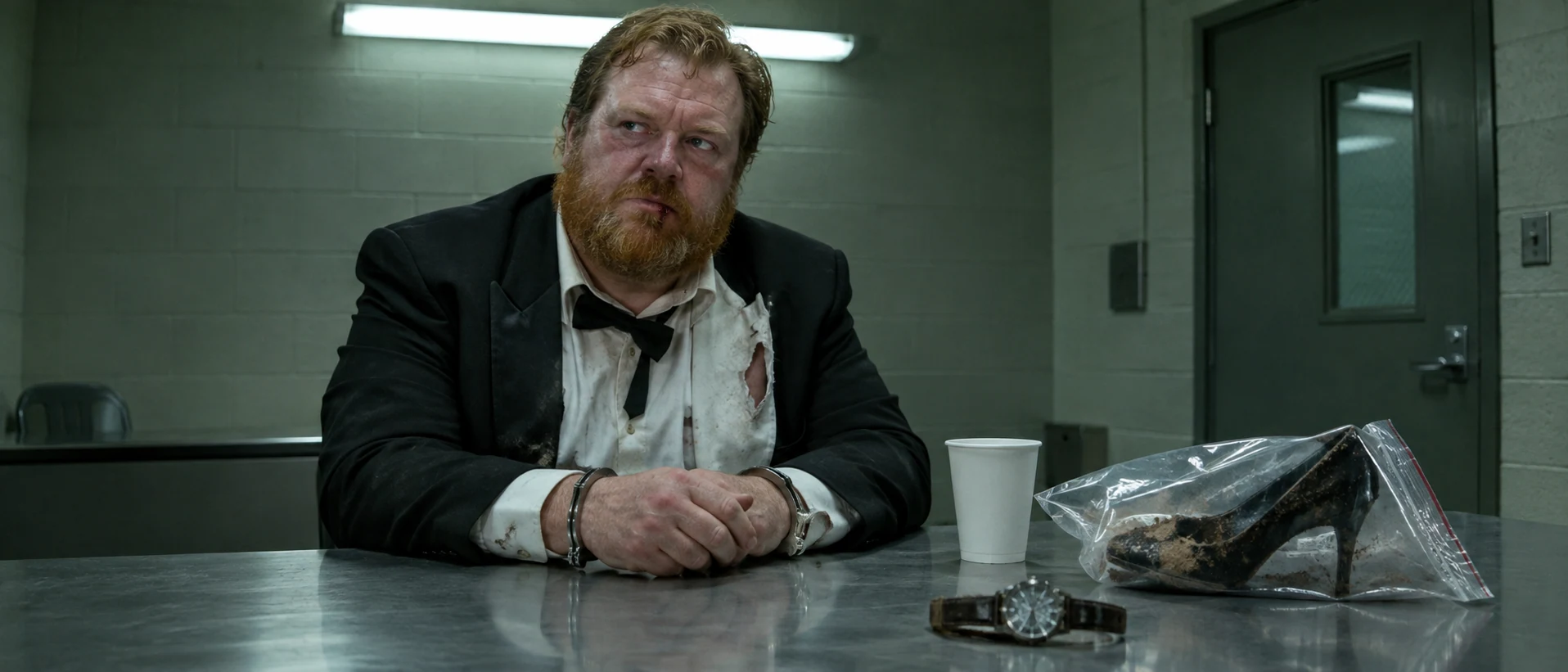
The jump-back version: a frame from near the end that the film will rewind from. The tuxedo shirt, the shoe in an evidence bag and the cracked watch are questions the story owes the viewer.
Open FlashBoardsCamera: handheld, backing away quickly in front of the woman at her running speed, holding a medium shot. Action: The woman is already sprinting through the rain, satchel pressed to her chest. She glances back as the flashlight beams sweep the boxcar walls. At the end of the gap she swerves left around a boxcar and leaves frame, and the beams slide over the empty wet gravel.Already sprinting makes the clip move from the first frame. Backing away at her running speed keeps her size constant, so the chase feels older than the shot.
Open FlashBoards{
"output": "Full-screen live-action scene from Pulp Fiction (1994), from its very first frame: one single continuous shot. Warm, grainy 1990s 35mm film, 2.39:1 scope frame, a sunlit Los Angeles coffee shop in the morning: a long row of tufted dark-red vinyl booths, a wide window behind the table with horizontal venetian blinds half open onto trees and a parking lot, bright hazy daylight from the window back-lighting the pair, the interior in soft brown shade.",
"characters": {
"S1": {
"name": "Honey Bunny, played by Amanda Plummer",
"look": "slight woman, short curly blonde bob, long-sleeved plum top",
"voice": "high, breathy, giddy"
},
"S2": {
"name": "Pumpkin, played by Tim Roth",
"look": "lean man, slicked-back light-brown hair, loud blue-and-white Hawaiian shirt worn open over a dark gray T-shirt, gray trousers",
"voice": "London accent, quick, playful"
}
},
"shots": [
{
"shot": 1,
"camera": "locked-off static camera at table height, 35mm lens, wide shot across the booths, a tall red booth back filling the left foreground and another at the right edge; S1 sits in the booth left of center facing right, S2 sits across the table at frame right facing left toward her; the framing stays the same to the end",
"action": [
"BEGINNING: alive from the first frame, the two lean far over the table toward each other, faces almost touching, ending a quick kiss; coffee cups, crumpled napkins and plates between them.",
"THEN: S2 drops back onto his seat and leans forward on both forearms, both hands flat on the tabletop beside his coffee cup, grinning at S1's face; S1 stays leaning in over the table with a wide smile, eyes on him.",
"THEN: S1 says her line to him, beaming; S2 answers, his lips moving, still grinning at her; neither looks anywhere but at the other.",
"THEN: suddenly S2's hand on the frame-left side comes up from the table holding a black pistol and he springs up out of the booth, twisting toward the room, his other hand gripping the top of the red booth back.",
"END: S2 is half standing, legs swinging out of the booth toward frame right, pistol low by the table edge; S1 is still leaning over the table, smiling."
],
"dialogue": [
{
"speaker": "S1",
"on_screen": true,
"when": "after S2 has settled back on his forearms, early in the shot",
"delivery": "tender, giddy",
"line": "<d>[English] I love you, Pumpkin.</d>"
},
{
"speaker": "S2",
"on_screen": true,
"when": "right after her line, just before he springs up",
"delivery": "warm, amused",
"line": "<d>[English] I love you, Honey Bunny.</d>"
}
]
}
],
"sound": {
"ambience": "quiet coffee-shop murmur, a cup set on a saucer, the squeak of vinyl as S2 springs out of the booth",
"speech": "exactly these spoken phrases, each said once, in this order",
"never_spoken": "no narration and no voice-over: the descriptions, performance notes and step words of this prompt are never spoken aloud",
"music": "a film score under the scene, always below the voices: a single low bass note held under the lines, snapping into a sudden twangy surf-guitar stab as he jumps up",
"subtitles": "none"
}
}Remakes the booth shot that ends the opening of Pulp Fiction (1994), dir. Quentin Tarantino, DP Andrzej Sekuła, the moment the film jumps back to at its finale: her place on the left and his on the right, the kiss, the two exact lines and the pistol coming up as he springs from the booth.
The whole trick sits in the action list: it opens on a kiss already ending, lets two lines of affection play, then suddenly puts a black pistol in his hand. Nothing explains who they are or why; the calm is the middle of a plan the viewer only learns about later.
Common mistakes
- Image models default to a posed, centered subject. Write the verb in progress (mid-stride, looking back) and place the threat in the frame.
- Models add signs or uniforms that answer the mystery. Describe only the clues you want.
- On video, a calm first frame gives a slow drift. State the ongoing action first.
Keep the reference frames, prompts and every generated take side by side — images and video in one canvas.
FAQ
5 questionsWhat does in medias res mean?
In medias res is Latin for "into the middle of things." A story told this way begins partway through the action, with the conflict already under way, and fills in earlier events later through dialogue, visual clues or flashbacks. The term comes from Horace, who used it to praise Homer's epics.
What are examples of in medias res in movies?
Star Wars (1977) opens with a rebel ship under attack, Raiders of the Lost Ark (1981) finds Indiana Jones mid-expedition, and Mission: Impossible - Ghost Protocol (2011) introduces Ethan Hunt inside a Moscow prison. Fight Club (1999) and Goodfellas (1990) open on a later moment, then jump back to explain it.
Is in medias res the same as a flashback?
No. In medias res is about where the story starts; a flashback is a scene showing an earlier event. Many in medias res films use flashbacks to fill in the past, but others simply run forward and let exposition cover it. A film can also use flashbacks without starting in the middle.
What is the opposite of in medias res?
The opposite is ab ovo, Latin for "from the egg," which Horace set against in medias res. An ab ovo story starts at the very beginning and moves forward in order, usually with a long setup before the conflict appears.
Why do writers start a story in medias res?
It gives the story immediate stakes and turns the opening into questions the audience wants answered. It shows character through action and, in the jump-back form, creates suspense about how events reach the moment already shown. The goal and danger must still read at once.
Related terms
5- Cold OpenStorytelling
A cold open drops the audience straight into a scene before the title card or opening credits, usually to hook them with a mystery, a joke or a jolt of action.
- FlashbackStorytelling
A flashback interrupts the present story to show an earlier event, usually signalled by a dissolve, a change of color or grade, or a sound cue, to reveal backstory or motive.
- Nonlinear NarrativeStorytelling
A nonlinear narrative tells events out of chronological order — through flashbacks, parallel timelines or reshuffled chapters — so meaning comes from how the pieces are arranged.
- PrologueStorytelling
A prologue is an opening section set apart from the main story — often in another time or place — that establishes backstory, tone or a mystery the film will pay off.
- Flash-ForwardStorytelling
A flash-forward jumps ahead to show events that will happen later, creating suspense about how the story will get there.
Further reading
Horace, Ars Poetica. Robert McKee, Story: Substance, Structure, Style and the Principles of Screenwriting.