 FlashBoards Learn
- Learn
- Storytelling
- Omniscient Point of View
Storytelling · Film language
Omniscient Point of View
Also called: omniscient narration, third-person omniscient
Omniscient point of view is narration that knows and shows more than any single character. The film cuts freely between places, people and sometimes thoughts, so the audience sees what no one on screen can. Restricted narration does the opposite: it stays tied to one protagonist and learns only what they learn.
- What it does
- Puts the audience above the characters, seeing across places and minds that no one person can reach.
- Use it when
- You want suspense from what characters don't know, an ensemble story, or a sense of fate and scale.
- Watch out
- If the film shows everything, nothing is hidden; decide scene by scene what the audience is allowed to know.
- Try this prompt
Night cross-section of a four-story apartment building, every room lit and visible at once, a different person alone in each room, wide frontal shot, 16:9
What is omniscient point of view?
In prose, an omniscient narrator can enter any head and any place. On screen, omniscience lives in the editing and the camera: whenever a scene shows something none of the characters witnesses, the film is narrating from above them. It is one of the core narrative techniques.
The clearest signs on screen:
- Cutting between lines of action that no single character connects, as in cross-cutting.
- Scenes without the protagonist, such as the antagonist planning the hero's trap.
- An all-knowing narrator. In Amélie (2001) and The Royal Tenenbaums (2001), an unseen voice lists the characters' habits, histories and secrets.
- Access to several minds, through voice-over, flashbacks or subjective shots given to more than one character.
Range and depth: how much does the story know?
David Bordwell describes narration along two lines. Range is how much of the story world we see: restricted range stays with one character, unrestricted range goes anywhere. Depth is how far inside characters we go: surface behavior, or dreams, memories and point-of-view images.
A film can be wide in range and shallow in depth: Traffic (2000) moves between several storylines on both sides of the U.S.–Mexico border without much inner monologue. Omniscient narration at full strength is both: Magnolia (1999) jumps between a dozen people across one day and into their private collapses.
Few films stay fully omniscient; most are restricted for long stretches and open up at chosen moments.
Why filmmakers use omniscient narration
Suspense. Showing the audience what the character can't see creates dramatic irony. Hitchcock's bomb under the table works only because the film cuts away from the people at the table to show it. Jaws (1975) opens underwater, with the shark closing in on a swimmer who has no idea. This is the main engine of suspense.
Scale. Ensemble and mosaic films need a narrator who can be everywhere: Nashville (1975), Short Cuts (1993), Babel (2006). Dunkirk (2017) runs land, sea and air strands on different time spans.
Irony and fate. An omniscient narrator can say what the characters don't know about their own future. The narrator of Barry Lyndon (1975) comments on Barry from a distance and sometimes tells us what is coming.
How to build an omniscient point of view on screen
- Map who knows what. For each scene, list what the audience knows that each character doesn't.
- Cut away with purpose. Every scene without the protagonist should hand the audience information: the trap, the other side's plan, a clock running out.
- Give the camera a vantage no character has. High wides, overhead shots and cross-section sets like the cutaway boarding house in The Ladies Man (1961) show several rooms or lives in one frame.
- Decide on a narrator. An omniscient voice-over sets the tone fast and can move through time.
- Go restricted for the reveals. Narrow the view before a twist so the audience learns it with the character.
In FlashBoards, lay the storylines out as parallel rows of reference frames and storyboard panels on one board, with a note on each scene saying what the audience knows at that point. Gaps between strands show up before you shoot.
Omniscient point of view vs. POV shot and restricted narration
A POV shot is a single camera setup at a character's eye line: we see exactly what they see. Point of view in storytelling is the knowledge the whole film gives the audience. An omniscient film can contain plenty of POV shots from many characters.
Restricted narration is the true opposite. Chinatown (1974) keeps Jake Gittes in almost every scene, so we discover the conspiracy at his pace. Rear Window (1954) almost never leaves Jeff's apartment. Restriction breeds mystery; omniscience breeds suspense.
An unreliable narrator is a restricted narrator who can't be trusted. Omniscient narration can mislead by leaving things out, but it rarely lies outright.
How to create a omniscient point of view with AI
4 promptsIn one frame, omniscience means the camera sees more than anyone in it: several spaces, several lives, one vantage no character has. Build a cross-section start frame, try a second take from above, then animate the view gliding past people who can't see each other. Keep the takes on one FlashBoards board next to your map of who knows what. The fourth prompt re-shoots a real film shot from a text description alone, and the original plays next to the result so you can compare.
Frontal cross-section of a narrow four-story brick apartment building at night, the front wall removed so every room is visible at once like a dollhouse. Top floor: an elderly woman with a white braid knitting under a green lamp. Third floor: a young man with a shaved head pacing with a phone. Second floor: a red-haired girl asleep under a desk lamp. Ground floor: a heavyset janitor in blue overalls quietly unlocking a door. Warm practical light in each room, dark street outside, wide lens, symmetrical composition, cinematic still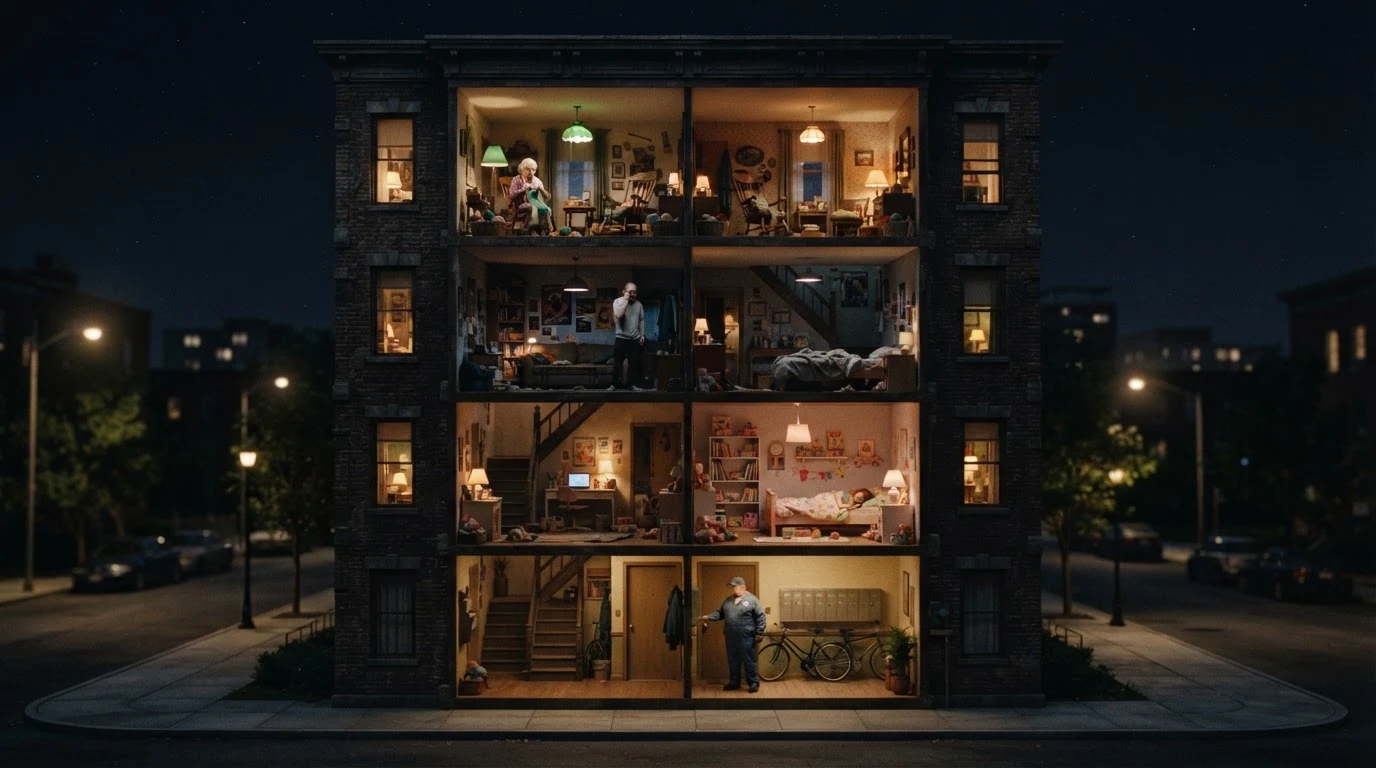
Cross-section and front wall removed give the camera a vantage no character has; four separate rooms, each with one action, let the viewer know more than any person inside.
Open FlashBoardsStraight-down overhead shot of a rainy city intersection at dusk: a courier in a yellow jacket on a bicycle waiting at the light, a woman with a gray bob and a green umbrella crossing toward him, a black car idling at the curb with its headlights on, a boy in a red raincoat running along the far sidewalk. None of them look at each other. Wet asphalt reflecting streetlights, high crane vantage, wide anamorphic frame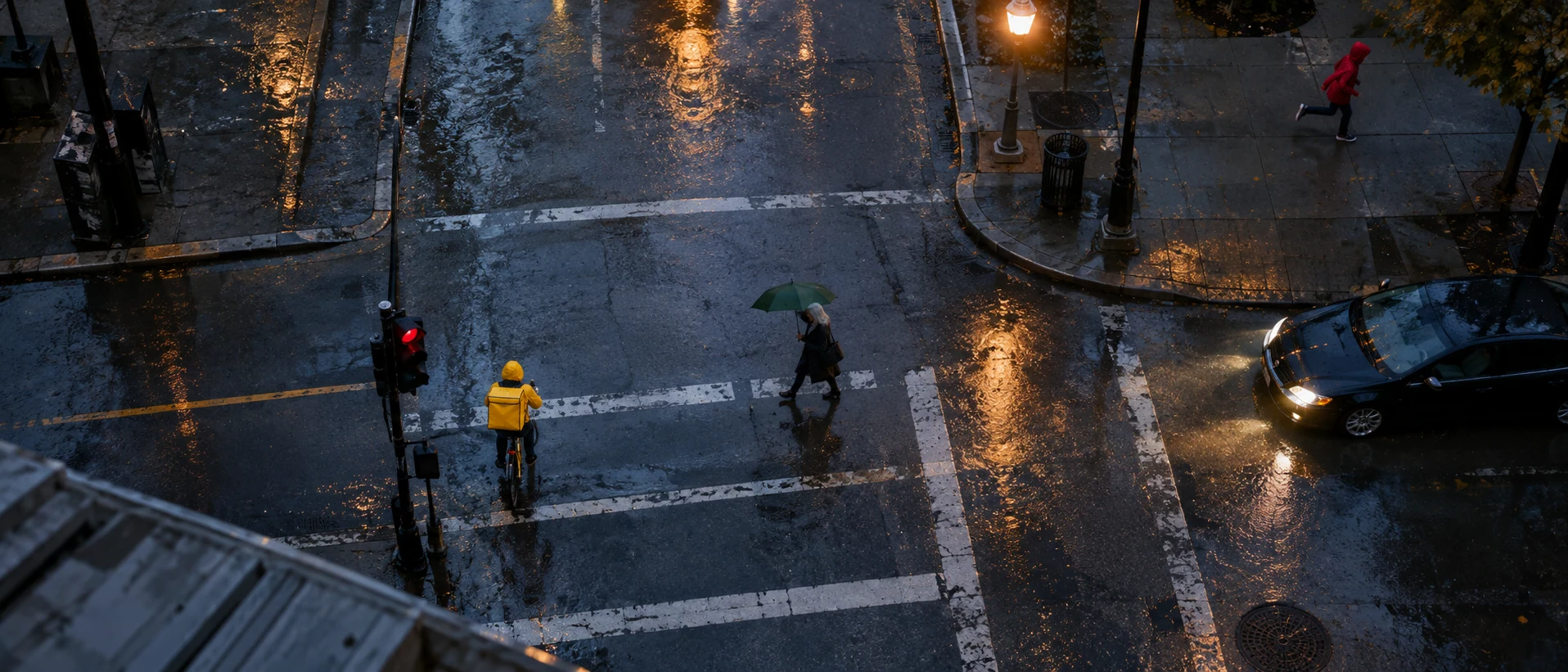
Straight-down overhead and high crane vantage play as a god's-eye view; none of them look at each other keeps the connections visible only to the audience.
Open FlashBoardsCamera: a slow, steady crane move straight down the front of the building, starting on the top floor and ending on the ground floor. Action: the elderly woman keeps knitting, the young man paces and stops at his window, the girl turns over in her sleep, and on the ground floor the janitor pushes the door open and steps inside. Each person stays in their own room, unaware of the others.The crane move reads the rooms one by one like cutting between storylines; every character moves from the first frame, and ending on the janitor gives the audience a secret.
Open FlashBoards{
"output": "Full-screen live-action fantasy scene from its very first frame, one continuous shot with no cuts, re-shooting a moment from The Chronicles of Narnia: Prince Caspian (2008): a high, all-seeing vantage above a forest path that no character in the scene shares. 35mm, summer daylight in a tall pine forest on a steep slope, sun shafts through the canopy, dappled gold on reddish-brown earth, deep green shade, soft haze far back.",
"characters": {
"S1": {
"name": "a young woman in an orange-red gown",
"look": "long blond hair down her back, floor-length orange-red gown with a belt, a bow slung across her back",
"voice": "silence"
},
"S2": {
"name": "a young woman in a lilac gown",
"look": "long dark-brown hair, floor-length pale lilac gown",
"voice": "silence"
},
"S3": {
"name": "a boy in a blue tunic",
"look": "short dark hair, blue belted tunic, dark trousers and boots",
"voice": "silence"
},
"S4": {
"name": "a young man in a white shirt",
"look": "dark hair, loose white shirt, brown trousers, a short sword in his right hand",
"voice": "silence"
},
"CROWD": {
"name": "the forest creatures",
"look": "dozens of fauns, dwarves, a brown bear, a small black badger, a red fox and a dark centaur standing and sitting among the trunks and rocks on the slope behind and to the right of the path",
"voice": "silence"
}
},
"shots": [
{
"shot": 1,
"camera": "high-angle extreme wide shot from high up the slope, looking down over the path, wide lens, deep focus; a thick dark pine trunk in the right third of the frame runs from top to bottom edge, a thinner trunk at centre-right; dense shaded shrubs fill the bottom of the frame; the camera tilts up slowly and pans slowly left, keeping the small group in the left half of the frame as they walk away",
"voice": "silence: nobody speaks in this shot, no voice at all",
"action": [
"BEGINNING: alive from the first frame, S1, S2 and S3 stand close together on the path in the left third, mid-ground, backs to the camera, S1 leftmost, S2 beside her, S3 on their right; S4 walks ahead of them toward the centre of the frame, sword low in his right hand; the creatures stand still among the trees on the slope, watching the path.",
"THEN: S4 walks away from camera and slightly to the right up the path while the small black badger trots across the path in front of him from right to left.",
"THEN: S1, S2 and S3 start walking slowly up the path away from camera, side by side, toward the upper left, S2's gown brushing the ground, their arms loose at their sides.",
"THEN: S4 turns back to his left and rejoins the group; fauns and dwarves on the left slope rise and fall in behind them; on the right slope the red fox walks down toward the path.",
"END: the whole company is small in the left-centre of the frame, still walking away into the sunlit trees, creatures on both slopes around them; the camera has tilted up so more tall trunks and the sunlit haze fill the top of the frame, the foreground shrubs still dark along the bottom edge."
],
"dialogue": []
}
],
"sound": {
"ambience": "quiet forest: footsteps and rustle of gowns on earth and leaves, birdsong high in the canopy, a soft breeze in the pines",
"speech": "no words in this video; the only human sounds are breaths and movement",
"never_spoken": "no narration and no voice-over: the descriptions, performance notes and step words of this prompt are never spoken aloud",
"music": "a film score under the scene, always below the voices: soft sustained strings with a gentle French-horn line, wondering and watchful",
"subtitles": "none"
}
}Remakes the high forest wide from The Chronicles of Narnia: Prince Caspian (2008), dir. Andrew Adamson, DP Karl Walter Lindenlaub: the four travellers walking away up the path, the creatures on the slopes around them and the slow tilt up, all in silence as in the original.
The omniscience sits in the camera field: a high-angle extreme wide from up the slope that nobody on the path occupies. The CROWD entry puts the watchers on both slopes, so the frame holds the travellers and everyone around them at once, and the slow tilt up lets them shrink into a world bigger than their view.
Common mistakes
- Models center a single hero. Name each character, their room or spot, and one action.
- Cross-sections often come out as ordinary windows seen from the street. Say front wall removed and every room visible at once.
- In video, characters start looking at each other or at the camera. Repeat that each stays in their own space.
Keep the reference frames, prompts and every generated take side by side — images and video in one canvas.
FAQ
5 questionsWhat is omniscient point of view in film?
It is narration that knows more than any single character. The film shows events in several places, cuts between people who never meet, and sometimes lets us hear several characters' thoughts or an all-knowing narrator. The audience sits above the story instead of inside one person's experience.
What is an example of an omniscient narrator in a movie?
Amélie (2001) and The Royal Tenenbaums (2001) both use an unseen narrator who knows every character's history and habits. Ensemble films like Magnolia (1999) and Short Cuts (1993) are omniscient without a narrator, through editing alone, cutting between people who never meet.
What is the difference between third-person omniscient and third-person limited?
Third-person limited follows one character: we learn only what they see, hear or think. Third-person omniscient can go anywhere and into anyone's mind. In film, limited narration keeps the protagonist in nearly every scene, as in Chinatown (1974); omniscient narration cuts to scenes the protagonist never sees.
Is omniscient point of view the same as a POV shot?
No. A POV shot is one camera setup that shows exactly what a character sees from their eye line. Omniscient point of view describes the whole film's knowledge. An omniscient film may use POV shots from several characters, each showing a different view.
Why do filmmakers use omniscient point of view?
Mainly for suspense: when the audience sees the danger a character can't, every scene carries tension. It also suits ensemble stories, large historical canvases and ironic narrators who know the ending. Many films turn restricted for twists, so the audience is surprised with the hero.
Related terms
6- POV ShotCamera Angles
A POV shot shows exactly what a character sees by placing the camera at their eyes — usually right after a shot of them looking — so the audience shares their perspective, including movement, obstruction or distortion.
- Unreliable NarratorStorytelling
An unreliable narrator is a storyteller — through voice-over or a point-of-view protagonist — whose account the audience can't fully trust because they lie, misremember or misread what happens.
- Voice-OverSound & Music
Voice-over is speech heard over the picture from someone not speaking on screen at that moment — a narrator, a character's inner thoughts, a documentary commentary.
- Cross-CuttingEditing
Cross-cutting alternates between two or more lines of action happening in different places, usually at the same time, so each strand builds tension or meaning against the other.
- Dramatic IronyStorytelling
Dramatic irony is when the audience knows something a character doesn't — the bomb under the table, the killer in the house — turning every line and choice into suspense.
- Narrative TechniquesStorytelling
Narrative techniques are the tools a storyteller uses to control what the audience knows and when — flashbacks, nonlinear order, point of view, foreshadowing, unreliable narrators, twists.
Further reading
David Bordwell, Narration in the Fiction Film (1985). David Bordwell & Kristin Thompson, Film Art: An Introduction, chapter on narrative form.