 FlashBoards Learn
Editing · Film language
Cross-Cutting
Also called: parallel editing, intercutting, crosscutting, parallel montage
Cross-cutting is an editing technique that alternates between two or more lines of action happening in different places, usually at the same time. Each cut away leaves a question hanging in the other strand, so the sequence builds suspense, irony or comparison that neither scene could carry on its own.
- What it does
- Links separate places into one sequence, so every cut away raises the stakes of the strand you just left.
- Use it when
- Two actions are racing toward the same moment, or one scene means more when it is set against another.
- Watch out
- If the audience can't tell instantly which strand they are in, the tension turns into confusion.
- Try this prompt
Night, wet overpass, a woman in an orange rain jacket rides a motorcycle fast left to right, low camera, sodium streetlights, 35mm, cinematic still
What is cross-cutting in film?
Cross-cutting is the practice of cutting back and forth between two or more separate scenes so that they play as one sequence. The strands usually happen at the same time in different places: a rescuer on the road and the victim waiting at home, a family at a church and the killers moving through the city, a heist crew inside the vault and the guard walking back toward it.
The technique goes by several names. Parallel editing and intercutting are used as synonyms by most editors; crosscutting (one word) and parallel montage show up in film-studies texts. In a screenplay you will see it written as INTERCUT or as a series of scene headings marked SAME TIME.
What separates cross-cutting from ordinary scene-to-scene editing is that the scenes do not finish before the next one starts. Each strand is interrupted at a point where something is unresolved, and the film only returns to it after the other strand has moved forward too. That is the basic mechanism of all film editing pushed to its limit: the cut does not just move us through the story, it makes two places comment on each other.
Three things define a cross-cut sequence:
- At least two strands in different spaces. Cutting between two angles in the same room is coverage, not cross-cutting.
- Interruption. Each return picks the strand up later than we left it, so time keeps passing on both sides of the cut.
- A relationship between the strands. They converge on one moment (a rescue, a collision, a phone ringing) or they rhyme in meaning (a sacrament and a massacre).
Why do filmmakers use cross-cutting?
To build suspense through withheld outcomes. Every cut away from a danger is a small cliffhanger. D. W. Griffith turned this into a formula in his early shorts: the family barricaded inside, the intruders breaking in, the rescuer racing to reach them, with the shots getting shorter as the strands close in. The same last-minute-rescue grammar still drives action finales, which is why cross-cutting sits so close to the craft of suspense.
To create irony and meaning. When two strands are placed side by side, the audience reads one through the other. The christening in The Godfather (1972) is the textbook case: Michael stands as godfather and renounces Satan in church while, elsewhere, his men murder the heads of the rival families. Neither strand alone says what the sequence says, a point about juxtaposition made at feature length.
To exploit what the audience knows. Cross-cutting can plant a false assumption. In The Silence of the Lambs (1991) the film alternates an FBI team closing in on a house with the killer at home hearing his doorbell, so we assume the agents are at his door. The reveal that Clarice is standing there alone works because the editing let us believe in the wrong geography. That is dramatic irony turned against the viewer.
To compare scales and worlds. Inception (2010) runs several dream levels at once, each on its own clock, and cross-cuts between them through the final act so that a falling van, a weightless hotel corridor and a snowbound fortress all pay off together. Intolerance (1916) went further, intercutting four stories set centuries apart.
To control rhythm and compress time. Cutting between strands lets an editor skip the dull middle of each action. Nobody watches a whole drive across town; we see the start, the other strand, a stretch of road, the other strand again. The alternation itself becomes a clock that the editor can speed up, which is where cross-cutting shades into pacing.
How to plan, shoot and edit a cross-cut sequence
Cross-cutting is decided in the script and on set, not rescued in the edit. The strands have to be shot so they can interleave.
1. Write the beats of each strand side by side. List both lines of action as numbered beats and decide where they meet. Mark the cut points on unresolved moments: a hand reaching for a door, a phone that has not been answered, a car that has not yet rounded the corner. A cut on a completed action lets the tension out.
2. Make every strand instantly recognizable. The viewer gets a fraction of a second after each cut to know where they are. Give each strand its own signature: color temperature (sodium orange on the road, cold blue in the house), lens (wide and moving versus long and still), or sound bed (engine roar versus a ticking clock). Open each strand with a clear establishing shot the first time we see it, then rely on the signature afterward.
3. Respect screen direction across the cut. If the rescuer travels left to right, the person waiting for them should look or face screen left, toward the arrival. Consistent screen direction lets the audience feel the two spaces closing in even though they never share a frame.
4. Shoot more coverage than a normal scene. Each strand needs enough shots to be returned to four, six or ten times without repeating itself. Plan coverage in escalating sizes: wides for the first visits, mediums in the middle, close-ups and inserts for the final alternations when shots last a second or less.
5. Accelerate the alternation. A typical shape starts with strand shots of 8 to 15 seconds, drops to 3 to 5 seconds as the strands converge and ends in cuts of 12 to 24 frames. That shortening is what the audience feels as suspense; it is the same toolkit as fast cutting, but aimed at one convergence point.
6. Bridge the cuts with sound. Let a sound from one strand run over the first frames of the other: a phone ringing, a siren, a line of dialogue. A sound bridge ties the spaces together and hides the jump.
7. Pay it off. The strands must meet, collide or resolve their comparison. A cross-cut that simply stops, with no convergence and no point, feels like a trick.
Intercutting: phone calls and scenes played as one
Intercutting is the narrower, everyday form of cross-cutting: two scenes in different places are edited as if they were a single scene. The classic case is a phone call. We see one speaker, then the other, then the first again, cut on the rhythm of the conversation exactly as if the two people were sitting across a table.
In a screenplay this is written with the instruction INTERCUT (or INTERCUT - PHONE CONVERSATION) after both locations are established once, so the writer doesn't have to repeat scene headings for every line.
Because intercutting imitates a dialogue scene, it borrows dialogue rules:
- Opposite eyelines. Put one caller on the left of frame looking right and the other on the right looking left. The cut then reads as two people facing each other across a distance.
- Matched shot sizes. Close-up answers close-up. Jumping from a wide on one side to a tight close-up on the other breaks the illusion of a shared conversation, unless that imbalance is the point.
- Contrasting environments. The two spaces should look different at a glance (a bright office versus a dark bedroom, rain outside one window and none at the other) so no cut needs explaining.
Intercutting does not have to involve telephones. Letters, emails and text messages are often intercut with the reader, with the screen treated as the second speaker, and radio links let action films intercut a hero with the voice guiding them from outside.
Is cross-cutting the same as parallel editing?
In practice, yes: most editors and textbooks treat cross-cutting, parallel editing and intercutting as the same technique. Where teachers draw a line, it usually looks like this:
| | Cross-cutting | Parallel editing (strict sense) | Intercutting | |---|---|---|---| | Time | Same time | Can be different times | Same time | | Strands | Converge on one event | Linked by theme or comparison | Played as one scene | | Typical use | Rescue, heist, chase | Rhyming lives, eras, fates | Phone calls, radio, messages |
The Godfather Part II (1974) is the usual example of parallel editing in the strict sense: it alternates the young Vito's rise in the early twentieth century with Michael's reign decades later, so the two storylines never meet in time but keep commenting on each other. That approach overlaps with nonlinear narrative, where the order of events is rearranged for meaning.
If you are writing a shot list or talking to an editor, any of the three terms will be understood. The distinction worth keeping is the practical one: are the strands heading for the same moment, or are they set side by side to compare?
Cross-cutting vs. montage
A montage compresses time or builds an idea from many short shots, usually over music, and it doesn't need separate strands at all. Cross-cutting needs at least two strands and keeps them distinct.
The two meet in sequences like the training section of Rocky IV (1985), which alternates Rocky in a snowbound farmhouse with his opponent in a high-tech gym. It is a montage (time compressed, set to music) built by cross-cutting (two locations, same period, each commenting on the other). A useful test: if you could remove one strand and the other would still make sense as a condensed passage of time, you are looking at a montage. If removing one strand kills the tension or the meaning of the other, you are looking at cross-cutting.
Cross-cutting is also different from a split screen, which shows both strands at once in the same frame. Split screen shows simultaneity directly; cross-cutting makes the viewer hold the absent strand in mind, and that act of remembering is where the tension comes from.
Cross-Cutting in motion
3 clipsEach clip jumps between two places, or between hunter and hunted, within a few seconds, so the cut itself is on screen. Watch the frame right after each cut: how quickly light, color and framing tell you which strand you are in. Mr. Brooks goes there and back, the basic cross-cut loop.
How to create a cross-cutting with AI
4 promptsAn AI model generates one shot at a time, so cross-cutting with AI is really about designing strands that belong together: matched aspect ratio, opposite screen directions and a clear visual signature for each side. Generate both strands on one FlashBoards board, lay them out in edit order and judge the cut before you animate anything. The recipes below build a race-against-time pair: a rider on the road and a man waiting at home. The fourth prompt re-shoots a real film shot from a text description alone, and the original plays next to the result so you can compare.
Cinematic wide shot at night, a woman in her forties with a gray-streaked braid and an orange reflective rain jacket rides a motorcycle fast from frame left to frame right across a wet concrete overpass, side profile, the front wheel and headlight point toward the right edge of the frame, camera low at bumper height, 35mm lens, heavy rain, sodium-orange streetlights reflected in the road, headlight beam cutting through spray, motion blur on the lights, warm orange and black palette, film grain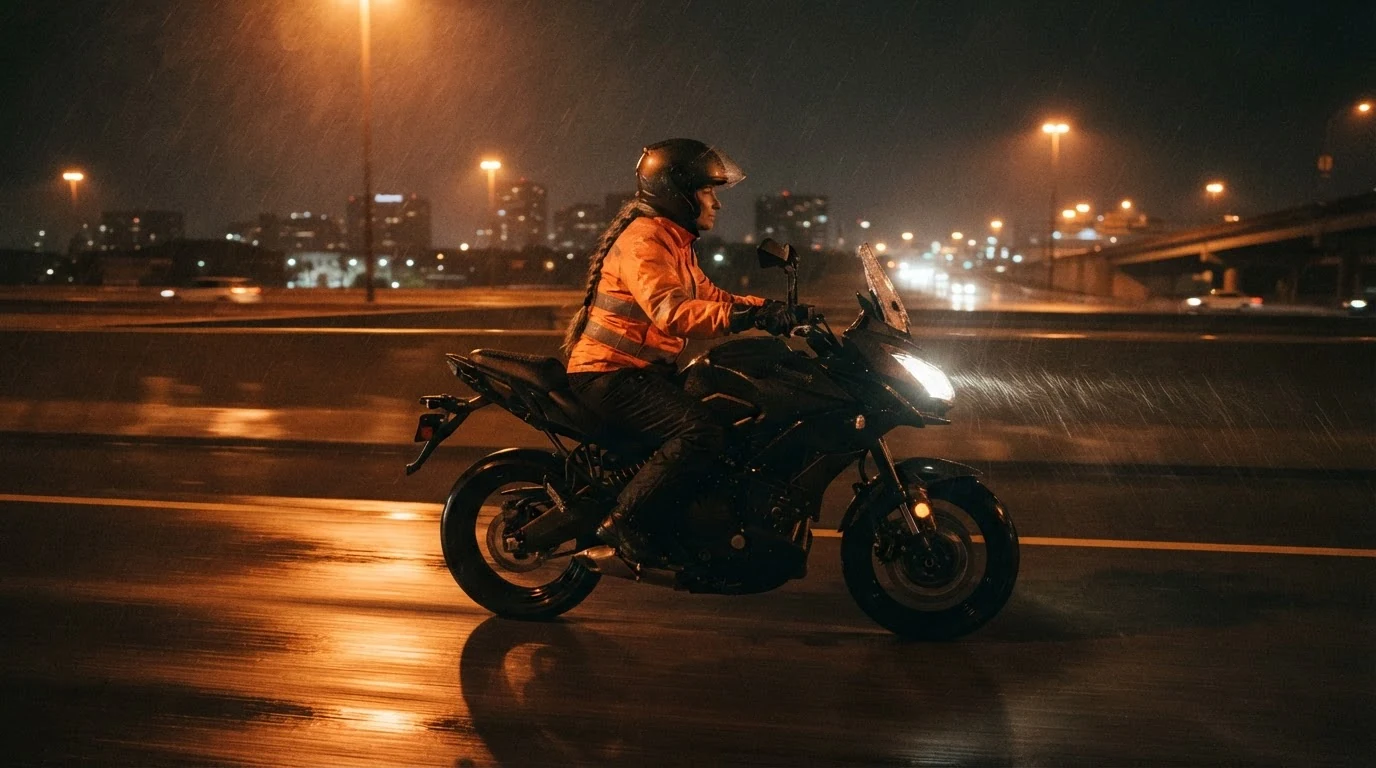
This is strand A. From frame left to frame right, locked with side profile, headlight toward the right edge, fixes the screen direction the other strand must answer. Sodium-orange streetlights and warm orange and black palette give the strand a color signature the viewer will recognize after every cut, and camera low at bumper height, 35mm keeps the energy of a chase instead of a static portrait of a rider.
Open FlashBoardsCinematic close-up at night, a man in his seventies with a short white beard, deep-set gray eyes and a hearing aid, sitting at a farmhouse kitchen table, he turns his head toward frame left as if listening for an engine, cold blue moonlight from a window behind him, one candle on the table lighting half his face, 85mm lens at eye level, background in soft darkness, still and quiet mood, film grain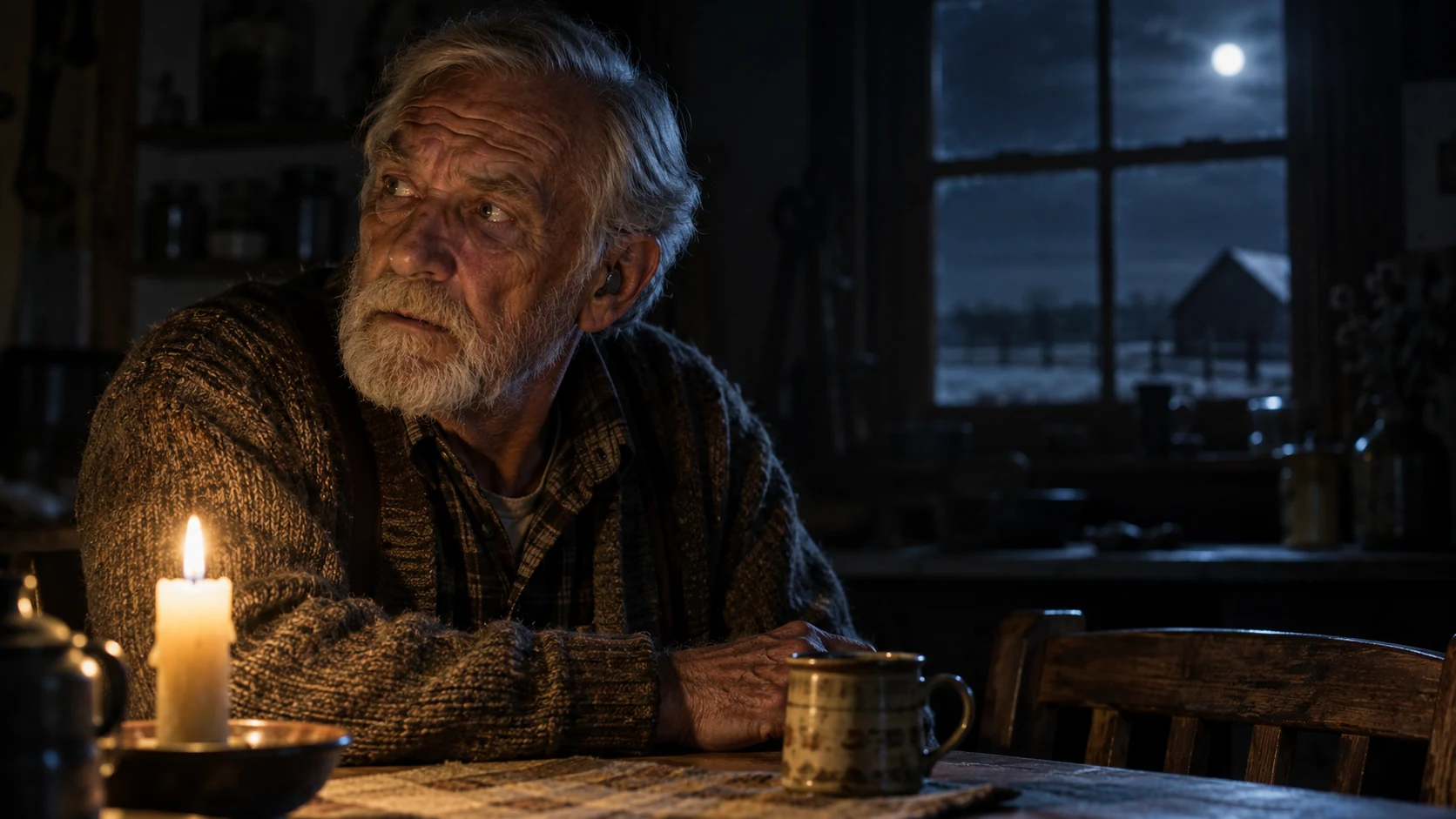
This is strand B, built to cut against recipe 1. Toward frame left answers the rider's left-to-right travel, so the two strands feel as if they are closing in on each other. Cold blue moonlight is the opposite of the orange road, and 85mm, still and quiet swaps motion for waiting. Same 16:9 aspect so the cut does not jump in shape.
Open FlashBoardsCamera: low tracking shot moving left to right alongside the motorcycle at the same fast speed, keeping the rider centered for the whole shot. Action: the motorcycle is already racing through the rain from the first frame, spray lifting off the rear wheel. The rider leans forward over the tank and the streetlights streak past behind her. She twists the throttle, the headlight flares in the rain and the bike pulls ahead toward frame right.Already racing from the first frame keeps the shot alive instead of drifting into a slow push-in on the still. Tracking alongside at the same speed holds the left-to-right direction the whole cross-cut depends on, and the ending pulls ahead toward frame right gives the editor a natural cut point: cut to the waiting man the moment she accelerates.
Open FlashBoards{
"output": "Full-screen live-action scene from Mr. Brooks (2007), from its very first frame: five shots joined by four hard cuts, cross-cutting one phone call between the caller on a rooftop and the detective in her office across the city. 2007 35mm film look with fine grain, 1.85:1 frame, overcast summer afternoon in a mid-size American downtown, soft flat daylight, muted palette of warm tan, olive green and steel gray.",
"characters": {
"S1": {
"name": "Mr. Brooks, played by Kevin Costner",
"look": "man in his fifties, swept-back brown hair, black wraparound sunglasses, blue-gray suit, pale blue shirt, a red flip phone held to his right ear with his right hand",
"voice": "low, calm, unhurried, a slight rasp"
},
"S2": {
"name": "Det. Tracy Atwood, played by Demi Moore",
"look": "woman in her forties, long straight dark brown hair, white button-front blouse under a dark olive cardigan, a phone held to her right ear with her right hand",
"voice": "controlled, clipped"
}
},
"shots": [
{
"shot": 1,
"camera": "static tight close-up from just behind S1's right shoulder, eye level; the back and right side of his head fill the left two thirds of the frame, dark reflective glass of an office tower out of focus at frame right",
"action": [
"BEGINNING: alive from the first frame, S1 faces screen right and slightly away from camera, the red phone pressed to his right ear, the fingers of his right hand spread over it, already talking.",
"END: he stays still, head and hand unmoved, listening."
],
"dialogue": [
{
"speaker": "S1",
"on_screen": true,
"when": "from the first frame, already at the end of his sentence",
"delivery": "calm, almost friendly",
"line": "<d>[English] Well, I have a little cold.</d>"
}
]
},
{
"shot": 2,
"cut_at": "00:00.920",
"camera": "a different place: wide exterior, almost static with a very slow drift, looking across a gap at a long lit office window on the upper floor of a dark building; a concrete ledge cuts diagonally across the lower-left foreground, leafy green treetops fill the right edge, a brick wall at top right",
"action": [
"BEGINNING: behind the glass a bright police squad room: fluorescent strip light along the ceiling, walls covered in pinned photographs and papers, empty desks, a pink-red chair at left.",
"END: the room stays still and nobody crosses the window."
],
"dialogue": [
{
"speaker": "S1",
"on_screen": false,
"when": "right after the cut to this shot, his voice heard over the phone line",
"delivery": "patient, pressing",
"line": "<d>[English] Are you going to give me the answer?</d>"
}
]
},
{
"shot": 3,
"cut_at": "00:03.040",
"camera": "static medium shot from outside, through the office glass: reflections of the street and a dark vertical window frame bar run across the image just right of her; the room behind is soft and out of focus",
"action": [
"BEGINNING: S2 stands left of center, phone at her right ear in her right hand, gaze just right of the lens toward the window; behind her, soft and blurred at right, a gray-haired man in glasses sits at a desk with both hands at his mouth.",
"THEN: her brow tightens, her lips move as she answers, her eyes stay on the window.",
"END: she keeps the phone at her ear and holds still, jaw set, listening."
],
"dialogue": [
{
"speaker": "S2",
"on_screen": true,
"when": "soon after the cut to this shot, never before the cut",
"delivery": "sharp, demanding",
"line": "<d>[English] Where are you?</d>"
}
]
},
{
"shot": 4,
"cut_at": "00:05.000",
"camera": "back to S1: medium shot from behind on a high rooftop, eye level, the camera follows him and pans right at medium speed; a tall office tower with tan horizontal bands and dark window strips fills the background, an older tan tower and a tree-lined street far below at left, a red-brick building edge rising at bottom right",
"action": [
"BEGINNING: alive right after the cut, S1 stands with his back to camera right of center, phone at his right ear, looking out over the city.",
"THEN: he steps to screen right and turns his head right; his profile and sunglasses come into view while his right hand keeps the red phone at his ear.",
"END: in three-quarter profile facing screen right, he keeps talking, calm, his left shoulder toward camera."
],
"dialogue": [
{
"speaker": "S1",
"on_screen": true,
"when": "as he turns his head into profile",
"delivery": "calm, deliberate, amused",
"line": "<d>[English] I'll tell you, if you can give me the true answer <scenetrans></d>"
}
]
},
{
"shot": 5,
"cut_at": "00:07.760",
"camera": "low-angle close-up of S1's face in three-quarter profile facing screen right, sunglasses on, red phone at his right ear, pale sky and a dark tower edge behind him",
"action": [
"BEGINNING: he holds still, the phone to his ear.",
"END: he is still finishing his sentence."
],
"dialogue": [
{
"speaker": "S1",
"on_screen": false,
"when": "carried straight over the cut, finishing the same sentence",
"delivery": "calm",
"line": "<d>[English] <scenetrans> to my question.</d>"
}
]
}
],
"sound": {
"ambience": "a light wind and distant city traffic heard from the rooftop in his shots, a quiet office hum in hers; his voice over the phone sounds slightly thin in shot 2",
"speech": "exactly these spoken phrases, each said once, in this order",
"never_spoken": "no narration and no voice-over: the descriptions, performance notes and step words of this prompt are never spoken aloud",
"music": "a film score under the scene, always below the voices: low sustained strings with a slow, uneasy pulse",
"subtitles": "none"
}
}Remakes the phone-call intercut from Mr. Brooks (2007), dir. Bruce A. Evans, DP John Lindley: the prompt keeps his close-up, the cut to the lit squad-room window, Atwood seen through the glass, the rooftop pan and the final close-up, with the film's own lines on the original cut points.
Each place is its own shot with its own camera line, and the four cut_at values copied from the film are the only timing, so the call keeps swapping ends on the original beats. The real lines sit in the shot whose time range holds them, and the last sentence is split across the final cut.
Common mistakes
- Strands that look the same. Models drift toward one default night look. Name a color signature per strand (sodium orange vs. moonlight blue) and repeat it in every prompt of that strand.
- Broken screen direction. Unless you write from frame left to frame right and turns toward frame left, the model picks a direction at random and the strands stop closing in. Flip the image on the board if one take comes out mirrored.
- Mismatched aspect ratios. A 21:9 strand cut against a 16:9 strand reads as a mistake. Keep every shot of the sequence in one ratio.
- Characters changing between returns. Each return to a strand must show the same person. Keep the exact character description (age, hair, jacket, beard) in every prompt and use the first good frame as a reference.
- Static video strands. A waiting strand can still move: a candle flame, a head turning, rain on the window. Describe that motion in the video prompt, or the clip will only creep toward the face.
Keep the reference frames, prompts and every generated take side by side — images and video in one canvas.
FAQ
5 questionsWhat is cross-cutting in film?
Cross-cutting is an editing technique that alternates between two or more scenes happening in different places, usually at the same time. Each strand is interrupted at an unresolved moment, so the audience carries a question into the next shot. Filmmakers use it to build suspense, create irony, compress time or compare characters, as in the christening sequence of The Godfather (1972).
What is the difference between cross-cutting and parallel editing?
Most editors use the terms interchangeably. When a distinction is made, cross-cutting means strands happening at the same time that converge on one event, such as a rescue, while parallel editing can link storylines set at different times by theme or comparison. The Godfather Part II, which alternates young Vito's story with Michael's decades later, is the usual example of the second.
What is intercutting?
Intercutting is a form of cross-cutting in which two scenes in different places are edited as if they were one scene. The classic example is a phone call: the film alternates between the two speakers on the rhythm of the dialogue. Screenwriters mark it with INTERCUT once both locations are established, and editors keep eyelines opposite and shot sizes matched.
How do you write cross-cutting in a screenplay?
Establish each location once with a full scene heading, then either write INTERCUT (for example INTERCUT - PHONE CONVERSATION) and continue the action and dialogue without new headings, or alternate short scenes with headings marked SAME TIME. Keep the beats of each strand short, end each piece on an unresolved moment and make the convergence point clear on the page.
Why does cross-cutting create suspense?
Because every cut away withholds an outcome. When the film leaves a character in danger to show the rescuer on the road, the viewer has to hold the unresolved danger in mind, and that waiting is tension. Editors increase it by shortening each return as the strands converge, so the alternation itself starts to feel like a ticking clock.
Related terms
6- MontageEditing
A montage is a sequence of short shots, usually set to music, that compresses time or builds an idea — weeks of training, a relationship, a city waking up — in a minute or two.
- JuxtapositionEditing
Juxtaposition places two contrasting images side by side — in one frame or across a cut — so their collision creates a meaning neither has alone.
- Pacing in FilmEditing
Pacing is how fast a film feels to the viewer — set by shot length, how much happens per scene and how long the edit lets moments breathe.
- Fast CuttingEditing
Fast cutting strings together many very short shots in quick succession to create energy, chaos or overload — common in action, trailers and music videos.
- Nonlinear NarrativeStorytelling
A nonlinear narrative tells events out of chronological order — through flashbacks, parallel timelines or reshuffled chapters — so meaning comes from how the pieces are arranged.
- Film EditingEditing
Film editing is the selection and ordering of shots — where each one starts, ends and what follows it — to build continuity, rhythm and meaning out of the raw footage.
Further reading
Karel Reisz and Gavin Millar, The Technique of Film Editing. Walter Murch, In the Blink of an Eye. David Bordwell and Kristin Thompson, Film Art: An Introduction (chapter on editing).