 FlashBoards Learn
- Learn
- Storytelling
- Plot Point
Storytelling · Film language
Plot Point
Also called: turning point, act break
A plot point is an event that hooks into the story and spins it in a new direction, usually through a choice the protagonist cannot take back. In the three-act model, plot point one ends the setup and launches the confrontation; plot point two ends the second act and sends the hero into the finale.
- What it does
- Turns the story in a new direction and closes the act that came before it.
- Use it when
- An act has done its job and the protagonist needs a new goal, a new world or a new problem.
- Watch out
- A plot point that happens to the hero but changes nothing they want or do is just an event.
- Try this prompt
A woman in a yellow raincoat at the stern of a departing night ferry, the loading ramp rising behind her, facing the dark sea, 35mm film still.
What is a plot point?
The term comes from Syd Field's Screenplay (1979), the book that popularized the three-act structure in Hollywood. Field described a plot point as an incident that grabs the action and turns it somewhere else. Screenwriters also say turning point or act break.
Before a plot point the story asks one question; after it, the question has changed. Strong plot points:
- are irreversible: the door closes behind the character, literally or not;
- change the goal: the protagonist wants something new, or pursues it by new means;
- come from character: something happens, and then the hero decides. The decision is the turn.
Where do plot point 1 and plot point 2 fall?
Field's paradigm assumes a 120-page script at roughly a minute per page. Plot point one lands around pages 25–27: the setup is over and the protagonist commits to the journey. Plot point two lands around pages 85–90: the act-two strategy has run out, often at the lowest moment, and a new resolve launches the final act toward the climax.
In a two-hour film that puts the act breaks near minutes 25–30 and 85–95. These are rules of thumb, not a stopwatch. Field later added a midpoint, and beat sheets such as Save the Cat name more turns, but all of them hang on these two tentpoles.
Plot point examples in film
Star Wars (1977): Luke finds the homestead burned and his aunt and uncle dead, and tells Obi-Wan he will go to Alderaan. Event plus decision: a textbook plot point one.
The Matrix (1999): Neo takes the red pill and wakes in a pod in the real world. The swallow is the choice; the pod proves there is no way back.
Chinatown (1974), Field's favorite example: the real Mrs. Mulwray walks into Jake Gittes's office: his client was an impostor, and an adultery case becomes a conspiracy.
The Shawshank Redemption (1994): the warden has Tommy killed, the one witness who could prove Andy innocent. The legal road out closes for good.
Before Sunset (2004) shows how quiet a turn can be: Jesse keeps not leaving for his plane, first in the car, then on the stairs to Celine's apartment, and an afternoon walk becomes a decision about their lives.
How to write and stage a plot point
On the page: make the protagonist act, not just witness, and close the old option explicitly. If the scene could be cut without changing what the character wants next, it is a story beat, not a plot point.
On the screen: audiences feel act breaks through picture as much as plot. Change something visual across the turn: location, palette, lens length or camera behavior. In The Wizard of Oz (1939) Dorothy opens the farmhouse door and the film switches from sepia to Technicolor. A locked-off camera that goes handheld says the same thing: the rules have changed.
On the board: in FlashBoards, lay the film out left to right and pin the two plot point frames at the quarter and three-quarter marks. Put reference stills and generated frames for the scenes just before and after each turn side by side, noting what the character wants on each side. If they look interchangeable, the turn is not landing visually.
Plot point vs. inciting incident vs. plot twist
The inciting incident disturbs the protagonist's normal life; plot point one is where they commit to dealing with it. In Star Wars, Leia's message in R2-D2 is the inciting incident; the burned homestead and Luke's decision are the plot point. One invites, the other commits.
A plot twist overturns what the audience believed. A twist can serve as a plot point (the impostor client in Chinatown is both), but most plot points are not twists, and many twists land after the last act break. More on how turns shape a film in the storytelling hub.
How to create a plot point with AI
3 promptsA plot point frame has to show the turn itself: what the character leaves, what lies ahead and what makes it irreversible. In FlashBoards, generate it next to the frames of the scene before, to check that the picture changes across the turn.
Night harbor. A woman in her late twenties with a shaved head and a mustard-yellow raincoat stands at the stern rail of a departing car ferry, a green duffel bag at her feet. Behind her the town lights and an empty pier recede across black water; the ferry's steel loading ramp is rising, half closed. Medium wide shot, 35mm lens, camera at deck height behind her shoulder, her face in three-quarter profile turned toward the dark sea ahead. Orange harbor lights behind, cold white deck lamp on her face. Cinematic film still.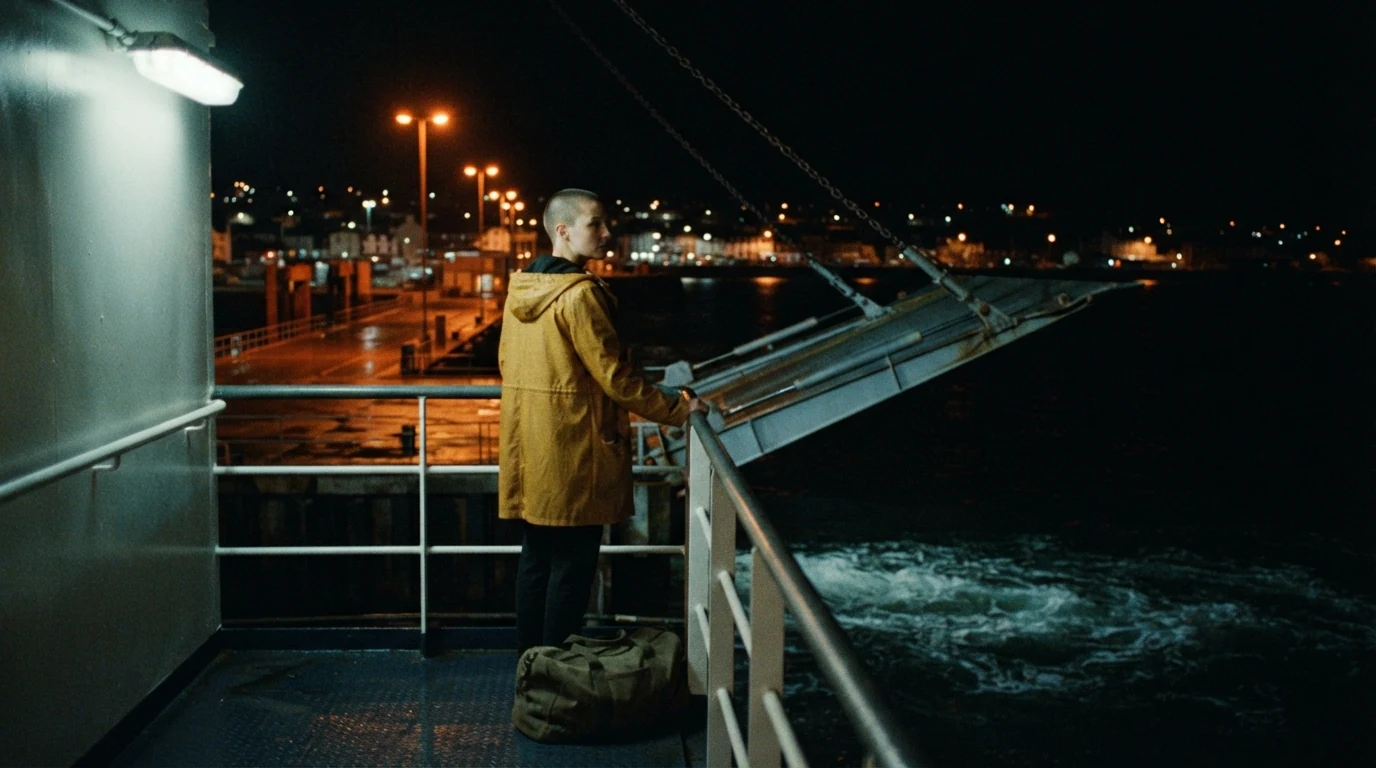
"Departing" and "ramp rising, half closed" carry the irreversibility; the old world sits behind her, her gaze points ahead. Warm light behind and cold light on her face split before from after.
Open FlashBoardsA storyboard page, six panels in two rows, loose grey marker on white paper, each panel numbered 1 to 6. A film's first plot point: 1) a man in his forties with a short red beard and a hearing aid reads a letter; 2) insert of the letter's wax seal; 3) he looks at a framed photo of a lighthouse; 4) he pulls a canvas bag from under a bed; 5) close-up of his hand dropping a house key through the mail slot; 6) extreme wide shot, he walks down an country road at dawn, the house small behind him.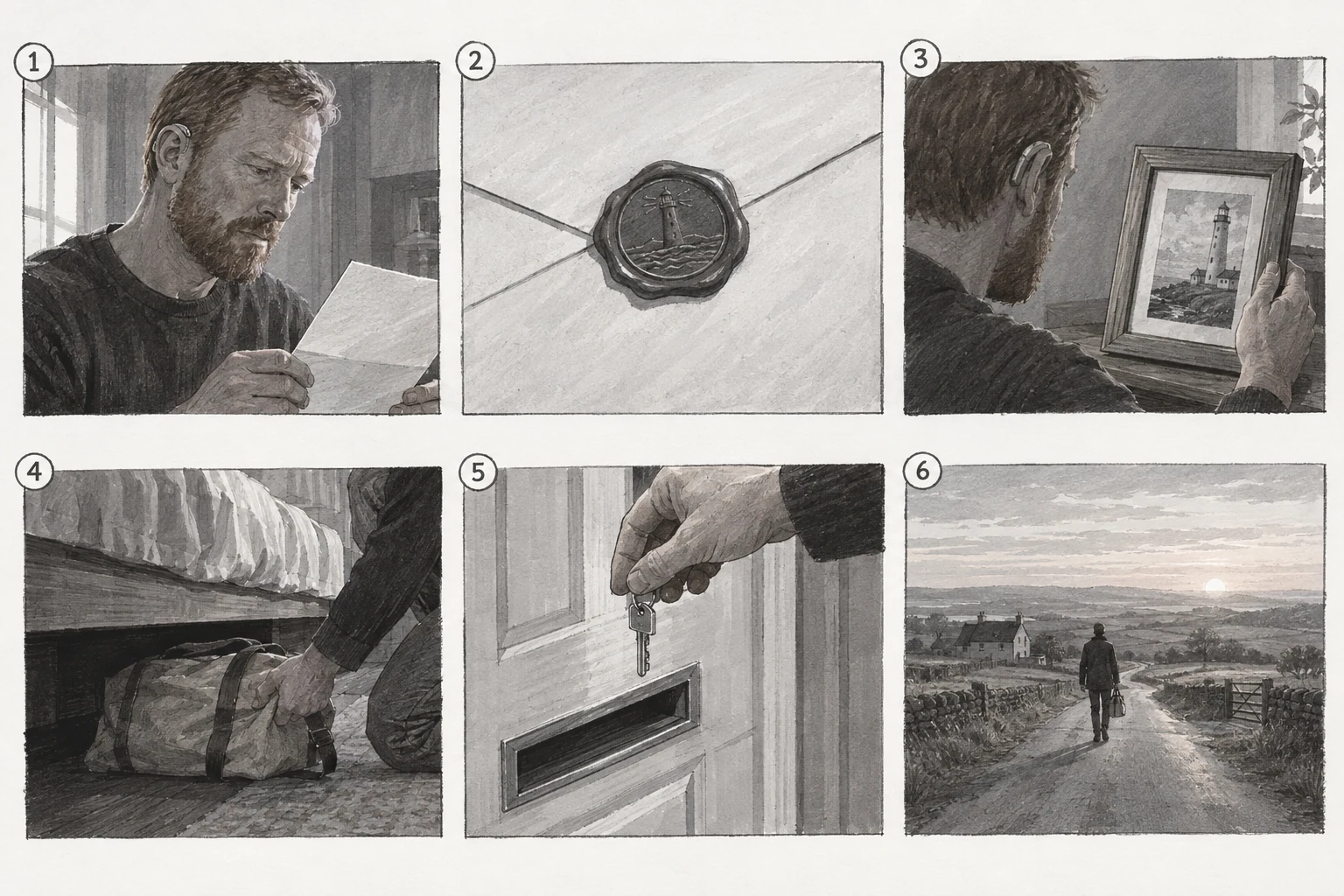
The recipe produces the planning artifact itself. Panels 1–4 are the event and the hesitation, panel 5 is the point of no return, panel 6 opens the new act in new space and light.
Open FlashBoardsCamera: slow, steady push in from behind her shoulder, ending on a medium close-up of her profile. Action: from the first frame the ferry is moving away from the pier, white water churning behind the stern, and the steel ramp keeps rising until it closes. The woman lifts the duffel bag onto her shoulder, glances once back at the harbor lights, then turns her face to the dark sea ahead and holds it, wind pushing at her raincoat.Ferry and ramp move from the first frame, so the shot never freezes; the glance back, then forward, is the decision in one gesture.
Open FlashBoardsCommon mistakes
- Models draw a pretty moment, not a turn. Put both sides in one frame: what closes behind the character and what lies ahead.
- Characters default to facing the camera. State where they look.
- In video, a closing action can play in reverse. Write "keeps rising until it closes," not "the ramp moves."
- Storyboard pages fill with garbled captions. Ask for panel numbers and describe each panel in the prompt.
Keep the reference frames, prompts and every generated take side by side — images and video in one canvas.
FAQ
4 questionsWhat is a plot point in a story?
A plot point is an event that turns the story in a new direction and cannot be undone. It usually pairs something that happens to the protagonist with a decision they make in response. In the three-act structure, two major plot points close the first and second acts.
What are plot point 1 and plot point 2?
Plot point one ends act one: the setup is done and the protagonist commits to the main conflict, about a quarter of the way in. Plot point two ends act two, about three quarters in, often at the lowest moment, and launches the final act. In a 120-page script they fall near pages 25 and 90.
What is the first plot point in a movie?
It is the moment the hero leaves the ordinary world behind and the real story begins. In Star Wars it is Luke finding his home destroyed and choosing to go with Obi-Wan; in The Matrix, Neo taking the red pill. It typically arrives 25 to 30 minutes into a two-hour film.
Is a plot point the same as a turning point?
Mostly, yes. Turning point is the broader term for any moment that changes a story's direction. Plot point usually means the major turns that end acts, especially Syd Field's plot point one and two; the act break is where such a turn falls.
Related terms
5- Plot TwistStorytelling
A plot twist is a revelation that overturns what the audience believed about the story or a character; a good one is prepared by fair clues and recolors everything seen before.
- Inciting IncidentStorytelling
The inciting incident is the event that upsets the protagonist's normal life and sets the main conflict in motion — the moment the story truly begins.
- Three-Act StructureStorytelling
The three-act structure splits a story into setup, confrontation and resolution, turned by plot points at roughly the quarter and three-quarter marks — the default blueprint of feature screenwriting.
- ClimaxStorytelling
The climax is the story's decisive peak: the protagonist faces the central conflict head-on and the main dramatic question is answered.
- Story BeatScreenwriting
A beat is the smallest unit of dramatic change in a story: a moment where an action, reaction or decision shifts the scene's direction. In dialogue, a parenthetical (beat) also marks a short pause.
Further reading
Syd Field, Screenplay: The Foundations of Screenwriting (1979). Syd Field, The Screenwriter's Workbook (1984).