 FlashBoards Learn
- Learn
- Storytelling
- Three-Act Structure
Storytelling · Film language
Three-Act Structure
Also called: 3-act structure, setup confrontation resolution
The three-act structure divides a story into setup, confrontation and resolution. Two turning points, near the quarter and three-quarter marks, push the story from one act into the next. It is the default blueprint of feature screenwriting because it tells the audience what's at stake, tightens the pressure, and pays off with an answer.
- What it does
- Splits a story into setup, confrontation and resolution, with two plot points that turn it from one act to the next.
- Use it when
- You outline a feature or short, fix a draft that sags in the middle, or plan which scenes get storyboarded first.
- Watch out
- Hitting the page numbers isn't enough; each act break has to be a choice or a loss that changes what the protagonist wants.
- Try this prompt
Plot point one keyframe: a woman in an orange parka steps from a warm radio hut into a blue blizzard, wide from inside, 16:9.
What is the three-act structure?
The three-act structure is the most common way to organize a screenplay. Act one sets up the world, the protagonist and the problem. Act two is the confrontation, where the protagonist chases a goal against rising opposition. Act three resolves it: the conflict peaks and the story's central dramatic question gets its answer. Screenwriters shorten it to setup, confrontation, resolution, or just beginning, middle and end.
The idea goes back to Aristotle's Poetics, which says a complete action needs a beginning, a middle and an end. Aristotle also split a tragedy into a complication and an unraveling, divided by a change of fortune. The version film schools teach comes from Syd Field. His book Screenplay (1979) laid out a "paradigm" for a 120-page script: a roughly 30-page first act, a 60-page second act and a 30-page third act. The acts are joined by two plot points: events that catch hold of the action and turn it in a new direction.
Three-act structure is one model within the bigger subject of story structure. The others mostly subdivide it, and it's a proportion, not a formula. A 12-minute short and a three-hour epic can share the same shape if their turns fall at similar points.
What makes it work is a question the audience wants answered. Will the family survive the island? Will the bodyguard get the girl back? Act one asks that question, act two makes a yes harder to get, and act three answers it.
Act one, act two, act three: what happens in each
Here are the checkpoints, scaled to a 110-page script (about a minute of screen time per page). Use the percentage column for other lengths.
| Beat | What happens | Page (of 110) | Share | |---|---|---|---| | Setup | Normal world, protagonist, flaw, stakes | 1–10 | 0–10% | | Inciting incident | Something upsets the normal world | 10–15 | ~10% | | Plot point one | The protagonist commits; no way back | 25–30 | ~25% | | Midpoint | A reversal or revelation raises the stakes | 55 | ~50% | | Plot point two | A crisis forces the final push | 75–85 | ~75% | | Climax | The central conflict is fought out | 90–105 | ~85–95% | | Resolution | New normal, final image | 105–110 | last 5% |
Act one: setup
The first act shows who the story is about, what they want and what's wrong with their life. Establish the tone, the rules of the world and the protagonist's flaw early. The inciting incident throws that world off balance. The act doesn't end there, though. It ends at plot point one, when the protagonist commits to the problem: they leave home, take the job or cross the line. A first act ends on a decision, not on an accident.
Act two: confrontation
The second act is the longest and the hardest to write. It's the rising action: the protagonist tries, fails, adapts, and the opposition gets stronger. Most writers split it at the midpoint. That's a false victory, a false defeat or a revelation that changes the goal, often from running away to fighting back. Subplots do their main work here, testing the protagonist's flaw from another side. The act ends at plot point two, usually the lowest point, when the old plan is dead and the protagonist needs a new one. Both turns are covered in the guide to the plot point.
Act three: resolution
The third act is short and fast. The protagonist uses what act two taught them and faces the conflict directly in the climax, which answers the dramatic question. After that comes a brief falling action and the resolution, sometimes called the denouement: a final image that shows how the world, or the character, has changed.
For filmmakers the act breaks are also visual beats. They are the moments to plan most carefully on the storyboard: a threshold crossed, a door shut, an image from the opening repeated in a changed form.
Three-act structure examples from films
Here is how well-known films hit the checkpoints. The labels are editorial, so writers argue about the exact scene, but the shape is easy to see.
Star Wars (1977). Setup: Luke is a farm boy on Tatooine who wants to leave, and two droids arrive carrying a message for Obi-Wan. Plot point one: Luke finds his aunt and uncle killed and decides to go to Alderaan with Obi-Wan. That's the classic commitment scene, because nothing is left to go home to. Confrontation: the cantina, the Falcon, the Death Star, the rescue of Leia, and Obi-Wan's death. Resolution: the trench run, where Luke switches off his targeting computer and trusts the Force, then the medal ceremony.
Jurassic Park (1993). Setup: Hammond pulls Grant and Sattler away from their dig to endorse his park, and the first sight of the dinosaurs sells the dream. Confrontation: on the tour, Nedry's sabotage kills the fences, the T. rex breaks out, and Grant has to get the kids across the park. Resolution: raptors corner the survivors in the visitor center, the T. rex arrives, and the group escapes by helicopter.
Titanic (1997). The film wraps its three acts inside a present-day frame story. A useful lesson is where the iceberg falls: close to the middle of the running time. The disaster everyone came for is the midpoint, not the end of act one. It turns a romance into a survival story, and the long sinking is the third act.
Man on Fire (2004). Tony Scott spends an unusually long first act on the friendship between Creasy, a burned-out bodyguard, and the girl he protects. So when the kidnapping comes, it hits hard, and it drives the whole revenge act that follows. The resolution trades one life for another on a bridge.
Avengers: Infinity War (2018). The resolution doesn't have to be a win. Thanos collects the stones, the snap wipes out half of all life, and the last shot leaves him watching a sunrise. The dramatic question, whether he can be stopped, gets a clear answer: no. A cliffhanger that grows out of that answer still counts as a resolved third act.
How to use a three-act structure template
- Write the dramatic question in one sentence. It sits underneath your logline. If the climax doesn't answer it, one of the two is wrong.
- Pin the five anchors. Write one line each for the inciting incident, plot point one, midpoint, plot point two and climax. Check that each one changes what the protagonist wants or how they go after it.
- Make plot point one a choice. The protagonist should step into act two on their own feet. If they're dragged in, they'll be passive for sixty pages.
- Split act two at the midpoint. Treat it as two 25-page movements with different goals. Most sagging middles come from one long stretch of "trying harder."
- Pay off in act three what act one planted. Skills, objects and fears set up early should decide the climax.
- Mirror the first and last images. The same place or framing, changed, shows the character's arc in one cut.
A worked example for a fictional short feature called The Signal Keeper:
- Setup: Noor, a radio operator in her fifties, runs a mountain weather station alone and has stopped leaving it.
- Inciting incident: a storm comes in, and a lost climbing party calls for help on a weak channel.
- Plot point one: rescue is hours away, so Noor pulls on her parka and walks out into the blizzard.
- Midpoint: she finds the party's tent, with only one survivor, a teenage boy with a broken ankle.
- Plot point two: their radio dies on the ridge, and the way back is buried.
- Climax: she steers them down by the station lights she left burning.
- Resolution: dawn, a helicopter, and Noor back at the desk with the door propped open.
In FlashBoards the template becomes a layout. Lay out three columns on one board, one for each act, put a keyframe on every anchor, and keep the beat notes and reference frames next to them. That way the proportions are visible, and a thin act two shows up before anyone shoots it. The same board then feeds the script outline and the shot plan.
Three-act structure vs. Save the Cat and the story circle
These models don't compete. They describe the same shape at different resolutions.
| | Three-act structure | Save the Cat | Story circle | |---|---|---|---| | Units | 3 acts, 2 plot points (+ midpoint) | 15 beats | 8 steps | | Page targets | Rough quarters | Specific pages | None | | Focus | Pressure and proportion | Commercial feature beats | The character's change | | Best for | First outline, diagnosis | Detailed feature planning | Episodes, character arcs |
The Save the Cat beat sheet is a three-act structure with more signposts: Break into Two and Break into Three are the plot points, and Fun and Games, Midpoint and Bad Guys Close In fill the long act two. Dan Harmon's story circle puts the same arc on a circle and asks what the character needs rather than where the pages fall. Its "go" step is plot point one, and its "return" step starts act three.
Use three acts to check proportion and momentum. Use Save the Cat when you need scene-level targets, and use the circle when the character arc is the weak spot.
Do all movies follow the three-act structure?
Most mainstream features can be mapped onto three acts. That's partly because the model is loose enough to fit almost anything. Some traditions count differently:
- Five acts. Elizabethan plays were often divided into five acts, following Roman models. Gustav Freytag's pyramid (1863) runs exposition, rising action, climax, falling action and catastrophe, with the peak in the middle rather than near the end.
- Four and more acts in TV. Network hours were written to commercial breaks, in four or five acts plus a teaser.
- Kishōtenketsu. This four-part pattern from Chinese and Japanese writing moves through introduction, development, a twist and a conclusion. It doesn't need direct conflict to drive it.
- Nonlinear and episodic films. They reorder or loosen the acts, but usually still build to a final turn.
The common failure isn't picking the wrong model. It's an act two with no rising pressure, or an act three that arrives by coincidence. Good pacing often means cutting setup scenes so plot point one comes sooner. More models are collected in the storytelling hub.
How to create a three-act structure with AI
3 promptsYou can't generate structure itself, but you can generate the images that carry it: the keyframe of an act break and a three-panel board of the whole arc. Put them on a FlashBoards board next to the beat notes and you can see whether the three acts read as one story. The recipes use the fictional The Signal Keeper outline above.
Plot point one keyframe of a mountain survival drama. Wide shot from inside a small wooden radio hut, looking out through the open doorway into a night blizzard. Noor, a woman in her mid-fifties with cropped gray hair, a thin scar through her left eyebrow, a red wool hat and an orange expedition parka, stands on the threshold with her back half to camera, headlamp on, one hand still on the door frame. Warm tungsten light inside on rough plank walls, cold blue snow swirling outside, a faint trail of footprints leading away into the white. Camera at chest height, 28mm lens, the doorway framing her, strong warm-cold contrast, 35mm film grain.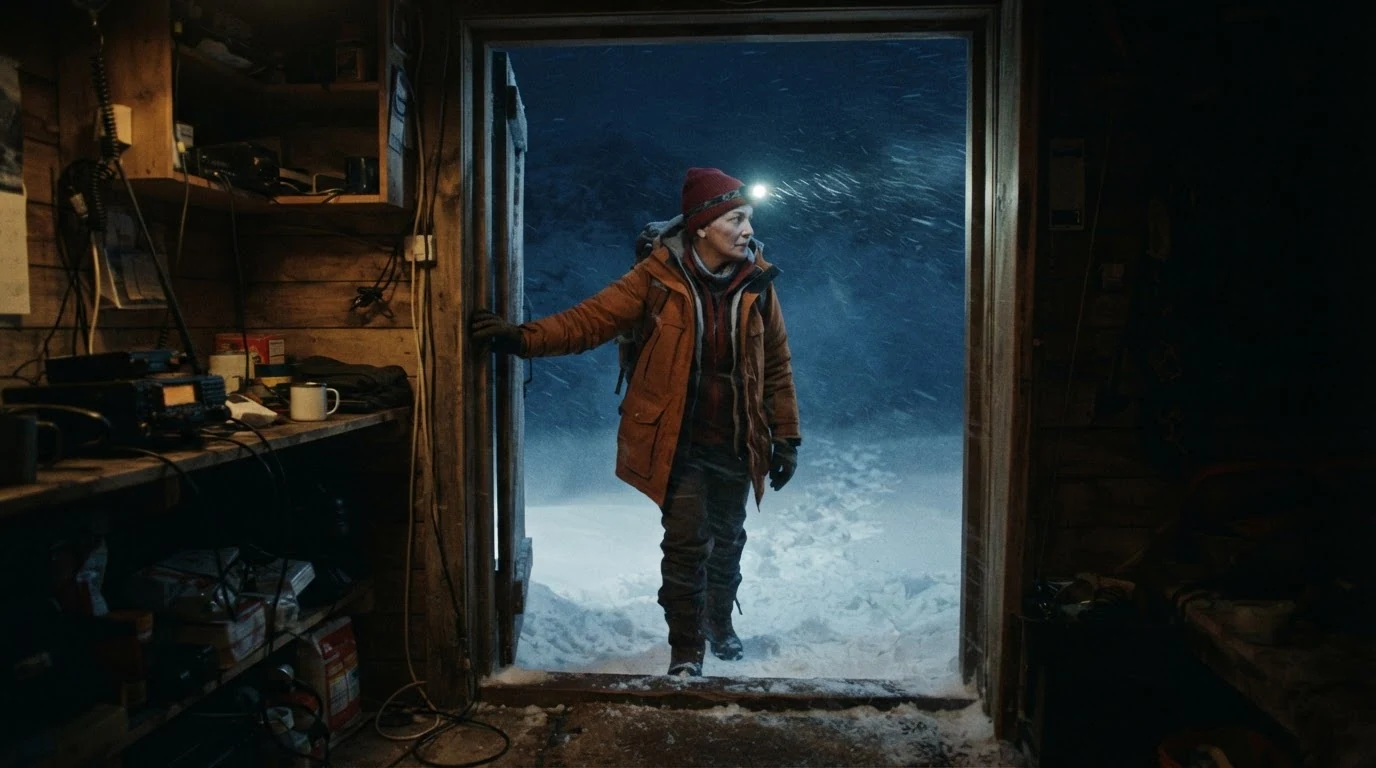
"Plot point one" and the threshold composition carry the idea: a character stepping out of the safe world into the act two world. The warm interior against the cold blue storm shows both worlds in one frame. "Back half to camera" and "hand still on the door frame" catch her in the moment of commitment. The specific features keep Noor fictional and consistent.
Open FlashBoardsA three-panel storyboard strip for a feature film, three equal panels side by side on white paper, loose graphite pencil with gray and pale blue marker wash, consistent style, a short hand-lettered caption in capitals under each panel. The same character in all three: Noor, a woman in her mid-fifties with cropped gray hair, a thin scar through her left eyebrow and an orange expedition parka. Panel 1 ACT I: medium shot, Noor alone at a cluttered radio desk in a wooden hut, headphones on, leaning toward the speaker. Panel 2 ACT II: wide shot in a blizzard, Noor kneeling beside a half-buried tent, helping a teenage boy with a splinted leg to his feet. Panel 3 ACT III: dawn on a snowy ridge, Noor and the boy standing together, a rescue helicopter small in the pale sky.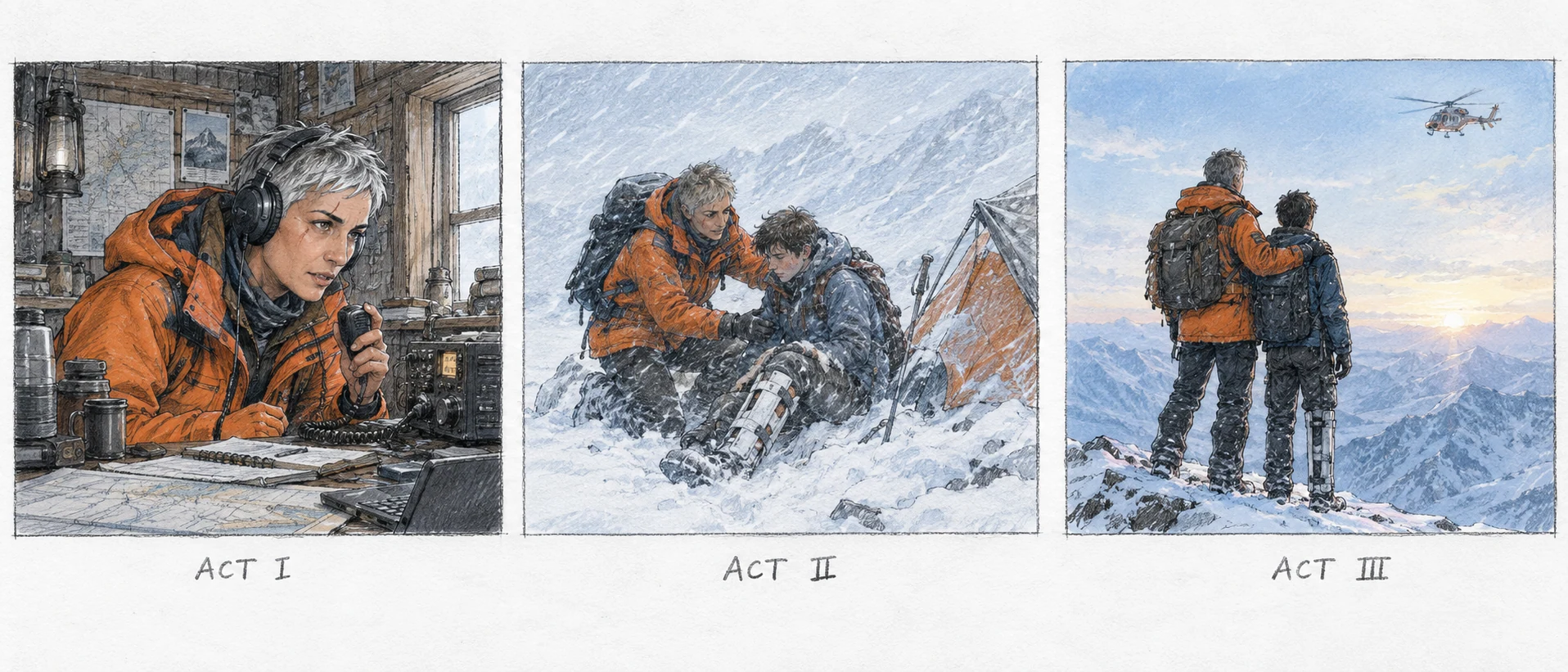
This take produces the planning artifact itself: the whole arc on one strip. The captions ACT I, ACT II and ACT III tie each panel to the structure, and the change from medium to wide to a dawn wide shows isolation, struggle and release. "Same character in all three" keeps Noor on model.
Open FlashBoardsCamera: static at chest height inside the hut, then a slow, steady push forward toward the doorway that stops at the threshold. Action: Snow is already blowing in through the open door and the headlamp beam is swinging in the wind. Noor tightens the hood of her orange parka, glances back over her shoulder toward the warm room for a moment, then lets go of the door frame and steps out into the blizzard. She walks away along the footprints until she is a small orange shape with a bright headlamp in the swirling blue white."Snow is already blowing in" makes the shot alive from the first frame. The glance back and the release of the door frame play out the act break: a last look at the safe world, then the commitment. The prompt only mentions things already in recipe 1's frame, so the model doesn't add a background of its own.
Open FlashBoardsCommon mistakes
- Keyframes that don't show a turn. A pretty frame of a person in snow isn't a plot point. Name the action at the moment of the turn: "stands on the threshold", "lets go of the door frame".
- Both worlds lost. Models often crop to the character alone. Say "from inside, looking out through the open doorway" so the old and new worlds share the frame.
- Character drift between acts. Copy one fixed description into every prompt, or keep recipe 1 on the board as the reference.
- Garbled panel captions. Keep labels to one or two words in capitals, or add them later as board notes.
- Frozen video. If the first second is static, H3 slowly pushes in on a still. Put motion ("snow already blowing in") in the first sentence.
Keep the reference frames, prompts and every generated take side by side — images and video in one canvas.
FAQ
5 questionsWhat are the three acts of a story?
Setup, confrontation and resolution. Act one introduces the protagonist, their world and the problem, and ends when they commit to it. Act two, roughly half the running time, piles up obstacles and turns at a midpoint. Act three brings the climax, where the central question is answered, followed by a short resolution showing the new normal.
How long is each act in a three-act screenplay?
A common rule is 25–50–25. In a 110-page script, act one runs about 25–30 pages, act two about 55–60, and act three about 20–30. These are guidelines, not laws. Many films have longer first acts or very short third acts. What matters is that each turn arrives before the audience gets ahead of the story.
What is the difference between the inciting incident and plot point one?
The inciting incident is the event that disrupts the protagonist's world, often around the 10% mark. Plot point one comes later, around the quarter mark, when the protagonist commits to dealing with that disruption and can't go back. In Star Wars (1977), the droids' message is the inciting incident. Luke choosing to leave with Obi-Wan is plot point one.
Is three-act structure the same as beginning, middle and end?
Almost, but more specific. Every story has a beginning, middle and end. Three-act structure adds proportions, roughly a quarter, a half and a quarter, and turning points that force the story from one act into the next. It also asks for rising pressure in the middle, so act two isn't just more of the same.
Can a short film use the three-act structure?
Yes, it just gets compressed. In a 10-minute short, act one may be one or two scenes ending around minute two or three, act two a few escalating beats, and act three a single decisive moment. Many shorts cut the setup to a single image and open close to the first turn, so every shot counts.
Related terms
6- Save the Cat Beat SheetScreenwriting
The Save the Cat beat sheet is Blake Snyder's 15-beat map of a feature, from Opening Image and Catalyst to Finale and Final Image, with page targets for each beat — a ready template for planning scenes and storyboards.
- Dan Harmon Story CircleStorytelling
Dan Harmon's story circle is an eight-step, simplified hero's journey — you, need, go, search, find, take, return, change — used to structure episodes and features.
- Inciting IncidentStorytelling
The inciting incident is the event that upsets the protagonist's normal life and sets the main conflict in motion — the moment the story truly begins.
- Plot PointStorytelling
A plot point is a turning event that spins the story in a new direction; in the three-act model, plot point one and two close the first and second acts.
- ClimaxStorytelling
The climax is the story's decisive peak: the protagonist faces the central conflict head-on and the main dramatic question is answered.
- Story StructureStorytelling
Story structure is the order and shape of the events that carry a story from setup to resolution; models like the three-act structure, Freytag's pyramid, the hero's journey or Save the Cat are different maps of it.
Further reading
Aristotle, Poetics. Syd Field, Screenplay: The Foundations of Screenwriting (1979). Robert McKee, Story: Substance, Structure, Style and the Principles of Screenwriting (1997).