 FlashBoards Learn
- Learn
- Storytelling
- Inciting Incident
Storytelling · Film language
Inciting Incident
Also called: catalyst, call to adventure
The inciting incident is the event that knocks the protagonist's ordinary life off balance and sets the main conflict in motion. It is the moment the story truly begins: before it, the audience watches a situation; after it, they watch a character who has a problem and has to do something about it.
- What it does
- Breaks the status quo and hands the protagonist the problem the rest of the film is about.
- Use it when
- Plotting act one: every feature needs one clear, visible disruption that the hero cannot ignore.
- Watch out
- Don't bury it in dialogue or push it so late that the audience waits half an act for the story to start.
- Try this prompt
Ordinary kitchen at dawn, a man pouring coffee freezes as headlights sweep the wall behind him, medium-wide shot, 35mm, tense stillness
What is an inciting incident?
An inciting incident is the first event that changes the protagonist's situation in a way they can't undo or ignore. It opens the central conflict of the film: a question the audience now wants answered. Will Luke get the stolen plans to the rebels? Will anyone stop the shark? Will Roger Thornhill prove he is not George Kaplan?
The term was popularized by Robert McKee in Story (1997), who describes it as the event that throws the forces in the protagonist's life out of balance and gives them a conscious or unconscious desire to restore that balance. The idea is older: Gustav Freytag's 1863 pyramid of dramatic structure already had an "exciting force" right after the introduction.
You will meet the same beat under other names:
- Catalyst — Blake Snyder's name for it in the Save the Cat beat sheet, where it sits around page 12 of a 110-page script.
- Call to adventure — the hero's journey version from Joseph Campbell and Christopher Vogler: a message, a threat or a stranger that summons the hero out of the ordinary world.
Whatever the label, three things define it. It happens to the protagonist or directly involves them. It changes their situation for the worse, or at least makes it unstable. And it creates a goal or a question that drives the next act of the three-act structure.
Inciting incident examples from famous films
The best way to learn the beat is to watch how different genres stage it. Each of these is a single event you could point to on a timeline.
- ***Jaws* (1975)** — A young woman swimming at night is dragged under and killed. The film opens with its inciting incident: the shark is in the water before we know anyone on Amity Island, and Chief Brody's problem arrives the next morning with the body on the beach.
- ***Star Wars* (1977)** — Luke, cleaning a newly bought droid, triggers a fragment of Princess Leia's recorded plea for help from Obi-Wan Kenobi. A farm boy's chore becomes a summons from a war he has only dreamed about.
- ***North by Northwest* (1959)** — In a hotel bar, Roger Thornhill raises his hand to call a bellboy at the very moment a man named George Kaplan is being paged. Two men take him for Kaplan and bundle him into a car. A tiny coincidence, played in a single gesture.
- ***Die Hard* (1988)** — John McClane arrives at his estranged wife's office Christmas party at Nakatomi Plaza, and armed men take over the building. The setup has already given him a personal problem, a marriage in trouble; the takeover gives him a physical one.
- ***Raiders of the Lost Ark* (1981)** — After the jungle-temple prologue, two Army intelligence officers come to Indiana Jones's college and ask about his old mentor Abner Ravenwood and a Nazi search for the Ark of the Covenant.
- ***Chinatown* (1974)** — A woman calling herself Mrs. Mulwray hires Jake Gittes to prove her husband is cheating. Then the real Evelyn Mulwray walks into his office. The inciting incident is a lie, and that lie is the first clue.
- ***Rear Window* (1954)** — Laid up with a broken leg, photographer Jeff watches the salesman across the courtyard leave his apartment again and again on a rainy night, carrying a sample case. Idle watching turns into suspicion.
- ***Glengarry Glen Ross* (1992)** — A hotshot from head office tells the real-estate salesmen about a new contest: first prize a Cadillac, second prize a set of steak knives, everyone else fired. One speech turns a bad week into a fight for survival.
- ***Saving Private Ryan* (1998)** — After the Omaha Beach landing, the War Department learns that three of four Ryan brothers have been killed in action, and General Marshall orders the fourth brought home. Captain Miller's squad gets its mission.
- ***Monsters, Inc. (2001)* — A closet door left on the scare floor after hours lets a human girl into Monstropolis, where children are believed to be toxic. Sulley's safe routine as the top scarer is over.
Notice the range: a death, a message, a mistaken identity, a job offer, a glimpse through a window. Scale doesn't matter. What matters is that the protagonist's life can't go back to how it was.
Where does the inciting incident go in a screenplay?
In a conventional feature the inciting incident lands in the first act, usually somewhere between pages 10 and 15, or about the first 10 to 15 percent of the running time. That gives the audience just enough exposition to know what "normal" looks like before it breaks. McKee's advice is to place it within roughly the first quarter of the story; the longer you wait, the longer the audience sits without a question to follow.
There are three common patterns:
- Early and on page one. Jaws opens with the attack. Thrillers, horror films and TV episodes with a cold open often lead with the disruption and fill in the ordinary world afterward. A film that starts in medias res may even place the incident before the first frame and reveal it later.
- After a setup. Die Hard and Star Wars spend real screen time on the world and the hero's flaw first, so the incident hits someone we already care about. This is the default for character-driven features.
- After a prologue. Raiders and Saving Private Ryan open with a big set piece that establishes tone and the hero's skills, then deliver the inciting incident. The prologue is not the incident; it is a promise of the kind of film you are watching.
A useful check: the inciting incident should come before plot point one, and everything between them is the protagonist reacting — resisting, testing, gathering information — until they commit. After that commitment, the rising action of act two begins.
How to write and stage an inciting incident
On the page, test your inciting incident with four questions:
- Is it one event? "His life slowly falls apart" is not an incident. "The bank calls in his loan on Friday" is.
- Does it hit the protagonist? If it happens to a side character, make sure it lands on the hero within the same scene.
- Does it create a want? After it, the hero should need something specific: to find the killer, get home, win the contest, save the kid.
- Could the story exist without it? If you can cut it and nothing changes, it's a complication, not the inciting incident.
On screen, the central inciting incident should be something the audience sees, not something a character reports afterward. Directors usually stage it in three beats, and it helps to board them that way:
- The normal world, one last time. A wider shot of routine: Luke at his chores, Thornhill dictating to his secretary, a kitchen at breakfast. Keep it calm and readable so the break registers.
- The intrusion. A clear visual event, often an insert or a change in the frame: a hologram flickering on, a hand raised at the wrong moment, headlights sweeping a wall, a letter on a doormat. Sound helps too: a phone ring, a scream, a knock.
- The reaction. A tighter shot of the protagonist absorbing it. This close-up is where the audience learns that the story has started, because the character's face tells them the event matters.
That triptych is easy to plan on a storyboard, and it is where FlashBoards fits naturally: pin reference frames of inciting moments from films you admire next to your act-one outline, generate the three panels for your own scene, and try alternatives side by side, such as the intrusion as an insert or as a background event, before you commit to a shot list.
Inciting incident vs. plot point one
The two are easy to confuse because both sit in act one and both turn the story. The difference is who acts.
- **The inciting incident happens to the protagonist.** It poses the question and disturbs the balance. The hero can still hesitate, refuse or hope it goes away.
- Plot point one is the protagonist's commitment. It closes act one: the hero crosses a threshold, often physically, and can no longer go back.
Star Wars shows the gap clearly. Leia's message is the inciting incident; Luke even tells Obi-Wan he can't get involved. Only after he finds his aunt and uncle killed does he choose to leave Tatooine — that's plot point one. In Die Hard the two nearly merge: the takeover forces McClane to act within minutes, which is part of why the film moves so fast.
The stretch between the two beats is the "refusal" or debate section in Snyder's and Vogler's models. Keep it short in thrillers and give it more room in dramas, where the hero's resistance is the point. The Dan Harmon story circle maps the same moves as "want" and "go", and the full sequence of turns is covered in story structure.
Common inciting incident mistakes
- Too late. Twenty pages of pleasant routine with no question in sight. Plant tension in the setup, or move the incident earlier and fill in the world afterward.
- Too small or too vague. A bad mood, a feeling of restlessness, a general sense that things must change. Make it an event with a date and a place.
- Told, not shown. A character explains over coffee that the factory is closing. Put the closing notice on the gate and the hero in front of it.
- Confused with backstory. The murder twenty years ago is backstory; the letter that reopens the case is the inciting incident.
- Two competing incidents. If the first act offers a heist offer and a terminal diagnosis, decide which one drives the central plot and let the other feed a subplot.
- Disconnected from the ending. The inciting incident raises the question the climax answers. If your climax resolves something else, one of them needs rewriting.
If you can't find your inciting incident, write your logline: the event after "when" in "When X happens, a Y must Z" is usually it. For more craft pieces like this, browse the storytelling hub.
How to create a inciting incident with AI
3 promptsAn inciting incident is a visual event, so it is worth previsualizing: the calm frame, the intrusion and the reaction. In FlashBoards you can generate the moment, keep it next to your act-one notes and reference frames, and compare different stagings side by side. The recipes below use a fictional scene: a retired baker whose quiet morning is broken by a car pulling up outside.
Cinematic film still, the moment an ordinary morning is interrupted. Medium-wide shot of a small, tidy kitchen at dawn: Tomas, a heavyset man in his sixties with a bald head, a thick white beard and a gray wool cardigan, stands at the counter pouring coffee from a dented steel pot into a blue mug. Behind him a window over the sink looks onto a wet, empty street; two white headlights glow at the far end of the street. Warm tungsten light from a single ceiling lamp inside, cold blue dawn outside. Camera at chest height, 35mm lens, deep focus so both the man and the headlights are sharp, quiet and tense, 35mm film grain.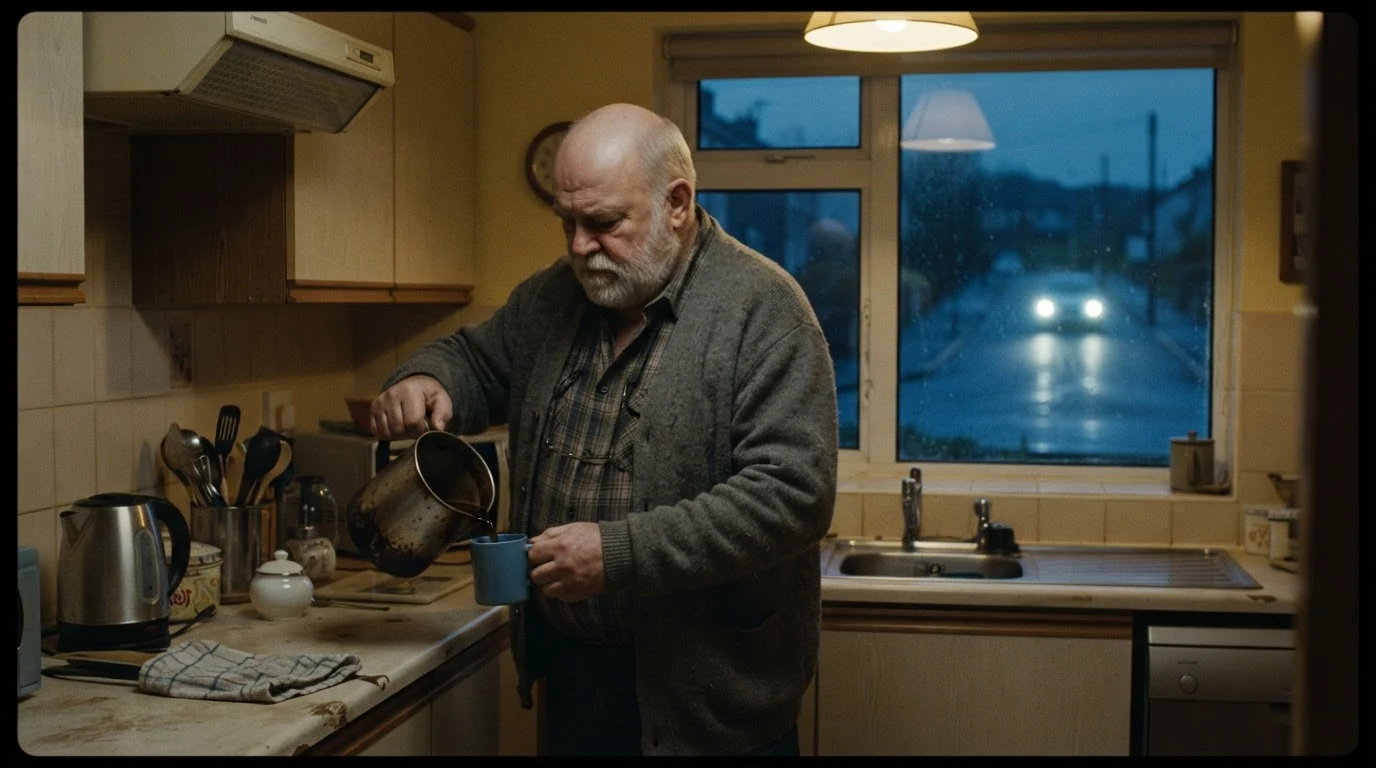
The shot holds the normal world and the intrusion in one frame: "pouring coffee" is the routine, "headlights at the far end of the street" is the disruption, and "deep focus" keeps both readable. The warm-inside, cold-outside contrast tells the viewer that something from outside is coming in. The specific features keep Tomas fictional and consistent across takes.
Open FlashBoardsStoryboard strip of an inciting incident: three panels side by side on white paper, loose graphite pencil with gray marker wash, consistent style, a short hand-lettered caption in capitals under each panel. The same character in every panel: Mira, a 17-year-old girl with a short black undercut, freckles across her nose and a green canvas work apron. Panel 1 NORMAL WORLD: wide shot of a cluttered bicycle repair shop, Mira truing a bicycle wheel on a stand. Panel 2 INTRUSION: insert close-up of a cream envelope with a red wax seal sliding under the shop door. Panel 3 REACTION: close-up of Mira holding the opened letter, eyes wide, lips parted.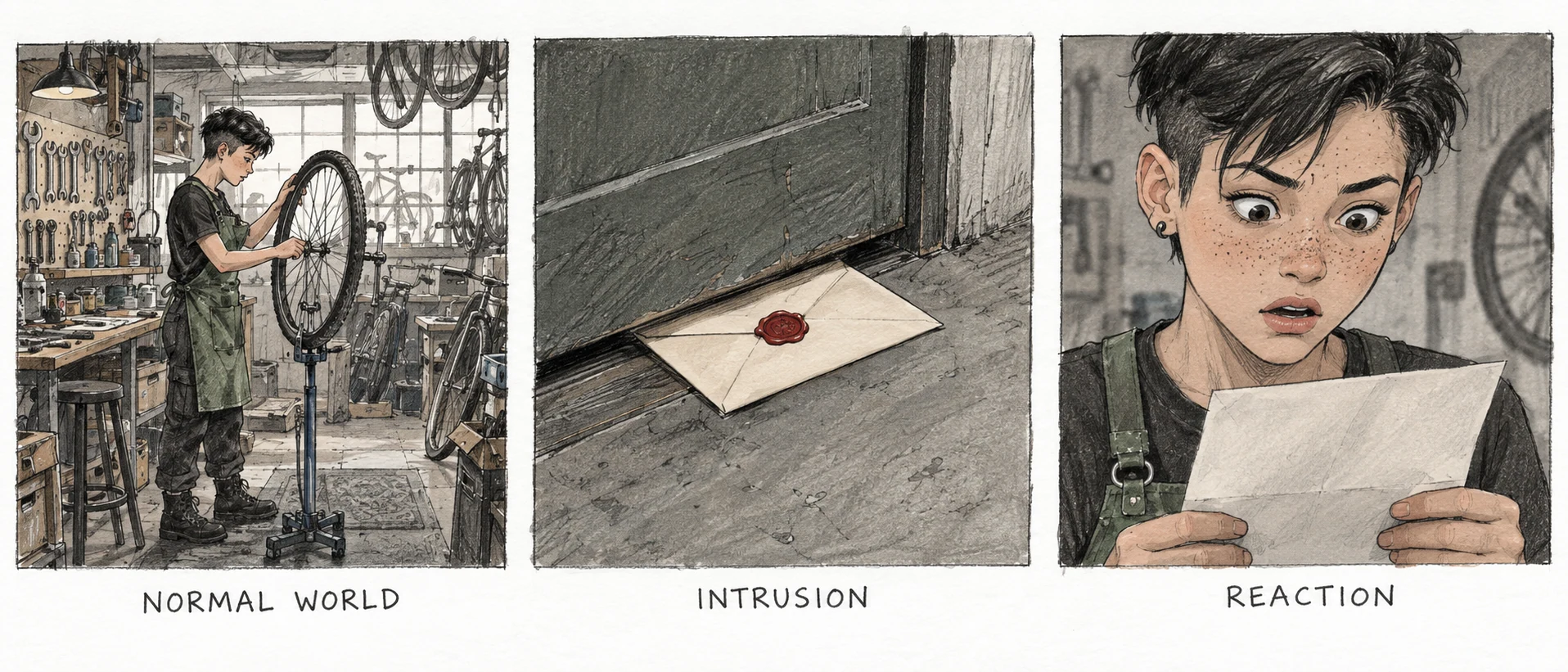
This take produces the planning artifact: the three-beat staging of an inciting incident as board panels. The capitalized captions tie each panel to its job, the shot sizes step from wide to insert to close-up so the strip reads as a sequence, and "same character in every panel" keeps Mira on model.
Open FlashBoardsCamera: slow push-in from the medium-wide framing toward Tomas at the counter, moving steadily for the whole shot and ending on a medium shot. Action: Coffee is already streaming from the steel pot into the blue mug. The headlights in the window grow brighter as the car rolls up the wet street and stops outside. White light sweeps across the kitchen wall and over Tomas's shoulder. He stops pouring, lowers the pot to the counter and slowly turns his head toward the window, holding still as the headlights stay on him.The pour starts in the first frame, so the shot is alive immediately. "Headlights grow brighter" and "light sweeps across the kitchen wall" stage the intrusion using only elements already in the frame, and the slow push-in tightens toward the reaction, the third beat of the incident.
Open FlashBoardsCommon mistakes
- Models tend to render the intrusion as decoration: headlights or an envelope appear but nobody reacts. Name the character's reaction in the prompt ("stops pouring", "eyes wide").
- A single image often splits focus. State "deep focus" or put the intrusion clearly in the foreground or background so both the routine and the disruption read.
- In video, if the prompt starts with calm routine only, the clip may drift without the event. Start the action in the first frame and bring the intrusion in early.
- For storyboard strips, list each panel's shot size; otherwise all panels come out as similar medium shots and the beat loses its rhythm.
Keep the reference frames, prompts and every generated take side by side — images and video in one canvas.
FAQ
5 questionsWhat is an inciting incident in simple terms?
It is the event that starts the real story. Before it, the main character lives a normal, balanced life; after it, they face a problem they can't ignore. In Jaws it is the first shark attack, in Star Wars it is Leia's hidden message. Everything that follows is the character trying to deal with that disruption, and the climax answers the question it raised.
What are some good inciting incident examples?
Classic film examples include the night shark attack in Jaws (1975), Roger Thornhill mistaken for George Kaplan in North by Northwest (1959), the building takeover in Die Hard (1988), the fake Mrs. Mulwray hiring Gittes in Chinatown (1974), and the sales contest announced in Glengarry Glen Ross (1992). Each is one clear event that changes the protagonist's situation for good.
Is the inciting incident the same as the catalyst?
Yes, in practice. "Catalyst" is Blake Snyder's name for the beat in the Save the Cat beat sheet, where he places it around page 12. "Call to adventure" is the hero's journey equivalent. The labels come from different teaching traditions, but all three describe the event that disrupts the hero's ordinary world and starts the central conflict.
What is the difference between an inciting incident and the first plot point?
The inciting incident happens to the protagonist and poses the story's question; the first plot point is the protagonist's decision or action that commits them to answering it and ends act one. In Star Wars, Leia's message is the inciting incident, while Luke leaving Tatooine after his family is killed is plot point one. Sometimes the two beats nearly merge, as in Die Hard.
When should the inciting incident happen?
In most features it arrives in the first act, around pages 10 to 15 of a 110-page script, or roughly the first 10 to 15 percent of the running time. Genre films often place it earlier, even in the opening scene, while character dramas may take longer to establish the normal world. Waiting past the first quarter usually makes the opening feel aimless.
Related terms
5- Plot PointStorytelling
A plot point is a turning event that spins the story in a new direction; in the three-act model, plot point one and two close the first and second acts.
- Three-Act StructureStorytelling
The three-act structure splits a story into setup, confrontation and resolution, turned by plot points at roughly the quarter and three-quarter marks — the default blueprint of feature screenwriting.
- Save the Cat Beat SheetScreenwriting
The Save the Cat beat sheet is Blake Snyder's 15-beat map of a feature, from Opening Image and Catalyst to Finale and Final Image, with page targets for each beat — a ready template for planning scenes and storyboards.
- Rising ActionStorytelling
Rising action is the chain of complications between the inciting incident and the climax, where obstacles pile up and stakes rise.
- ExpositionStorytelling
Exposition is the information the audience needs to follow the story — who the characters are, what's at stake, how the world works — ideally delivered through action and conflict rather than explanatory speeches.
Further reading
Robert McKee, Story: Substance, Structure, Style and the Principles of Screenwriting (1997). Blake Snyder, Save the Cat! (2005). Christopher Vogler, The Writer's Journey: Mythic Structure for Writers.