 FlashBoards Learn
- Learn
- Storytelling
- Dan Harmon Story Circle
Storytelling · Film language
Dan Harmon Story Circle
Also called: story circle, 8-step story circle
Dan Harmon's story circle is an eight-step loop (you, need, go, search, find, take, return, change) that boils the hero's journey down to a shape you can run once per episode or once per feature. A character leaves comfort to chase a want, pays for it and comes home different.
- What it does
- Turns any story into a loop of eight steps where the character crosses into the unknown, gets what they wanted, pays for it and comes back changed.
- Use it when
- You are breaking a TV episode, a short film or a subplot and need the character's change to be built into the plot.
- Watch out
- Skipping Take: if getting what they wanted costs nothing, the Return and Change steps feel unearned.
- Try this prompt
Wide shot, a 12-year-old girl folding laundry alone in a fluorescent laundromat at 2 a.m., comfort zone, 16:9.
What is the Dan Harmon story circle?
Dan Harmon, the creator of Community and co-creator of Rick and Morty, worked out the circle while writing screenplays and short pilots, and spread it through Channel 101, the monthly short-film screening he co-founded in Los Angeles. He wanted a version of Joseph Campbell's monomyth from The Hero with a Thousand Faces (1949) compact enough for a five-minute short.
The circle is cut by a horizontal line. Above it is the character's ordinary world; below it is the unknown. The character crosses down at step 3, hits bottom at step 5 and climbs back across at step 7. The point: a story is a trip out and back, and the character returns changed. It is one of several maps of story structure, and the one most tuned to the character arc.
What are the 8 steps of the story circle?
| # | Step | What happens | Position | |---|---|---|---| | 1 | You | A character in a zone of comfort | Top | | 2 | Need | They want something | Upper right | | 3 | Go | They enter an unfamiliar situation | Crossing down | | 4 | Search | They adapt and struggle | Lower right | | 5 | Find | They get what they wanted | Bottom | | 6 | Take | They pay a heavy price for it | Lower left | | 7 | Return | They go back to the familiar world | Crossing up | | 8 | Change | They have changed | Upper left |
The steps pair across the circle. You and Find are opposites: at home versus at the bottom of the unknown, holding the prize. Need mirrors Take, because the want has a cost. Go and Return are the two crossings. A weak Take usually means the Need was vague.
Story circle examples: Star Wars and an episode outline
Star Wars (1977) runs the full loop around Luke Skywalker:
- You: a farm boy on Tatooine.
- Need: he wants off the planet and into the fight.
- Go: after his aunt and uncle are killed, he leaves with Obi-Wan Kenobi.
- Search: Mos Eisley and the Death Star.
- Find: he rescues Princess Leia.
- Take: Obi-Wan dies.
- Return: the Rebel base.
- Change: in the trench run he switches off his targeting computer and trusts the Force.
The same loop fits one TV episode. A fictional one, Last Wash: Wren, 12, runs her father's laundromat on the night shift (You). A notice says the building is being sold, and she wants to save it (Need). She takes the last bus to the landlord's tower (Go), bluffs past security (Search) and wins a two-month delay (Find), then learns her father asked for the sale because he is worn out (Take). At dawn she is back at the laundromat (Return), folding the last load with him and letting the place go (Change).
How to use the story circle to plan an episode
Start from the Take. Know what the win costs before you outline.
Nest circles. In TV, give the A story, the B story and even a runner their own loops. When they share a Find or a Return, the subplots collide in the climax.
Let Go be a choice. Step 3 lines up with the end of act one. An inciting incident can push the character, but the crossing lands harder when they choose it.
Make it visual. On a FlashBoards board, lay the eight steps out as a literal ring and pin a reference frame and a generated keyframe under each. With You and Change side by side at the top, you see whether the ending shows the change. Then turn each step into a storyboard sequence.
Story circle vs. three-act structure and Save the Cat
All three describe the same journey at different resolutions. In three-act structure, You and Need are act one, Go is the first turning point, Search, Find and Take fill act two with Find near the midpoint, and Return and Change make act three. The Save the Cat beat sheet cuts the same span into 15 beats with page targets.
| | Story circle | Three acts | Save the Cat | |---|---|---|---| | Units | 8 steps | 3 acts | 15 beats | | Page targets | None | Rough quarters | Specific pages | | Best for | Episodes, shorts | Any length | Features |
Against Campbell's hero's journey, the circle drops the mythic furniture (mentors, threshold guardians) and keeps the motion. The unknown can be a new job or a family dinner. More maps: storytelling.
How to create a dan harmon story circle with AI
3 promptsThe circle is a plan, but You and Change are pictures, and the whole loop can be storyboarded before a scene is written. These recipes use the fictional Last Wash outline; keep them on one FlashBoards board next to the step notes.
Step 1 of a story, the comfort zone. Wide shot of a small laundromat at 2 a.m.: Wren, a 12-year-old girl with short curly copper hair, round tortoiseshell glasses and an oversized moss-green hoodie, stands alone at a folding counter folding a white shirt. Behind her a row of dryers with glowing round glass doors, clothes tumbling inside. Flat fluorescent light, pale green tiles. Eye level, 28mm lens, deep focus, calm and settled, muted teal palette, fine film grain.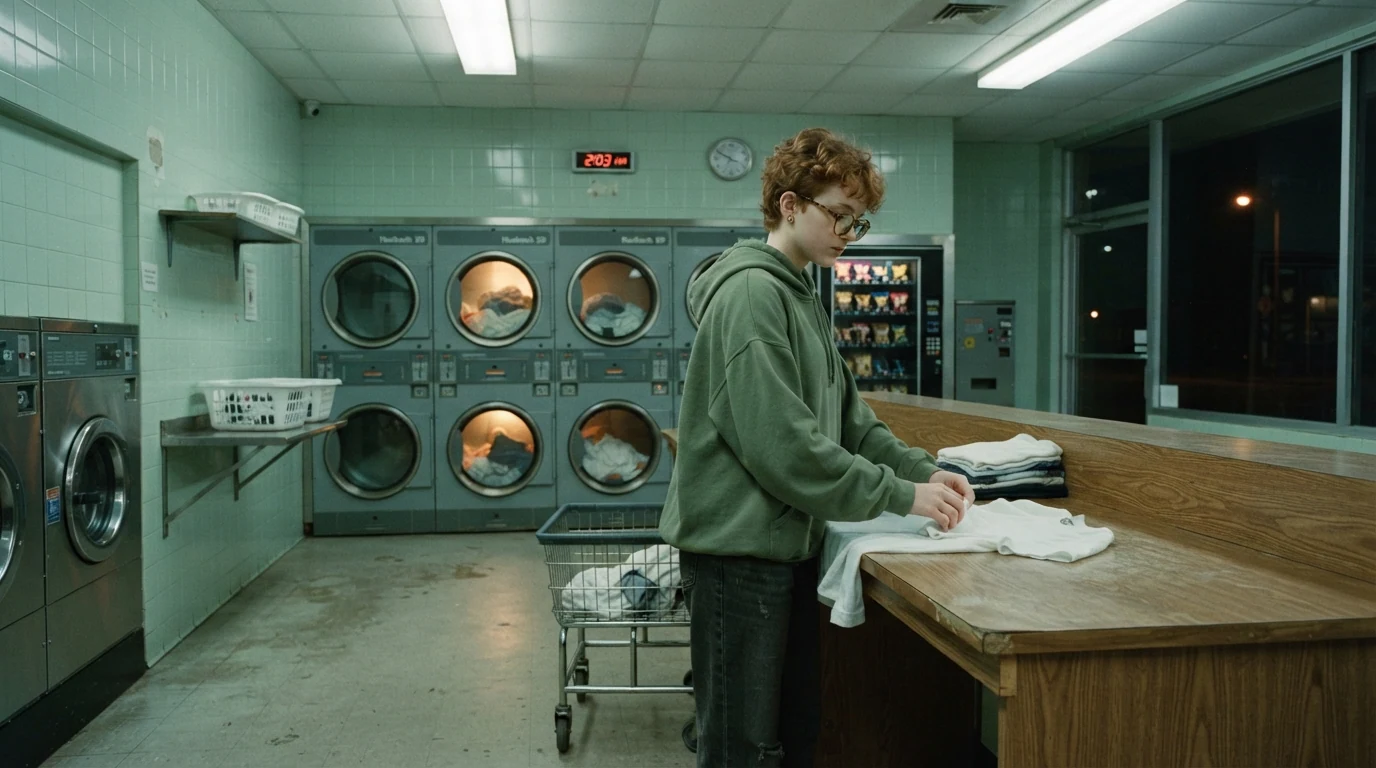
"Comfort zone", "alone" and the routine folding put step 1 on screen. The tumbling dryers give recipe 3 motion to start from, and Wren's specific features keep her fictional and consistent.
Open FlashBoardsStory circle storyboard sheet: eight panels in two rows of four, graphite pencil with gray marker wash, one style. The same girl in every panel: 12, short curly hair, round glasses, oversized hoodie. A one-word capital caption under each panel. YOU: wide, she folds laundry alone at night. NEED: close-up, she reads a notice on a glass door. GO: she boards an empty night bus. SEARCH: low angle, a long corridor. FIND: she faces a man in a suit across a desk. TAKE: close-up, tears. RETURN: wide, laundromat at dawn. CHANGE: she and her father fold a sheet together.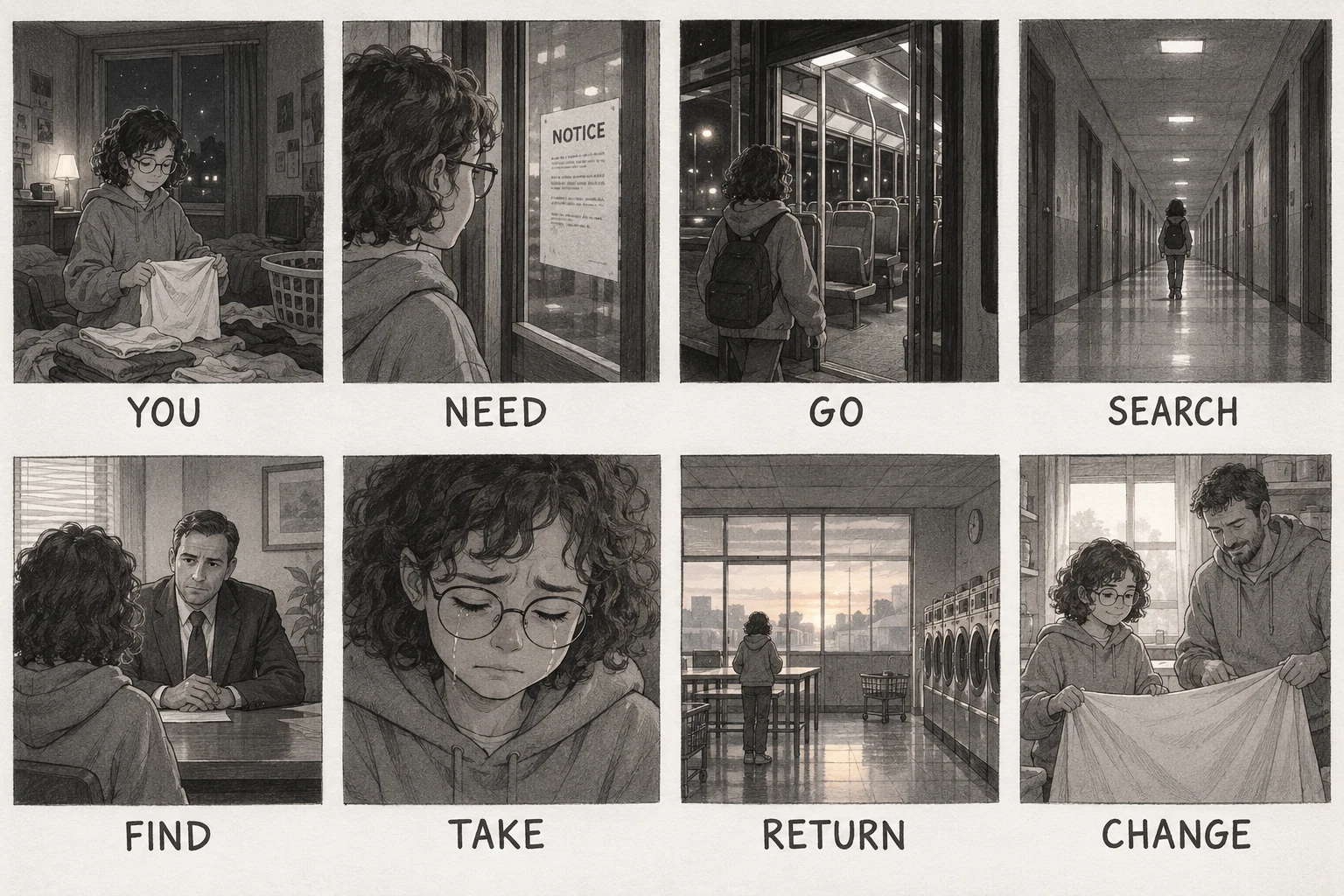
This take produces the planning artifact itself. One-word step names tie panels to the circle, varied shot sizes make it read as a sequence, and YOU and CHANGE repeat the folding so the change shows.
Open FlashBoardsCamera: static wide shot with a very slow push toward Wren. Action: The dryers are already spinning, clothes tumbling behind the glowing doors. Wren shakes out the white shirt, folds it in three quick moves and lays it on a stack. She reaches for the next shirt, then stops and looks up toward the front window while the dryers keep turning."Already spinning" makes the shot alive from the first frame. The glance up is the hinge into Need, and nothing appears that isn't in recipe 1's frame.
Open FlashBoardsCommon mistakes
- Comfort reads as bleak. Night and fluorescent light feel lonely; add "calm and settled".
- Character drift. Repeat the same short description, or keep recipe 1 on the board as reference.
- Garbled captions. One word per panel, in capitals.
Keep the reference frames, prompts and every generated take side by side — images and video in one canvas.
FAQ
4 questionsWhat are the 8 steps of Dan Harmon's story circle?
You, Need, Go, Search, Find, Take, Return, Change. A character in a zone of comfort wants something, enters an unfamiliar situation, adapts, gets what they wanted, pays a heavy price, returns to the familiar world and comes back changed. The top half of the circle is the ordinary world; the bottom half is the unknown.
Is the story circle the same as the hero's journey?
It's a simplified version. Harmon built the circle from Joseph Campbell's monomyth and kept the core movement (leave home, win something, pay for it, return changed) while dropping Campbell's many named stages. That makes it easy to apply to comedy and TV.
What is a good story circle example?
Star Wars (1977): Luke is a farm boy (You) who wants adventure (Need), leaves Tatooine (Go), learns a new world (Search), rescues Leia (Find), loses Obi-Wan (Take), reaches the Rebel base (Return) and trusts the Force in the trench run (Change).
Why do TV writers use the story circle?
Because it loops. An episode can run a full circle and end near where it started, so characters are back in place next week. Writers draw separate circles for the A, B and C stories so each has a want and a cost, then line up the Find and Return steps so the storylines meet.
Related terms
4- Save the Cat Beat SheetScreenwriting
The Save the Cat beat sheet is Blake Snyder's 15-beat map of a feature, from Opening Image and Catalyst to Finale and Final Image, with page targets for each beat — a ready template for planning scenes and storyboards.
- Three-Act StructureStorytelling
The three-act structure splits a story into setup, confrontation and resolution, turned by plot points at roughly the quarter and three-quarter marks — the default blueprint of feature screenwriting.
- Story StructureStorytelling
Story structure is the order and shape of the events that carry a story from setup to resolution; models like the three-act structure, Freytag's pyramid, the hero's journey or Save the Cat are different maps of it.
- Character ArcStorytelling
A character arc is the inner change a character goes through over the story — from a flaw or false belief to a new understanding (or a fall) — driven by the choices the plot forces on them.
Further reading
Joseph Campbell, The Hero with a Thousand Faces (1949). Dan Harmon's story structure essays, originally posted on the Channel 101 wiki. Christopher Vogler, The Writer's Journey (3rd ed., 2007).