 FlashBoards Learn
- Learn
- Storytelling
- Rising Action
Storytelling · Film language
Rising Action
Also called: complications
Rising action is the chain of complications between the inciting incident and the climax. Each obstacle makes the protagonist's goal harder to reach, raises the stakes and closes off easy exits, so tension climbs scene by scene. In a feature film it is the longest stretch of the story, most of act two.
- What it does
- Turns one problem into a mounting chain of problems, so the audience's tension grows toward the climax.
- Use it when
- Planning the middle of a script: every scene between the inciting incident and the climax should make things worse or more costly.
- Watch out
- Repeating the same kind of obstacle at the same level; if nothing escalates, the middle sags.
- Try this prompt
A mechanic with a red braid kneels at a stalled pickup on a desert road at dusk, dust storm rolling in behind, headlights approaching, wide shot, 35mm film still.
What is rising action?
Rising action is everything between the moment the conflict starts and the moment it peaks. The inciting incident gives the protagonist a problem; the rising action makes that problem bigger, more personal and more expensive to solve, until the climax forces a final confrontation.
The term comes from Gustav Freytag's pyramid for five-act plays: exposition, rising action, climax, falling action, catastrophe. Screenwriters map it onto the three-act structure: the rising action starts around the first plot point (about 25% into the film), runs through the midpoint and builds until the climax near the 85–90% mark. It is the engine room of the whole story structure. Its building blocks are complications: obstacles, reversals and bad decisions.
How does rising action build tension?
Rising action is not a list of events; it is escalation. Each complication should change the situation, not just delay it:
- Raise the stakes. What the hero can lose grows: first money, then safety, then someone they love.
- Try, fail, adjust. An attempt fails or backfires, and the next one costs more.
- Close the exits. Options disappear until the only way out is through the climax.
- Tighten the clock. A deadline, a pursuer getting closer, a storm arriving.
- Turn the midpoint. A reversal or revelation mid-film changes what the hero is fighting for.
- Braid in subplots. A subplot adds pressure from a second direction.
The test for any mid-script scene: does the protagonist leave it worse off, or more committed, than they entered? If not, it is marking time.
Rising action examples in film
Parasite (2019) builds its rising action as a con that works too well. One by one the Kims take over the jobs of tutor, art therapist, driver and housekeeper in a rich household. Each success raises the cost of exposure, and the night the old housekeeper returns in the rain turns the con into a trap.
Get Out (2017) stacks small wrongnesses into dread: the housekeeper's stare, the groundskeeper sprinting at night, the teacup hypnosis. Andre's warning and the photos in the closet end any chance it's all in his head.
No Country for Old Men (2007) runs on one bad decision. Moss takes the money, then goes back at night with water for a dying man, and the pursuit only tightens: a tracking device in the case, a relentless hitman, a second hunter hired to find both.
The Lord of the Rings: The Fellowship of the Ring (2001) escalates by geography and loss: Frodo is stabbed on Weathertop, and Gandalf falls in Moria.
Good Will Hunting (1997) shows that rising action can be internal: therapy, a relationship Will pushes away and job offers he sabotages all tighten one question, whether he will let anyone in.
How to write and stage rising action
On the page, outline the middle as a ladder: list each complication and check that every rung is higher than the last in stakes, cost or urgency. If two rungs are the same height, merge or cut one. Vary scene lengths too: pacing makes escalation feel like pressure, not repetition.
On set and in the edit, the camera can carry the escalation:
- Shrink the frame. Open compositions early; tighter framing as options close.
- Shorten the shots. Save the fastest cutting for the approach to the climax.
- Show the clock. Keep the deadline or the pursuer visible in frame.
In FlashBoards, lay the rising action out left to right on one board: one column per complication, with the key frame, reference stills and a note on what the hero loses there. Flat stretches show up before you shoot.
Rising action vs. falling action
They sit on opposite sides of the climax. Rising action adds problems and tension; falling action plays out the consequences once the central question is answered. A quick check: a scene that creates a new problem belongs before the climax; one that resolves or shows the cost of one belongs after. More on shaping tension in the storytelling hub.
How to create a rising action with AI
4 promptsA single frame can hold rising action: a character mid-task while complications close in. The recipes make that frame, a storyboard strip of four escalating beats, and a clip where problems stack in real time. In FlashBoards, keep them in order on one board. The fourth prompt re-shoots a real film shot from a text description alone, and the original plays next to the result so you can compare.
Empty desert road at dusk. A woman in her late twenties with a long red braid, a sunburned face and grease-stained blue coveralls kneels beside a stalled white pickup, hood open, wrench in hand, glancing back over her shoulder. Behind her a brown dust storm fills the horizon, and two headlights approach far down the road. Wide shot, 35mm lens, waist height, low orange sun, long shadows. Cinematic film still, film grain.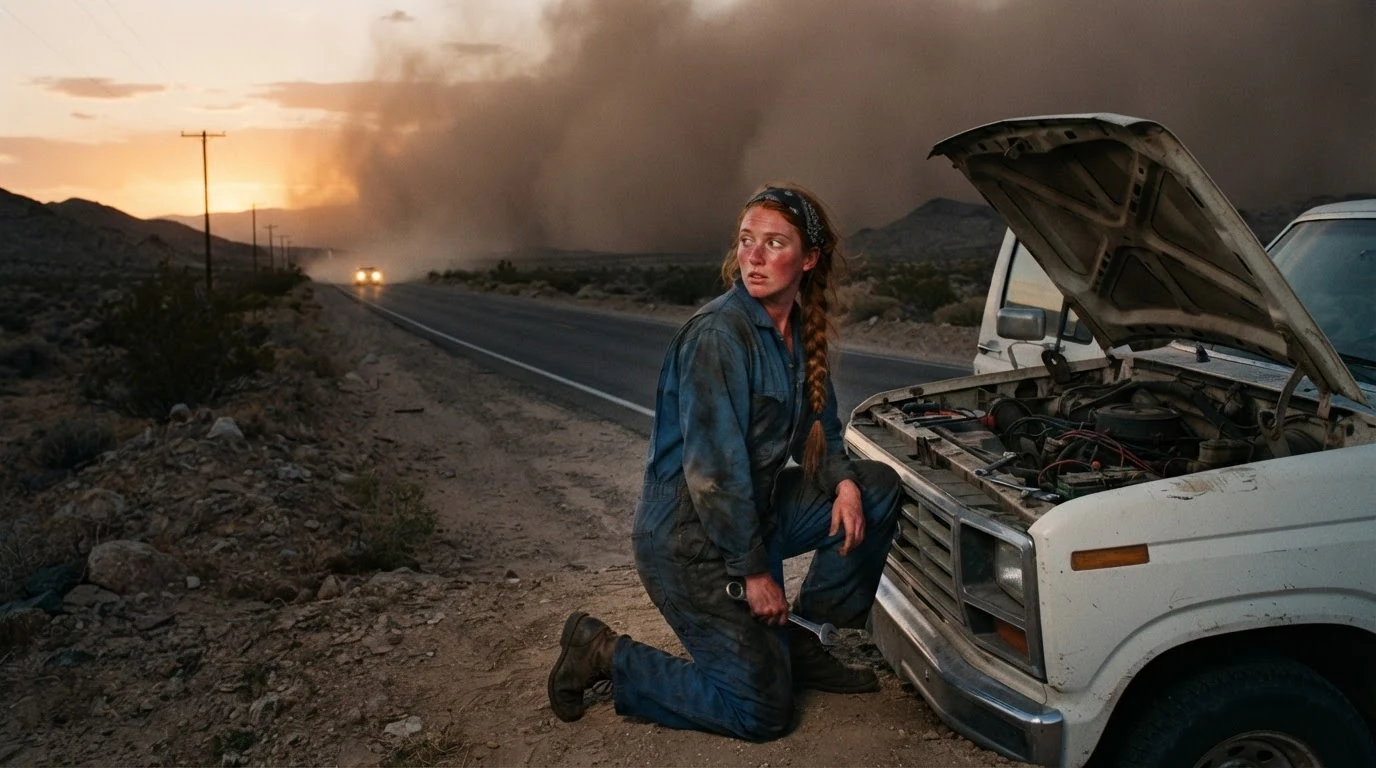
Three complications share one frame: the dead truck, the storm and the distant headlights. "Glancing back over her shoulder" shows she knows time is running out. This frame starts the video.
Open FlashBoardsStoryboard sheet, four panels in a row, loose pencil and grey marker, panels numbered 1 to 4. Same character in every panel: a lanky boy of about twelve with a shaved head, big ears and a yellow raincoat. Panel 1: he spots a small white dog in a rainy alley, wide shot. Panel 2: the dog runs into a concrete storm drain and he follows, medium shot. Panel 3: water up to his knees inside the drain, the dog on a ledge ahead, medium close-up. Panel 4: his flashlight flickers, water at his chest, close-up.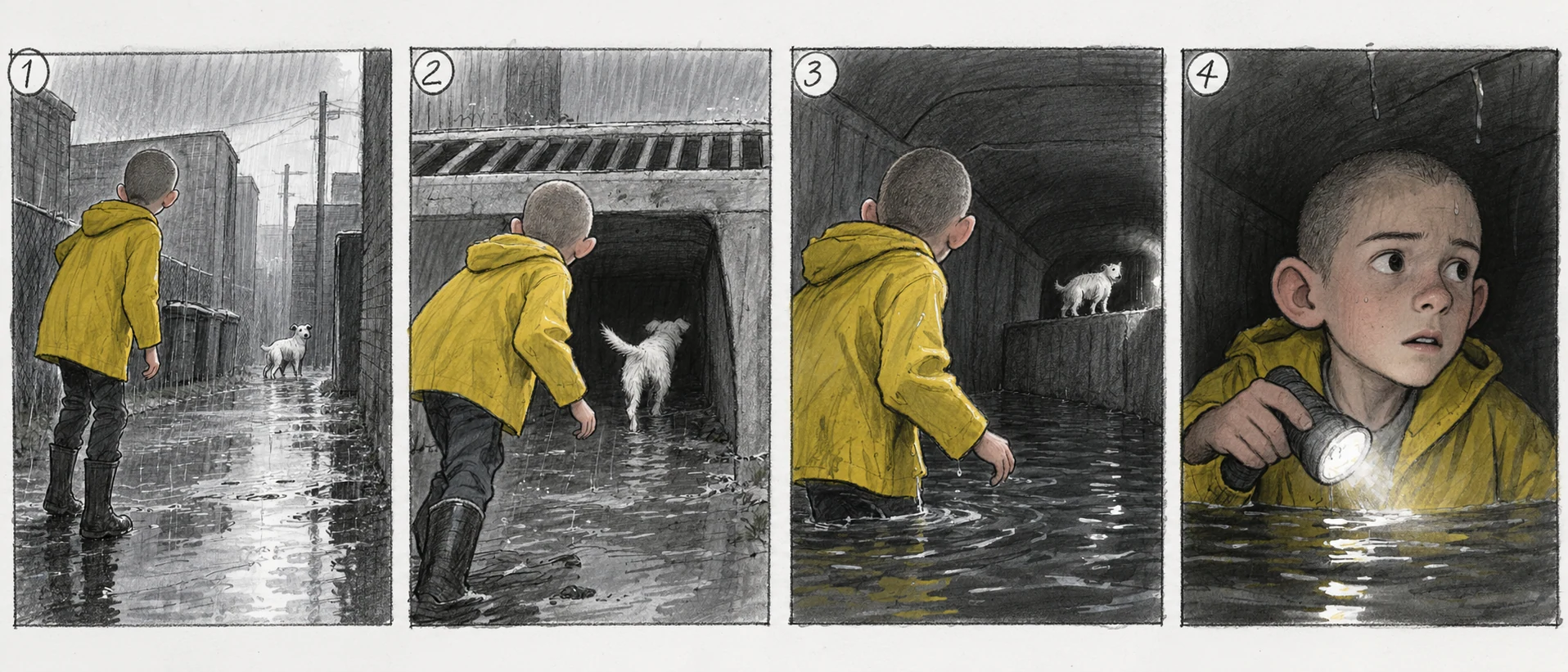
Each panel raises the stakes (water, darkness) and tightens the shot size, so escalation reads in story and framing. "Same character in every panel" keeps him consistent.
Open FlashBoardsCamera: slow, steady push in toward the woman at the pickup, ending in a medium shot with the storm and headlights behind her. Action: from the first frame wind whips dust across the road and her braid blows sideways. She works the wrench hard, then climbs into the cab and turns the key; the truck shudders and does not start. The dust wall rolls closer and the headlights grow brighter behind her.Wind moves from the first frame, so the shot is alive at once. A try-and-fail beat while two threats get closer: the act's escalation inside one shot.
Open FlashBoards{
"output": "Full-screen live-action single continuous shot from its very first frame, one unbroken take with no cuts, a scene from The Lord of the Rings: The Fellowship of the Ring (2001). Anamorphic 35mm film look in a very wide 2.39:1 frame, dusk just after sunset: everything on the ground is a pure black silhouette against a bright evening sky of pale blue with big soft clouds lit pink, lilac and gold at their edges; open rolling farmland with a low wooden rail fence along the horizon and a few round, bushy trees.",
"characters": {
"S1": {
"name": "Gandalf, played by Ian McKellen",
"look": "a tall old wizard seen only as a black silhouette in profile: tall pointed hat with a wide brim, long robe falling to the ground, walking with a long, slow stride",
"voice": "deep, warm, brisk old man's voice"
},
"S2": {
"name": "Frodo Baggins, a hobbit",
"look": "a small figure, barely as tall as the horse's chest, curly head, short jacket, seen only as a black silhouette",
"voice": "silent in this shot"
},
"S3": {
"name": "Samwise Gamgee, a hobbit",
"look": "a small stocky figure bent forward under a huge overstuffed backpack with a rolled blanket on top, seen only as a black silhouette",
"voice": "silent in this shot"
}
},
"shots": [
{
"shot": 1,
"camera": "wide shot from a low angle, the horizon in the lower fifth of the frame so the sky fills most of it; the camera trucks left at walking pace, following the group sideways, so the fence posts and trees slide from left to right across the frame; the group drifts slowly from the centre toward the left third; deep focus, the shot size stays the same from start to end",
"action": [
"BEGINNING: alive from the first frame, S1 stands just left of centre in profile, facing screen left, one hand holding the reins close to the muzzle of a saddled horse that stands just to the right of him in the frame, also facing left, a long pole strapped at an angle across its saddle; the horse is already taking its first step.",
"THEN: S1 walks left at an easy pace, leading the horse; S2 comes into view between S1 and the horse's front legs and walks along at the horse's shoulder, head slightly bowed.",
"THEN: the three keep walking left as one tight group, S1 tipping his hat toward the horse's head; S1 calls back over his shoulder while walking, without stopping or turning around.",
"THEN: S3 appears at the right edge of the frame, far behind the group, bent forward under his huge pack, and hurries after them with short quick steps.",
"END: S1, S2 and the horse have reached the left third, still walking left; S3 trots along in the right third, still well behind them, keeping pace but not closing the gap."
],
"dialogue": [
{
"speaker": "S1",
"on_screen": true,
"when": "once S2 is walking at the horse's shoulder; the line ends just as S3 appears at the right edge",
"delivery": "brisk, kindly, a little impatient, called back over his shoulder",
"line": "<d>[English] Come along, Samwise. Keep up.</d>"
}
]
}
],
"sound": {
"ambience": "a quiet summer evening in the countryside: slow hoofbeats on a soft dirt path, the creak of saddle leather, footsteps in dry grass, crickets, a light breeze; once S3 appears, the quick thud of his running feet and the jangle of his heavy pack",
"speech": "exactly these spoken phrases, each said once, in this order",
"never_spoken": "no narration and no voice-over: the descriptions, performance notes and step words of this prompt are never spoken aloud; the two hobbits stay silent",
"music": "a film score under the scene, always below the voices: a gentle pastoral theme on soft strings and a low woodwind at walking pace, warm but beginning to move forward",
"subtitles": "none"
}
}Remakes the dusk silhouette shot from The Lord of the Rings: The Fellowship of the Ring (2001) where Gandalf leads Frodo out of the Shire, keeping the leftward tracking move, Sam's late entrance under his pack and Gandalf's exact line.
Rising action begins when the hero leaves the safe world. In one leftward tracking shot Gandalf leads Frodo out of the Shire and Sam hurries after them, still behind: the journey is under way and the pace is set. The JSON gives the silhouettes, the camera move, each character's beat and Gandalf's exact line separate slots.
Open FlashBoardsCommon mistakes
- Models calm the scene and drop the threats. Place each complication in the frame ("behind her," "far down the road").
- Storyboard panels drift into different characters. Fix the character's features once.
- In video, the attempt succeeds by default. Say it fails and what gets closer.
Keep the reference frames, prompts and every generated take side by side — images and video in one canvas.
FAQ
5 questionsWhat is rising action in a story?
Rising action is the series of complications between the inciting incident and the climax. Obstacles pile up, stakes grow and the protagonist's options narrow, so tension keeps building. In a feature film it covers most of the second act, from the first plot point to the final confrontation.
What are some examples of rising action?
In Parasite, the Kim family's con succeeds step by step until the old housekeeper returns and it turns into a trap. In Get Out, small oddities at the Armitage house escalate into proof that Chris is in danger. In No Country for Old Men, a hidden tracker keeps a hitman on Moss's trail.
What is the difference between rising action and complications?
Complications are the individual obstacles, reversals and setbacks; rising action is the stretch of story they form together. A good rising action orders its complications by escalation, so each one costs the protagonist more than the last and pushes toward the climax.
How long should the rising action be?
In most feature screenplays it is the longest part of the story, roughly half the running time: from about the 25% mark to the climax near 85–90%. Short films compress it into a few beats, but every scene must still raise the pressure.
Is the midpoint part of the rising action?
Yes. The midpoint sits in the middle of the rising action and usually turns it, through a reversal, a revelation or a false victory. Afterward the stakes are higher and the protagonist more committed, so the second half escalates faster.
Related terms
5- Falling ActionStorytelling
Falling action is the stretch right after the climax where the consequences play out and tension winds down toward the resolution.
- Inciting IncidentStorytelling
The inciting incident is the event that upsets the protagonist's normal life and sets the main conflict in motion — the moment the story truly begins.
- ClimaxStorytelling
The climax is the story's decisive peak: the protagonist faces the central conflict head-on and the main dramatic question is answered.
- Three-Act StructureStorytelling
The three-act structure splits a story into setup, confrontation and resolution, turned by plot points at roughly the quarter and three-quarter marks — the default blueprint of feature screenwriting.
- Story StructureStorytelling
Story structure is the order and shape of the events that carry a story from setup to resolution; models like the three-act structure, Freytag's pyramid, the hero's journey or Save the Cat are different maps of it.
Further reading
Gustav Freytag, Technique of the Drama (1863). Syd Field, Screenplay: The Foundations of Screenwriting (1979), on act two as confrontation.