 FlashBoards Learn
- Learn
- Storytelling
- Subplot
Storytelling · Film language
Subplot
Also called: B-story, secondary plot, B plot
A subplot is a secondary storyline that runs alongside the main plot, usually a relationship or a side character's goal, and comments on the film's theme from another angle. It gives the audience relief from the main conflict and raises its stakes. A strong subplot eventually collides with the main plot.
- What it does
- Adds a second line of want and conflict that mirrors or tests the main plot's theme.
- Use it when
- The main plot needs breathing room, a relationship to show who the hero really is, or a second strand to cut against.
- Watch out
- A subplot that never touches the main plot or its theme reads as padding and is the first thing cut in the edit.
- Try this prompt
Dusk in an empty parking lot, a young firefighter with copper hair teaches her teenage brother to drive, wildfire haze on the horizon, 35mm film still.
What is a subplot?
In story structure, the main plot (the A-story) is the protagonist's central goal: catch the killer, win the case, get into college. A subplot is any other storyline with its own beginning, middle and end that shares screen time with it. Screenwriters also call it the B-story or B plot. A very small thread that surfaces three or four times is often called a runner or C-story.
What separates a subplot from a stray scene is shape: a want, an obstacle and a resolution, even across six scenes. In good storytelling, a subplot is a second argument about the same theme, told through different people.
Subplot examples in film
The Dark Knight (2008). The main plot is Batman against the Joker. Harvey Dent's fall from crusading district attorney to Two-Face runs beside it and carries the film's real question: can a good man be corrupted?
Good Will Hunting (1997). The spine is Will's therapy with Sean. His romance with Skylar is the B-story and tests the same fear: Will pushes her away while Sean pushes him to let people in.
Lady Bird (2017). Around the mother-daughter conflict, Christine's friendship with Julie, her two boyfriends and the school play form a cluster of subplots, each a version of her trying on an identity.
Hidden Figures (2016) braids three lines: Katherine at the Space Task Group, Dorothy teaching her team to program the new IBM, and Mary petitioning a court to attend engineering classes.
Superbad (2007) sends Fogell off with two police officers for most of the night, a comic counter-rhythm to the main duo's party quest.
What does a subplot do for a story?
- Carries the theme. The main plot is often too busy with action to say what the film is about. The subplot, usually a relationship, shows it in quieter scenes.
- Controls pacing. Cutting from a tense chase to a slower B-story scene resets attention, so the next A-story beat hits harder.
- Reveals the protagonist. A love interest, mentor or sibling draws out sides of the hero the main conflict never would; it is often where the character arc happens.
- Creates convergence. The best subplots crash into the main plot near the climax, forcing a choice neither strand could produce alone.
In the edit, cross-cutting between strands lets each comment on the other.
How to write a subplot
- Start from the theme. Build a subplot that answers the main plot's question differently: a character who makes the opposite choice, or the hero's choice in a smaller arena.
- Give it its own spine. A specific want, an obstacle, a clear change.
- Place its beats. In the Save the Cat beat sheet, the B-story arrives around the start of Act Two. Intro, complication, crisis and payoff are usually enough.
- Tie it back. If you can remove the subplot without changing the climax, it is not doing its job.
- Budget screen time. Past two or three real subplots, you are drifting into an ensemble film.
In FlashBoards you can lay the A-story and B-story out as two rows of storyboard frames and notes and see where the strands alternate and meet.
Subplot vs. main plot vs. parallel plots
The main plot drives the film: its question is the one answered at the climax. A subplot gets less screen time and serves the main plot by mirroring, complicating or paying it off.
Parallel plots are storylines of roughly equal weight, as in ensemble films. Traffic (2000) intercuts three drug-war stories and gives each a distinct color treatment.
On TV, an episode often runs an A-plot, a B-plot and a C-runner.
How to create a subplot with AI
3 promptsAI can't generate "a subplot" as such. It can generate the B-story scene that must feel different from the main action, and the storyboard that shows how the strands alternate. Keep A-story and B-story frames in separate rows on one FlashBoards board to check tone and rhythm.
Film still, medium two-shot through the open driver window of an old green sedan in an empty supermarket lot at dusk. A fictional young woman firefighter, early twenties, freckles, short copper hair tied back, soot on her navy T-shirt, laughs in the passenger seat, one hand braced on the dashboard. Her lanky teenage brother with curly black hair and braces grips the wheel, jaw tense. Orange wildfire haze glows on the horizon. 35mm lens at eye level, warm intimate mood, soft film grain.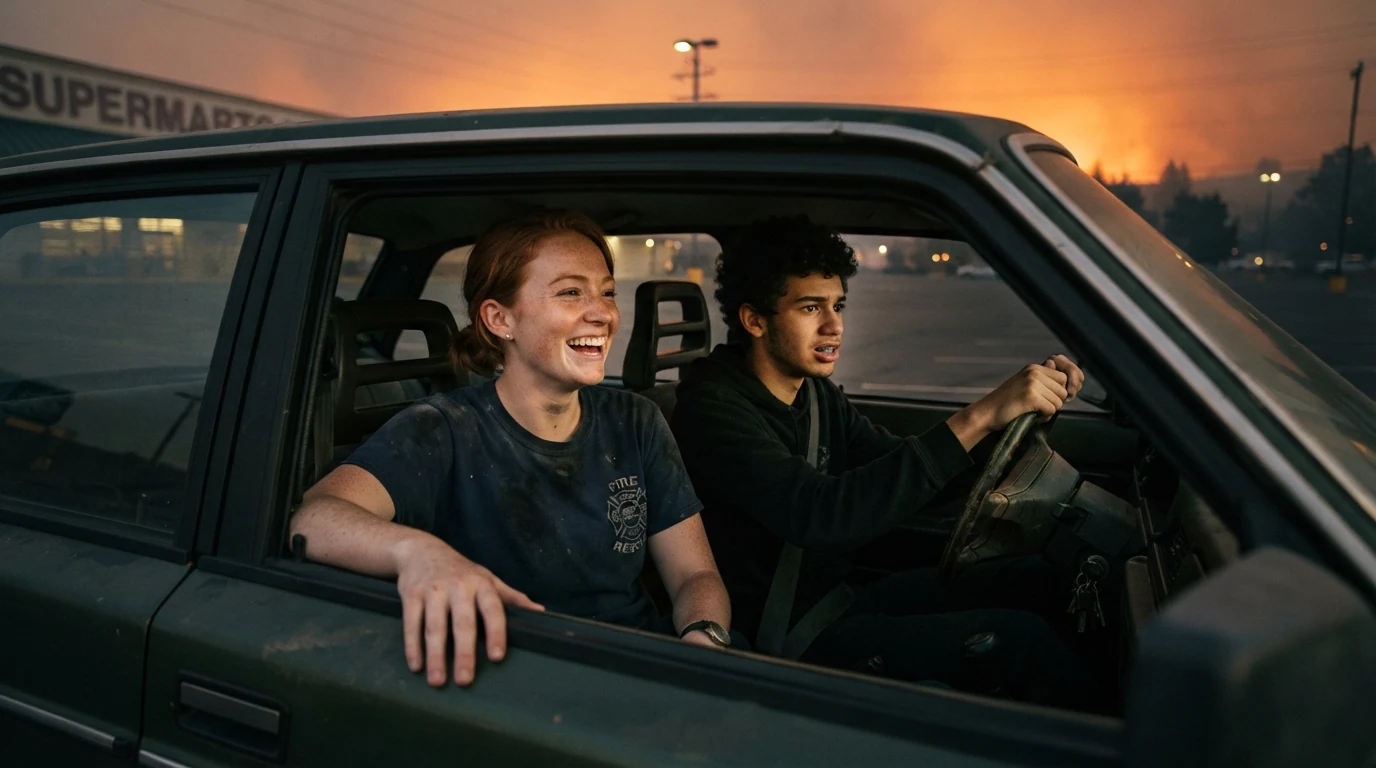
The B-story register comes from the action: a driving lesson instead of the main plot's firefight. Wildfire haze on the horizon and soot on her T-shirt keep the A-story in frame, so the subplot visibly lives inside the main plot's world. Medium two-shot at eye level keeps it a relationship scene.
Open FlashBoardsStoryboard sheet, six panels in two rows on white paper, grey pencil with marker accents, one letter in each panel corner. Panels 1, 3, 5, marked A: firefighters in yellow helmets cut a firebreak on a burning ridge at night, wide shots, cool blue accents. Panels 2, 4, 6, marked B: a freckled young woman with short copper hair teaches her curly-haired teenage brother with braces to drive an old sedan in an empty parking lot, close two-shots, warm amber accents. Panel 6: the brother drives alone at night toward an orange glow. Characters drawn consistently.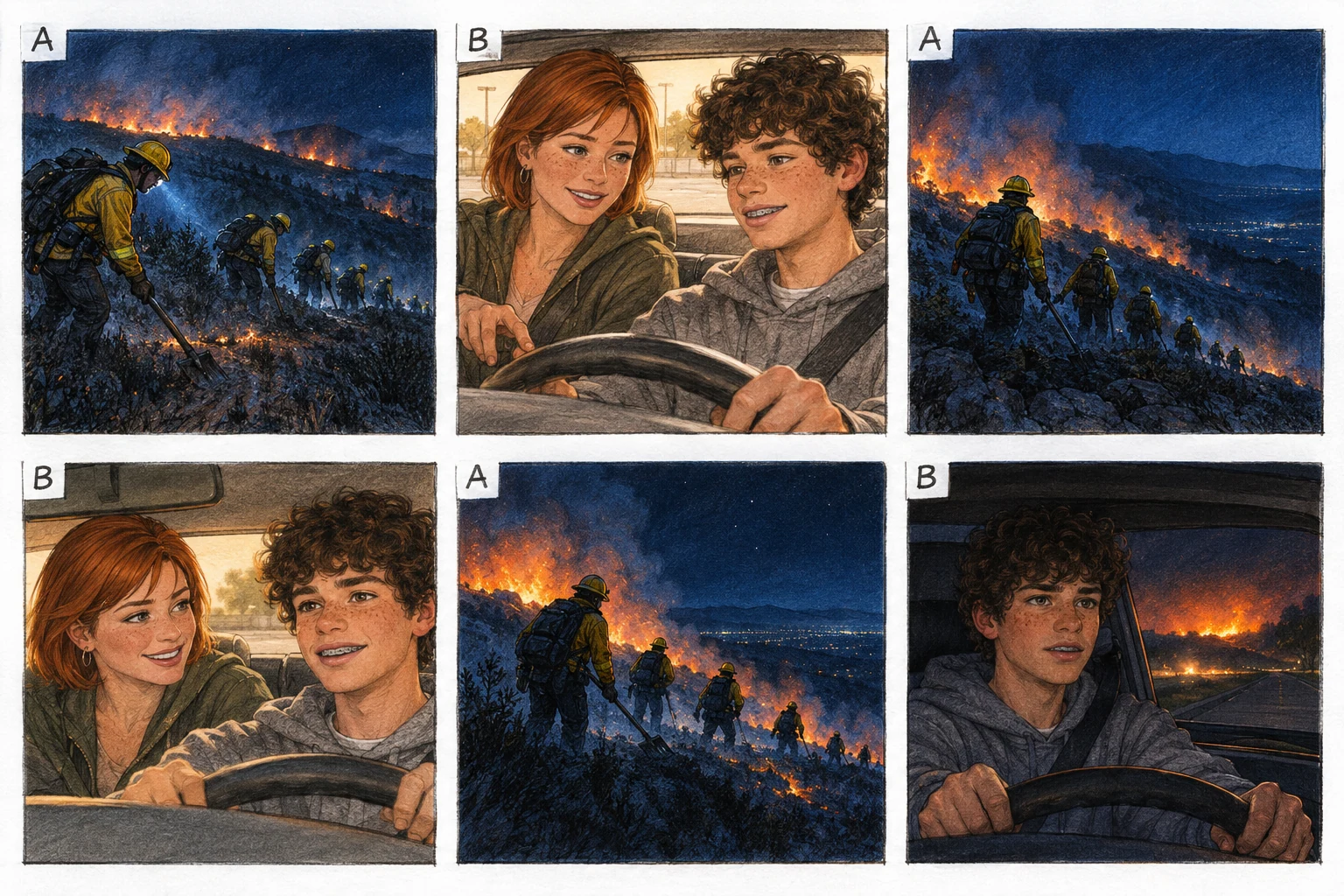
This take produces the planning artifact. Alternating A and B panels show the cross-cut rhythm, and cool blue versus warm amber accents color-code the strands. Panel 6 is the convergence: the subplot character driving into the main plot's danger.
Open FlashBoardsCamera: a slow handheld push-in toward the open driver window starts immediately and ends on a tighter two-shot of the siblings. Action: The brother eases the sedan forward and it lurches to a sharp stop; the woman jolts against her braced hand and bursts out laughing. He drops his forehead onto the steering wheel, then turns to her and grins. The orange haze keeps glowing on the horizon behind them.The lurch puts motion into the first moment, so the clip doesn't become a slow push on a still. The action uses only what is in recipe 1's frame, and the laugh-then-grin ending gives the scene its own small beat.
Open FlashBoardsCommon mistakes
- Asked for "a main plot and a subplot", image models merge everything into one busy frame. Generate each strand as its own shot and let the board carry the structure.
- Storyboard characters drift between panels. Repeat their defining features and say "drawn consistently".
- Long on-image captions come out misspelled. Keep panel text to one letter.
- In video, the haze can grow into flames. Call it a steady glow on the horizon.
Keep the reference frames, prompts and every generated take side by side — images and video in one canvas.
FAQ
4 questionsWhat is a subplot in a movie?
A subplot is a secondary storyline that runs alongside the main plot with its own goal, conflict and resolution. It usually follows a relationship or a side character, takes less screen time and supports the main plot: mirroring its theme, relieving tension or colliding with it near the climax.
What is a B-story?
B-story is screenwriters' shorthand for the most important subplot. In the Save the Cat model it enters around the start of Act Two and is often a love story or mentor relationship that carries the theme. The A-story is what the hero chases; the B-story is usually where the hero learns what the film is about.
How many subplots should a movie have?
There's no fixed rule, but most features carry one strong B-story and one or two smaller runners. Past three real subplots, screen time splits so much that the film behaves like an ensemble piece. Test each one: if removing it changes neither the climax nor the theme, cut it.
What is the difference between a subplot and a parallel plot?
A subplot is subordinate: it has less screen time and serves the main plot. Parallel plots are storylines of roughly equal weight running side by side, as in Traffic (2000) and other ensemble films, often linked by theme rather than one protagonist. Both are commonly cross-cut, but only parallel plots share the lead.
Related terms
5- ThemeStorytelling
Theme is the idea a story explores — what it says about love, power, guilt or freedom — expressed not as a slogan but through the protagonist's choices and their consequences.
- Cross-CuttingEditing
Cross-cutting alternates between two or more lines of action happening in different places, usually at the same time, so each strand builds tension or meaning against the other.
- Save the Cat Beat SheetScreenwriting
The Save the Cat beat sheet is Blake Snyder's 15-beat map of a feature, from Opening Image and Catalyst to Finale and Final Image, with page targets for each beat — a ready template for planning scenes and storyboards.
- PacingStorytelling
Pacing is how fast the story feels as it moves — set in the script by scene length, how quickly events escalate and where the quiet moments fall, then fine-tuned in the edit.
- Story StructureStorytelling
Story structure is the order and shape of the events that carry a story from setup to resolution; models like the three-act structure, Freytag's pyramid, the hero's journey or Save the Cat are different maps of it.
Further reading
Blake Snyder, Save the Cat! (2005). Robert McKee, Story (1997). Syd Field, Screenplay: The Foundations of Screenwriting (1979).