 FlashBoards Learn
- Learn
- Camera Movement
- Static Shot
Camera Movement · Film language
Static Shot
Also called: locked-off shot, fixed shot, fixed camera, stationary camera
A static shot keeps the camera completely still for the whole take: no pan, tilt, zoom or move. Because the frame never changes, every bit of energy comes from the actors, the light and the composition, and the viewer starts to watch the way an observer does, patiently and with nowhere to hide.
- What it does
- Fixes the frame so all movement and meaning come from inside it: performance, blocking, light.
- Use it when
- You want the audience to observe rather than be guided: long dialogue, deadpan comedy, tension, a composed tableau.
- Watch out
- A static frame with weak blocking goes dead fast; design movement inside the frame before you lock off.
- Try this prompt
Locked-off static wide shot on a tripod at eye height, two people at a kitchen table, window light, 35mm lens, symmetrical frame
What is a static shot?
A static shot is a take in which the camera does not move and the framing never changes. The camera sits on a tripod, a high hat or a parked dolly; nothing pans, tilts or zooms.
It is the baseline of camera movement: every pan or tilt is measured against a frame that could have stayed still.
A static shot is not a still image: actors enter and leave, light changes. The frame is fixed; the world inside it is not.
What is a locked-off shot?
Locked-off is the crew term for the same thing, with extra emphasis: the head is locked, the legs weighted, and nobody touches the camera until cut.
It matters when the frame must match itself exactly:
- VFX plates, so a compositor can remove rigs or duplicate an actor.
- Time-lapse and day-to-night transitions, where any drift shows as a jump.
- In-camera tricks such as split screens or objects vanishing in a jump cut.
Why do filmmakers use static shots?
To make the audience watch. A moving camera tells you where to look; a fixed frame hands that job back. In Hunger (2008) Steve McQueen and DP Sean Bobbitt play a conversation between a prisoner and a priest as one locked-off take of around 17 minutes, so the argument itself becomes the event.

To build a designed world. Wes Anderson's frontal frames in The Grand Budapest Hotel (2014) turn each set-up into a diorama built on symmetry; Ozu's fixed low camera in Tokyo Story (1953) gives domestic scenes a ritual calm.
For comedy. A character walks out, the frame holds, the joke lands on the empty space.
For dread. A fixed camera cannot look away, as in the long, nearly motionless wide of Solomon under the noose in 12 Years a Slave (2013).
For orientation. Most establishing shots are static wides.
How to shoot a static shot
- Support. A fluid-head tripod with pan and tilt locks tightened, or a high hat for low frames. Sandbag it in wind.
- Lens. 24–40mm on Super 35 leaves room for blocking and reads as observational.
- Height. Eye level (about 1.5 m) is neutral; seated height feels more formal. Level the horizon: a fixed frame shows tilt more than a moving one.
- Blocking is the camera move. An actor walking from background to foreground turns a wide into a close-up. Use doorways and windows as frames within the frame.
- Light carries time. A passing cloud, a lamp switched on, headlights sweeping a wall.
- Stabilized handheld is not static. It keeps a faint float; use sticks.
Static shot vs. locked-on shot
In a static shot the world moves and the frame stays fixed to the set. In a locked-on shot the camera is rigged to a moving subject, which stays pinned in frame while the background rushes past.
Test: compare the first and last frames. Same background: static. Same subject position, new background: locked on.
A freeze frame is different again: it stops time in the edit, while a static shot runs in real time.
Static Shot in motion
11 clipsWatch what moves when the camera doesn't: actors, smoke, traffic and light carry each clip, while the frame edges stay fixed from first frame to last.
How to create a static shot with AI
4 promptsAn image is static by nature; the work is composing a frame that holds up without movement. Video models drift unless told otherwise, so lock the camera in words and put all motion in the action. Keep takes side by side on one FlashBoards board to see which frame survives ten seconds of stillness. The fourth prompt re-shoots a real film shot from a text description alone, and the original plays next to the result so you can compare.
Cinematic film still, locked-off static wide shot from a tripod at eye height, 32mm lens, symmetrical frame: a narrow kitchen at dawn seen straight on through an open doorway. A woman in her sixties with cropped silver hair, round tortoiseshell glasses and a mustard cardigan sits at a small table on the left, pouring tea from a blue enamel pot; a lanky young man with a shaved head and a gray hoodie leans on the counter on the right, arms crossed. Cold blue window light, warm pendant lamp, steam, deep focus, 35mm film grain.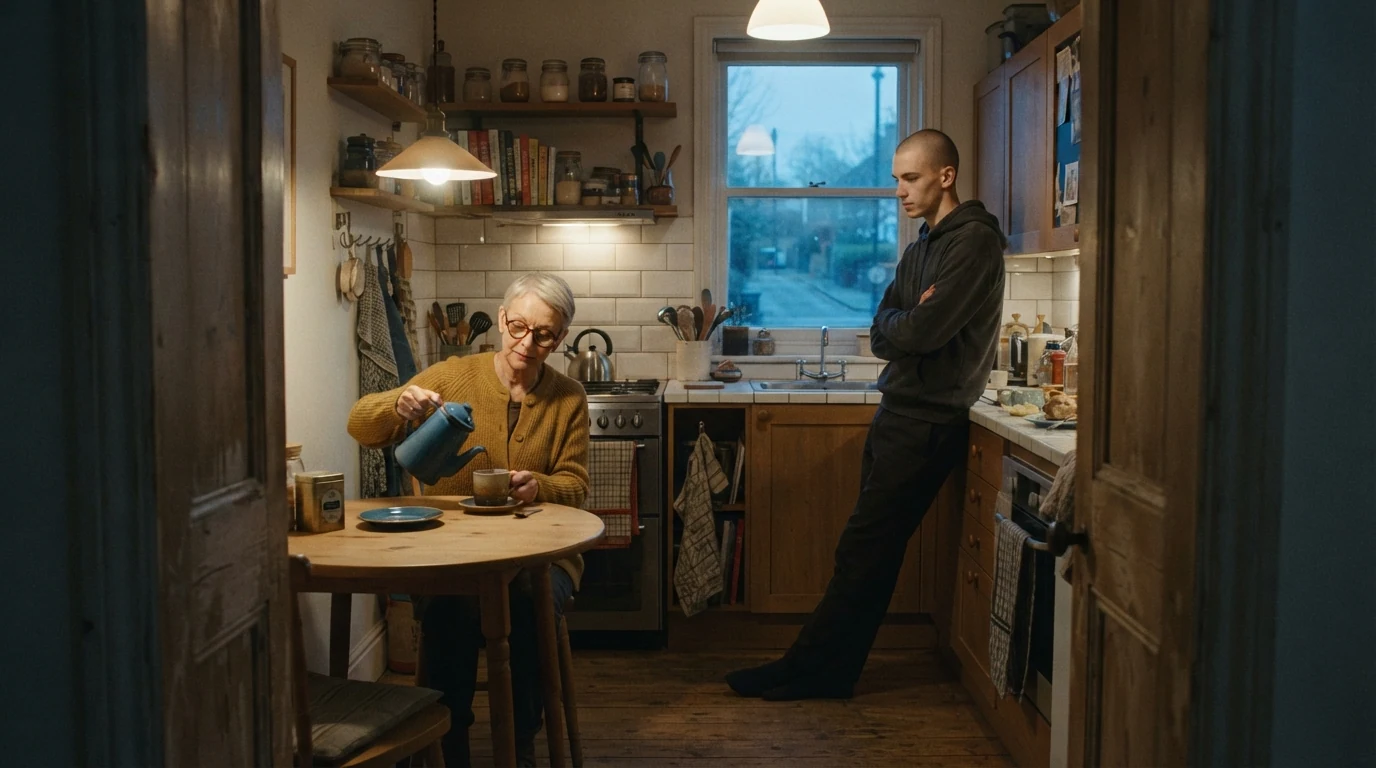
Locked-off static wide shot from a tripod and straight on set a level, frontal frame; the doorway adds a frame within the frame, and deep focus lets the viewer choose where to look. The pouring tea gives the video step motion from frame one.
Open FlashBoardsWide cinematic film still, static locked-off frame on a tripod at seated height, 40mm lens, perfectly level horizon: an empty desert road runs to a vanishing point, a bus-stop shelter on the right shoulder. A heavyset man in his forties with a red beard and a white short-sleeved shirt sits alone on the bench holding a paper bag. Late afternoon side light, long shadows, muted colors, 35mm film grain.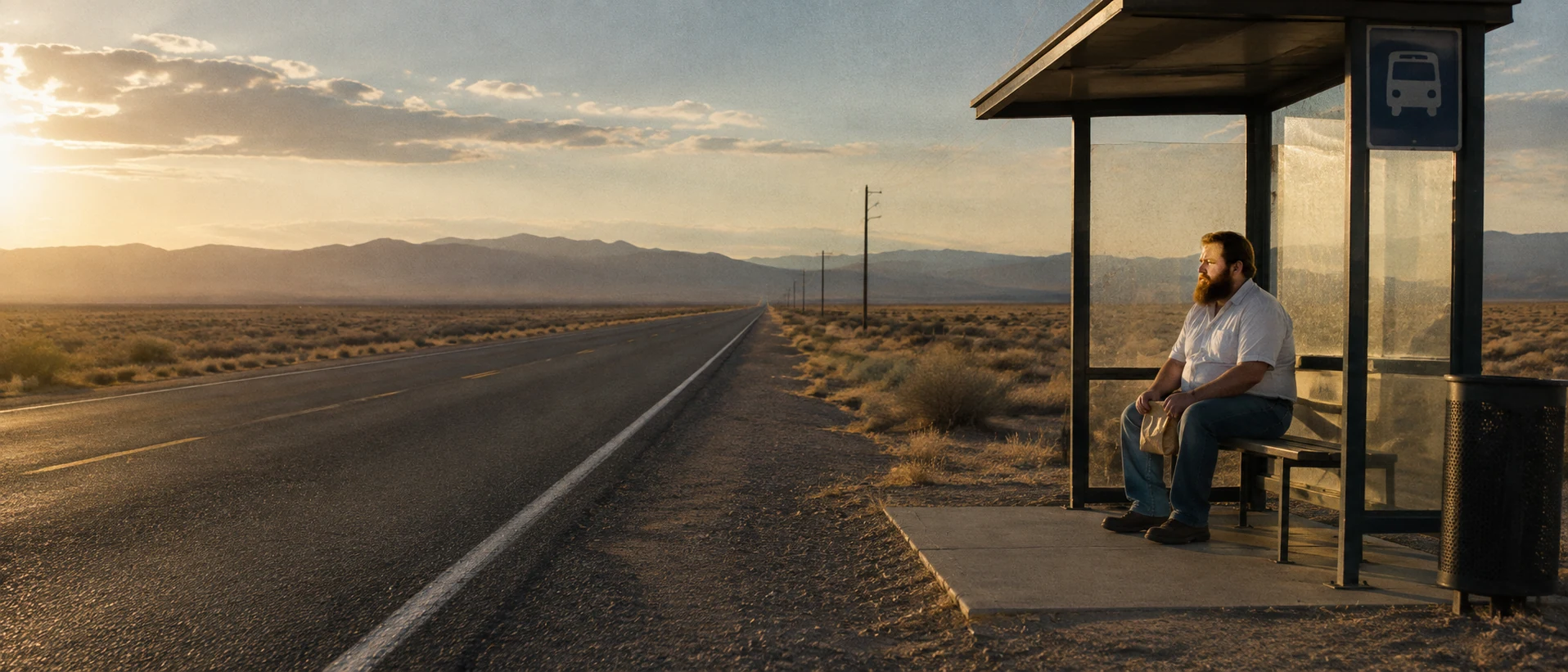
A deadpan take: perfectly level horizon, vanishing point and a small off-center figure make a frame that waits for something to happen, and 21:9 leaves empty space for an entrance.
Open FlashBoardsCamera: completely static, locked off on a tripod for the whole shot; the doorway and the window stay exactly in place from the first frame to the last. Action: the woman is already pouring tea as the shot begins, steam curling up from the cup. In the middle she sets the blue pot down and slides the cup across the table. The young man uncrosses his arms, steps from the counter and sits down opposite her. At the end they both hold still, looking at each other, while the steam keeps rising.Completely static, locked off plus two anchors that stay exactly in place stops the default push-in; the young man's cross recomposes the frame instead of the camera.
Open FlashBoards{
"output": "Full-screen live-action film shot from Hunger (2008), alive from its very first frame: one single continuous shot, no cuts. Locked-off static profile two-shot in a bare prison visiting room, cold grey-blue window light from behind, desaturated teal palette, 35mm film grain.",
"characters": {
"S1": {
"name": "Bobby Sands, played by Michael Fassbender",
"look": "lean man in his late twenties, bare-chested and thin, short cropped hair, dark trousers, seated in profile at the left end of the table facing right",
"voice": "quiet Belfast accent, low and even"
},
"S2": {
"name": "the visiting priest",
"look": "heavier man in his fifties, receding grey hair, black clerical suit, seated in profile at the right end of the table facing left, almost a silhouette",
"voice": "silent in this shot"
}
},
"shots": [
{
"shot": 1,
"camera": "completely static, locked off on a tripod at seated eye height, wide lens; a long table runs straight across the frame between the two men; rows of empty tables and plastic chairs fill the room behind them; the frame does not move, pan or zoom for the whole shot",
"action": [
"BEGINNING: alive from the first frame, Bobby Sands sits on the left with both forearms resting on the table, looking right across the table at the priest; the priest on the right sits hunched, head bowed, looking down at his hands on the table",
"THEN: a thin line of cigarette smoke rises from the ashtray in front of Bobby Sands and drifts up into the window light",
"THEN: Bobby Sands speaks one short line toward the priest, his head and body otherwise still; the priest keeps his head bowed, hands turning slightly on the table, no nod",
"END: both men hold their positions in silence, the smoke still curling upward, the empty room unchanged"
],
"dialogue": [
{
"speaker": "S1",
"on_screen": true,
"when": "in the middle of the shot, after a pause of silence",
"delivery": "quiet, flat, certain",
"line": "<d>[English] Couldn't have that on my conscience, no.</d>"
}
]
}
],
"sound": {
"ambience": "the hush of a large empty room, a faint hum, a chair creak",
"speech": "exactly these spoken phrases, each said once, in this order",
"never_spoken": "no narration and no voice-over: the descriptions, performance notes and step words of this prompt are never spoken aloud",
"music": "a film score under the scene, always below the voices: a barely audible low drone of sustained strings",
"subtitles": "none"
}
}Remakes the locked profile two-shot from Hunger (2008): the prompt carries over the table between the men, the rising smoke, the single line and the frame that never moves.
The camera field says locked off and does not move, pan or zoom, so every beat lives in action: smoke rising, one quiet line, a bowed head. The corpus line is quoted verbatim and the music stays a low drone.
Common mistakes
- Camera drift. Video models add a slow push-in. Say completely static, locked off on a tripod and name anchors that stay in place.
- A frozen shot. Start
Action:with motion already happening. - Handheld breathing. Documentary or raw invite shake; say tripod, level horizon.
- Invented extras. Anything named only in the video prompt gets drawn in.
Keep the reference frames, prompts and every generated take side by side — images and video in one canvas.
FAQ
4 questionsWhat is a static shot in film?
A static shot is a take where the camera stays completely still, usually on a tripod, with no pan, tilt, zoom or dolly move. The framing never changes, so the audience reads the scene through the actors' movement, the staging and the light. It becomes a style when held long or wide.
Is a locked-off shot the same as a static shot?
Yes. Locked-off is the set term for a static shot, stressing that the tripod head is locked and nobody touches the camera during the take. The strict meaning matters for visual effects plates, time-lapses and split screens, where the frame must match itself exactly.
How do you keep a static shot from feeling boring?
Put the movement inside the frame. Block actors in depth so they walk toward or away from the lens, use entrances and exits, frame with doorways and windows, and let light change during the take. In a static shot the composition is the whole shot.
What is the difference between a static shot and a freeze frame?
A static shot runs in real time: the camera is still, but people and light keep moving inside the frame. A freeze frame is an editing effect that repeats one frame so everything stops, often to end a film. One holds the camera, the other holds time.
Related terms
8- Film StillFormats & Exhibition
A film still is a single image representing a film — either a frame grab taken from the footage or a production still shot by the set photographer for publicity; stills are the raw material of lookbooks and mood boards.
- Freeze FrameEditing
A freeze frame holds a single frame on screen so the action stops dead — to end a film, introduce a character, underline a moment or cue narration.
- Locked-On ShotCamera Movement
A locked-on shot keeps one moving object pinned to the same spot in the frame — by rigging the camera to it or by stabilising on it in post — so the object seems frozen while the world swings around it.
- SymmetryComposition & Framing
Symmetry arranges the frame so its left and right halves mirror each other around a central axis — architecture, props and actors in matched positions — creating order, formality and sometimes an uncanny, controlled world.
- PanCamera Movement
A pan swivels the camera horizontally from a fixed position — left or right around its vertical axis — to follow action, connect two points in space or reveal a scene bit by bit.
- Tilt ShotCamera Movement
A tilt pivots the camera up or down from a fixed position, like nodding your head — to reveal a tall subject, follow a rise or fall, or shift attention between sky and ground.
- Establishing ShotCamera Shots
An establishing shot opens a scene or sequence by showing where — and often when — it takes place, typically a wide view of a building, street, city or landscape before the film cuts closer to the characters.
- Camera MovementCamera Movement
Camera movement is any change of the camera's position or direction during a shot — pans, tilts, dollies, cranes, handheld and more — used to guide attention, reveal space and set the emotional rhythm of a scene.
Further reading
Steven D. Katz, Film Directing Shot by Shot (Michael Wiese Productions, 1991). David Bordwell and Kristin Thompson, Film Art: An Introduction (McGraw-Hill).