 FlashBoards Learn
- Learn
- Camera Movement
- Tilt Shot
Camera Movement · Film language
Tilt Shot
Also called: tilt, tilt up, tilt down, vertical pan
A tilt shot pivots the camera up or down from a fixed position, like nodding your head, while the camera itself stays in place. It reveals tall subjects, follows something that rises or falls, and moves attention between sky and ground, changing the viewing angle during the shot without a cut.
- What it does
- Swings the view vertically from one fixed spot, carrying attention up to scale or down to detail.
- Use it when
- You need to reveal height, follow a rise or fall, or link a sky, a building or a face with what lies below it.
- Watch out
- Verticals bend on wide lenses and exposure jumps between sky and ground; plan both ends of the move.
- Try this prompt
Camera locked on a tripod, only pivoting: slow tilt up over 8 seconds from a woman's hands releasing a glowing paper lantern to the lantern rising into a dusk sky
What is a tilt shot?
A tilt is a rotation of the camera around its horizontal axis: the lens swings up or down while the camera body stays on the same spot, usually on a fluid head on a tripod. Only the direction of view changes, the way your eyes follow a building from door to roof while you stand on the sidewalk.
Because the camera pivots rather than moves, a tilt changes the angle of the shot as it runs. A tilt up that starts level ends as a low-angle shot looking up; a tilt down ends as a high-angle shot looking down. That shift in angle is part of what the move means.
The tilt is the vertical twin of the pan, and together they are the two basic rotations in camera movement. Combined, they give a diagonal move from the same fixed base.
Direction is named for the lens, not the picture. On a tilt up, the lens points higher and the image appears to slide down the screen as new space enters from the top edge.
Why do filmmakers use tilt shots?
To reveal scale. A tilt up a tower, a tree or a person makes the audience experience height as time: the longer it takes to reach the top, the bigger the thing feels. In The Matrix (1999) the camera climbs the face of a glass tower until a helicopter appears against the sky, and the length of the climb is what makes the rooftop feel far from the street.
To connect two levels of a scene. Many films open on the sky, a rooftop or a steeple and tilt down to street level, placing a character inside a location in one move. It works as an establishing shot that ends on a person rather than a map. The opening of Star Wars (1977) famously tilts down from the stars after the title crawl to bring in the planet and the ships.
To follow vertical action. Anything that rises or falls is a natural motivation: a ball thrown in the air, a load hauled on ropes, a person climbing stairs, a lantern floating up. The tilt keeps the subject in frame the same way a pan follows a car.
To shift status and emphasis. Tilting up a character from shoes to face builds presence and threat; tilting down from a face to trembling hands moves attention from what someone says to what they are hiding.
To time a reveal. Because new space only enters from the top or bottom edge, the operator controls exactly when the audience sees the payoff. A fast tilt lands a punchline; a slow one makes the viewer wait.
Tilt up
A tilt up pivots the lens upward from a fixed position. It is the move of awe and scale: the frame starts on something human-sized — a doorway, a pair of boots, the base of a trunk — and climbs until the subject fills the sky. Because the ending framing is a low angle, a tilt up tends to leave its subject feeling larger, more powerful or more remote than it did at the start.
Typical uses:
- Revealing height — skyscrapers, cathedrals, rockets, trees. Hold the base long enough to register its size.
- Introducing a character — boots, belt, hands, then face. The slower the climb, the more the reveal is withheld.
- Following an ascent — something released, thrown or lifted. Match the subject's speed and let it lead slightly.
- Ending on the sky — leaving the characters behind to settle on clouds or treetops is a classic way to close a scene.
On a wide lens the verticals converge as you climb and buildings lean inward. That is often the point; if not, use a longer lens and more distance.
Tilt down
A tilt down pivots the lens downward from a fixed position, moving attention from the top of the scene to the bottom: from sky to ground, from a sign to the door beneath it, from a face to the hands. It is the grounding move. Where a tilt up opens outward, a tilt down usually arrives somewhere specific, which makes it a natural way to begin a scene.
Typical uses:
- Sky to street — open on a rooftop, spire or treetops and settle on the location or the character.
- Object to person — follow a rope, a pole or a wall down to whoever is at the bottom of it, linking cause and effect in one shot.
- Face to detail — drop from an expression to a gesture, a weapon, a ring or a letter, so the audience discovers what the character already knows.
The landing is everything. Compose the final frame first, then find the top position that makes the trip worth taking, and hold the end for a beat so the audience can read what the tilt was heading toward.
How to shoot a smooth tilt
Balance the head. A fluid head with counterbalance keeps the camera from falling forward or back when you let go of the pan bar. Balance the rig as built — lens, matte box, monitor — then add tilt drag until the move feels heavy and even.
Level first. A tilt on an unlevel head rolls the horizon as the angle changes. Level the bowl before every setup, especially when the tilt is combined with a pan.
Mind the lens. On a 18–24 mm wide-angle lens the verticals converge as soon as the camera points up, and a tall building leans in dramatically. On 50–85 mm the lines stay straighter and the move feels more observational. A long lens also magnifies speed, so the same rotation that looks gentle at 24 mm races at 100 mm.
Pace. At 24 fps, fast tilts judder on strong horizontal lines — window rows, stair treads, rooftops — just as fast pans judder on verticals. Let a line take several seconds to cross the frame, or follow a subject so the eye has something sharp to hold. A deliberate snap tilt is the vertical cousin of the whip pan: blur is the point, and it can hide a cut.
Plan exposure and focus. Sky is often three or four stops brighter than the ground, so a long tilt may need an iris pull or a graduated filter. The focus distance changes too: a tilt from a face at 2 m to a tower at infinity needs a focus pull timed with the move.
Watch the extremes. Steep tilts can catch tripod legs, the lens hood or the operator's feet. For a look straight up, use a 90-degree bracket or low mode.
Motivate both ends. Hold two to three seconds at the top and bottom for the editor, ease in and out, and make both end frames work as compositions.
Tilt vs. pedestal shot (and other lookalikes)
The most common mix-up is between a tilt and a pedestal shot. Both move the frame vertically, but they are different physical moves:
- Tilt — the camera stays at the same height and pivots. The angle changes: level becomes low or high. Foreground and background stay locked together.
- Pedestal — the whole camera rises or falls while staying level. The angle stays the same, and near objects slide past faster than distant ones, showing parallax.
The test is the horizon and the verticals. If lines start to converge and the angle steepens, it is a tilt. If the view stays level but the eyeline climbs through the scene, it is a pedestal. A crane shot usually does both at once: it lifts the camera and tilts it to keep the subject framed.
Two other terms cause trouble. A "tilted shot" in everyday English often means a Dutch angle, where the camera is rotated sideways around the lens axis so the horizon runs diagonally — that is a camera roll axis, not a tilt. And a tilt-shift lens tilts its plane of focus inside the lens; the camera itself does not move at all.
Tilt Shot in motion
11 clipsWatch the angle change: in a tilt the camera never leaves its spot, so the view steepens from level to looking up or looking down, and lines on buildings converge or straighten as it goes. The first clips climb toward height and sky; the rest tilt down to land on a place, a person or a detail.


How to create a tilt shot with AI
3 promptsVideo models confuse pivoting with rising, so a prompt that just says tilt up often returns a crane or a pedestal, or a slow push-in. Say that the camera stays at the same height and only pivots, give the direction and where the move ends, and motivate it with something that rises or falls. Nano Banana 2 Lite builds the start frame, GPT Image 2.5 sets up the landing frame of a steep tilt in portrait, and MiniMax H3 Max Turbo animates the first frame into a motivated tilt up. On a FlashBoards board, keep the film clips next to your takes and compare the speed of each climb side by side.
Cinematic film still from a tripod at chest height, eye level, 35mm lens: on a grassy riverbank at dusk, a young woman with short copper-red curls, a freckled face and a mustard wool coat holds a glowing white paper lantern at chest height with both hands, about to let it go; she is framed from the waist up in the lower half of the frame, looking up; the upper half of the frame is open deep-blue dusk sky with a thin band of dark treetops along the far bank; warm lantern light on her face, cool ambient light, level horizon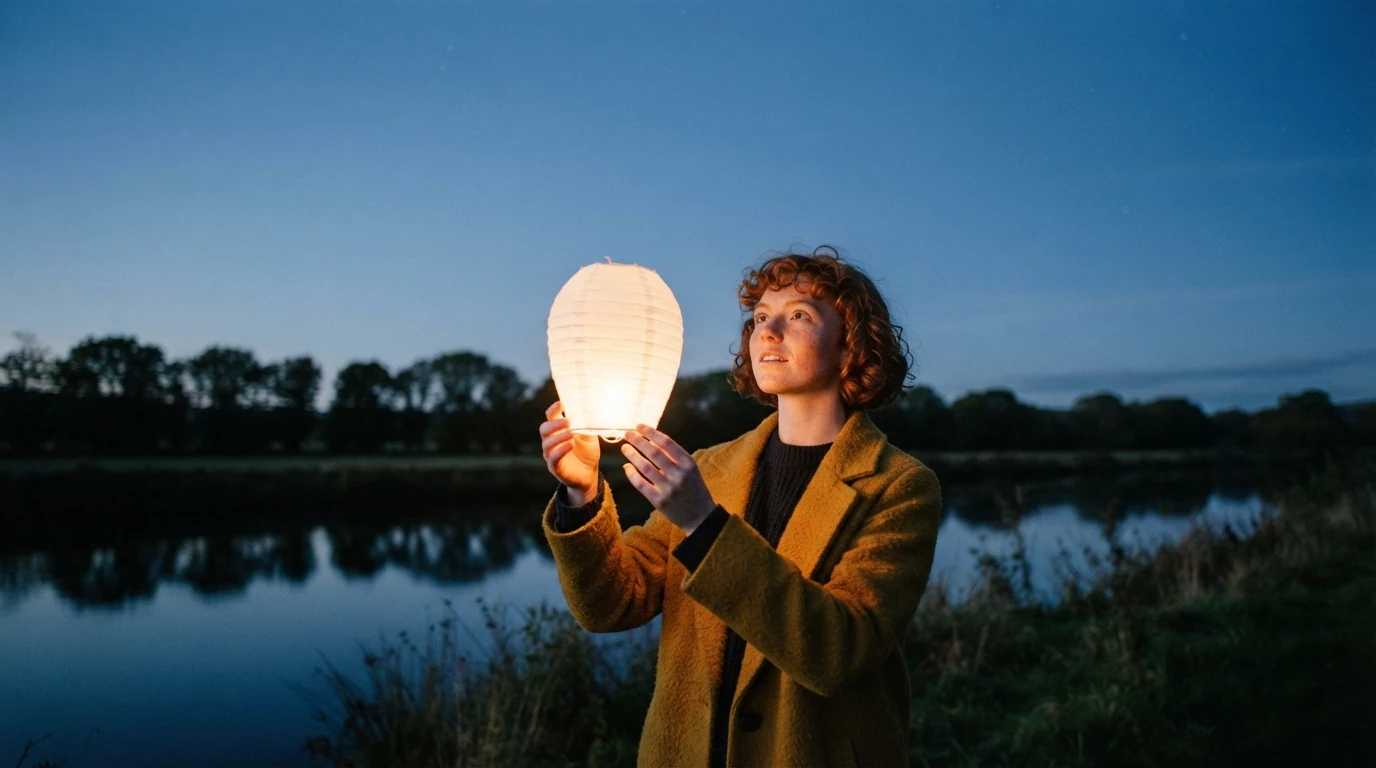
From a tripod at chest height, eye level sets the fixed pivot point and a level start, so the later move has an angle to change. Placing the woman in the lower half with open dusk sky above leaves headroom for the lantern to rise into and keeps the space the tilt will reveal simple, so the video model has little to invent. The copper curls, freckles and mustard coat make her a specific, fictional person.
Open FlashBoardsCinematic wide film still, the final frame of a steep tilt up: camera on a tripod on the ground floor of an old concrete lighthouse, pointed almost straight up, 18mm lens; a spiral iron staircase winds upward in rings that spread across the wide frame toward a round skylight at the center; a lanky man with a gray ponytail, round glasses and a faded orange rain jacket leans over the railing on the highest landing, small in the frame, looking down at the lens; cold daylight from the skylight, peeling white paint, strong converging lines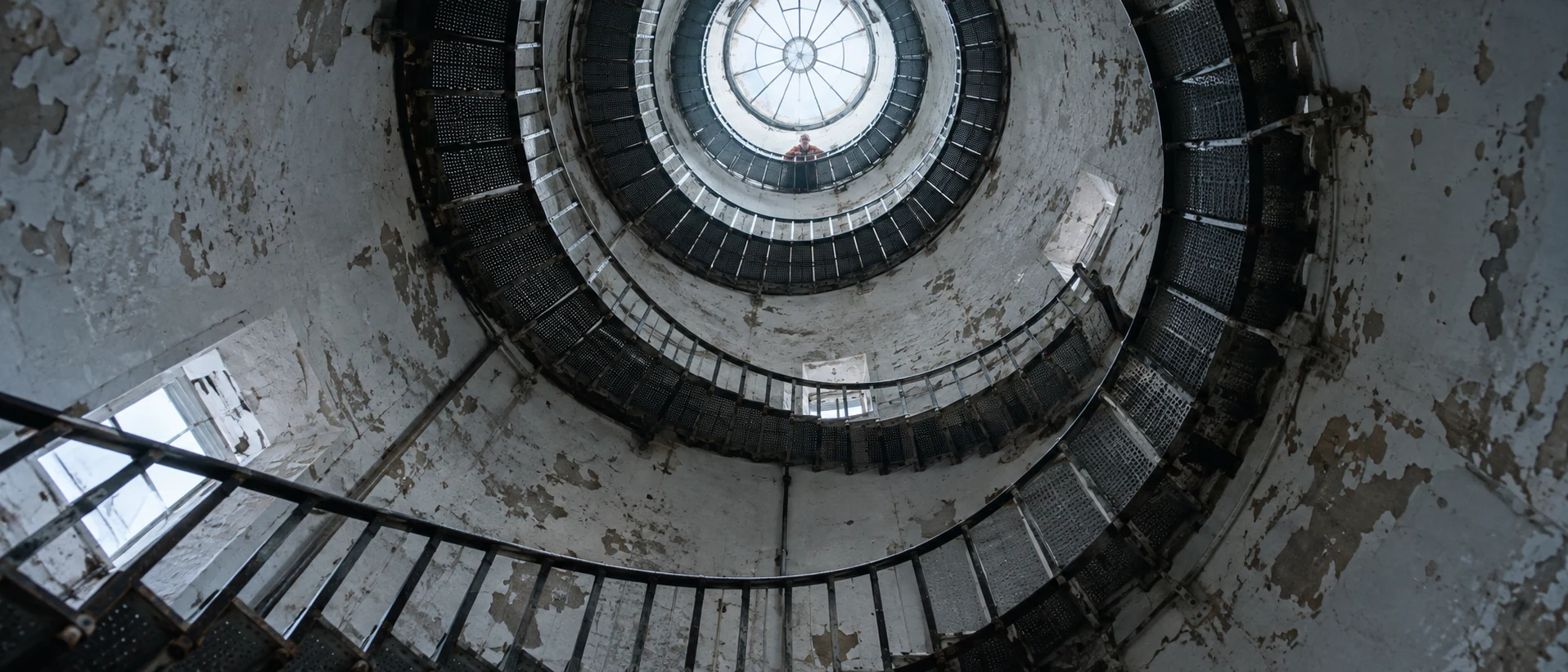
A second take on the landing of a tilt up instead of its start. Pointed almost straight up and 18mm push the angle and make the spiral and walls converge toward the skylight, the look a steep tilt arrives at. In the wide frame the rings spread sideways, so the converging lines carry the upward angle.
Open FlashBoardsCamera: locked on a tripod at chest height with a fixed 35mm lens, the camera tilts up at a slow, steady speed to follow the paper lantern as it rises, pivoting about 40 degrees over the shot; it stays at the same height and only changes its angle, the horizon stays level, and the framing size stays constant. The woman slides down and out of the bottom of the frame as the tilt climbs. The tilt eases out and settles with the glowing lantern in the upper center of the frame against the deep-blue dusk sky. Action: she is already opening her hands and the lantern is lifting off her palms as the shot begins. In the middle it drifts upward, swaying gently, its warm light fading from her upturned face. At the end the lantern floats alone in the dusk sky, small and bright above the dark treetops.Stays at the same height and only changes its angle is the line that separates a tilt from a crane or pedestal without writing a negative. About 40 degrees at a slow, steady speed gives a clear pivot that does not smear, and the rising lantern motivates the move so camera and subject travel together. The lantern is already lifting when the shot starts, so the clip is alive at once, and the space revealed above is only sky and treetops that exist in the start frame.
Open FlashBoardsCommon mistakes
- The tilt becomes a crane or pedestal. The camera rises instead of pivoting. Write stays at the same height and only changes its angle.
- A push-in replaces the move. If the prompt is vague, the model creeps toward the subject. Name the direction, the angle in degrees and where the move lands.
- The horizon rolls. Ask for a tripod and a level horizon; otherwise tilts drift into a Dutch angle.
- Invented space. Everything the tilt reveals gets invented. Keep the move modest, or reveal only sky, ceiling or ground.
- Verticals stay parallel. Image models flatten steep angles. State the lens and pointed almost straight up or looking steeply down to get converging lines.
- A frozen start. If nothing moves, MiniMax H3 Max Turbo slowly pushes in on the still. Give the subject a motion that begins in the first frame.
Keep the reference frames, prompts and every generated take side by side — images and video in one canvas.
FAQ
6 questionsWhat is a tilt shot in film?
A tilt shot is a camera move in which the camera pivots vertically, up or down, from a fixed position — usually on a tripod head — without traveling. It is used to reveal tall subjects, follow something rising or falling, or move attention between sky and ground. Because the camera pivots, the angle changes during the shot: a tilt up ends looking up, a tilt down ends looking down.
What is the difference between tilt up and tilt down?
The names describe where the lens points. In a tilt up the camera pivots upward, new space enters from the top of the frame and the move usually builds height, scale or awe. In a tilt down it pivots downward, new space enters from the bottom and the move usually grounds the scene, landing on a place, a person or a detail.
What is the difference between a tilt and a pan?
Both rotate the camera from one spot. A pan turns it horizontally, left or right, like shaking your head; a tilt turns it vertically, up or down, like nodding. Pans follow sideways action and sweep across a space; tilts reveal height and connect what is above with what is below.
Is a tilt shot the same as a Dutch angle?
No. A tilt pivots the camera up or down while the horizon stays level. A Dutch angle rotates the camera sideways around the lens axis, so the horizon and verticals run diagonally and the world looks off balance. People sometimes call a Dutch angle a tilted shot, which causes the confusion. On a shot list, write Dutch or canted for the sideways lean and tilt for the vertical pivot.
Is a vertical pan the same as a tilt?
Yes. Vertical pan is an informal name for a tilt, and you will hear it on sets and in older manuals. Most camera crews prefer tilt, because pan specifically means horizontal rotation. Tilt up and tilt down on a shot list avoid ambiguity when a move combines both axes.
How do you make a tilt look smooth?
Use a fluid head that is balanced for the exact rig, level the tripod, and set enough tilt drag that the move feels heavy. Ease in and ease out, and hold two to three seconds at each end. Keep it slow enough that horizontal lines do not judder at 24 fps, and plan an iris pull from a dark street to a bright sky.
Related terms
8- Pedestal ShotCamera Movement
A pedestal move raises or lowers the whole camera vertically without tilting it, so the eyeline climbs or sinks while the angle stays level — named after the studio pedestal that does it.
- Dutch AngleCamera Angles
A Dutch angle tilts the camera sideways around the lens axis so the horizon and verticals run diagonally, making the world look off-balance — a classic signal of unease, madness, intoxication or danger.
- Tilt-ShiftLenses, Focus & Exposure
A tilt-shift lens can tilt its plane of focus relative to the sensor; tilted to leave only a thin, angled band sharp across a high-angle view of a city or landscape, it makes real places look like toy models.
- PanCamera Movement
A pan swivels the camera horizontally from a fixed position — left or right around its vertical axis — to follow action, connect two points in space or reveal a scene bit by bit.
- Low-Angle ShotCamera Angles
A low-angle shot looks up at the subject from below eye level, making them loom larger against the ceiling or sky — used for power, menace or heroism, or to make a space feel monumental.
- High-Angle ShotCamera Angles
A high-angle shot looks down on the subject from above eye level, shrinking them in the frame and in status — often used to make a character seem small, vulnerable, trapped or overwhelmed.
- Whip PanCamera Movement
A whip pan is a pan so fast that the image dissolves into motion blur; it snaps attention between two points, links two characters with energy or hides a cut, making it one of the liveliest transitions in film.
- Camera MovementCamera Movement
Camera movement is any change of the camera's position or direction during a shot — pans, tilts, dollies, cranes, handheld and more — used to guide attention, reveal space and set the emotional rhythm of a scene.
Further reading
Blain Brown, Cinematography: Theory and Practice (Routledge). American Cinematographer Manual (ASC Press). Joseph V. Mascelli, The Five C's of Cinematography.