 FlashBoards Learn
Editing · Film language
Cutaway Shot
Also called: cutaway, cut-away
A cutaway shot briefly leaves the main action to show something else: a detail, a bystander, a place or an event elsewhere, then cuts back. It adds information the scene can't carry on its own, sets up a joke or suspense, and gives the editor a clean place to hide a cut or compress time.
- What it does
- Steps out of the main action for a beat and returns, adding information, tension, a joke or a hidden edit.
- Use it when
- The scene needs a fact from outside the frame, a pause, a time jump, or cover for a cut in continuous action.
- Watch out
- A cutaway with no reason to exist reads as filler; tie it to an eyeline, a sound or a question in the scene.
- Try this prompt
Wide shot from a farmhouse porch at night: an old red pickup idling at the end of a snowy driveway, headlights on, exhaust drifting, snow falling through the beams.
What is a cutaway shot?
A cutaway is an editing move before it is a type of framing. The editor is on the main action (call it A), makes a cut to a shot of something that is not part of that action (B), and then cuts back to A. The pattern is A, B, A. The B shot is the cutaway.
What makes B a cutaway is where it sits, not how it is framed. It can be a wide landscape, a face across the room, a dog asleep on the porch while a fight happens inside. The same frame can be a cutaway in one film and the opening of a scene in another.
Two things separate a cutaway from shots that look similar:
- It leaves the action. A cut-in goes tighter on something already inside the current frame. A cutaway goes somewhere the current frame doesn't show: another part of the room, another location, another person.
- It returns. If the film stays in the new place and builds a scene there, that's a scene change. If it keeps alternating between two lines of action, that's cross-cutting. A cutaway is a short visit, usually one to four seconds.
In the editing room the word also has a practical meaning: "do we have cutaways?" means "is there anything I can cut to so I can switch takes without a visible jump?"
Why do editors use cutaways?
Cutaways do five jobs, and good ones do two at once.
1. Add information the scene can't show. A couple argues in a kitchen; cut away to the truck idling in the driveway, and the audience now knows someone is waiting outside, even if nobody in the kitchen does. The cutaway lets the viewer know more than the characters, which is the engine of dramatic irony.
2. Build suspense. Hitchcock's often-repeated example of the bomb under the table works through cutaways: show the bomb and the ticking timer, cut back to people making small talk, and the small talk becomes unbearable. High Noon (1952) does the same with repeated shots of clocks as the hour approaches.
3. Land a joke. Comedy uses the cutaway as a punchline: a character insists everything is under control, cut to the thing that is plainly not under control, cut back to the character. Animated sitcoms such as Family Guy turned the cutaway gag into a signature, jumping to a whole unrelated mini-scene and back.
4. Hide a cut. This is the job editors lean on most. In interviews and dialogue scenes you often join two takes or drop a stumble mid-sentence. Cutting straight across would create a jump cut. Cut away to the listener, to hands, to the view out the window, and when you return the audience accepts that time has passed. It also covers continuity errors, like a glass that refills between takes.
5. Control rhythm and time. A cutaway to a landscape or a detail gives the audience a breath after a hard beat. It can also compress time: cut away to the kettle for two seconds, cut back, and the tea is poured.
Underneath all five sits the Kuleshov effect: the viewer reads the face or action they return to in the light of what the cutaway just showed. The cutaway doesn't only add a shot; it changes the meaning of the shots around it.
Types of cutaway shots
There is no fixed taxonomy, but most cutaways fall into a few families.
The bystander or listener cutaway
A face that is not the speaker: the person being talked to, a stranger at the next table, a crowd member. It overlaps with the reaction shot, but a reaction shot is about the response, while a listener cutaway is often there only to cover a cut. In interviews this shot is called a "noddy": the interviewer nodding, shot after the interview.
The object or detail cutaway
Something outside the current frame that carries a fact: a phone lighting up on the counter, a pot boiling over in the next room, a letter sitting unopened on a hallway table. If the object is inside the frame you are already on, a tighter shot of it is an insert shot or cut-in rather than a cutaway.
The location and weather cutaway
The street outside, the rain on the window, the snow piling up on a car roof. They carry time, weather and pressure, and they are the easiest shots to reuse as cover. Documentary crews shoot these as B-roll.
The time cutaway
Clocks, a candle burning down, light moving across a wall. The cutaway marks elapsed time, so the return can jump forward.
The cutaway gag
A comic cut to something that contradicts, exaggerates or literalizes what was just said. It works best short and hard, returning before the audience has finished laughing.
The parallel-action cutaway
A single short cut to what another character is doing at the same moment: the villain loading a gun, the rescuer still stuck in traffic. One or two of these are cutaways; once the film settles into alternating between the two lines, it has become cross-cutting.
How to shoot and cut a cutaway
Most missing cutaways are a planning failure, not an editing one. Build them into your coverage on purpose.
Write a cutaway list. List five to ten shots per scene outside the main action: the listener's face, hands, objects, the view through the window, the exterior, a clock. Put them on the shot list so they survive a late day.
Shoot them in the scene's light. A cutaway that looks like another day breaks the illusion of the same moment. Grab cutaways while the lighting setup is still up, and match time of day and weather on exteriors.
Hold each shot long. Roll 8–15 seconds with a clean start and end, even if the cutaway will play for 1.5 seconds. If it contains action (steam, a car arriving, a head turning), shoot three takes at different speeds.
Choose lenses to match or to separate. A 35–50mm matched to the main coverage makes the cutaway feel part of the same space. A long lens (85–135mm) isolates a detail or a bystander and makes the cutaway feel observed, like a glance. A wide lens from far away turns an exterior into geography.
Mind the eyelines. A listener cutaway must look where the audience expects. Keep it on the correct side of the 180-degree rule and match the eyeline of the main coverage.
Record room tone and the cutaway's own sound. A kettle, a car idling, a clock: these sounds let the editor start the cutaway early under dialogue or let it spill into the return as an L-cut, which makes the cut feel motivated.
In the edit, motivate and keep it short. The best cutaways are motivated by something in the scene: a character looks away, a sound starts off-screen, a line of dialogue raises a question. Leave on a beat (end of a line, a look), stay one to three seconds for a detail or a face, up to five for a landscape, and return on action so the cut back feels like a continuation, not a restart.
Cutaway vs. cut-in: what's the difference?
The two are confused constantly because both interrupt a shot with another shot for a moment. The test is simple: is the new shot showing something inside the frame you just left?
| | Cutaway | Cut-in | |---|---|---| | What it shows | Something outside the current frame: another person, place, object or event | A tighter view of something already visible in the current frame | | Where it goes | Away from the action | Deeper into the action | | Typical job | Add outside information, suspense, a joke, cover a cut, mark time | Point attention at a detail: a hand, a ring, a note | | Example | Argument in the kitchen, cut to the truck idling outside | Argument in the kitchen, cut to the knife on the counter between them |
An insert shot usually behaves like a cut-in: a close shot of an object or small action that lives inside the scene. If the object is in another room, the same close-up is a cutaway.
Cutaway vs. cross-cutting. A cutaway is one visit and a return. Cross-cutting keeps alternating between two or more lines of action happening at the same time, and each line gets its own development. The baptism sequence in The Godfather (1972) alternates the ceremony with a series of killings for minutes; that is cross-cutting, not a string of cutaways. Inception (2010) keeps several dream levels running at once in its final act and moves between them the same way.
Cutaway Shot in motion
6 clipsEach clip below contains at least one cut, so you can watch the cutaway do its job instead of guessing from a still. Look for the moment the film leaves the main action, how long it stays away, and whether it comes back: the return is what makes a short visit a cutaway.
How to create a cutaway shot with AI
4 promptsWith AI, a cutaway is a separate generation that has to feel like the same moment as the main scene: same night, same weather, same light. Keep the main scene's frames, the cutaway frames and your edit notes on one FlashBoards board, generate cutaways in the scene's palette, and compare takes side by side before choosing the one that earns its two seconds. The fourth prompt re-shoots a real film shot from a text description alone, and the original plays next to the result so you can compare.
Wide exterior shot from a farmhouse porch at night: an old red pickup truck idling at the end of a long snowy driveway, headlights on, white exhaust drifting from the tailpipe, snow falling through the headlight beams. Camera at eye level on the porch, 35mm lens, a snow-dusted porch rail soft in the lower foreground, the truck small in the center of the frame. Cold blue moonlight on the snow, warm amber glow inside the cab, a dark silhouette in the driver's seat. Quiet, tense, 35mm film grain, muted palette.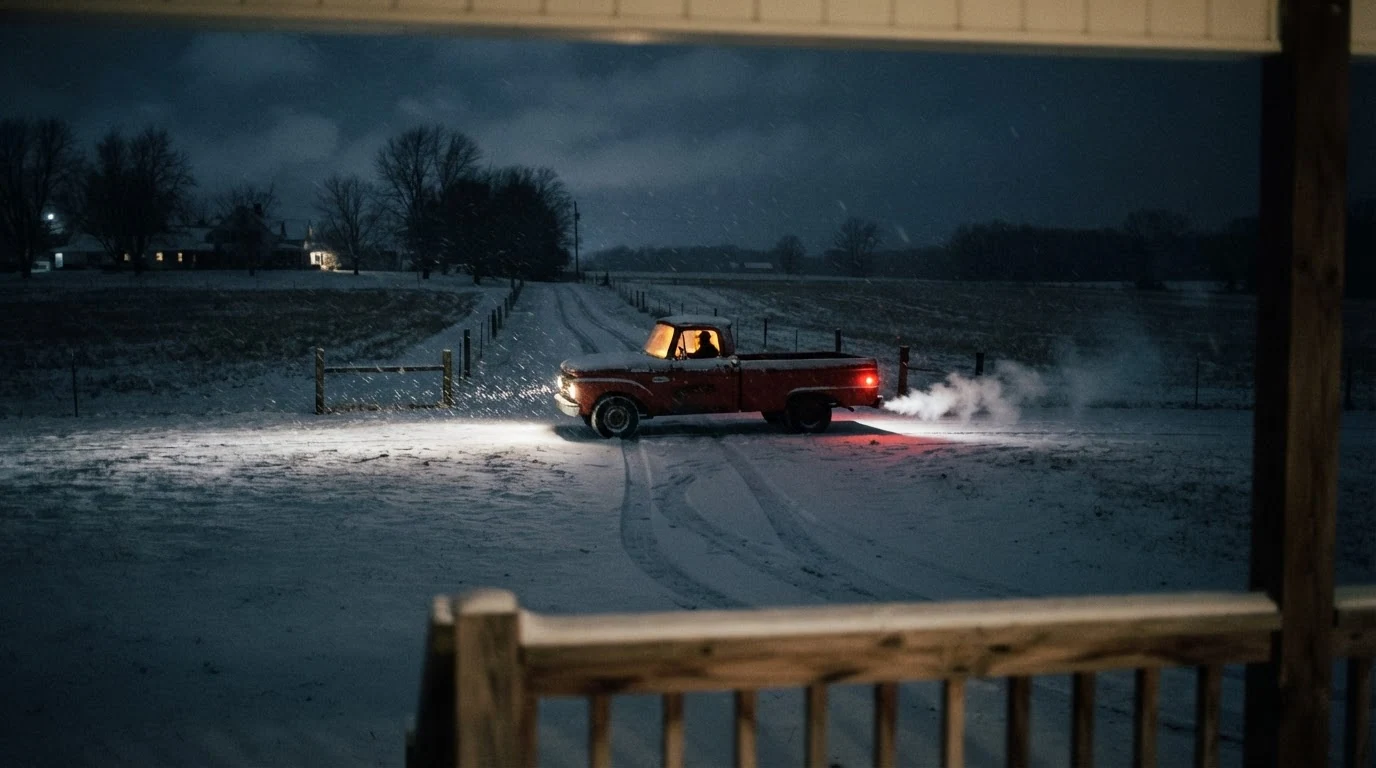
"From a farmhouse porch" and the porch rail in the foreground put the camera at the house, so the shot reads as a look outside from the main scene. The headlights, exhaust and cab glow are the information the cutaway carries: someone is waiting. The word cutaway is kept out of the prompt, because image models tend to read it as a cross-section illustration.
Open FlashBoardsCinematic medium close-up of a street vendor at a roast-chestnut cart on a snowy city sidewalk at dusk: a man in his fifties with a gray handlebar mustache, a knit orange beanie, a chipped front tooth and a burn scar across the back of his right hand, holding a paper cup of coffee. His head is still, but his eyes are turned sharply to frame left, toward something out of shot. 85mm lens at eye level, shallow depth of field, the street behind him dissolved into amber and teal bokeh, snowflakes in the foreground, steam rising from the cart. Anamorphic widescreen, natural color.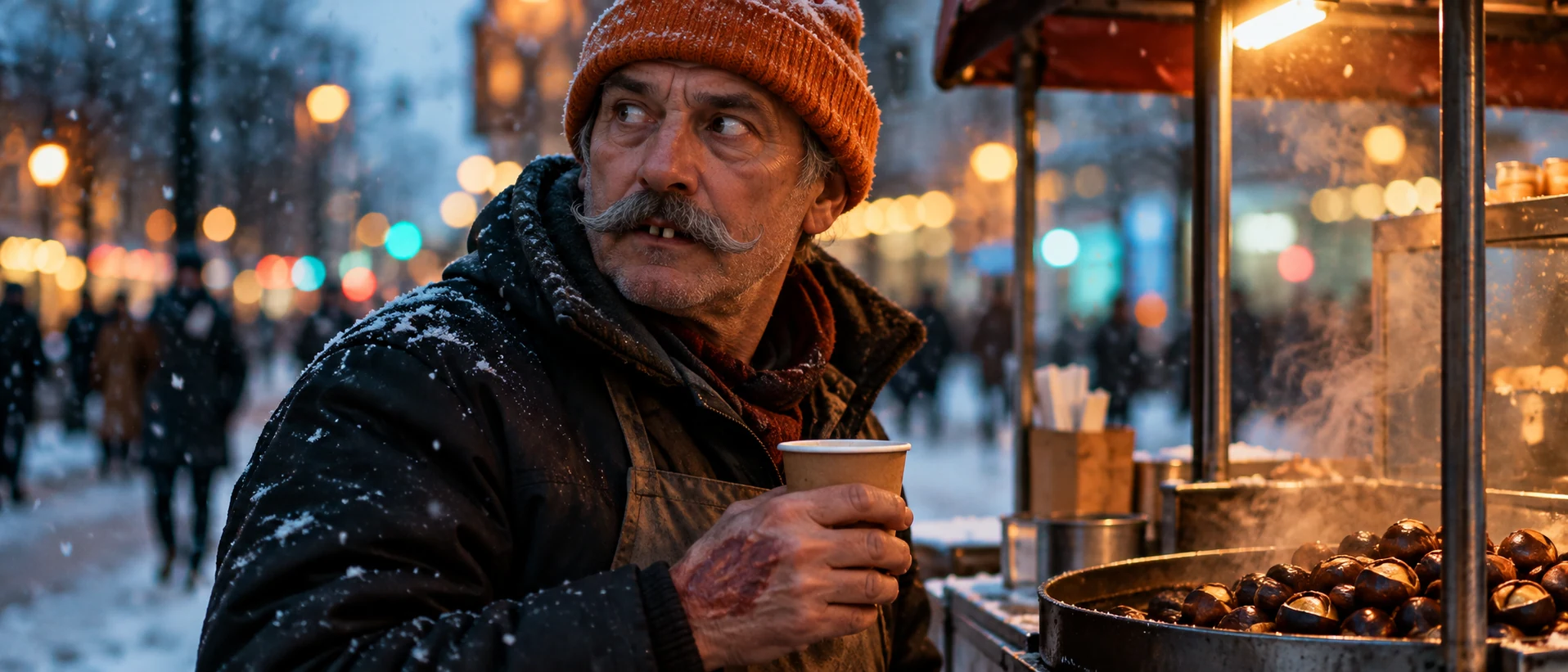
This is a bystander cutaway, the shot you drop into a chase or an argument to show that someone saw it. "Eyes turned sharply to frame left, toward something out of shot" sets the eyeline so it can cut against action that moves from left to right. The 85mm and the bokeh isolate him like a glance, and the specific features keep him clearly fictional.
Open FlashBoardsCamera: locked-off on the porch, completely static for the whole shot. Action: Snow is already falling steadily through the headlight beams and white exhaust is rolling out from behind the red pickup truck. The windshield wipers sweep once across the glass. Then the headlights flash twice. At the end the exhaust keeps drifting low across the snowy driveway and the snow keeps falling.The first sentence starts the snow and exhaust immediately, so the clip is alive from frame one instead of slowly pushing in on the still. A static camera suits a cutaway, which should feel like a glance. The wipers and the double flash give the editor clear beats to cut on.
Open FlashBoards{
"output": "Full-screen live-action scene from The Day After Tomorrow (2004), from its very first frame: three shots joined by two hard cuts. Early-2000s 35mm disaster-film look with fine grain, 2.39:1 scope frame, a total whiteout blizzard over a flat snowfield that buries the glass roof of a big city shopping mall, flat cold blue daylight, desaturated steel-blue palette, snow streaking sideways through both outdoor shots.",
"characters": {
"S1": {
"name": "Frank Harris, played by Jay O. Sanders",
"look": "big man in a bulky frost-caked pale gray expedition parka with the fur-trimmed hood pulled tight, goggles, snowshoes, a climbing rope clipped at his waist",
"voice": "silent in this scene"
},
"S2": {
"name": "Jason Evans, played by Dash Mihok",
"look": "tan expedition parka, dark hood under a red-and-black backpack, a yellow light clipped on the left shoulder strap, snow-crusted face mask and goggles, an ice axe, roped to Frank",
"voice": "silent in this scene"
}
},
"shots": [
{
"shot": 1,
"camera": "static, low at snow level, long lens, wide; Frank in the centre of the frame on a flat snowfield, a straight dark line of a buried roof edge showing through the snow just in front of him; Jason a blurred shape lying flat in the right third, the rope running between them; the camera holds its position",
"action": [
"BEGINNING: alive from the first frame, Frank has just been thrown onto his back, one snowshoe kicking up, then rolls up to sit hip-deep in the broken snow facing screen left, powder bursting around him.",
"THEN: the snow under Frank gives way and he drops to the chest, his right arm flung straight up above his hood, while Jason stays flat on the snow at the right, snowshoes raised.",
"THEN: Frank's head bows forward and he sinks straight down, a cloud of powder blowing out to screen left.",
"END: only the top of his hood shows, then he is gone into a dark hole in the snow; the rope snaps taut toward the hole and Jason lies alone at the right."
],
"voice": "silence: nobody speaks in this shot, no voice at all",
"dialogue": []
},
{
"shot": 2,
"cut_at": "00:02.480",
"camera": "static, wide lens, low angle inside a vast dark empty mall atrium, looking up at a high ceiling of long black steel trusses and glass roof panels; dark shop galleries with railings line both sides; the only light is the gray daylight through one broken roof panel left of centre",
"action": [
"BEGINNING: a thick white column of snow is already pouring down through the broken roof panel into the dark atrium, a small dark shape dropping inside it.",
"THEN: chunks of ice and loose snow keep cascading down the column, billowing out in a white cloud where they hit the floor.",
"END: the column of snow keeps pouring, the only bright thing in the black hall; nobody else is in the shot."
],
"voice": "silence: nobody speaks in this shot, no voice at all",
"dialogue": []
},
{
"shot": 3,
"cut_at": "00:03.760",
"camera": "static, low at snow level on the near side of the hole, long lens; the dark steel frame of the roof opening runs across the lower third of the frame under a thick lip of snow that crumbles over it; Jason fills the centre just beyond the lip",
"action": [
"BEGINNING: Jason lies face-down on the snow, head toward camera, being dragged by the rope toward the lip, his right hand (screen left) holding the ice axe high above his shoulder, his left hand (screen right) clawing at the snow.",
"THEN: he swings the axe down hard and bites it into the snow at screen left.",
"THEN: his body keeps sliding toward camera, snow spraying over the lip and falling past the steel frame into the dark below.",
"END: he stops right at the edge, face in the snow, both arms spread, the axe buried at screen left."
],
"voice": "silence: nobody speaks in this shot, no voice at all",
"dialogue": []
}
],
"sound": {
"ambience": "howling blizzard wind and the hiss of blown snow on the snowfield; in shot 2 a hollow roar of falling snow and ice echoing through a huge empty hall",
"speech": "no words in this video; the only human sounds are breaths and movement",
"never_spoken": "no narration and no voice-over: the descriptions, performance notes and step words of this prompt are never spoken aloud",
"music": "a film score under the scene, always below the voices: low tense strings with a slow pulse that swell with brass as the snow gives way",
"subtitles": "none"
}
}Remakes the three-shot blizzard beat from The Day After Tomorrow (2004), dir. Roland Emmerich, DP Ueli Steiger: Frank Harris dropping through the snow, the cut away to snow pouring into the dark mall below and the return to Jason Evans digging in his ice axe at the edge, with the original's cut times kept.
The three shots carry the A, B, A pattern, and each cut_at is copied from the original's cuts, so the visit away lasts the same 1.3 seconds. Shot 2 has nobody in it on purpose: the cutaway shows a place the main frame can't, the dark hall under the snow, and every shot is marked silent so only the score and the roar of snow change.
Common mistakes
- "Cutaway" gets drawn as a diagram. Image models often read the word as a cross-section illustration of a building or machine. Describe the shot (framing, subject, place) and leave the editing term out of the prompt.
- The main characters wander in. Mention the kitchen argument and the couple appears in the frame. Describe only what the cutaway shows: the truck, the driveway, the snow.
- Light and weather don't match the scene. Repeat the scene's time of day, weather, color and grain words in every cutaway prompt, and keep the main scene frame beside it on the board to compare.
- Eyelines drift. Bystander cutaways come back looking into the lens. State the direction of the look ("eyes turned to frame left, toward something out of shot") and check it against the scene's screen direction.
- Video clips run too long to be cutaways. Generate 5–6 seconds for handles, but use one to three seconds in the edit. If the model adds a slow push-in, ask for a locked-off, static camera and start the motion in the first sentence.
Keep the reference frames, prompts and every generated take side by side — images and video in one canvas.
FAQ
6 questionsWhat is a cutaway shot in film?
A cutaway shot is a brief shot that leaves the main action to show something else, such as a bystander, an object, a place or an event elsewhere, before the film cuts back. Editors use cutaways to add information, build suspense, land jokes, compress time and hide edits. What makes a shot a cutaway is its position in the edit, not its framing.
What is the difference between a cutaway and a cut-in?
A cut-in moves tighter on something already visible in the current shot, like a hand or a note on a table. A cutaway leaves the current frame entirely to show something outside it: another person, another room, the street outside. Quick test: if the new shot shows something the previous shot contained, it's a cut-in; if it shows something new, it's a cutaway.
Why do editors use cutaways in interviews?
Interviews are edited heavily: pauses, stumbles and repeated answers get removed, and parts of answers are joined. Cutting straight across those edits creates a visible jump. Cutting away to the interviewer nodding, the subject's hands, or footage of what they're describing covers the join, so the answer plays as one continuous thought. That's why crews shoot cutaways and B-roll after every interview.
What is a cutaway gag?
A cutaway gag is a comic cutaway: a character says something, the film cuts to a short scene or image that contradicts, exaggerates or literalizes it, then cuts back. Animated sitcoms like Family Guy made it a signature, often jumping to a full unrelated mini-scene. The gag works when the cutaway is short and the return comes quickly.
How long should a cutaway shot be?
Usually one to three seconds for a face or a detail, and up to about five seconds for a landscape or establishing view. It should last long enough to be read and no longer. On set, roll 8–15 seconds per cutaway so the editor has room to pick the best moment and to trim around any action inside the shot.
Is a cutaway the same as B-roll?
Not quite. B-roll is a kind of footage: secondary details, locations and actions shot to support the main material. A cutaway is a way of using a shot in the edit: stepping away from the main action and returning. Much B-roll ends up as cutaways, but B-roll can also run long under narration, which is no longer a cutaway.
Related terms
6- B-RollCamera Shots
B-roll is secondary footage — details, locations, actions, atmosphere — shot to be cut over or between the main material (the A-roll, such as an interview or dialogue), hiding edits and illustrating what is being said.
- Insert ShotCamera Shots
An insert is a close shot of an object or small action inside the scene — a note, a phone screen, a hand turning a key — cut into the coverage so the audience notices exactly the detail the story needs.
- Reaction ShotCamera Shots
A reaction shot cuts away from an action or line to show how another character responds — usually a close-up of their face — so the emotional meaning of the moment lands through the listener.
- CoverageDirecting & Staging
Coverage is the full set of shots filmed for one scene — master, singles, over-the-shoulders, inserts, reactions — that gives the editor choices of pace, emphasis and performance.
- Jump CutEditing
A jump cut joins two shots of the same subject from nearly the same angle, so time visibly skips forward and the cut itself becomes noticeable — used for energy, unease or elapsed time.
- CutEditing
A cut is the instant change from one shot to the next with no transition effect — the basic unit of editing, from invisible continuity cuts to jarring jump and smash cuts.
Further reading
Walter Murch, In the Blink of an Eye (Silman-James Press, 2001). François Truffaut, Hitchcock/Truffaut (Simon & Schuster, 1967). Karel Reisz and Gavin Millar, The Technique of Film Editing (Focal Press).