 FlashBoards Learn
- Learn
- Camera Shots
- Shot Reverse Shot
Camera Shots · Film language
Shot Reverse Shot
Also called: shot/reverse shot, reverse angle shot, reverse shot, shot-countershot
Shot reverse shot is the pattern of cutting between two opposing camera setups, one on each character, usually over-the-shoulder shots or singles filmed from the same side of the axis. A conversation then plays as a back-and-forth: each cut answers the last one, and the viewer reads the space between the two faces as the relationship.
- What it does
- Turns two separately filmed angles into one continuous conversation by cutting between opposing setups on each character.
- Use it when
- Any dialogue, interrogation or confrontation where both faces, both reactions and control of the pace matter.
- Watch out
- Crossing the axis, or changing lens, height or shot size between the two sides, breaks the illusion that the two people face each other.
- Try this prompt
Medium close-up single, 75mm, eye level, woman on the left third facing screen right, looking just past the lens, soft shoulder at the right edge
What is shot reverse shot?
Shot reverse shot (also written shot/reverse shot, or shot-countershot, from the French champ-contrechamp) is a pair of camera setups designed to be intercut. Setup A looks at the first character from roughly where the second character stands; setup B turns around and looks back at the second character from roughly where the first one stands. Cut them together and the audience assumes the two people face each other in one continuous space, even if the two sides were filmed hours apart.
Three things have to agree for the pattern to work:
- Opposing angles. The two cameras point roughly toward each other across the conversation.
- One side of the line. Both setups stay on the same side of the axis drawn between the two characters, as the 180-degree rule requires. That is what keeps the first character looking screen right and the second looking screen left in every cut.
- Matching eyelines. Each actor looks just off the lens, on the side where the partner is. That eyeline match is what convinces the viewer the two looks meet.
The individual frames can be over-the-shoulder shots, clean singles with nobody else in the frame, or dirty singles with a sliver of the partner at the edge. Most scenes mix them: a wide or master shot sets the geography, and the scene then tightens into matched reverses as the conversation heats up. It belongs to the camera shots, but it is really an editing idea: no single frame is a shot reverse shot; the pair and the cut between them are.
Why do filmmakers use shot reverse shot?
It is the most economical way to put two faces and one relationship on screen: not in the same frame, but in the same rhythm.
- It tells the viewer where to look. Each cut gives one face the full frame and the full attention of the audience. Who gets the camera, and for how long, tells us whose scene it is.
- It places the viewer inside the conversation. Because each angle sits close to the other character's position, the audience stands where a participant would. Film theorists called this suture: the reverse answers who is looking, stitching the viewer into the fiction.
- It gives the editor control. With both sides covered, the editor can tighten pauses, borrow a reaction from another take or stay on the listener. That flexibility is why shot reverse shot is the backbone of dialogue coverage.
- It can show power through asymmetry. Match the two setups and the characters meet as equals. Make one side tighter, lower or on a longer lens, and the balance tips.
Michael Mann plays the coffee-shop meeting in Heat (1995) almost entirely in over-the-shoulder shot/reverse, so two equally matched men mirror each other across a table. Jonathan Demme pushes the eyelines toward the lens in The Silence of the Lambs (1991): Lecter and Clarice often look almost straight into the camera, so each reverse feels like being stared down. And Yasujirō Ozu regularly cut between near-frontal singles that ignore the usual screen-direction rules: the convention is a choice, not a law.
How to shoot shot reverse shot
Draw the line before the camera goes up
Decide the axis first: a line through both characters' eyes, with every setup of the scene on one side of it. Mark the actors and both camera positions on the floor. If the blocking moves a character across the line, carry the audience across on screen (a move, a new wide) instead of cutting across it.
Match the two setups
The pair cuts invisibly when the sides are mirror images:
- Same focal length. 50–85mm on a Super 35 sensor is the dialogue workhorse; 75–100mm for tight close-ups. Switching lenses between sides changes face shape and background scale, and the audience feels it.
- Same distance and height. The lens usually sits at the actors' eye level. A camera 10–15 cm lower on one side already reads as a shift in status, so do it on purpose or not at all.
- Same shot size. Pair a medium close-up with a medium close-up, keeping headroom and eye height on the same line of the frame.
- Mirrored placement. If the first character sits on the left third looking right, the second sits on the right third looking left, with the same looking room.
Keep the eyelines tight to the lens
The closer the off-camera actor stands to the lens, the more intimate the reverse. Put them beside the matte box, on the correct side. Too far away and the characters seem to look past each other; straight into the lens and it becomes a point-of-view reverse.
Light for both directions
The lighting has to survive the turnaround. A common plan keys each face from the far side of the axis, so both actors get modeling light from the same side relative to the line, with windows and practicals kept consistent. Relighting for the reverse is often the biggest cost of a dialogue day.
Choose the shooting order
Traditionally: the wide, then one side from loose to tight, then the turnaround at matching sizes. Many productions now cross-shoot with two cameras so overlapping lines and improvised reactions match; the price is a lighting compromise and longer lenses to keep each camera out of the other's frame.
Types of shot reverse shot
Over-the-shoulder reverses
Each side includes the back of the partner's head and shoulder, soft and dark at the edge. Both people are present in every cut, which keeps the space continuous.
Clean singles
Only one face in the frame. Clean singles isolate the characters, which suits people who are emotionally apart, and give the editor freedom: there is no foreground shoulder to match.
Dirty singles
A single with a thin, blurred slice of the partner at the edge, an ear or a shoulder seam: a reminder that someone is listening, without splitting attention.
Point-of-view reverses
The eyeline goes straight into the lens, so each side becomes that character's POV shot. Confrontational and tiring, it is usually saved for the peak of a scene.
Asymmetric reverses
The sides are deliberately unmatched: one looser and higher, the other tight and low; one over the shoulder, the other clean. The mismatch tells the audience who is winning.
Reverses across distance
Phone calls, video calls, a lookout and a target: the reverse is in another place, and only screen direction and eyelines hold the two sides together. The axis matters more here, not less.
How to cut a shot reverse shot sequence
The rhythm is decided in the cut. A few habits separate a living conversation from ping-pong (the full craft is in editing a dialogue scene):
- Cut on thought, not on the line. Cut when a thought changes, and let the sound overlap the cut to hide it.
- Stay on the listener. A reaction shot often carries more meaning than the line itself; the face taking the hit is the story.
- Let the size carry the escalation. Start on the looser reverses and move to the tighter pair as the stakes rise, then release back to a wide when the scene turns.
- Break the metronome. Alternating strictly every line makes the pattern visible. Hold one side for two or three exchanges, then answer with a quick reverse.
Shot reverse shot vs. over-the-shoulder shot
The terms are often used interchangeably, but they sit at different levels of the craft. An over-the-shoulder shot is one framing: a camera looks past a foreground shoulder at a subject. Shot reverse shot is a pattern of at least two opposing setups and the cuts between them.
| | Over-the-shoulder shot | Shot reverse shot | |---|---|---| | What it is | One framing | Opposing setups, intercut | | Needs a partner shot? | No | Yes, by definition | | Frames used | Always a foreground shoulder | Over-the-shoulders, singles, POVs |
An over-the-shoulder can stand alone (a character watching a screen), and a shot reverse shot can be built from clean singles with no shoulder at all. The related eyeline match is wider still: a cut from a look to whatever is being looked at. Shot reverse shot is the case where the object of the look looks back. To keep both people in one frame for the whole exchange, use a two shot instead.
Shot Reverse Shot in motion
7 clipsEvery clip alternates between two people: one angle, the cut, the answering angle, and back. Watch which way each face looks, what fills the opposite edge of the frame, and whether the two sides match in size or deliberately don't.
How to create a shot reverse shot with AI
4 promptsAn image model makes one frame at a time, so a shot reverse shot is built from two linked prompts that repeat the lens, height, room and light while swapping screen direction. Nano Banana 2 Lite makes the first side, GPT Image 2.5 the reverse, and MiniMax H3 Max Turbo brings the first side to life. Keep the reference frames and both sides on one FlashBoards board and check that the eyelines meet before you animate. The fourth prompt re-shoots a real film shot from a text description alone, and the original plays next to the result so you can compare.
Cinematic film still, the first side of a shot reverse shot in a small police interview room. Medium close-up single at eye level, 75mm lens. A detective in her fifties with close-cropped grey hair, a thin scar through her left eyebrow and a navy wool cardigan sits on the left third of the frame, facing screen right, a ballpoint pen in her right hand, looking just past the right edge of the lens at someone across the table. At the right edge of the frame, the soft out-of-focus shoulder of a man's olive work jacket. A barred window behind her lets in cool daylight, a desk lamp on the table warms her face from screen right, pale green walls, shallow depth of field, 35mm film grain.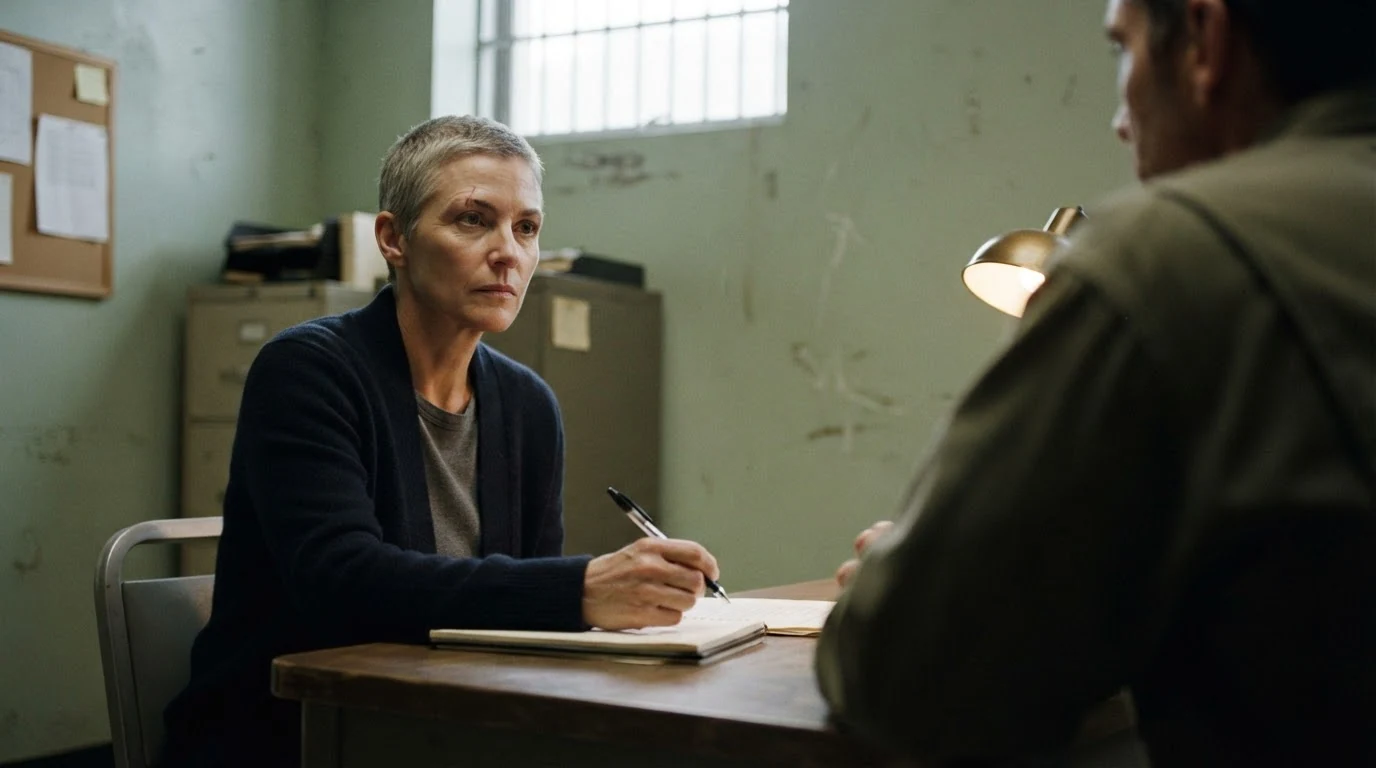
Medium close-up single at eye level, 75mm sets the size, height and lens the reverse must copy. Left third, facing screen right and looking just past the right edge of the lens fix screen direction and eyeline; without them models center the face and stare into the camera. The soft out-of-focus shoulder … at the right edge makes it a dirty single. The pen gives the video something to do from the first frame.
Open FlashBoardsCinematic film still, the reverse angle of a conversation in a small police interview room. Medium close-up single at eye level, 75mm lens. A man in his late twenties with a shaved head, a short red beard, a silver ring in his left ear and an olive work jacket sits on the right third of the frame, facing screen left, hands folded on the table, looking just past the left edge of the lens toward the woman across from him. At the left edge of the frame, the soft out-of-focus shoulder of a navy wool cardigan. Behind him a grey steel door and pale green walls; cool daylight from a window behind the camera falls flat on his face, the desk lamp on the table glows warm from screen left. Shallow depth of field, 35mm film grain.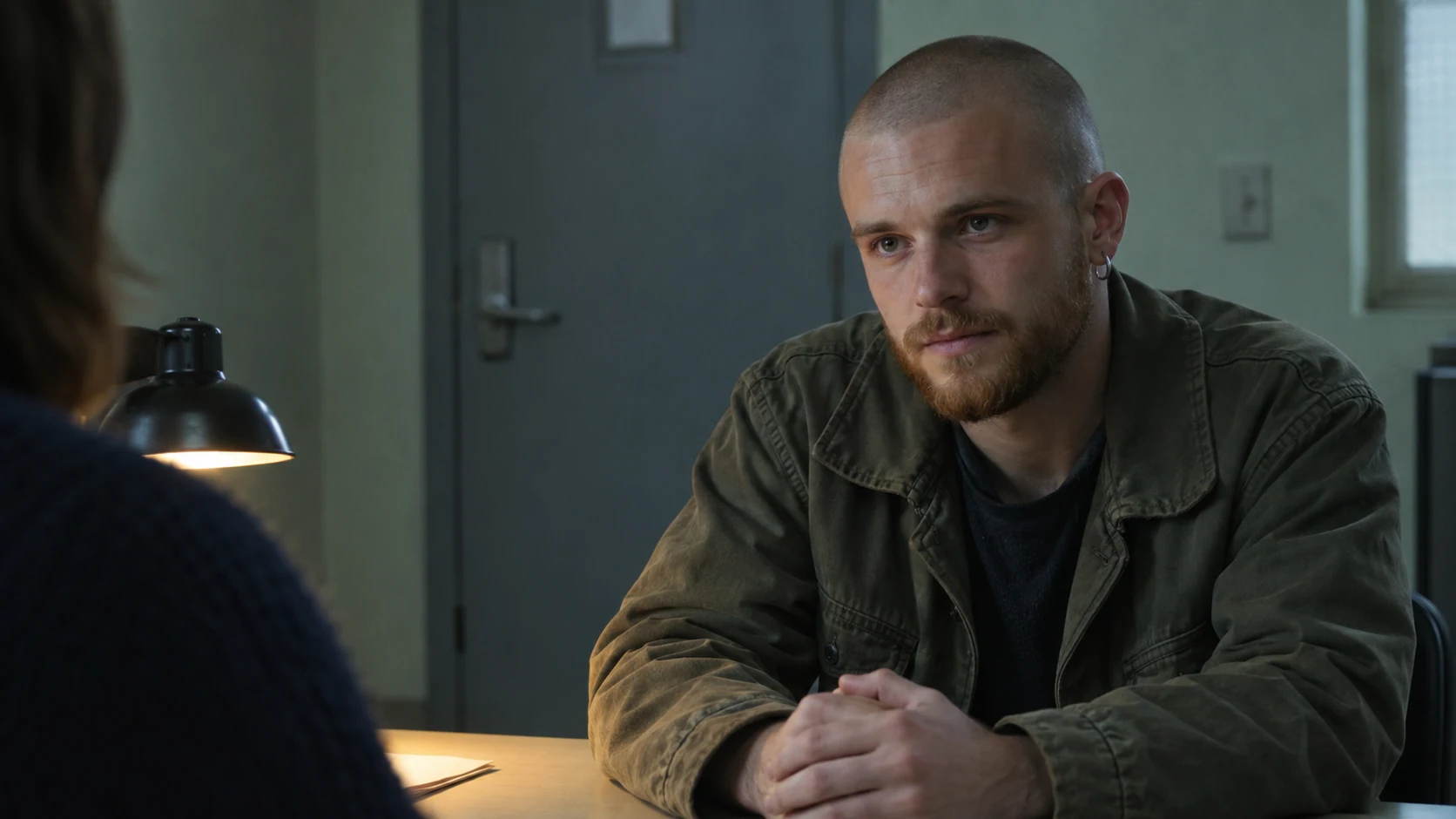
The other half of the pair. Size, height, 75mm, room and grain are repeated word for word; only direction flips: right third, facing screen left, shoulder at the left edge. The light is reasoned from the first frame: the window behind her is now behind the camera, and the lamp between them sits screen left. Put both images side by side on the board and check that the eyelines meet.
Open FlashBoardsCamera: locked off on a tripod at the detective's eye level, holding the same medium close-up from the first frame to the last, with the soft olive shoulder staying at the right edge of the frame. Action: the detective is already speaking as the shot begins, her eyes on the man just right of the lens, tapping the pen on the table. In the middle she stops, sets the pen down flat and leans forward a little, waiting for his answer. At the end she tilts her head slightly and holds his gaze, while the olive shoulder in the foreground shifts as he moves in his chair.The pattern is built in the edit, so the video needs only one living side. Locked off … holding the same medium close-up stops a drift into a push-in that would break the match with the reverse. Already speaking as the shot begins and the pen tap put motion into the first frames, and the shifting shoulder gives you a natural moment to cut.
Open FlashBoards{
"output": "Full-screen live-action conversation from The Game (1997), from its very first frame: three shots joined by two hard cuts, a shot reverse shot between two men in over-the-shoulder angles. 1990s 35mm film look with grain, 16:9 frame, a dim indoor viewing hall at a zoo on an overcast day: a wall of tall windows with heavy steel bars and wire mesh, flat cool daylight from outside backlighting the two men, dark interior, muted slate-blue, olive and charcoal palette.",
"characters": {
"S1": {
"name": "Nicholas Van Orton, played by Michael Douglas",
"look": "man in his early fifties, swept-back wavy gray-streaked hair, black turtleneck under a black jacket",
"voice": "low, hard, controlled anger"
},
"S2": {
"name": "Feingold, played by James Rebhorn",
"look": "tall thin man in his late forties, balding, short light-brown hair at the sides, pale face, olive-khaki zip rain jacket with the collar up over a dark patterned shirt",
"voice": "quick, nervous, placating"
}
},
"shots": [
{
"shot": 1,
"camera": "static, only a very slow slight drift, eye level, 50mm lens, over-the-shoulder medium shot: the back of S1's head and his dark shoulder fill the left third of the frame, soft in the foreground; S2 stands right of center, framed from the chest up, facing screen left toward S1; behind S2 the tall barred windows, at frame right a pale green wall and a crowd of schoolchildren in red, orange and blue jackets",
"action": [
"BEGINNING: alive from the first frame, S2 is already in the middle of his sentence, head turned three-quarters to screen left, eyes on S1's face, brows raised, talking fast; S1's head stays still with its back to camera.",
"THEN: S2's head swings a little toward frame center, then back to S1, still talking; his hands stay below the frame.",
"END: S2 finishes the sentence, head tilted slightly, eyes locked on S1; the children at frame right mill about in the background."
],
"dialogue": [
{
"speaker": "S2",
"on_screen": true,
"when": "from the first frame, already in the middle of his sentence",
"delivery": "fast, apologetic, half-justifying",
"line": "<d>[English] improvise a little. I mean, it's what I'm good at...</d>"
}
]
},
{
"shot": 2,
"cut_at": "00:02.120",
"camera": "reverse angle, static with a very slow slight drift, eye level, 50mm lens, over-the-shoulder medium close-up: S1 left of center, framed from the chest up, facing screen right toward S2; S2's olive shoulder and the back of his balding head fill the right third of the frame, soft and out of focus; behind S1 the barred window glows almost white with overcast daylight, his face in soft shadow",
"action": [
"BEGINNING: alive right after the cut, S1 looks straight at S2's face just right of the lens, brows raised, and starts speaking at once.",
"THEN: he leans his head slightly forward toward S2 as he presses the end of his sentence.",
"THEN: he stops, lips pressed together, lowers his chin a little and glares at S2 from under his brows, jaw set, no nod.",
"END: he holds that hard stare without moving while S2's blurred shoulder at frame right shifts slightly as S2 starts to answer."
],
"dialogue": [
{
"speaker": "S1",
"on_screen": true,
"when": "right after the cut to this shot, never before the cut",
"delivery": "low, hard, insistent",
"line": "<d>[English] I need to talk to who's in charge.</d>"
},
{
"speaker": "S2",
"on_screen": false,
"when": "at the very end of the shot, from behind his blurred shoulder, carried over the cut",
"delivery": "quick, placating",
"line": "<d>[English] Nobody <scenetrans></d>"
}
]
},
{
"shot": 3,
"cut_at": "00:05.960",
"camera": "back to the first angle: static, eye level, 50mm lens, the back of S1's head and dark shoulder soft in the left foreground, S2 right of center from the chest up, the schoolchildren at frame right; far behind the bars, small and soft, a white tiger paces in its enclosure",
"action": [
"BEGINNING: right after the cut, S2 faces S1 at screen left, finishing his short answer.",
"THEN: he turns his head to screen left into profile, still talking, his eyes sliding away from S1 toward the windows.",
"END: he keeps turning until the back of his head faces the camera, looking out through the bars, his voice trailing off; S1 stays still in the foreground."
],
"dialogue": [
{
"speaker": "S2",
"on_screen": false,
"when": "carried straight over the cut, finishing the same two words",
"delivery": "quick",
"line": "<d>[English] <scenetrans> knows.</d>"
},
{
"speaker": "S2",
"on_screen": true,
"when": "as he turns his head away toward the windows, still speaking as the video ends",
"delivery": "quieter, evasive, trailing off",
"line": "<d>[English] I mean nobody gets a big picture...</d>"
}
]
}
],
"sound": {
"ambience": "the hushed echo of a large indoor hall, soft chatter and shuffling footsteps of the schoolchildren in the background",
"speech": "exactly these spoken phrases, each said once, in this order",
"never_spoken": "no narration and no voice-over: the descriptions, performance notes and step words of this prompt are never spoken aloud",
"music": "a film score under the scene, always below the voices: a sparse, cold piano figure over low sustained strings with a faint uneasy pulse",
"subtitles": "none"
}
}Remakes the zoo-hall exchange from The Game (1997), dir. David Fincher, DP Harris Savides: the mirrored over-the-shoulder angles in A-B-A order, the film's own lines on the original cut points and Feingold turning away toward the bars at the end.
Each setup gets its own camera line: Van Orton's back in the left third with Feingold right of center facing screen left, then the mirror with the blurred olive shoulder on the right. The two cut_at values from the film are the only timing, and the film's own lines sit in the shot that holds them, with Nobody knows split across the second cut.
Common mistakes
- Eyes into the lens. Say which edge of the lens the character looks past, unless you want a point-of-view reverse.
- Both sides face the same way. Write the screen direction and mirror it: left third facing screen right, then right third facing screen left.
- The foreground partner turns into a second sharp face, or vanishes. Describe the shoulder as soft, out of focus, at the right edge, with its clothing.
- The two sides don't match. Copy the lens, height and light sentence word for word; change only direction and subject.
- Asking for a whip instead of a cut. A prompted camera move between two faces gives a smeared pan. Ask for a hard cut at a stated second, as in the fourth prompt, or generate each side separately and cut them together.
Keep the reference frames, prompts and every generated take side by side — images and video in one canvas.
FAQ
6 questionsWhat is a reverse angle shot?
A reverse angle shot looks back in the opposite direction from the previous shot, usually from roughly where the first subject stood. If shot A shows one character from the partner's side, the reverse angle shows the partner from the first character's side. Intercut, the two angles form a shot reverse shot, as long as both stay on the same side of the axis.
What is an example of shot reverse shot?
Almost every dialogue scene uses it. Well-known cases include the coffee-shop meeting in Heat (1995), played in matched over-the-shoulder shots across the table, and the conversations between Lecter and Clarice in The Silence of the Lambs (1991), where the reverses push the eyelines almost into the lens. Interrogation scenes, like those in Insomnia (2002), are a classic showcase.
Does shot reverse shot have to use over-the-shoulder shots?
No. Over-the-shoulder shots are the most common version because they keep both people in each frame, but the pattern can be built entirely from clean singles, dirty singles or point-of-view shots. What makes it a shot reverse shot is the pairing of opposing angles with matched eyelines, not a shoulder in the foreground.
How does the 180-degree rule apply to shot reverse shot?
The rule keeps both setups on the same side of an imaginary line through the two characters. One character then always looks screen right and the other screen left, so their eyelines seem to meet across the cut. If one setup crosses the line, both look the same way on screen and the viewer loses the geography.
What is shot-countershot?
Shot-countershot is another name for shot reverse shot, taken from the French champ-contrechamp and common in film theory and criticism. It means the same pattern: a shot of one character, a counter shot from the opposite direction on the other, and the alternation that makes separate setups read as one continuous conversation.
How do you make a shot reverse shot with AI?
Generate the two sides as separate images with nearly identical prompts: the same lens, shot size, camera height, room and light, with only the character and screen direction swapped. State where each person sits and which edge of the lens they look past. Compare both frames side by side on a FlashBoards board, animate each side, and cut them together.
Related terms
6- Over-the-Shoulder ShotCamera Shots
An over-the-shoulder shot looks at one character past the back of another's shoulder and head, keeping both in frame so a conversation feels connected and spatially anchored.
- Eyeline MatchEditing
An eyeline match cuts from a character looking off-screen to what they are looking at, with the gaze direction matched so the audience instantly reads the second shot as their view.
- 180-Degree RuleComposition & Framing
The 180-degree rule keeps the camera on one side of an imaginary line between two characters (or along a movement), so their left-right positions and eyelines stay consistent from shot to shot; crossing it flips the geography and disorients the viewer.
- CoverageDirecting & Staging
Coverage is the full set of shots filmed for one scene — master, singles, over-the-shoulders, inserts, reactions — that gives the editor choices of pace, emphasis and performance.
- Editing a Dialogue SceneEditing
Editing a dialogue scene means choosing when to show the speaker, the listener or both, and where to cut on lines, pauses and reactions so the conversation keeps its rhythm and subtext.
- Reaction ShotCamera Shots
A reaction shot cuts away from an action or line to show how another character responds — usually a close-up of their face — so the emotional meaning of the moment lands through the listener.
Further reading
Daniel Arijon, Grammar of the Film Language (1976). David Bordwell and Kristin Thompson, Film Art: An Introduction. Walter Murch, In the Blink of an Eye (2nd ed., 2001).