 FlashBoards Learn
Editing · Film language
Eyeline Match
Also called: eye-line match, eyeline cut
An eyeline match is a cut from a character looking off-screen to the thing they are looking at, with the direction and height of the gaze matched between the two shots. The audience reads the second shot as the character's view without being told, so attention, desire or dread passes from the face to the object.
- What it does
- Links a look to its target across a cut, so the viewer sees what the character sees and feels why it matters.
- Use it when
- A character notices something the scene depends on: a person entering, a clue, a threat, a face across the room.
- Watch out
- If the look goes frame right but the answering shot is staged from the wrong side or height, the connection breaks and the cut feels random.
- Try this prompt
Medium close-up, a woman with a silver buzz cut looks off-screen past the right edge of frame, eyes lifted, rain-lit train platform, 50mm
What is an eyeline match in film?
An eyeline match is a two-shot figure of editing. Shot one: a character looks at something outside the frame. Shot two: the thing itself. The match is geometric. If the character looks off frame right and slightly up, the second shot is framed so its subject sits where that look lands, seen from roughly the same side and height.
The second shot can be a true POV shot from the character's eye position or a neutral angle on the object, as long as the direction agrees. It is a core tool of continuity and of classical film editing. In dialogue it runs both ways: each person's eyeline must point where the other one is, which is why shot reverse shot coverage lives or dies on matched eyelines.
Why filmmakers use eyeline matches
It directs attention. A look is the strongest pointer in cinema. When an actor's eyes move, the audience wants to see what moved them, and the cut pays that off.
It puts us inside the character. Hitchcock built Rear Window (1954) on this pattern: Jeffries looks, we see a window across the courtyard, we return to his face.
It builds meaning between shots. Face and object color each other. That is the logic of the Kuleshov effect: the same neutral face reads as hunger or grief depending on what it seems to look at.
It builds suspense. Intercut a watcher and what they watch, and every return to the face asks whether they have seen the danger yet, as with Brody scanning the beach in Jaws (1975).
How to shoot an eyeline match
Decide the look before you light. Choose the side of the lens and the height of the target. A seated character looking at someone standing lifts the eyes; the answering shot then sits a little below the standing person's eye level, as if seen from the chair.
Give the actor a real mark. The scene partner, or tape on a C-stand, goes exactly where the object is in the story. For a close-up the mark usually sits 15 to 40 cm off the side of the matte box: tighter to the lens feels intimate, wider feels detached.
Keep one side of the line. The 180-degree rule applies to looks. A character looking frame right needs an answering subject that faces frame left. Cross the line and the two shots seem to look away from each other.
Match lens and height. Keep focal length and camera height consistent between the pair, and when several people watch one thing, make all their eyelines converge on one point.
Cut on the settle. Let the eyes land and hold for a few frames before cutting to the object; cut too early and the look has not registered.
Eyeline match vs. POV shot
A POV shot is a camera position: the lens stands in for the character's eyes. An eyeline match is an editing relationship: a look, then its object, matched in direction. A POV after a look is one kind of eyeline match, but many eyeline matches cut to an objective angle that simply agrees with the look.
Eyeline match vs. match on action
Both are continuity cuts. A match on action carries a movement across the cut; an eyeline match carries attention.
Eyeline Match in motion
7 clipsWatch the eyes first, then the cut. In each clip a look points out of the frame and the next shot answers it from the matching side and height, or the look and its target share one frame.
How to create a eyeline match with AI
4 promptsAn eyeline match needs two images that agree: the look and its target. Generate the watcher, then the object framed from the matching side and height and compare them side by side on one FlashBoards board before you animate. The fourth prompt re-shoots a real film shot from a text description alone, and the original plays next to the result so you can compare.
Cinematic medium close-up of a woman in her late fifties with a silver buzz cut, a thin pale scar through her left eyebrow and a mustard wool coat, on a rain-wet night train platform. She looks off-screen past the right edge of the frame and slightly upward, eyes fixed and alert, body turned toward frame left. Empty dark space on the right of the frame. 50mm lens at her eye height, cold sodium light from above, shallow depth of field.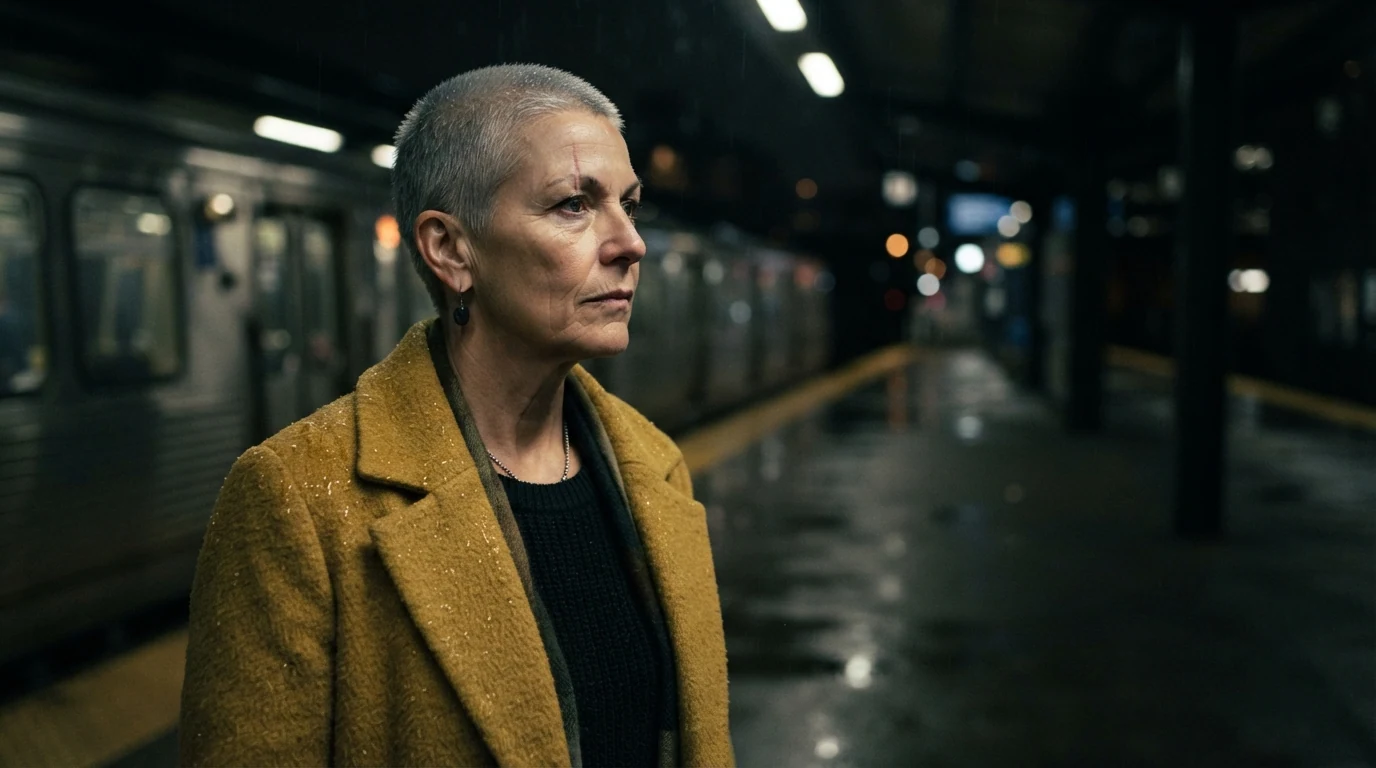
Past the right edge of the frame and slightly upward sets direction and height. Empty dark space on the right gives the look room, and 50mm at her eye height keeps the angle neutral.
Open FlashBoardsA large flip-style departure board hanging above a rain-wet night train platform, seen from a slightly low angle as if by a person standing below and to the left of it. The board fills the right two thirds of the frame, one line of white letters changing to a new destination. Cold sodium light, soft rain, 50mm lens.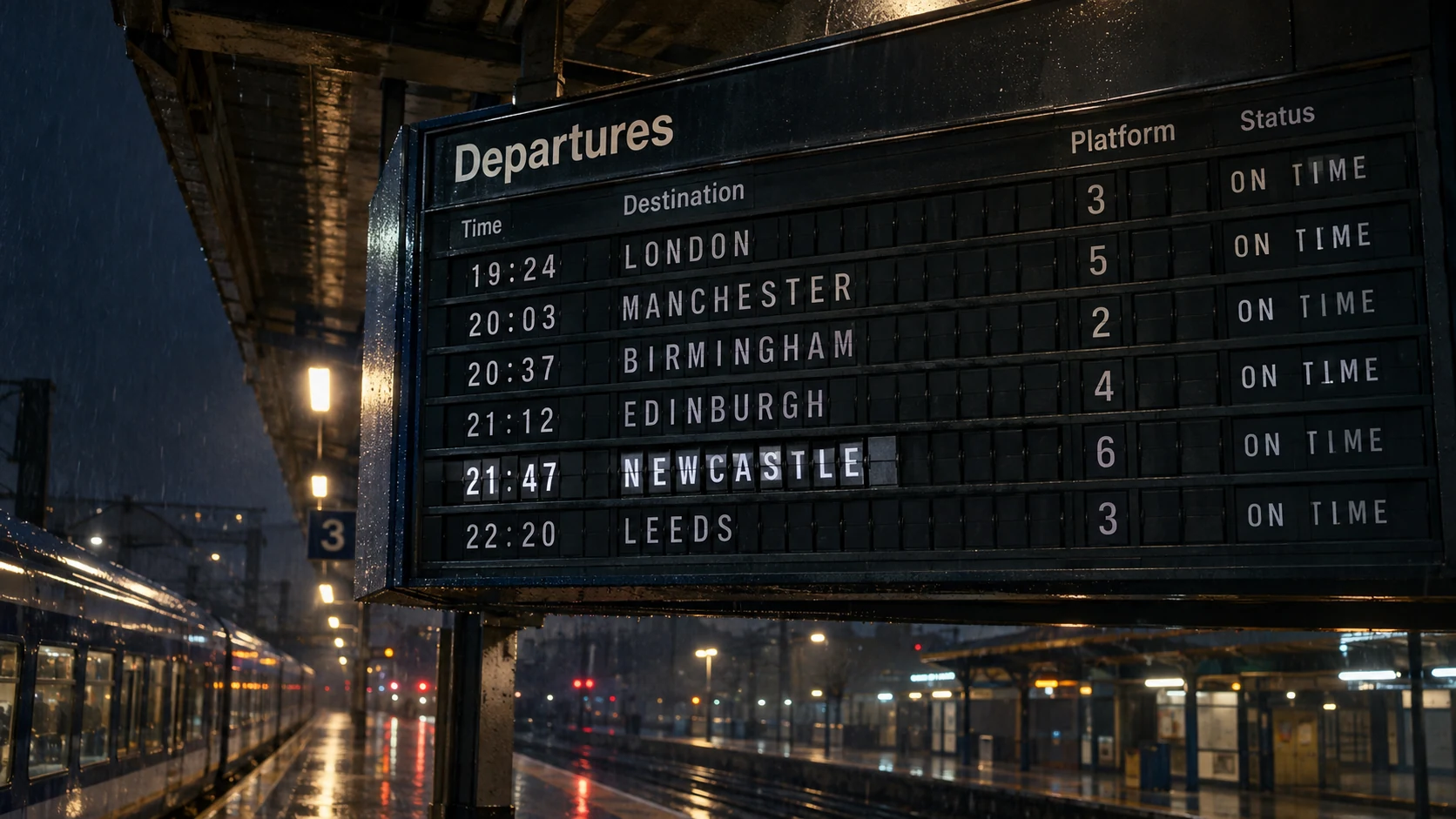
Low angle, from below and to the left is the matched geometry: she looked right and up. The same light and 50mm keep the pair from reading as separate setups.
Open FlashBoardsCamera: locked-off medium close-up at her eye height with a very slow push-in toward her face. Action: her head is already turning from frame left toward the right edge of the frame. Her eyes lift and land on a point beyond the right edge, slightly above her. She stops, holds the look, her jaw tightens and she draws one slow breath while rain keeps falling behind her.Already turning keeps the clip alive from frame one. Holds the look gives you the settle to cut on, straight into recipe 2.
Open FlashBoards{
"output": "Full-screen live-action scene from Up in the Air (2009), from its very first frame: two shots joined by one hard cut, an eyeline match across a restaurant table. 2000s 35mm film look, airport-hotel restaurant at lunchtime, soft even daylight from overhead, muted brown, charcoal and pale grey-green palette, framed landscape paintings on the wall, other diners soft in the background.",
"characters": {
"S1": {
"name": "Ryan Bingham, played by George Clooney",
"look": "man in his late forties, short salt-and-pepper hair, charcoal suit, white shirt, dark purple-and-grey striped tie",
"voice": "relaxed, warm, confident"
},
"S2": {
"name": "Natalie Keener, played by Anna Kendrick",
"look": "woman in her mid-twenties, dark brown hair pulled back in a ponytail, black suit jacket over a light blue collared shirt",
"voice": "brisk, curious, slightly impatient"
}
},
"shots": [
{
"shot": 1,
"camera": "seated eye level, medium shot of S1 alone at his side of the table, slightly right of centre, with a very slow slight pan left; a water glass and his plate in the lower foreground; S2 sits off-screen past the left edge of the frame, only her dark blurred shoulder edges into the far left border",
"action": [
"BEGINNING: alive from the first frame, S1 sits with his head tilted down and toward frame left, eyes on the table in front of him, already talking, both hands low near his plate.",
"THEN: he lifts his eyes and turns his face toward the left edge of the frame, his gaze landing on S2 just off-screen left at seated eye height.",
"THEN: he holds that look toward frame left while he keeps talking, head tilted a little, the corner of his mouth easing into a small smile; a waiter in dark clothes walks past behind him on the right.",
"END: he dips his chin slightly but keeps his eyes up on S2 off-screen left, lips closed, a knowing half smile."
],
"dialogue": [
{
"speaker": "S1",
"on_screen": true,
"when": "from the first frame, while he looks down and then lifts his eyes to her",
"delivery": "relaxed, matter-of-fact",
"line": "<d>[English] I plan on grabbing as many miles as I can.</d>"
}
]
},
{
"shot": 2,
"cut_at": "00:02.800",
"camera": "locked-off reverse angle at seated eye level, medium shot of S2 facing the camera left of centre, the dark blurred back of S1's head and shoulder filling the right foreground; a white-haired man in a suit eats at a table in the background behind her",
"action": [
"BEGINNING: S2 looks down at her plate, already speaking.",
"THEN: she lifts one hand on screen right to her mouth for a moment, then lowers it back to the table, eyes still down.",
"THEN: she raises her eyes and looks toward the right side of the frame, straight at the blurred back of S1's head in the right foreground, her gaze level at seated eye height.",
"END: her eyes stay locked on S1 toward frame right, eyebrows slightly raised as she asks; S1's hand rises into the lower right foreground."
],
"dialogue": [
{
"speaker": "S2",
"on_screen": true,
"when": "right after the cut to this shot, never before the cut; the question lands as her eyes lock on his",
"delivery": "brisk, curious",
"line": "<d>[English] Okay, you gotta fill me in on the miles thing. What is that about?</d>"
}
]
}
],
"sound": {
"ambience": "quiet restaurant murmur, cutlery on plates, a glass set down",
"speech": "exactly these spoken phrases, each said once, in this order",
"never_spoken": "no narration and no voice-over: the descriptions, performance notes and step words of this prompt are never spoken aloud",
"music": "a film score under the scene, always below the voices: light dry acoustic guitar over a soft, easygoing bass pulse",
"subtitles": "none"
}
}Remakes the lunch exchange in Up in the Air (2009): the prompt kept the verbatim lines, Ryan's lift of the eyes toward frame left, the cut at 2.8 s and Natalie's answering look toward frame right over his shoulder.
Toward the left edge of the frame for Ryan and toward the right side of the frame for Natalie give the two looks opposite directions, so they meet across the cut. Seated eye height in both shots keeps the level matched, and cut_at places the cut where the original has it.
Open FlashBoardsCommon mistakes
- Eyes drift into the lens. Name the target: "looks past the right edge of the frame" plus "body turned toward frame left".
- The answering shot ignores geometry. Without "seen from below and to the left", models frame objects dead-on at eye level and the cut stops matching.
- Light and lens change between takes. Repeat the lighting phrase and focal length in both prompts.
- The video pushes in on a still face. State the head turn as already happening in the first frame.
Keep the reference frames, prompts and every generated take side by side — images and video in one canvas.
FAQ
4 questionsWhat is an eyeline match in film?
An eyeline match is a cut from a character looking off-screen to the thing they are looking at. The direction and height of the look match the placement of the object in the next shot, so the audience reads the second shot as what the character sees.
What is an example of an eyeline match?
In Rear Window (1954), Jeffries looks out of his window and the film cuts to the apartments across the courtyard, then back to his reaction. In Jaws (1975), Brody's anxious looks at the water are intercut with swimmers. Neither scene needs a wide shot: the look alone places the object.
What is the difference between an eyeline match and a POV shot?
A POV shot is a camera placement that shows the scene from the character's eyes. An eyeline match is the editing relationship between a look and its object. It can cut to a POV shot, but also to a neutral angle on the object, as long as direction and height agree with the look.
How do you keep eyelines consistent when shooting coverage?
Stay on one side of the 180-degree line, give actors a physical mark where the other character or object is, and keep it at the right height and close to the lens for close-ups. Match focal length and camera height between the look and the answering shot, and check the pairs together before moving on.
Related terms
8- POV ShotCamera Angles
A POV shot shows exactly what a character sees by placing the camera at their eyes — usually right after a shot of them looking — so the audience shares their perspective, including movement, obstruction or distortion.
- Match on ActionEditing
Match on action cuts in the middle of a movement — a door opening, a punch, a glass raised — and continues it in the next shot from another angle, so the cut hides inside the motion.
- Shot Reverse ShotCamera Shots
Shot reverse shot alternates between two opposing camera setups — one on each character, typically over-the-shoulder shots or singles from the same side of the axis — so a conversation plays as a rhythmic back-and-forth.
- 180-Degree RuleComposition & Framing
The 180-degree rule keeps the camera on one side of an imaginary line between two characters (or along a movement), so their left-right positions and eyelines stay consistent from shot to shot; crossing it flips the geography and disorients the viewer.
- Kuleshov EffectEditing
The Kuleshov effect is the finding that viewers read the same neutral face differently depending on the shot cut next to it — food, a coffin, a child — so meaning comes from the edit, not the single shot.
- Screen DirectionComposition & Framing
Screen direction is the left-to-right or right-to-left way characters move and look across the frame; keeping it consistent between shots tells the audience where people are heading and who is chasing whom.
- Reaction ShotCamera Shots
A reaction shot cuts away from an action or line to show how another character responds — usually a close-up of their face — so the emotional meaning of the moment lands through the listener.
- ContinuityFilmmaking Process & Crew
Continuity is the consistency of every visible and audible detail — props, costume, hair, eyelines, positions, light, weather — across shots that were filmed out of order, so the edited scene reads as one unbroken moment.
Further reading
David Bordwell and Kristin Thompson, Film Art: An Introduction, chapter on continuity editing. Karel Reisz and Gavin Millar, The Technique of Film Editing (1968).