 FlashBoards Learn
- Learn
- Cameras & Capture
- Digital Cinematography
Cameras & Capture · Film language
Digital Cinematography
Also called: digital filmmaking, shooting digital
Digital cinematography is shooting motion pictures on an electronic image sensor instead of film stock. Light is converted to data, reviewed on set and graded in software. Since the early 2010s it has been the industry default, with cinema cameras like the ARRI Alexa, RED and Sony Venice.
- What it does
- Records the image as data: instant playback, long takes, clean low light and deep latitude for the grade.
- Use it when
- Almost always today; especially for night exteriors, long takes, heavy VFX or tight schedules.
- Watch out
- Digital clips highlights hard and looks sterile if you don't design its texture with lenses, light and grade.
- Try this prompt
night street, woman at a rain-wet bus stop, large-format digital cinema camera, clean low-light image, shadow detail visible, neon holds color
What is digital cinematography?
It is the whole craft of cinematography (lens, framing, light, movement) with one change at the gate: a CMOS sensor sits where the negative used to run. The camera writes what each photosite sees to a card as RAW data or a compressed codec.
There is no lab wait: the DP judges the real exposure on a calibrated monitor, and a take costs storage instead of stock. A digital cinema camera differs from a camcorder by its Super 35 or larger sensor, log and RAW recording, PL or LPL lens mount and dynamic range, today roughly 14 to 17 stops on high-end bodies.
How digital took over, and why filmmakers chose it
The shift took about a decade. The Celebration (1998) was shot on a consumer camcorder; Star Wars: Episode II – Attack of the Clones (2002) on a Sony 24p HD camera; 28 Days Later (2002) turned rough MiniDV into a look. Michael Mann's Collateral (2004) is the key artistic case: digital let the Los Angeles night sky read as a glowing sodium haze instead of black.
The ARRI Alexa arrived in 2010 and won over most DPs with skin tones and highlight handling close to negative. Roger Deakins shot Skyfall (2012) on it, the first Bond film captured digitally; Robert Richardson used it for the 3D of Hugo (2011). Avatar (2009) had already shown stereoscopic digital capture could carry a blockbuster.
What filmmakers get: unlimited takes, clean images at ISO 800 to 3200 so practical lamps can light a scene, exact monitoring, and footage that drops straight into VFX and virtual production.
How to shoot digital like a cinematographer
Record log or RAW. ARRI LogC, Sony S-Log3 or RED RAW keep the full sensor range in a flat image; a viewing LUT shows the intended look on set.
Expose for the highlights. A sensor holds detail until it clips to a flat edge, so protect windows, skies and skin highlights with false color or zebras. Knowing your camera's dynamic range tells you how far below a hot window a face can sit.
Work at native ISO. Most cinema cameras are cleanest at their base (often 800); dual-ISO bodies add a second base around 2500 to 3200 for night work.
Keep film motion. Shoot 24 fps with a 172.8° to 180° shutter (the 180-degree shutter rule) and set white balance in kelvin, not auto.
Design the texture. A clean sensor with modern glass can look clinical. DPs add character with vintage lenses, 1/8 to 1/4 diffusion filters, haze, and film grain or halation in the grade. On Dune (2021) Greig Fraser shot large-format Alexa, then printed the images to film and scanned them back.
Digital vs. film: what actually differs?
Resolution and stop counts are no longer the argument; behavior is.
- Highlights. Negative rolls off gradually and forgives overexposure; digital holds, then clips.
- Shadows. Digital sees deep into low light with fine noise; thin negative turns muddy.
- Texture. A film stock has grain that moves every frame; digital is clean unless you add it.
- Workflow. Film means lab processing, loaders and a scan; digital means cards, a DIT, backups and instant review.
- Color. Film bakes in the stock's palette; digital gives a neutral base, so more of the look is decided in the grade.
Film survives by choice: Christopher Nolan's Oppenheimer (2023) was shot on large-format film. For the pocket-sized version of digital capture, see iPhone cinematography.
Which cameras do professionals use?
Three families dominate high-end work: ARRI (Alexa 35, Mini LF, Alexa 65), prized for skin tone and highlight roll-off; RED (V-Raptor, Komodo), known for resolution and compact bodies; and Sony (Venice 2, Burano), with dual base ISO. Blackmagic, Canon and Panasonic cover the independent end.
The body matters less than sensor size, lenses and light. Super 35 gives the classic 35mm field of view; large format gives shallower focus and a wider view on the same lens. More in the cameras and capture hub.
How to create a digital cinematography with AI
3 promptsImage models default to an over-polished "cinematic" look, so describe digital cinematography by its qualities: clean low-light detail, protected highlights, natural skin and deliberate texture. In FlashBoards, keep references, generations and grade notes on one board and compare the clean and textured takes side by side.
Night exterior, medium close-up at eye level, 35mm lens: a fictional woman in her forties with close-cropped silver hair, a thin scar through her left eyebrow and a navy raincoat stands at a rain-wet bus stop. Warm sodium streetlight from above, cool light from a shop window on her left cheek, soft city lights far behind her. Shot on a large-format digital cinema camera at high ISO: clean low-light image, fine detail in her coat, shadow detail visible, bright shop sign holds its color, natural skin tones, modern clean digital look.
"Digital cinema camera at high ISO", "clean low-light image" and "shadow detail visible" describe what a sensor does at night. Two named light sources give it real practicals to see by.
Open FlashBoardsWide shot, 21:9: a fictional young man with a shaved head, heavy freckles and a sand-colored linen cloak walks along a desert dune ridge, harsh sun behind him and low in the sky. Large-format digital cinema camera, 40mm lens at chest height. Wide dynamic range: the bright sky keeps smooth gradation, soft highlight roll-off around the sun, the shadow side of his face stays readable. Muted ochre grade, subtle fine film grain added in post, gentle halation on the rim light.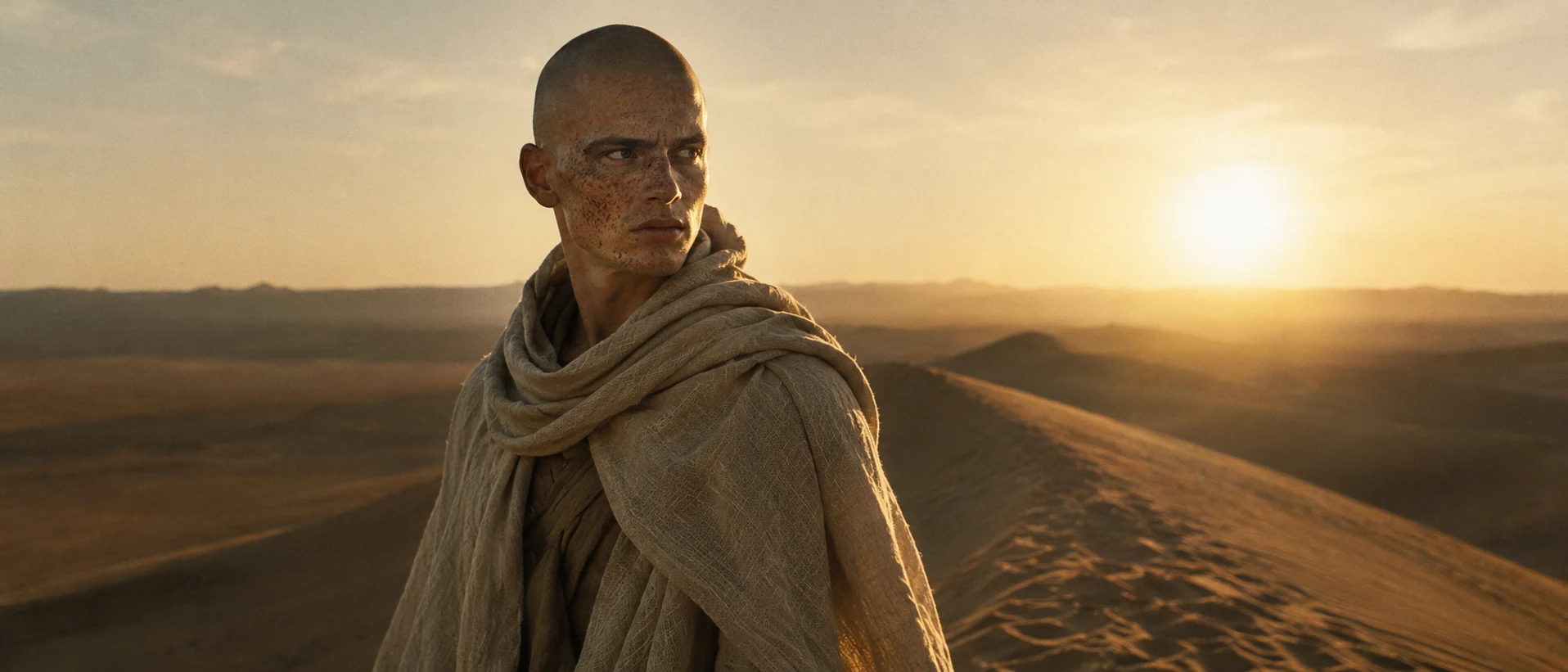
The textured take: "soft highlight roll-off" and "smooth gradation" ask for a modern sensor's range, while "film grain added in post" and "halation" add the organic layer DPs build into digital images.
Open FlashBoardsCamera: slow, steady push-in from medium close-up to close-up on her face, moving at a crawl for the whole shot. Action: from the first frame rain falls in bright streaks through the streetlight and the hem of her raincoat stirs in the wind. A sweep of white light passes across her face from the left and fades. She lifts her eyes toward the road and exhales a small cloud of breath. Natural 24 fps motion blur, clean dark shadows with detail.Rain and the moving coat make the shot alive from frame one; the passing light shows the clean low-light response, and "24 fps motion blur" keeps a film cadence.
Open FlashBoardsCommon mistakes
- "Cinematic" means teal-and-orange. The word alone pulls in heavy contrast and flares; name the light sources and the grade.
- "Film look" adds grain everywhere. For a clean digital image say "clean low-light image, fine detail"; add grain only as a named layer.
- Crushed night shadows. Write "shadow detail visible" and give the scene practical light.
- Camera brand names are weak levers. Describe what the sensor does: highlight roll-off, skin tones, noise.
- Video looks too smooth. Ask for "natural 24 fps motion blur" so motion reads as cinema.
Keep the reference frames, prompts and every generated take side by side — images and video in one canvas.
FAQ
5 questionsIs digital cinematography better than film?
Neither is better; they behave differently. Digital gives clean low-light images, instant review, cheap takes and an easy VFX pipeline. Film gives gradual highlight roll-off, organic moving grain and a color response baked into the stock. Most features shoot digital for practical reasons; directors who choose film do it for texture.
What was the first movie shot digitally?
Small films came first: the Danish The Celebration (1998) was shot on a consumer camcorder. Star Wars: Episode II – Attack of the Clones (2002) is usually named as the first major studio feature shot entirely on a 24p high-definition digital camera. In the early 2010s, with the ARRI Alexa and RED cameras, digital capture became mainstream for features and television.
What cameras are used for digital cinematography?
High-end productions mostly use ARRI Alexa models (Alexa 35, Mini LF, Alexa 65), RED cameras (V-Raptor, Komodo) and Sony Venice. Independent films and documentaries often use Blackmagic, Canon, Panasonic or Sony FX bodies. They share a Super 35 or larger sensor, log or RAW recording and cinema lens mounts.
What is log and RAW footage?
Log footage stores brightness on a logarithmic curve, so the image looks flat and gray but keeps the full highlight and shadow range for grading. RAW goes further and records the sensor data before most processing, letting you set white balance and ISO later. Both need a LUT or a grade to look normal and give the colorist the most room to shape the image.
Do movies still shoot on film?
Yes. A minority of productions still choose 35mm, 16mm or 65mm, for example Christopher Nolan's Oppenheimer (2023), for highlight handling, grain and the discipline of limited takes. Many digital productions imitate film instead by adding grain and halation or by printing digital images to film and scanning them back.
Related terms
6- Film StockCameras & Capture
Film stock is the light-sensitive celluloid a movie is shot on: a base coated with emulsion whose format (16, 35, 65mm), speed and color response shape grain, contrast and palette before any grading.
- Dynamic RangeLenses, Focus & Exposure
Dynamic range is the span between the darkest shadow and the brightest highlight a camera or film stock can record with detail, measured in stops; the wider it is, the less you lose to crushed blacks or blown-out windows.
- Film GrainCameras & Capture
Film grain is the random speckled texture of silver-halide crystals in developed film; faster stocks and push processing make it coarser, and digital productions add it back to soften the clean video look.
- iPhone CinematographyCameras & Capture
iPhone cinematography means shooting films on a smartphone — as Sean Baker did with Tangerine and Steven Soderbergh with Unsane — using add-on lenses, stabilisers and pro camera apps.
- White BalanceCameras & Capture
White balance tells the camera which color of light to treat as neutral white — about 3200K for tungsten, 5600K for daylight — so skin and whites look natural, or are pushed deliberately warm or cool.
- CinematographyCameras & Capture
Cinematography is the art of creating the moving image: the choices of camera, lens, framing, movement, light and exposure through which the director of photography turns a script into pictures.
Further reading
American Society of Cinematographers, American Cinematographer coverage of digital capture on Collateral, Skyfall and Dune; Blain Brown, Cinematography: Theory and Practice.