 FlashBoards Learn
- Learn
- Composition & Framing
- Tableau Shot
Composition & Framing · Film language
Tableau Shot
Also called: tableau, tableau vivant, painterly frame
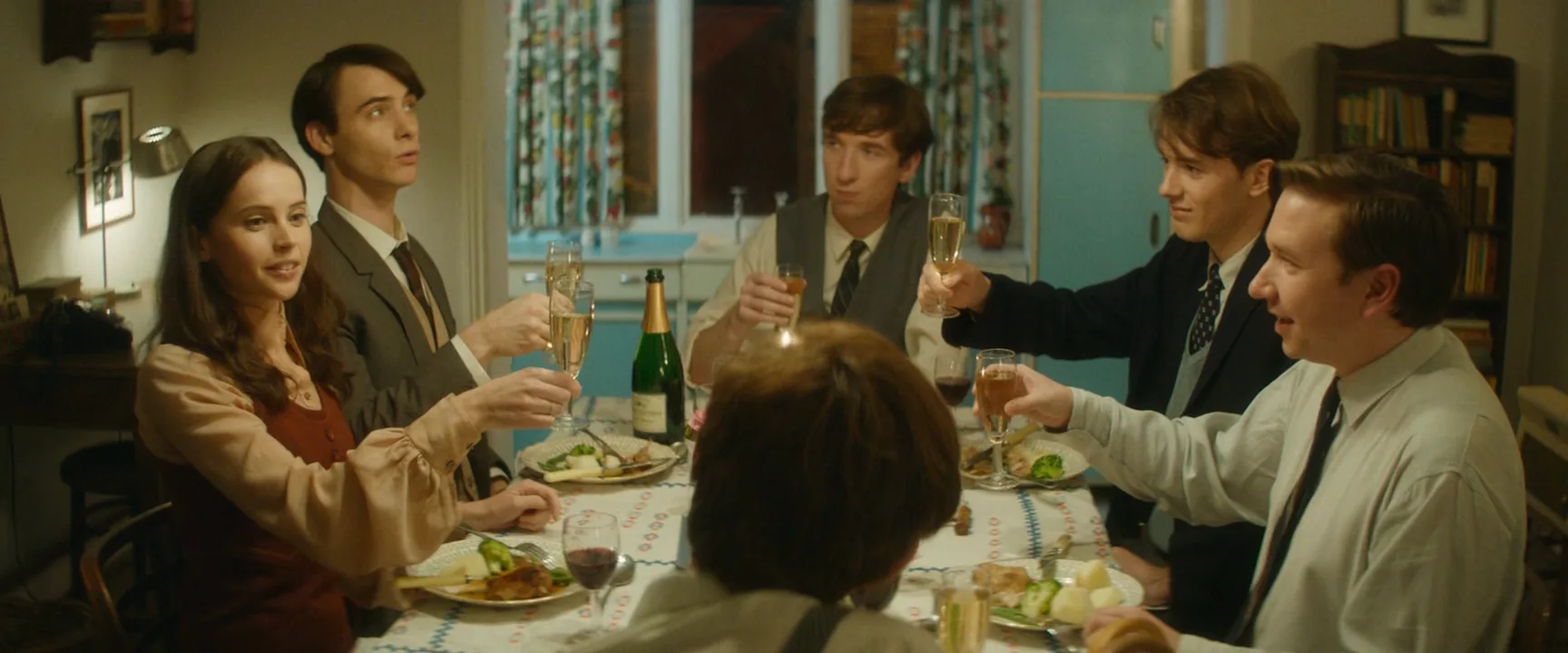
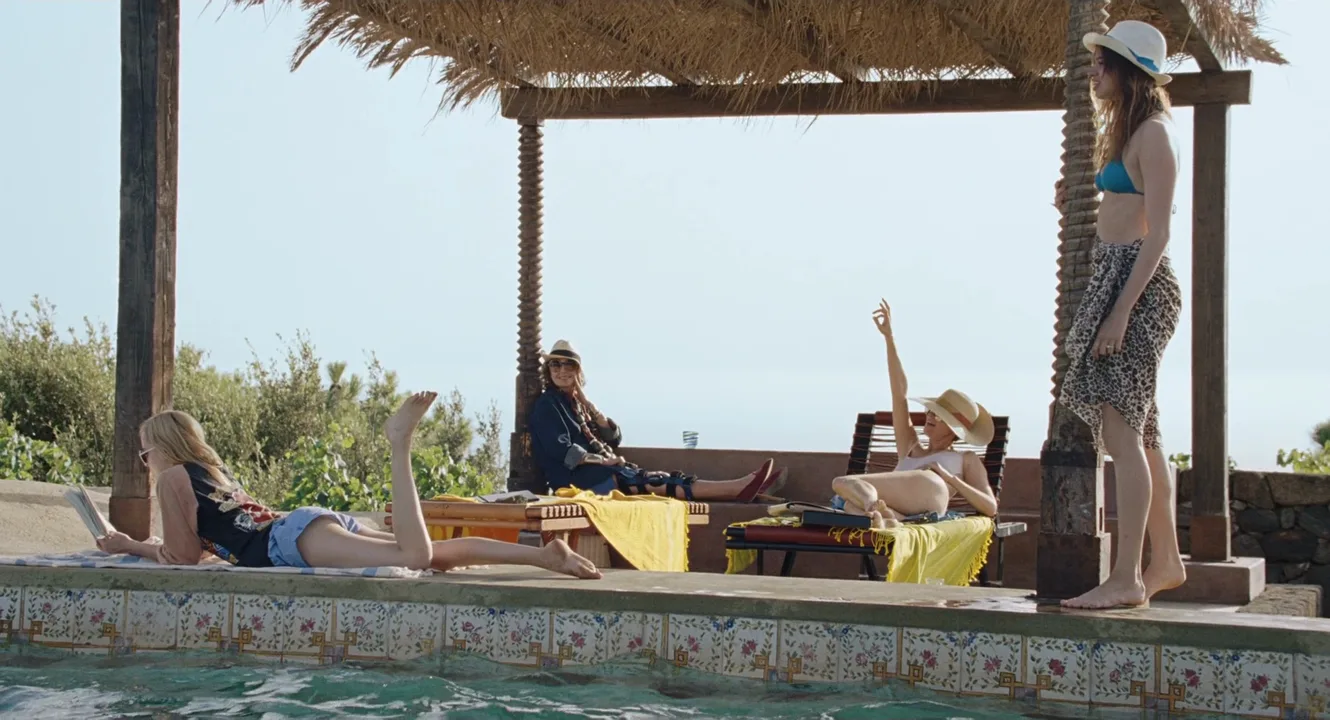
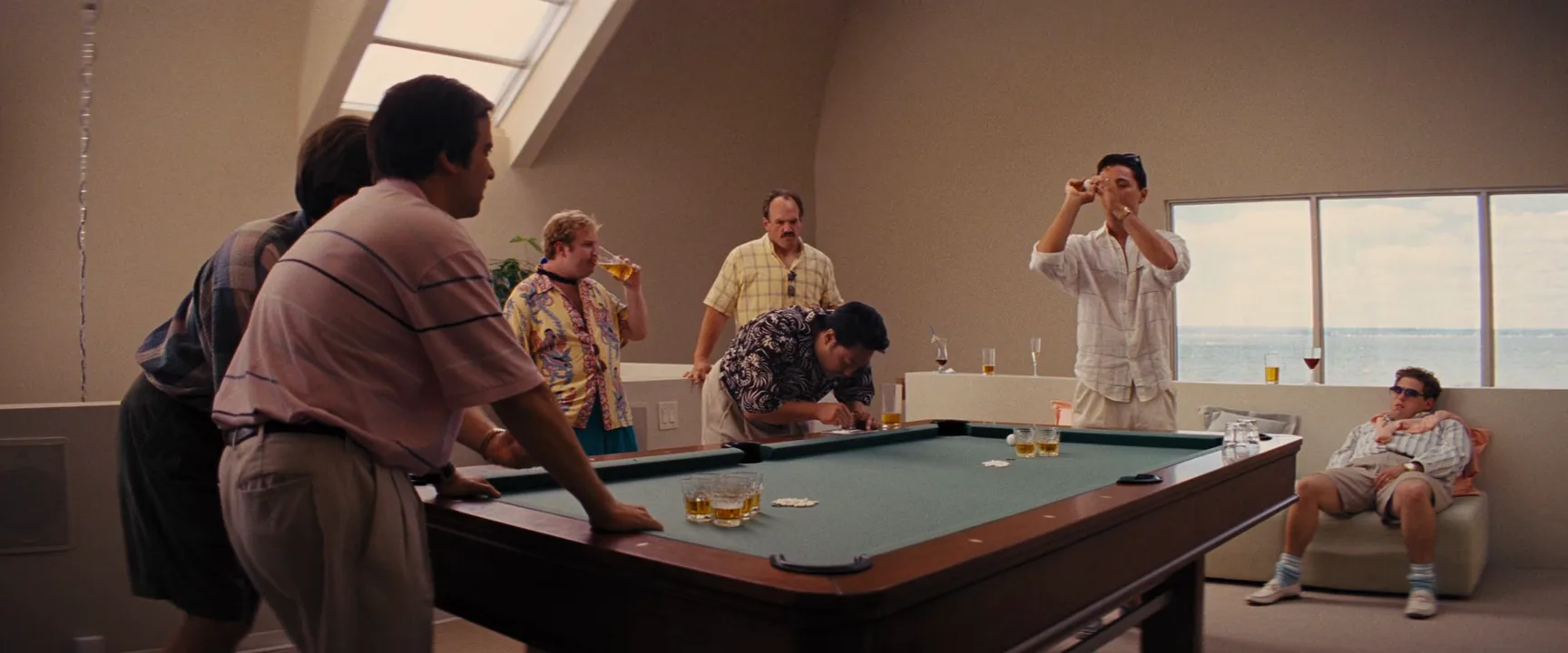
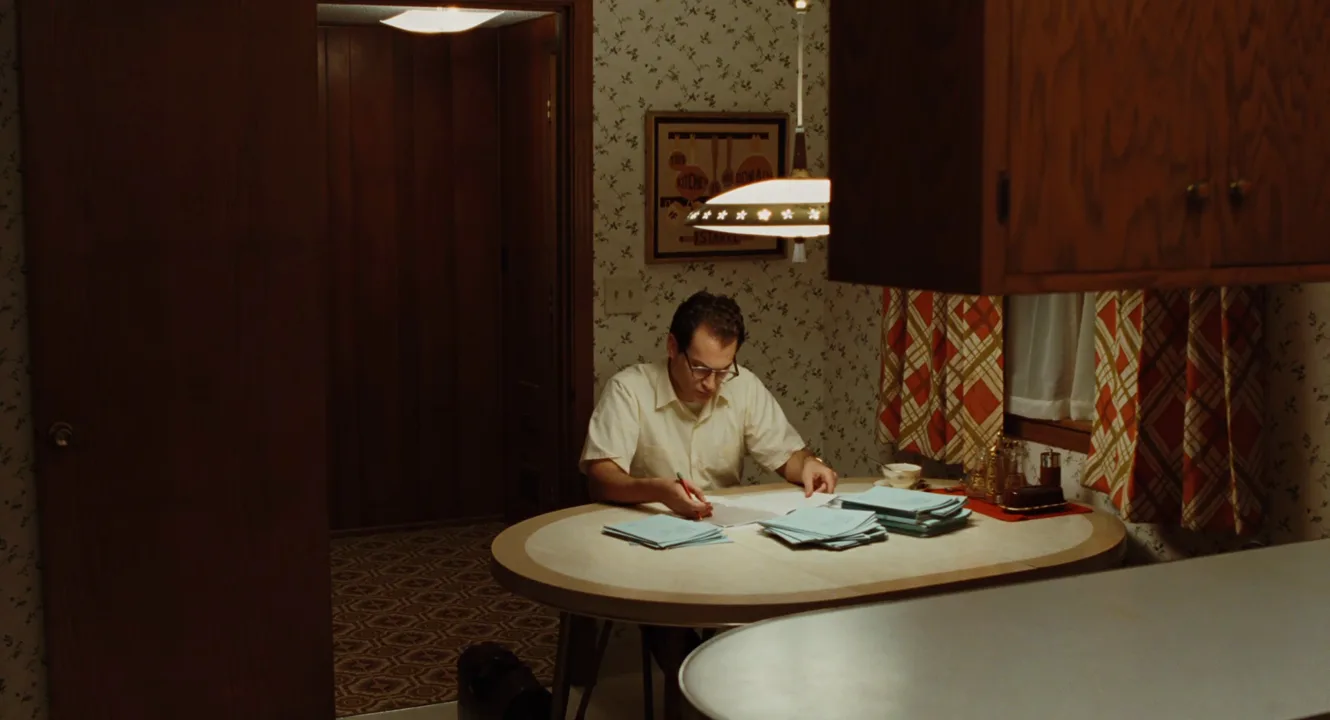
A tableau shot is a static, carefully arranged frame in which actors are posed across the set like figures in a painting, usually wide and square to the camera, so the whole composition reads as one picture. It slows the viewer down, keeps characters at a distance and turns a moment into an image.
- What it does
- Freezes a scene into one composed picture the viewer reads as a whole, often with ironic or ceremonial distance.
- Use it when
- A group, a ritual or a turning point should register as an image rather than as coverage.
- Watch out
- Without precise blocking and design it reads as a stiff wide shot; the arrangement is the whole point.
- Try this prompt
tableau shot, wide frontal frame, locked-off camera square to the back wall, five figures posed in a row facing the lens, flat even light, deep focus
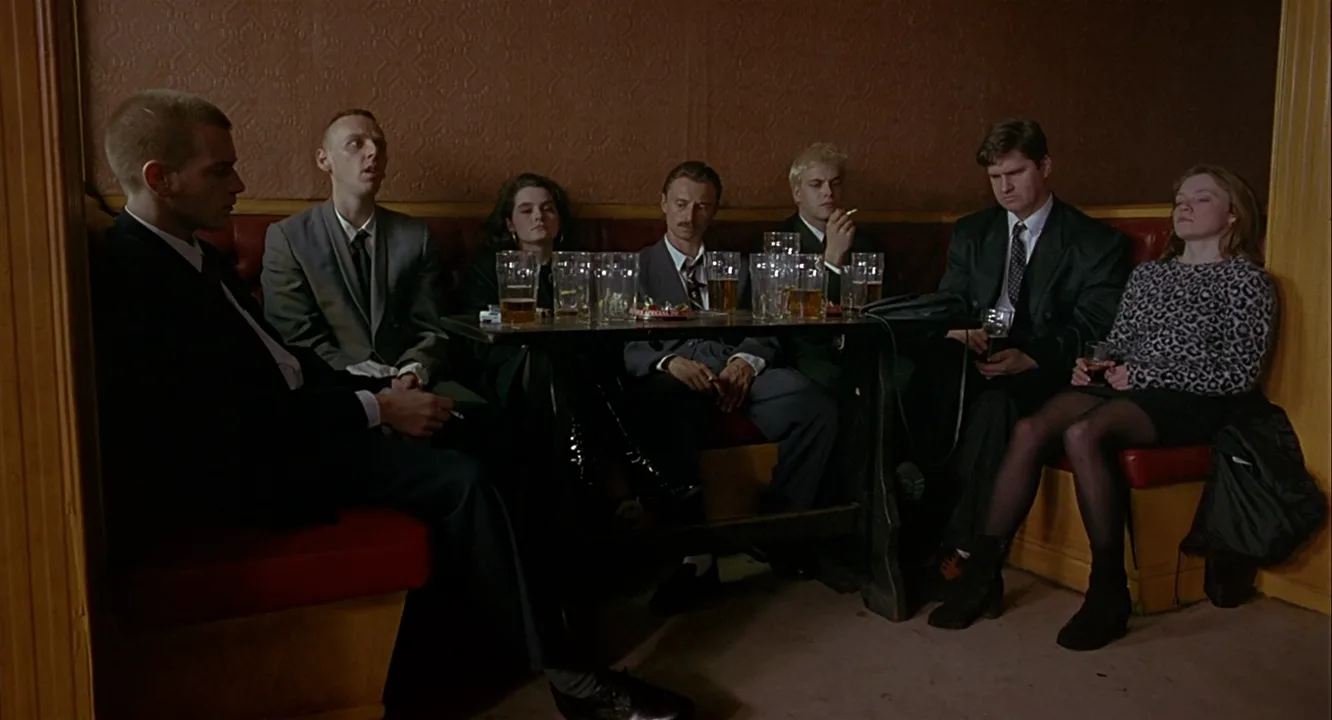
What is a tableau shot?
A tableau shot (French for "picture") is a frame built like a painting and then held. Four traits usually appear together:
- Stillness. The camera is locked off; the actors barely move.
- Frontality. The lens faces the back wall, so space reads in flat layers, not receding diagonals.
- Staged arrangement. Every position, pose and eyeline is chosen for the picture.
- Width. The frame holds the whole set and everyone in it.
It is pure mise-en-scène: meaning comes from where people stand, not from cutting or camera movement. It is a core composition tool, and it need not be symmetrical.
From tableau vivant to the tableau shot
The term comes from the tableau vivant, or "living picture": costumed people holding still to recreate a painting, a popular 19th-century salon and theater entertainment. Many films of the 1900s were chains of tableaux — a fixed camera at the distance of a theater seat, as in Georges Méliès's A Trip to the Moon (1902).
Once editing took over, the tableau became a deliberate style. Luis Buñuel arranged beggars into a mock Last Supper in Viridiana (1961); Sergei Parajanov built The Color of Pomegranates (1969) from frontal living pictures.
Why do filmmakers use tableau shots?
- Distance and irony. A still, frontal picture keeps the viewer out of a character's head. Roy Andersson plays whole scenes as single static tableaux in Songs from the Second Floor (2000).
- Deadpan comedy. In Wes Anderson's posed frames, one small gesture or mismatch becomes the joke.
- Reading a group. A tableau is a group shot with rules: who stands higher, who is isolated, who faces away.
- Ceremony. Dinners, weddings and verdicts gain weight when presented as a picture.
- Painterly reference. Stanley Kubrick's Barry Lyndon (1975) composes scenes like 18th-century canvases.
How to shoot a tableau shot
- Square the camera. Sensor parallel to the back wall, horizon level; a few degrees of pan bring back diagonals.
- Lens and distance. On Super 35, 25–40mm from 5–8 m holds a room without heavy distortion; for flatter planes, use 50–75mm and move back. Lens at chest or eye height.
- Deep focus. Stop down to f/5.6–f/8 so foreground and back wall stay sharp for deep focus.
- Block in planes. Two or three depth layers, no face covering another, bodies open to the lens. Blocking here means poses and marks, not paths.
- Light evenly. Soft, broad light keeps every figure readable; one brighter pool marks the center of attention.
- Hold it. Five seconds or more lets the eye scan the frame; one head turning becomes an event.
Tableau shot vs. static shot
A static shot describes only the camera: no pan, tilt, move or zoom. A tableau describes the staging: posed figures arranged frontally into one picture. Almost every tableau is static, but most static shots are not tableaux — a locked-off close-up is ordinary coverage.
The test: would the frame work as a painting with the sound off? Many tableaux use symmetry, but a lopsided arrangement held square to the lens still qualifies.
Tableau Shot in motion
3 clipsThese loops show tableau shot in motion, where a still frame can't: watch how the effect plays out over a few seconds.



Tableau Shot stills
5 framesEight frames where staging turns a scene into one picture.
How to create a tableau shot with AI
4 promptsImage models default to an angled snapshot, so spell the tableau out: camera square to the back wall, posed facing the lens, deep focus. In FlashBoards, keep the film frames and your takes on one board and compare them side by side. The fourth prompt re-shoots a real film shot from a text description alone, and the original plays next to the result so you can compare.
Tableau shot, cinematic film still. Wide frontal frame of a pale green motel porch, camera square to the wall, perfectly level, chest height, 32mm lens, deep focus. Four fictional figures posed facing the lens: an old man with a white walrus mustache in a wicker chair; a tall red-haired woman in a yellow sundress beside him; a freckled boy with a bowl cut on the steps holding a tin lunchbox; a young man with round glasses in the doorway holding a folded map. White sheets on a laundry line at right. Soft overcast light, faded pastel palette.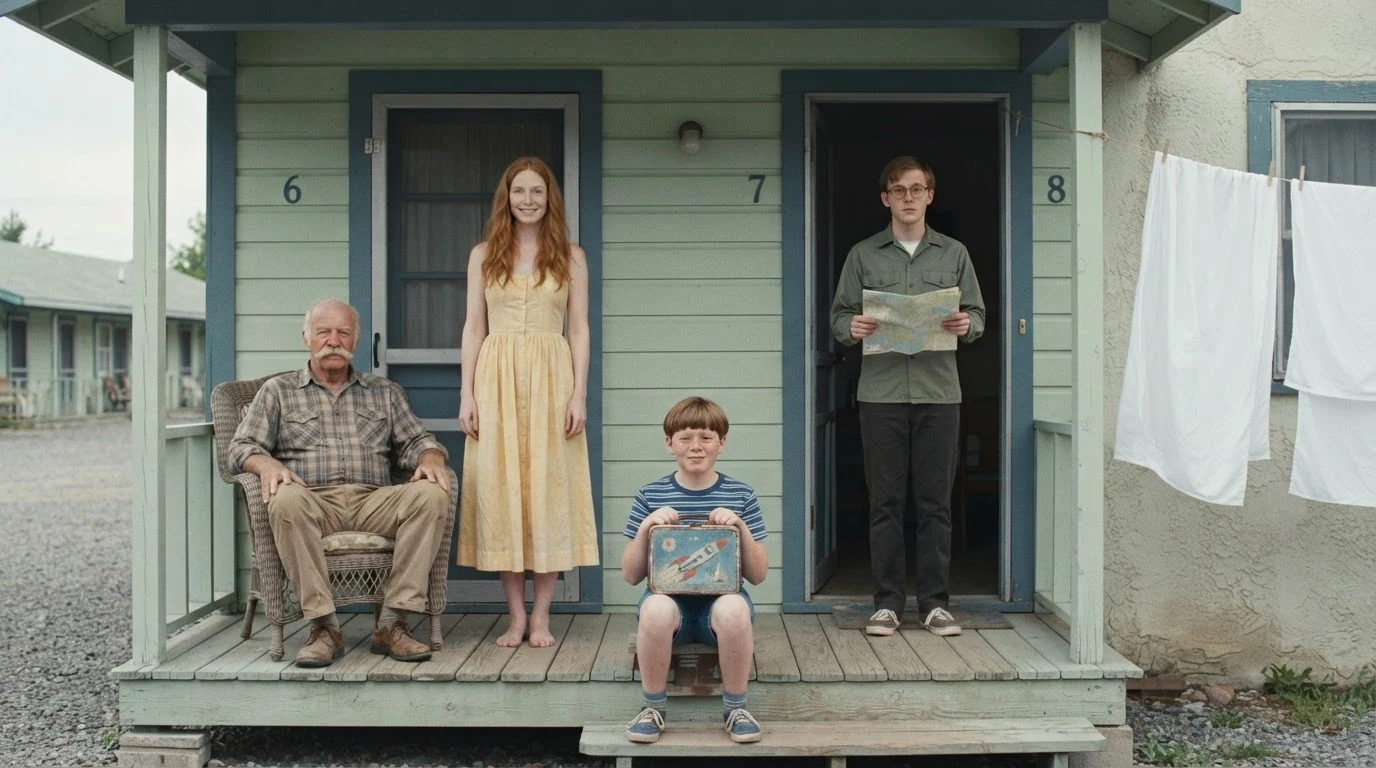
Camera square to the wall and perfectly level flatten the space into planes; posed facing the lens and a place for each figure make it an arrangement, not a snapshot.
Open FlashBoardsPainterly tableau, anamorphic film still. A long banquet table seen dead-on, camera locked off at seated eye height, 50mm lens, deep focus. Seven fictional guests on the far side face the camera like a group portrait, frozen mid-toast: a bald man with a silver goatee at center, a young woman with a black bob and scarlet collar, twin gray-haired sisters in lace. Candles on white linen, dark paneled wall, soft window light, amber and oxblood palette.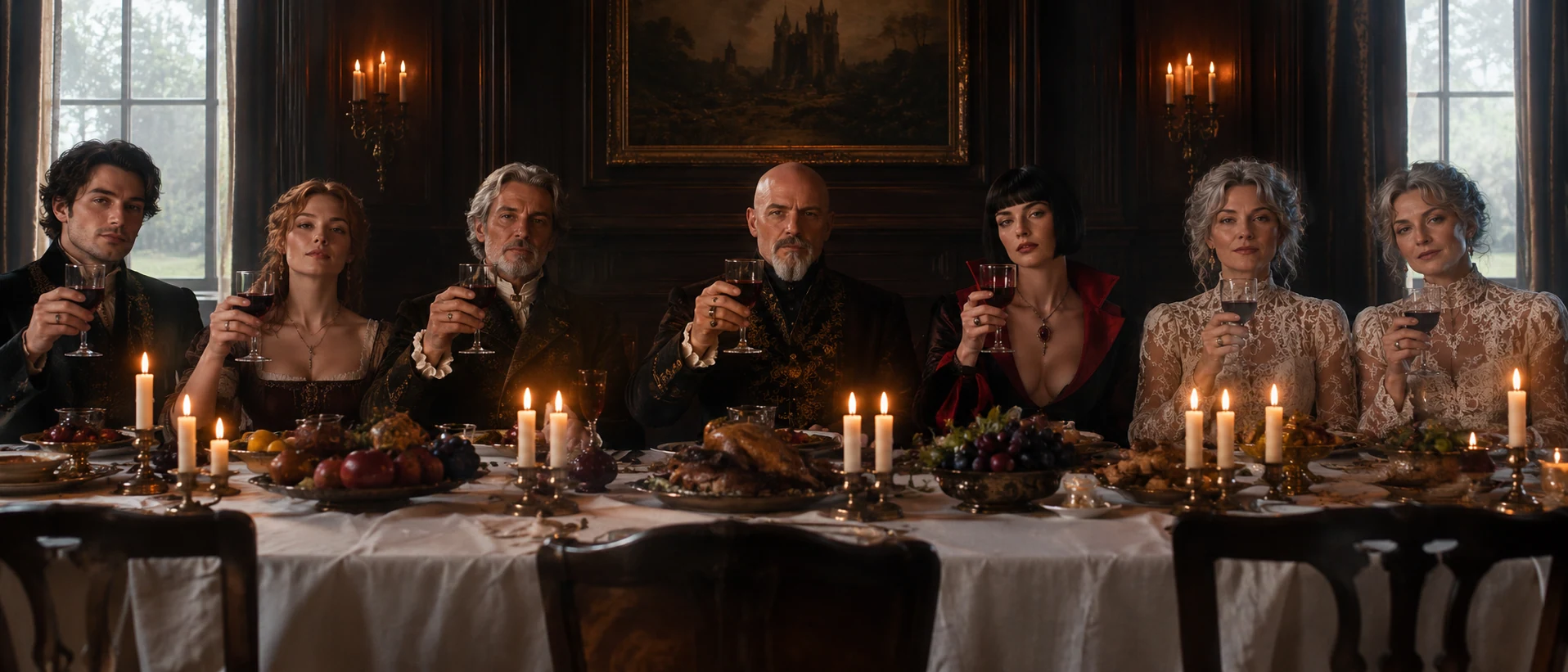
The 21:9 frame and seen dead-on make the table a horizontal frieze; frozen mid-toast makes everyone hold a pose.
Open FlashBoardsCamera: completely static, locked off on a tripod, the frame stays exactly as it is. Action: The white sheets on the laundry line are already rippling in a breeze and the freckled boy swings his feet. The old man slowly turns his head toward the red-haired woman, who keeps looking into the lens. At the end the young man lowers the map and everyone is still again.The frame stays exactly as it is stops a slow push-in. Rippling sheets and swinging feet start at frame one, so the held picture is alive.
Open FlashBoards{
"output": "Full-screen live-action 35mm film footage from Trainspotting (1996), one continuous shot from its very first frame, no cuts: a tableau shot in a dim Edinburgh pub back room after a funeral. Warm low tungsten light, brown wood panelling, red banquette, muted brown and oxblood palette, soft grain.",
"characters": {
"S1": {
"name": "a mourner in a black suit",
"look": "short fair hair, dark suit, sitting at the far left edge nearest the lens, turned in profile toward the table",
"voice": "silent"
},
"S2": {
"name": "a mourner in a grey suit",
"look": "shaved head, grey suit, seated second from left on the banquette",
"voice": "a rough Scottish male voice, singing a pub song"
},
"S3": {
"name": "the row of mourners",
"look": "five more people in dark funeral clothes along the red banquette behind a low table crowded with pint glasses and whisky tumblers; at right a young woman with fair hair, patterned blouse and black tights, legs crossed",
"voice": "silent"
}
},
"shots": [
{
"shot": 1,
"camera": "locked-off wide frontal frame at seated height, square to the back wall, deep focus; a very slow dolly in with a slight pan left across the whole shot, the group stays centred",
"action": [
"BEGINNING: alive from the first frame, seven mourners sit in one line on the red banquette facing the lens like a group portrait, the table of glasses between them and the camera, the man in the black suit in profile at the left edge",
"THEN: the man in the grey suit tilts his head back and sings with his eyes half closed while the others sit still, hands in laps",
"THEN: the fair-haired woman at right leans her head back against the wall, eyes toward the ceiling; a blond man at centre lifts a cigarette to his mouth",
"THEN: the camera has crept closer, the man in the black suit on the left drifts toward the frame edge",
"END: everyone holds their pose in the row, nobody stands, the frame stays a frozen portrait of the table"
],
"dialogue": [
{
"speaker": "S2",
"on_screen": true,
"when": "from about the first second, sung slowly",
"delivery": "sung, drunk, mournful",
"line": "<d>[English] Climb up here, Tommy, don't be dying</d>"
},
{
"speaker": "S2",
"on_screen": true,
"when": "after a short pause, the second half of the shot",
"delivery": "sung, drunk",
"line": "<d>[English] I can go just as fast with two</d>"
}
]
}
],
"sound": {
"ambience": "quiet pub room tone, a glass set down on the table",
"speech": "exactly these sung phrases, each sung once, in this order",
"never_spoken": "no narration and no voice-over: the descriptions, performance notes and step words of this prompt are never spoken aloud",
"music": "a film score under the scene, always below the voices: a slow, low elegiac organ chord held softly",
"subtitles": "none"
}
}Remakes the pub-wake shot from Trainspotting (1996): the row of mourners on the red banquette, the sung lines and the slow creep in.
The action steps keep every mourner in one row facing the lens, and locked-off frontal frame, square to the back wall holds the portrait while only the slow creep moves.
Open FlashBoardsCommon mistakes
- Angled set. Repeat camera square to the back wall, perfectly level.
- Candid chaos. Write posed, facing the lens and give each figure a place.
- Shallow focus. Add deep focus, everything sharp.
- Push-in in video. Say the frame stays exactly as it is and start small motions at frame one.
- Extra people. List every figure.
Keep the reference frames, prompts and every generated take side by side — images and video in one canvas.
FAQ
5 questionsWhat is a tableau shot in film?
A tableau shot is a static, usually wide and frontal frame in which actors are arranged like figures in a painting. The camera holds still, the poses are deliberate and the composition reads as one picture. Directors use it for distance, deadpan comedy, ceremony or painterly reference.
What is a tableau vivant in film?
A tableau vivant, or living picture, is a staged scene in which costumed people hold still to recreate a painting or historical moment. In film, the term describes scenes that restage a painting with actors, or frames so posed and motionless that they work as living pictures.
What is tableau composition?
Tableau composition arranges figures and set in flat layers parallel to the lens, each person placed for the picture rather than for natural movement. The camera faces the main plane, focus is deep and the frame is held. It may be symmetrical, but posed staging matters more.
Which directors are known for tableau shots?
Roy Andersson builds whole films from static single-shot tableaux. Wes Anderson uses frontal, posed frames throughout his work, as in Asteroid City (2023). Sergei Parajanov's The Color of Pomegranates (1969) is made of living pictures, and Kubrick's Barry Lyndon (1975) composes scenes like period paintings.
Is a tableau shot the same as a wide shot?
No. A wide shot is a shot size showing full figures and their surroundings. A tableau is a way of staging: a held, frontal frame with figures posed as one picture. Most tableaux are wide, but a moving-camera wide shot with actors walking naturally through it is not one.
Related terms
6- Static ShotCamera Movement
A static shot keeps the camera completely still — locked off on a tripod or dolly with no pan, tilt, zoom or move — so all the energy comes from actors, light and composition inside the frame.
- SymmetryComposition & Framing
Symmetry arranges the frame so its left and right halves mirror each other around a central axis — architecture, props and actors in matched positions — creating order, formality and sometimes an uncanny, controlled world.
- Center FramingComposition & Framing
Center framing puts the subject on the vertical center line of the frame, giving it instant dominance and a formal, confrontational or claustrophobic feel; unlike symmetry, the two sides need not mirror each other.
- Group ShotCamera Shots
A group shot holds several characters in one frame as a unit, letting the audience read their positions, hierarchy and reactions at once instead of cutting between singles.
- Mise-en-ScèneFilm History & Theory
Mise-en-scène is everything placed and arranged in front of the camera — setting, props, costume, makeup, lighting, and the actors' positions and movement — and how it is composed in the frame to create meaning.
- BlockingDirecting & Staging
Blocking is the planned choreography of actors and camera within a scene — where people stand, when they move, how they relate in space — so that movement itself tells the story and gives the editor usable shots.
Further reading
David Bordwell, Figures Traced in Light: On Cinematic Staging (University of California Press). Bruce Block, The Visual Story (Focal Press).