 FlashBoards Learn
- Learn
- Film History & Theory
- Genre Iconography
Film History & Theory · Film language
Genre Iconography
Also called: iconography, visual iconography
In film studies, iconography is the set of recurring objects, costumes, settings and star images that tell you a film's genre at a glance: the Stetson, six-shooter and open desert of the western, the fedora, trench coat and rain-slick street of film noir. Audiences read these icons before a word is spoken.
- What it does
- Signals the genre in a single frame and switches on everything the audience expects from it.
- Use it when
- You need the audience oriented fast, or you want to play with genre by borrowing, mixing or subverting its images.
- Watch out
- Pile on too many icons and the frame turns into a costume party or a parody. Three to five well-chosen ones read as genre.
- Try this prompt
Wide film still, a weathered frontier woman in a sand-colored Stetson and canvas coat beside a saddled horse on a dusty main street, false-front saloon, low sun, long shadows, 16:9.
What is iconography in film?
Iconography is the visual vocabulary a genre shares across hundreds of films: the part of genre conventions you can see and point at.
The word comes from art history, where Erwin Panofsky used it for identifying the stock subjects of paintings, like a saint recognized by the objects he holds. Edward Buscombe, writing in Screen in 1970, described the western's visible "outer form": settings, clothes, weapons, horses. Colin McArthur's Underworld U.S.A. (1972) sorted gangster-film iconography into the look of the actors, their milieu and their technology (guns, cars, telephones).
So in film theory, "iconography" rarely means crucifixes and stained glass. It means the recurring images that make a western look like a western.
Genre iconography examples
| Genre | Costume | Props and technology | Settings | |---|---|---|---| | Western | Stetson, gun belt, spurs, duster | Six-shooter, rifle, horse, stagecoach | Desert, one-street town, saloon | | Gangster | Pinstripe suit, fedora | Tommy gun, black sedan, telephone | Speakeasy, nightclub, city at night | | Film noir | Trench coat, fedora, evening gown | Revolver, cigarette, whiskey glass | Office with venetian blinds, wet street, neon | | Gothic horror | Cape, nightgown | Crucifix, candelabra, stake, coffin | Castle, crypt, foggy graveyard | | Science fiction | Spacesuit, uniform | Ray gun, robot, control console | Spaceship, alien planet, laboratory |
Most icons are props and costumes, so genre is often decided in the art department. Light can be iconographic too: hard shadow through blinds is as much a noir icon as the fedora.
Stars work the same way. By the 1940s John Wayne on horseback meant western, and Humphrey Bogart in a trench coat meant the compromised hero of The Maltese Falcon (1941) and Casablanca (1942). Critics call this the star image.
Why does genre iconography matter?
It is instant exposition. A dusty street, a hitching rail and a holstered revolver tell the audience the era and the rules of violence in one wide shot.
It sets expectations the plot can pay off or betray. A six-shooter in the first act promises a showdown, and it carries every earlier western's ideas about law and violence with it. Rick Altman's 1984 "semantic/syntactic" approach to genre frames it well: iconography is the genre's semantics, its building blocks; the plot structures that arrange them are its syntax. Keep the blocks, change the syntax, and the audience feels the shift.
How filmmakers borrow and subvert iconography
- Revision. Italian spaghetti westerns kept the guns and the desert but dirtied the heroes with stubble, ponchos and dusters. Unforgiven (1992) keeps the classic icons and makes the gunfighting ugly and sad.
- Transplanting. Blade Runner (1982) moves noir's trench coat, rain, neon and blind-slatted light into a science-fiction city. Star Wars (1977) gives its cantina a western gunslinger with a low-slung holster.
- Exaggeration. Blazing Saddles (1974) piles up western icons until they become jokes.
The rule behind all three: the icon must stay recognizable, or nobody feels the bend.
How to build iconography into your film
- List the icons by category: costume, props, vehicles, settings, light. Keep the three to five that do the most work.
- Put them in the first images. The establishing wide and the hero's entrance decide the genre. A hat brim or long coat should read even when the figure is small in frame.
- Age them. A new Stetson looks like a souvenir; sweat stains, dust and a bent brim make it belong to a person.
- Twist one. Keep most icons classic and change one. The change is your film's voice.
In FlashBoards, build a genre mood board with reference frames grouped by those categories, generate test frames beside it, and check whether each reads as the genre without a caption.
Genre iconography vs. symbolism
Iconography is shared: a fedora means noir because hundreds of films taught audiences to read it that way. Symbolism is usually built inside one film: the sled in Citizen Kane (1941) means something because that film gives it meaning.
Iconography tells you which world you are in; symbols tell you what this story is about. Push an icon hard enough within one film, like a hat lost and found again, and it becomes that film's symbol too.
How to create a genre iconography with AI
3 promptsModels know genre icons, but only if you name them. "Cowboy" gets a costume-shop outfit; "sand-colored Stetson with a sweat-stained band" gets a western. Build the frame from specific objects, a setting and a genre light, keep the people invented, and compare takes against your reference frames on the same FlashBoards board.
Wide shot, cinematic western film still. A weathered woman in her fifties with a long grey braid and a thin scar on her chin stands beside a saddled dun horse on a dusty frontier main street. She wears a sand-colored Stetson with a sweat-stained band, a canvas coat and a revolver in a worn leather holster. Behind her: a wooden false-front saloon, a hitching rail, a water trough. Low late-afternoon sun from the left, long shadows, dust in the air. 35mm lens at waist height, fine film grain.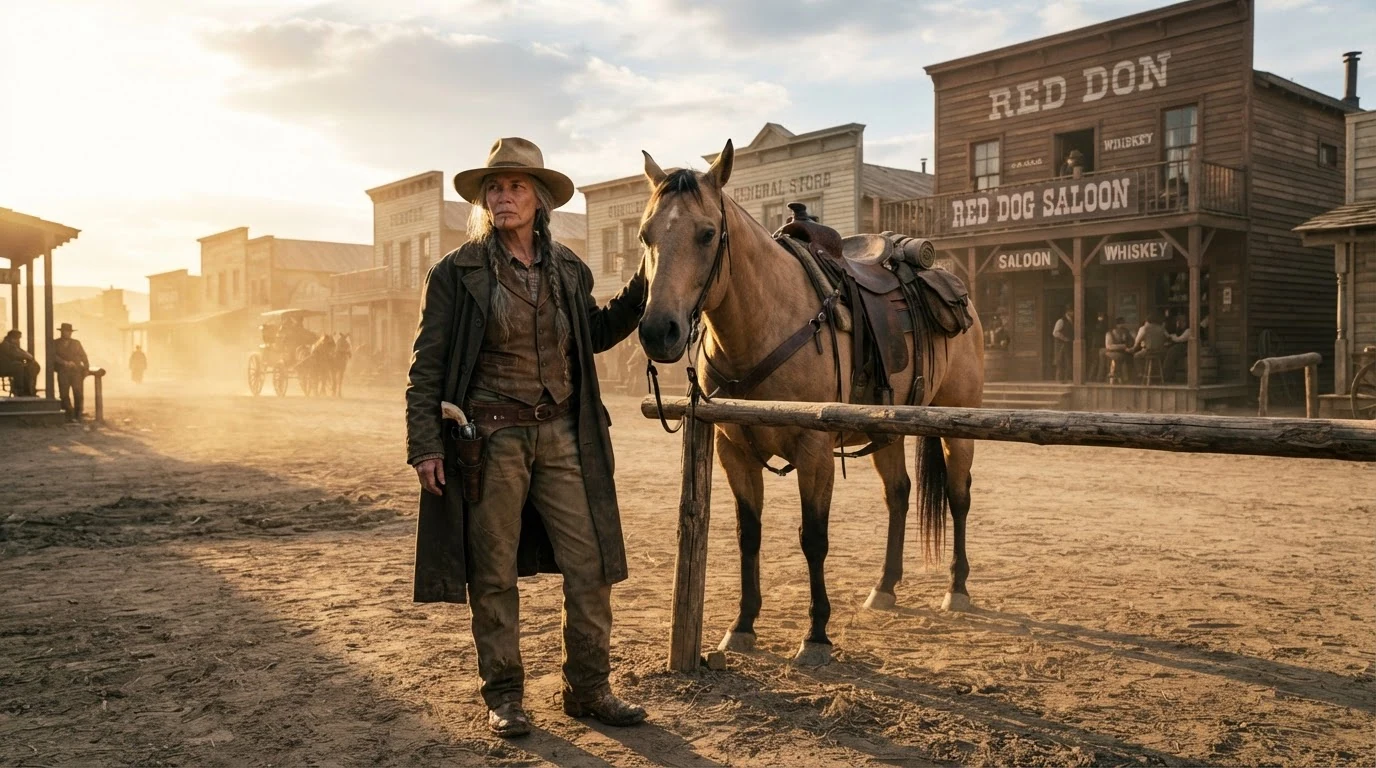
The genre lives in the nouns: Stetson, holster, false-front saloon, hitching rail, dun horse. Together they say western without the word "cowboy". Low sun and hanging dust add the genre's light; the braid and scar make her an invented person.
Open FlashBoardsCinematic film still, tech-noir: a rain-slick street in a near-future city at night. A tall detective in her thirties with a sharp black bob and a silver nose ring stands under a streetlight, hands in the pockets of a belted tan trench coat, a dark grey fedora tilted low. Red and cyan neon reflects in puddles, steam rises from a grate, a small police drone with a white searchlight hovers above. Hard low-key light, anamorphic 40mm lens at eye level.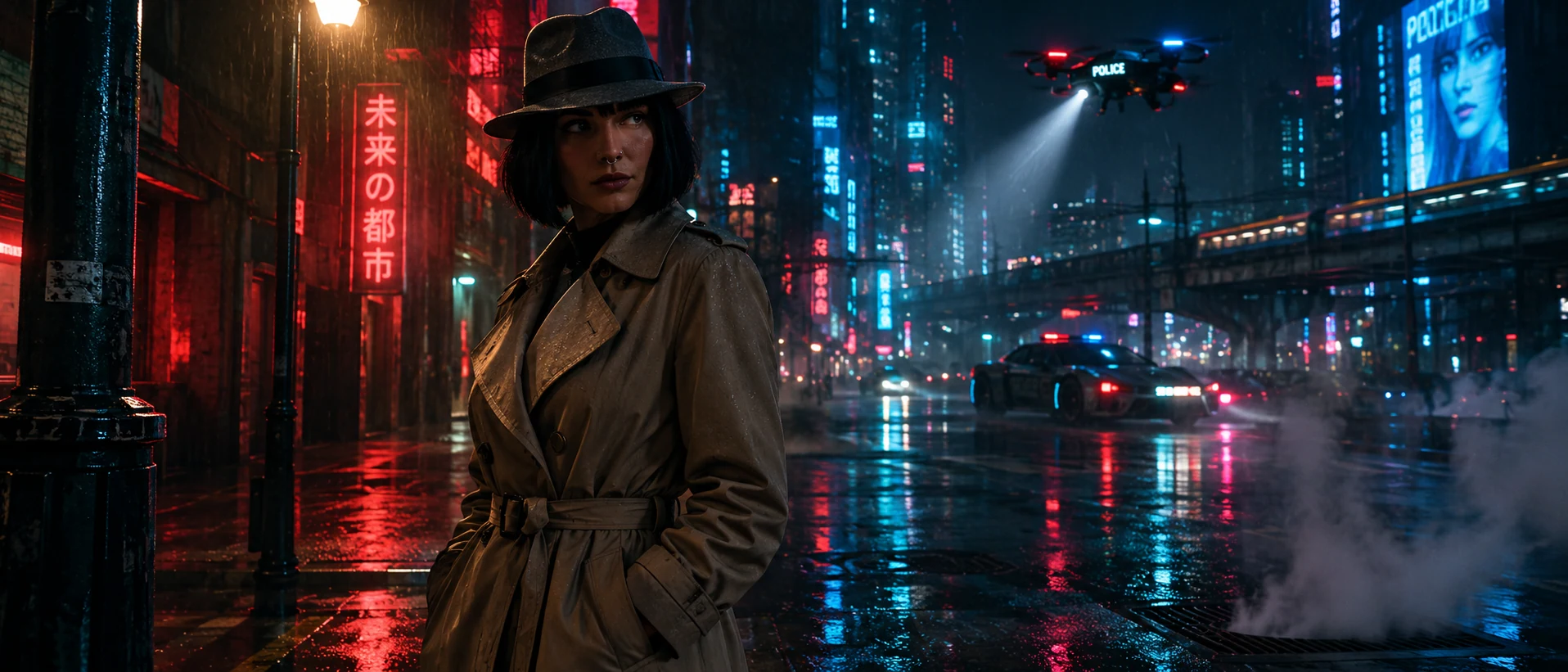
A second take that transplants iconography, as Blade Runner did: trench coat, fedora, rain-slick street, neon, hard low-key light are noir; the drone is science fiction.
Open FlashBoardsCamera: a slow push-in at walking pace, from the wide to a medium-wide of the woman and the horse. Action: From the first frame the horse stamps a hoof and swishes its tail while dust drifts across the street. The woman pulls her Stetson brim lower, takes the reins and swings up into the saddle. She turns the horse and it walks away down the street.Motion starts in the first moment (hoof, tail, dust), so the shot doesn't become a slow zoom on a still. The action uses only what the frame shows, and riding out of town is itself a western icon.
Open FlashBoardsCommon mistakes
- Era drift. Zippers, sunglasses and modern denim creep in. Name period materials: canvas, wool, leather.
- Costume-party look. Clean icons look fake; ask for sweat stains, dust and frayed edges.
- Icon overload. Every western object at once reads as parody.
- Star likeness. Never write "like John Wayne"; describe an invented face.
Keep the reference frames, prompts and every generated take side by side — images and video in one canvas.
FAQ
4 questionsWhat is iconography in film?
Iconography in film is the set of recurring costumes, props, settings, vehicles and star images an audience associates with a genre. A Stetson and a six-shooter signal a western; a fedora, trench coat and wet neon street signal film noir. Because viewers have seen these images across many films, they read the genre instantly.
What are examples of genre iconography?
Westerns: cowboy hats, revolvers, horses, saloons, desert. Gangster films: pinstripe suits, tommy guns, black sedans. Film noir: trench coats, venetian blind shadows, rain-slick streets. Gothic horror: castles, crucifixes, coffins, fog. Science fiction: spaceships, ray guns, robots. Star images count too, like John Wayne on horseback.
What is the difference between iconography and genre conventions?
Genre conventions are everything an audience expects from a genre: plot patterns, character types, themes, music and images. Iconography is the visual part, the objects, costumes and places you can see in the frame. A final showdown is a western convention; the six-shooters and empty main street are its iconography.
Is iconography the same as mise-en-scène?
No. Mise-en-scène is everything placed in front of the camera in one film: set, costume, props, lighting, actors and blocking. Iconography is the subset of those choices that repeats across a whole genre and carries shared meaning, so a genre film's mise-en-scène draws on it deliberately.
Related terms
5- Genre ConventionsGenres
Genre conventions are the recurring settings, characters, plot moves, images and sounds an audience expects from a genre; filmmakers follow, bend or break them to meet or subvert those expectations.
- SymbolismStorytelling
Symbolism is using a concrete object, color, place or action to stand for an abstract idea — a key, a staircase, rain, a red coat — so the image carries meaning beyond itself.
- Movie PropProduction Design
A prop is any movable object an actor handles or uses on screen — a gun, a letter, a cup, a sled — as opposed to set dressing, which only furnishes the space.
- Costume DesignProduction Design
Costume design is the creation of everything a character wears, from silhouette and fabric to color and wear-and-tear; the costume designer uses clothing to tell us who a character is, what era they live in and how they change.
- Film NoirFilm Movements & Styles
Film noir is the cycle of 1940s–50s American crime films — named by French critics — defined by fatalistic plots, morally compromised heroes, femmes fatales and low-key black-and-white lighting full of hard shadows.
Further reading
Edward Buscombe, "The Idea of Genre in the American Cinema", Screen (1970). Colin McArthur, Underworld U.S.A. (1972). Rick Altman, "A Semantic/Syntactic Approach to Film Genre", Cinema Journal (1984).