 FlashBoards Learn
Genres · Film language
Spaghetti Western
Also called: Italian western, Euro-western
A spaghetti western is an Italian-made western from the 1960s and 70s, the wave led by Sergio Leone. Mercenary gunmen, ritual violence, sun-bleached Spanish deserts and Ennio Morricone's scores define it, along with a signature cut from vast wide shots to extreme close-ups of squinting eyes that stretches every duel into opera.
- What it does
- Turns the western into a slow, operatic ritual of greed and revenge, told in huge landscapes and enormous faces.
- Use it when
- You want a showdown, a stranger arriving in town, or a moral vacuum to feel mythic, tense and a little ironic.
- Watch out
- The look is more than ponchos and dust; without long holds, hard sun and the wide-to-eyes cutting pattern it reads as costume.
- Try this prompt
Italian western, 2.35:1, extreme close-up of a squinting gunslinger's eyes under a hat brim, hard noon sun, sweat and dust, 35mm grain
What is a spaghetti western?
The spaghetti western is the Italian western boom that ran from roughly 1964 into the mid-1970s: several hundred films, usually Italian productions or Italian-Spanish-German co-productions, shot in the deserts of Almería in southern Spain, around Rome and in studio backlots, then dubbed for every market. It is one of the most recognizable national variations in the history of film genres.
Italian and Spanish westerns existed before 1964, but the boom starts with Sergio Leone's A Fistful of Dollars (1964), an uncredited reworking of Akira Kurosawa's Yojimbo (1961) that led to legal action. Its success produced Leone's Dollars trilogy (For a Few Dollars More, 1965; The Good, the Bad and the Ugly, 1966), his epic Once Upon a Time in the West (1968) and Duck, You Sucker (1971), plus a flood of films by other directors.
- Sergio Corbucci made it muddier and crueler: Django (1966), with its coffin-dragging stranger, and The Great Silence (1968), set in snow.
- Sergio Sollima and Damiano Damiani turned it political with The Big Gundown (1967) and A Bullet for the General (1966), a "Zapata western" set during the Mexican Revolution.
- Enzo Barboni turned it toward slapstick in They Call Me Trinity (1970).
The name started as a critics' jab at cheap foreign imitations. Italians called them western all'italiana. Today the label is used with affection, and the Leone films are counted among the best westerns ever made.
What makes a western a spaghetti western?
Every genre runs on shared genre conventions. The Italian version kept the props of the Hollywood western (horses, saloons, pistols) and changed almost everything they meant.
- The hero is a mercenary. The Man with No Name works for whoever pays. The Italian western made the anti-hero the default: bounty hunters, bandits and avengers, all motivated by money or revenge, rarely by law or community.
- Violence is ritual. Duels are staged as ceremonies, with circling, waiting and staring, and the shooting itself lasts seconds.
- The world is filthy. Stubble, sweat, flies, cracked lips, rotting towns. Costumes are dusters and ponchos, worn and sun-faded.
- Mexico and the border. Many plots cross into Mexico or the Revolution, with bandits, federales, church bells and Catholic imagery.
- Irony and black humor. Characters bargain over corpses; comic cruelty sits next to grief.
- Music as a character. Ennio Morricone's film score for the Leone films mixes whistling, electric guitar, wordless voices, whip cracks and bells. In Once Upon a Time in the West the harmonica theme works as a leitmotif tied to one man and one memory, and it keeps playing until the flashback finally explains it.
Dialogue is sparse. Faces, music and silence carry scenes that a Hollywood western would have explained in words.
Sergio Leone style: how the spaghetti western was shot
Leone's films were photographed by Massimo Dallamano (A Fistful of Dollars, For a Few Dollars More) and Tonino Delli Colli (The Good, the Bad and the Ugly, Once Upon a Time in the West), mostly in Techniscope: a two-perforation 35mm process that used ordinary spherical lenses and printed the image to about 2.35:1. It gave a scope frame cheaply, which is why so many Italian westerns look wide. It differs from CinemaScope, which squeezed the image with anamorphic lenses.
That wide frame drives the grammar:
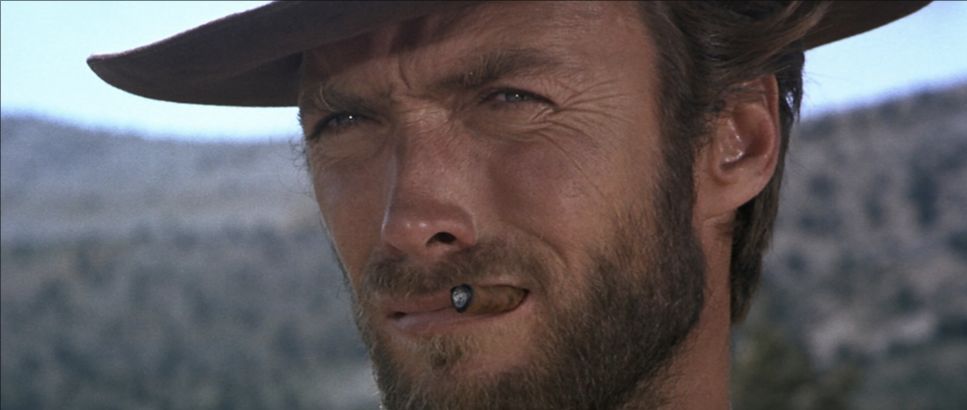
- Scale jumps. An extreme long shot of riders crossing a plain cuts straight to an extreme close-up of eyes filling the 2.35:1 frame. Nothing in between. The jump makes landscape and face equally monumental.
- Face in the foreground, world in the background. A head sits at one edge of the frame, huge, while a rider or a town stays sharp far behind. Short focal lengths and small apertures give deep focus from nose to horizon.
- Low angles and big skies. Gunmen are shot from hip height against pale sky, so they tower.
- The zoom. Italian westerns use the zoom shot freely, snapping in on a face or a gun to punctuate a beat.
- Hard sun. Almería light is overhead and unforgiving. Hard light under hat brims cuts faces into bright cheekbones and black eye sockets, which is exactly why the eyes are then shown in close-up.
- Time stretched to music. The three-way duel at the end of The Good, the Bad and the Ugly holds on the circling men, then cuts faster and tighter, eyes, hands, holsters, as Morricone's piece builds. The shot lengths shrink with the music.
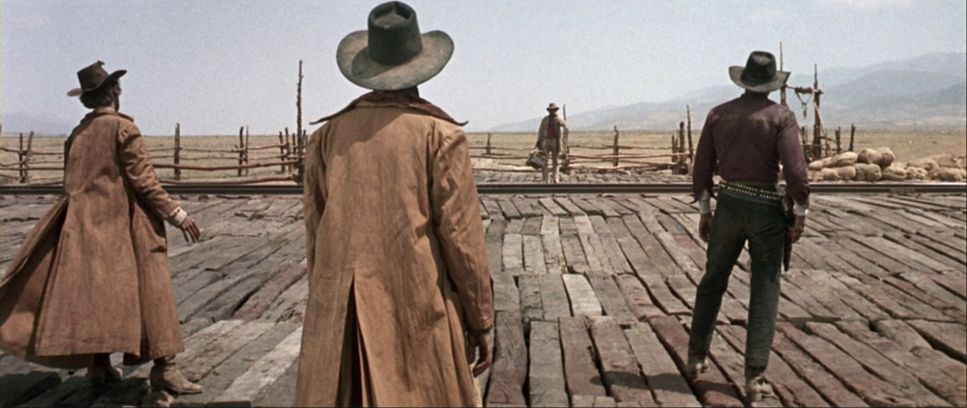
The opening of Once Upon a Time in the West is the textbook: three gunmen wait at a station for minutes of screen time with almost no dialogue, only a creaking windmill, dripping water and a buzzing fly.
How to shoot a spaghetti western scene today
You do not need Almería, but you do need the method.
- Aspect ratio. Frame for 2.39:1. A 2-perf or cropped sensor with spherical lenses matches the Techniscope feel better than heavy anamorphic flares.
- Two lens families. Wide primes (18–32mm on Super 35) placed 40–70 cm from a face for foreground heads with deep backgrounds; a long telephoto lens (200mm and up) for compressed riders swimming in heat haze.
- Stop down. f/8–f/11 in daylight keeps foreground and horizon sharp together. Use ND to control exposure, not a wide aperture.
- Shoot at midday. Put the sun high and slightly behind the actor, skip the fill or use only a weak bounce, and let the hat brim throw the eyes into shadow. Save golden hour for riders on the horizon.
- Texture the faces. Glycerin sweat, dust blown in with a leaf blower, cracked lips, three days of stubble. The extreme close-up only works if the skin has something to show.
- Block the duel as geometry. Two men on a line, or three on a triangle in a circular space; cover each with the same lens and angle so the cuts rhyme.
- Edit to a rhythm, not to dialogue. Hold a wide far longer than feels safe, then accelerate: 4 seconds, 2, 1, half a second on the eyes. Record music or a temp track first and cut to it.
- Build silence. Strip the soundtrack to wind, spurs and one repeating noise before the music enters.
Spaghetti western vs. classic Hollywood western
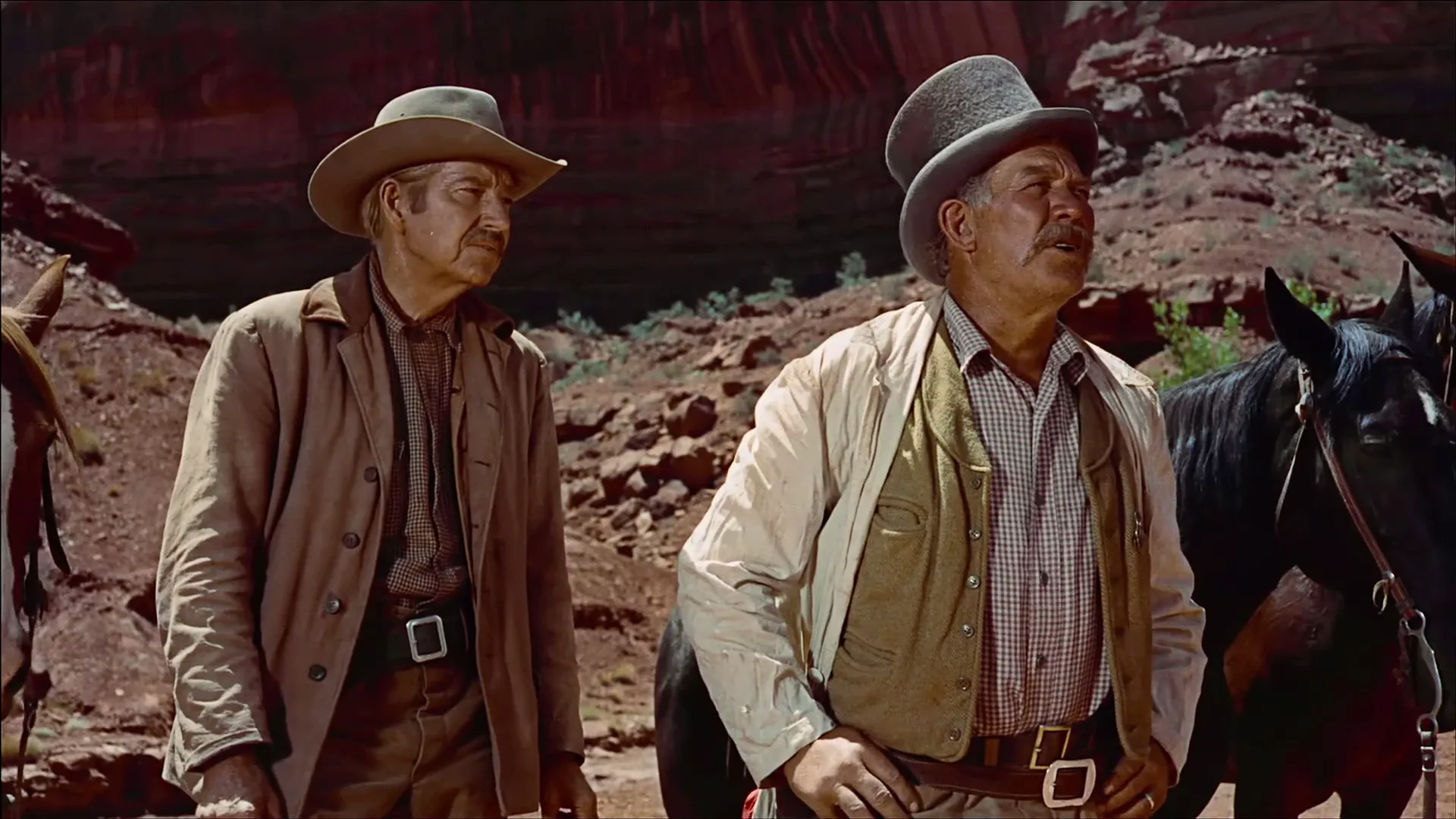
The classical American western of John Ford and Howard Hawks, The Searchers (1956) or Rio Bravo (1959), is built on community: towns to protect, a code of honor, a frontier being civilized. Its camera usually sits at eye level in medium and full shots, and violence is quick and relatively bloodless.
The Italian western keeps the setting and removes the faith. Towns are rackets, the law is for sale and heroes collect bounties.
| | Classic Hollywood western | Spaghetti western | |---|---|---| | Hero | Lawman, cavalry officer, settler | Bounty hunter, bandit, avenger | | Motive | Duty, family, civilization | Money, revenge | | Camera | Eye level, medium and full shots | Extreme wides cut to extreme close-ups | | Violence | Brief, mostly clean | Stylized, lingering, cruel | | Music | Folk songs, orchestral Americana | Whistles, guitar, voices, bells | | Landscape | Monument Valley, Utah, Arizona | Almería standing in for the Southwest and Mexico |
The traffic ran both ways. Leone borrowed from Ford and even filmed part of Once Upon a Time in the West in Monument Valley, while Sam Peckinpah's The Wild Bunch (1969) answered with American violence even bloodier than the Italians'. Clint Eastwood took the Man with No Name home, and his Unforgiven (1992) is dedicated "to Sergio and Don": Leone and Don Siegel.
Legacy: where the spaghetti western lives now
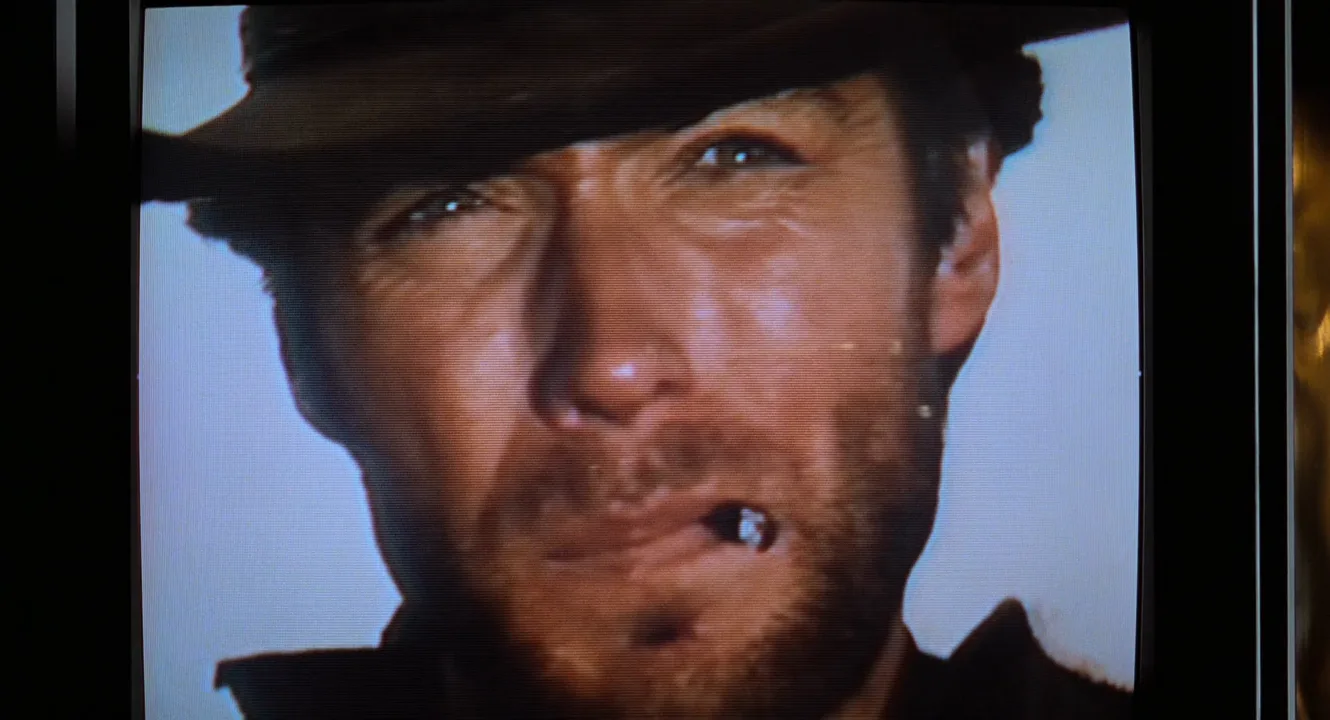
The cycle faded in the mid-1970s, but its grammar spread through popular filmmaking. Every staring contest cut in escalating close-ups, every stranger framed in a doorway against white sky, borrows from Leone. Quentin Tarantino made the debt explicit with Django Unchained (2012), which includes a cameo by Franco Nero, star of the original Django, and The Hateful Eight (2015), which earned Morricone his competitive Oscar. Takashi Miike turned the trade back toward Japan with Sukiyaki Western Django (2007), and Back to the Future Part II (1989) has Biff watching A Fistful of Dollars on television.
The modern neo-western (No Country for Old Men, True Grit, Hell or High Water) keeps the moral vacuum and the patient standoffs, even when the music is quieter. For a filmmaker the lesson is portable: time and scale are dramatic tools. A duel is not interesting because of who shoots first but because of how long you make the audience wait, and how big you make the eyes while they do.
Spaghetti Western examples in film
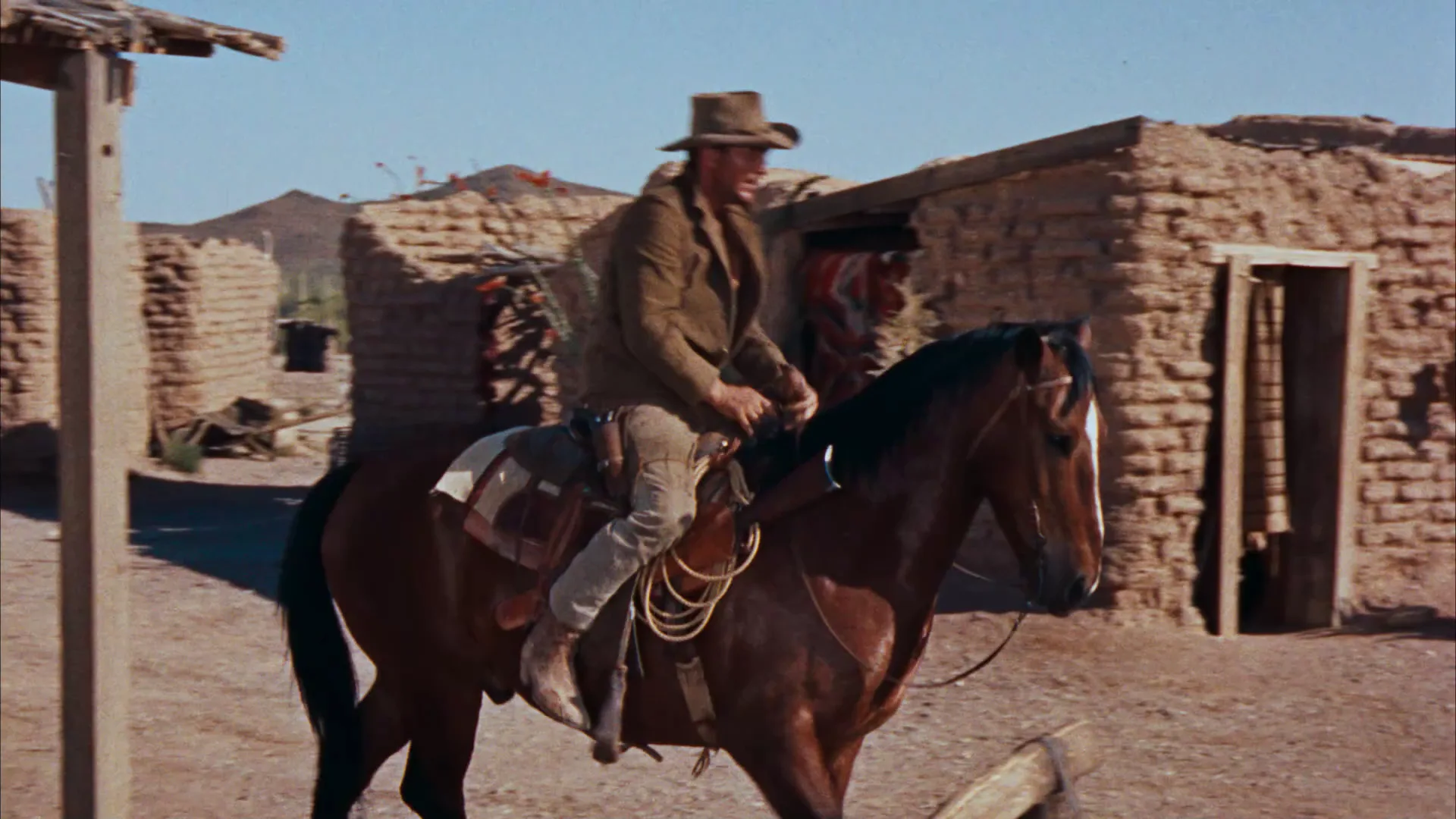
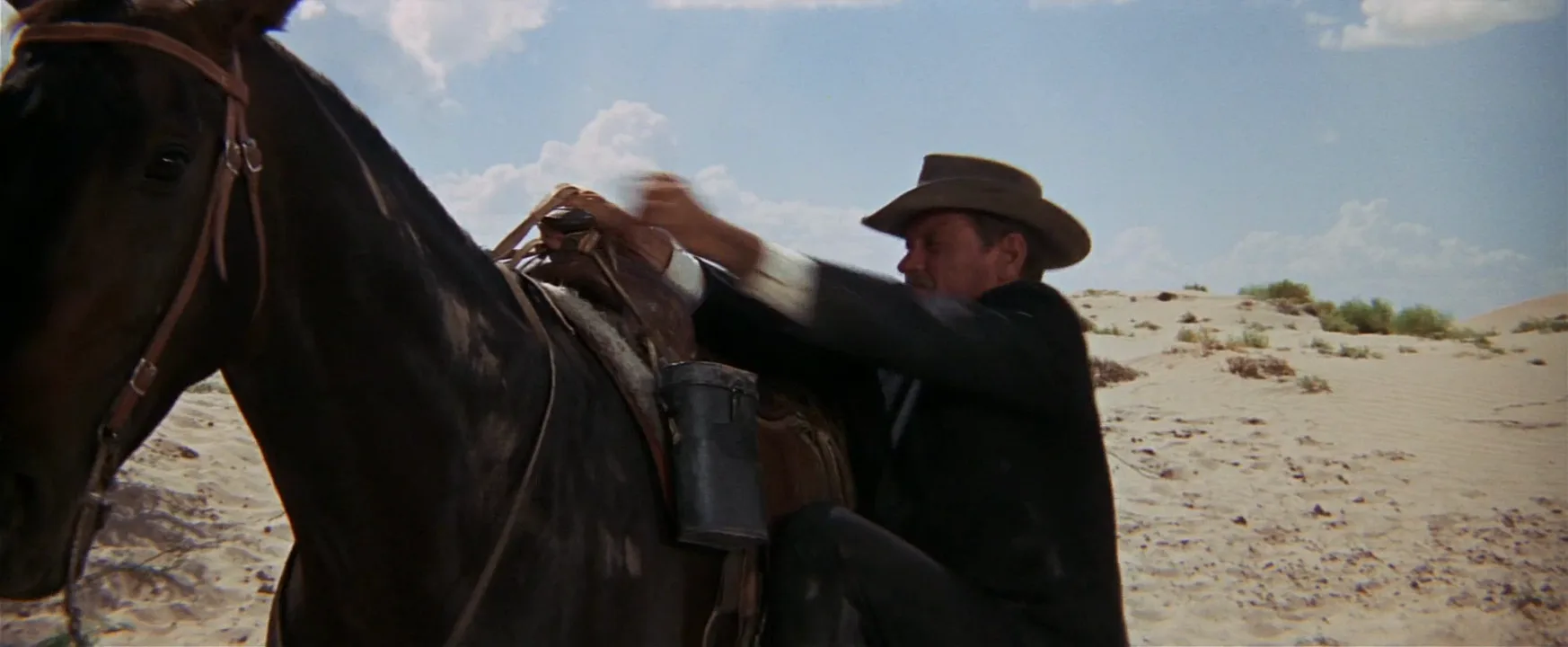
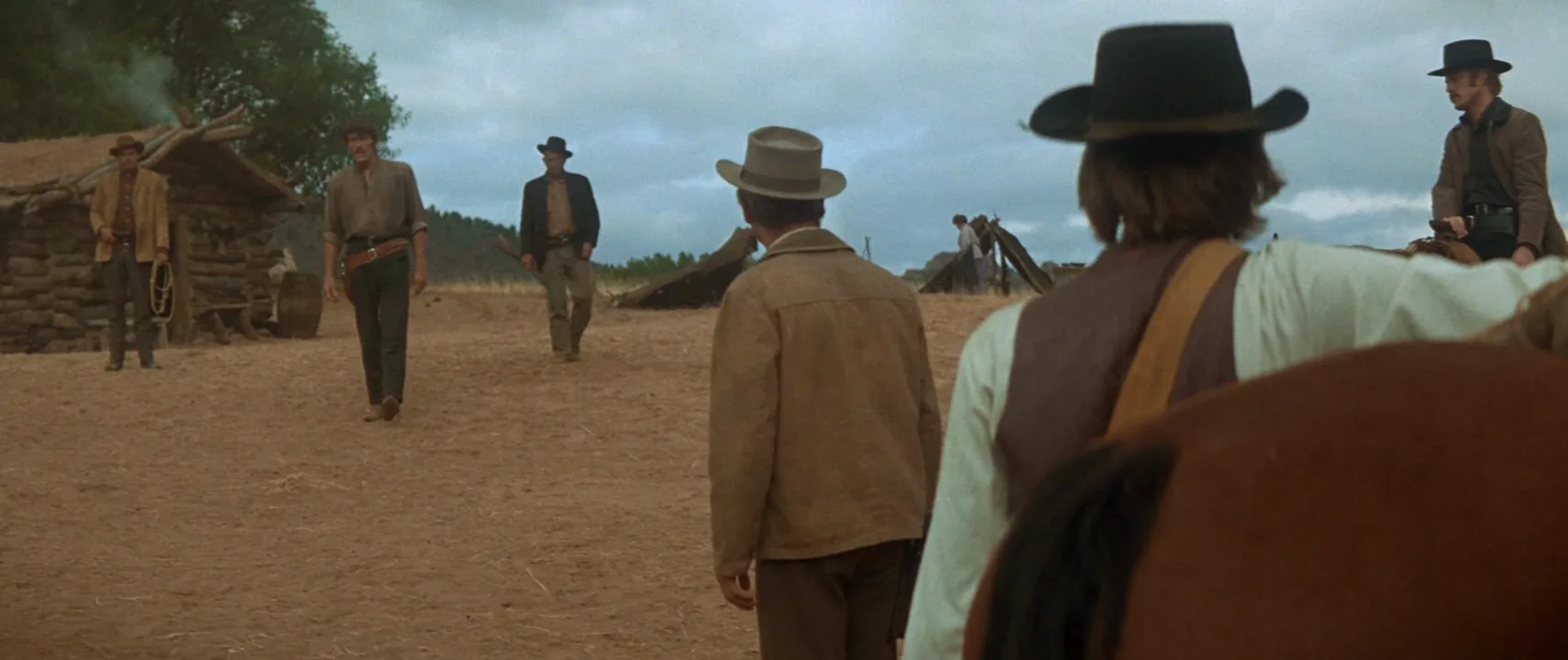
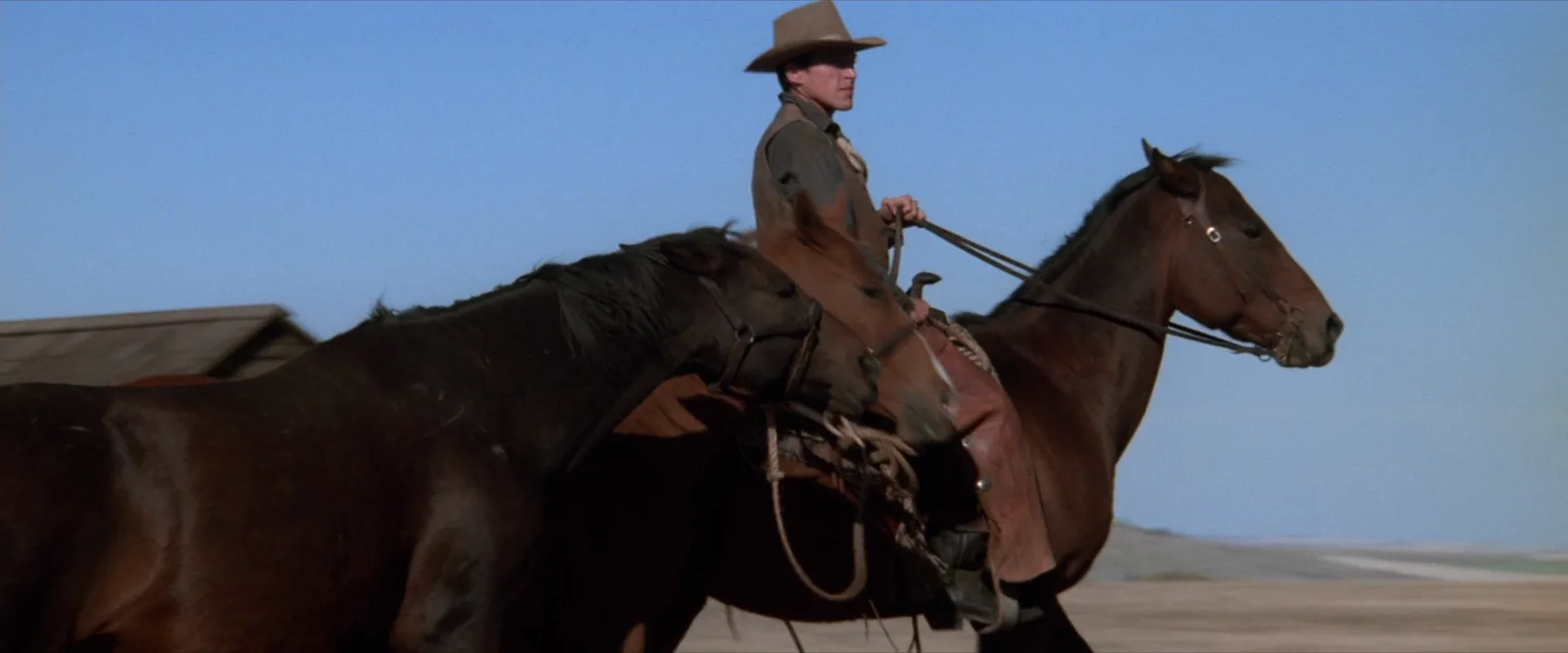
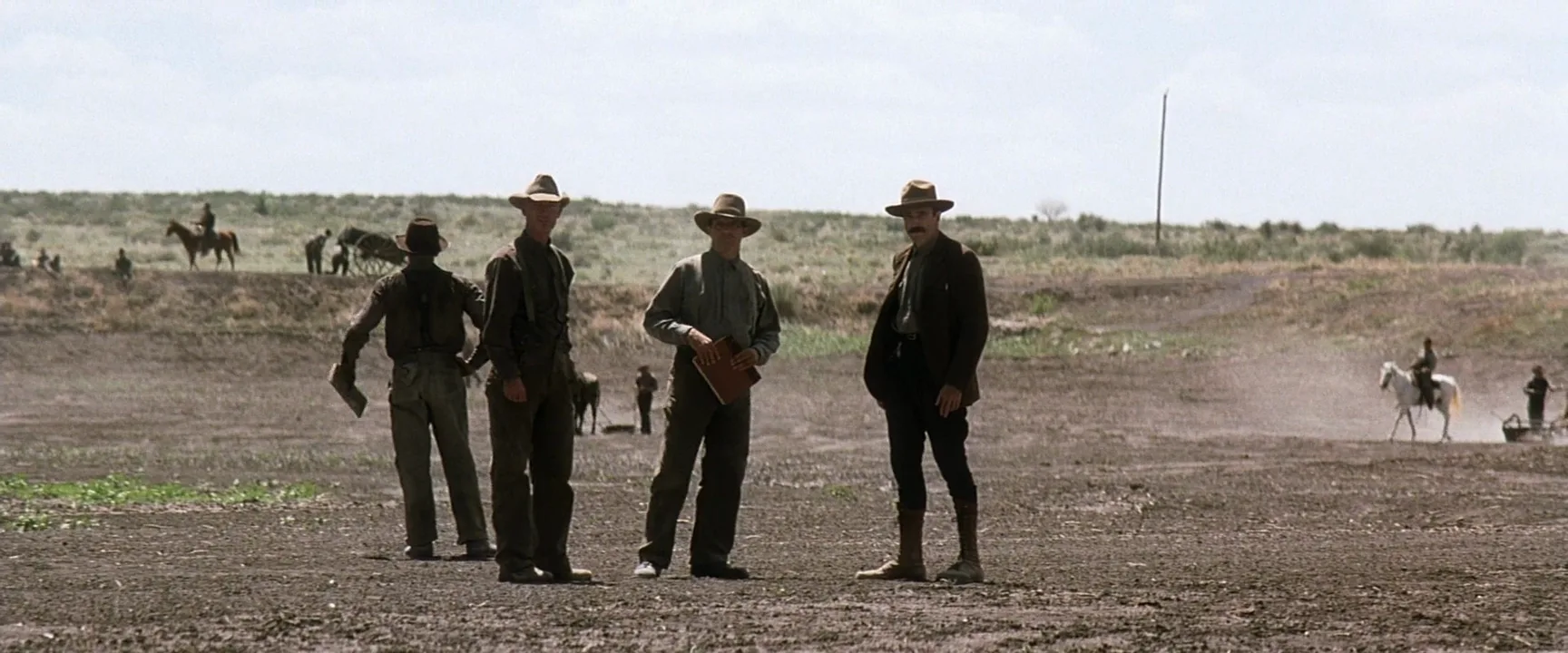
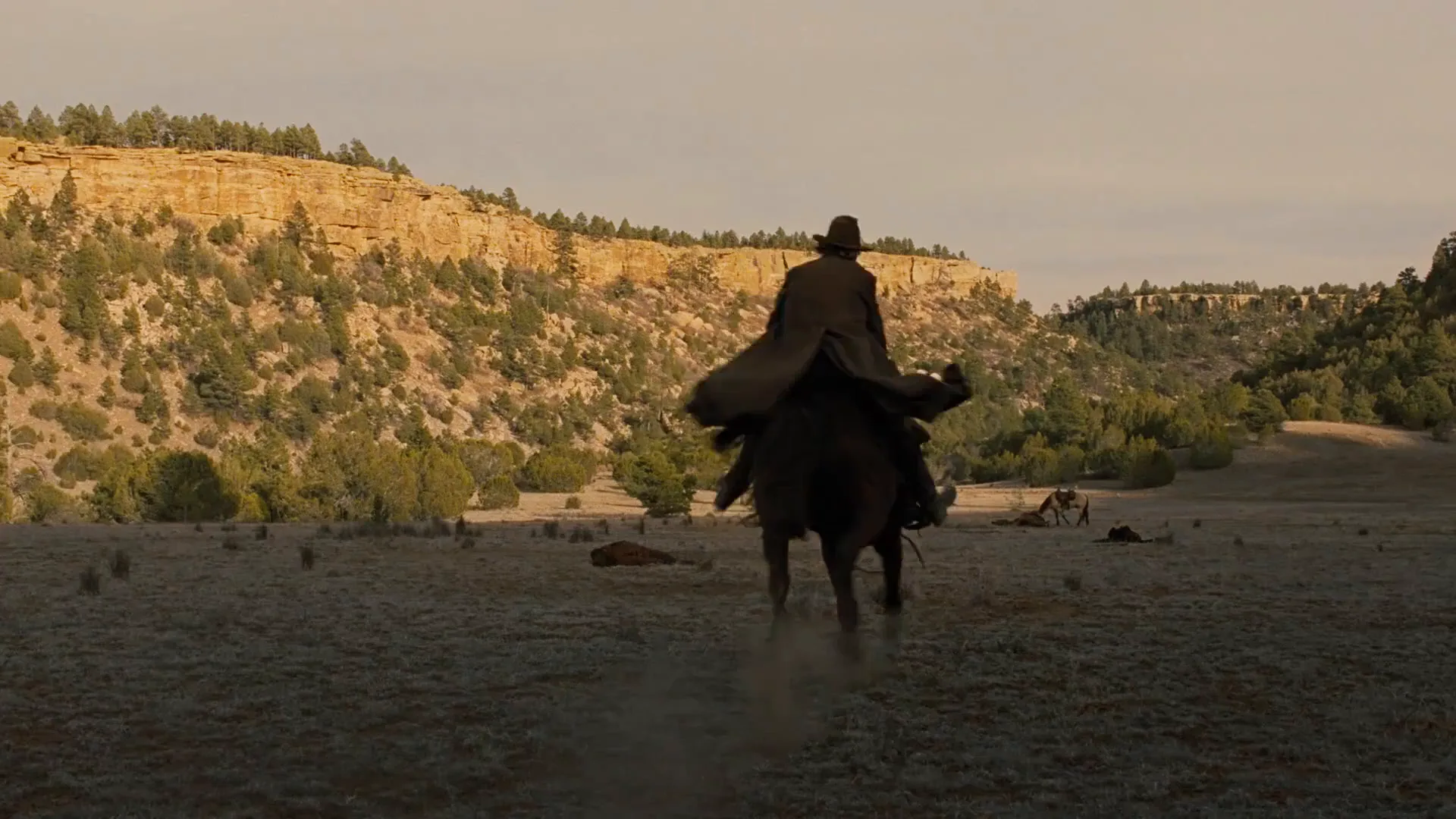
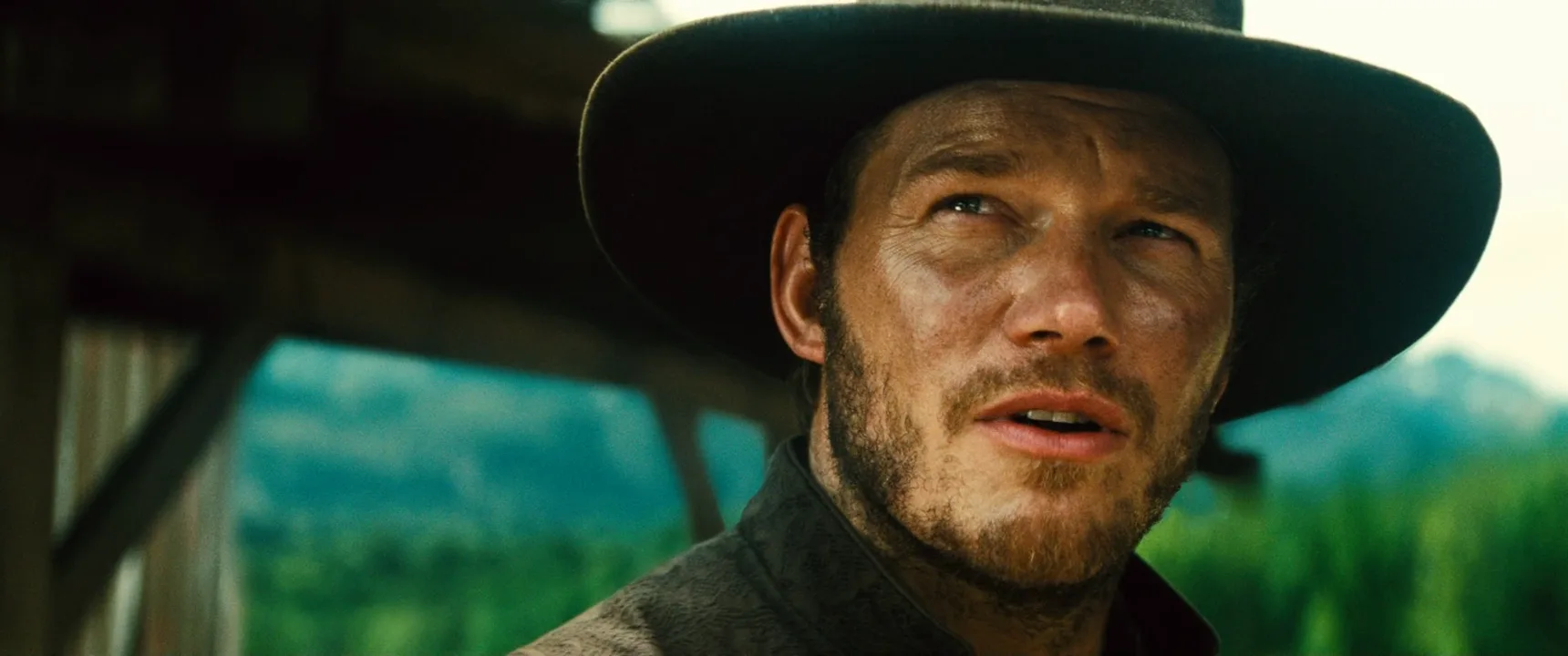
13 framesLeone frames first, then the American westerns the Italians answered and the films that absorbed the style. Watch the scale jumps: faces that fill a 2.35:1 frame, men reduced to dots on a plain.
How to create a spaghetti western with AI
4 promptsAn image model gives you "a cowboy" by default; to get the Italian western you have to name the grammar: 2.35:1, the scale (extreme close-up or extreme long shot, never in between), hard overhead sun and a face placed against a deep background. Build the start frame in Nano Banana 2 Lite, try a second composition with GPT Image 2.5, then animate the first frame with MiniMax H3 Max Turbo. On a FlashBoards board you can pin Leone reference frames next to your takes and compare them side by side. The fourth prompt re-shoots a real film shot from a text description alone, and the original plays next to the result so you can compare.
1960s Italian western, Techniscope 2.35:1 frame. Extreme close-up of a weathered gunslinger filling the left third of the frame: sun-creased olive skin, grey three-day stubble, a pale scar through his left eyebrow, pale green eyes squinting under a sweat-stained flat-brim hat. In deep focus far behind him, a lone rider on a dark horse crosses a white salt flat. Wide-angle lens 60 cm from his face, everything sharp from nose to horizon. Hard overhead noon sun, brim shadow across his eyes, dust in the air, bleached sky, ochre and bone-white palette, fine 35mm film grain.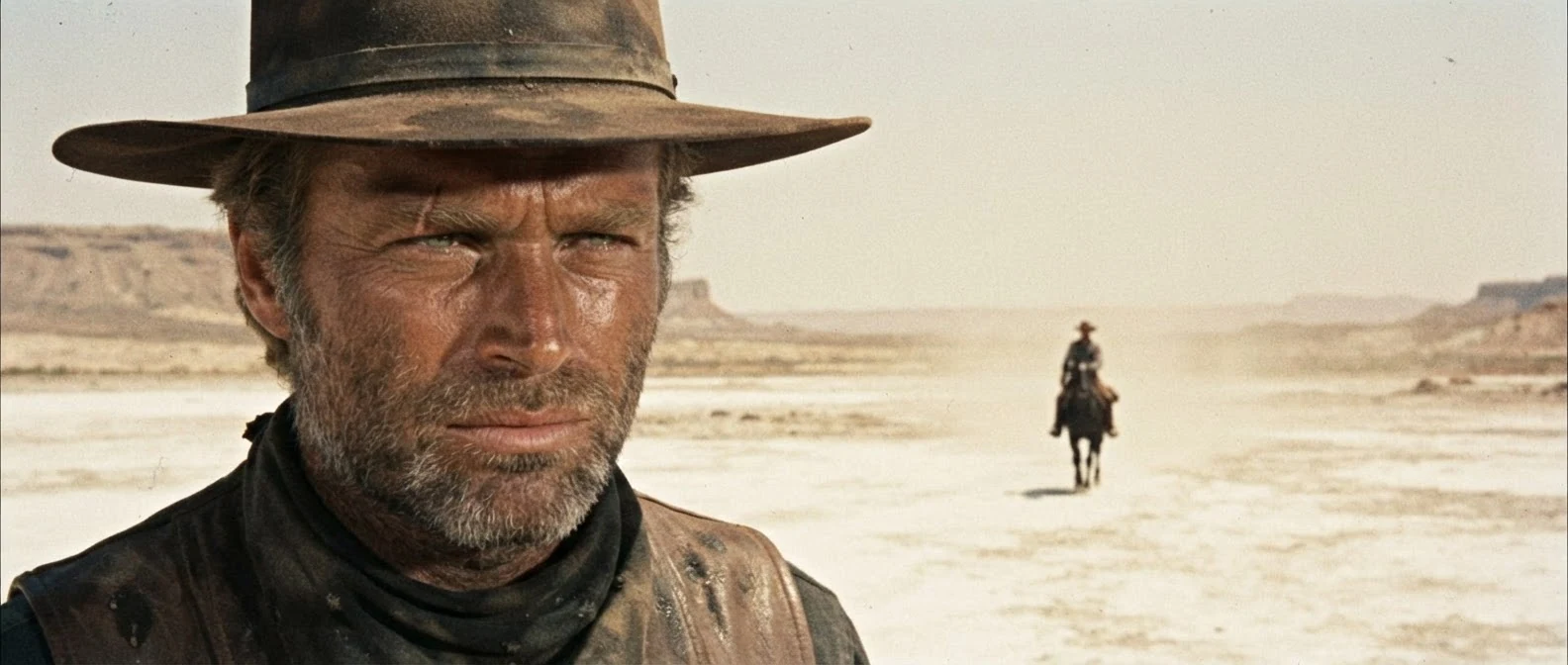
"Extreme close-up" plus "in deep focus far behind him" builds the Leone foreground-face composition; "wide-angle lens 60 cm from his face" and "sharp from nose to horizon" stop the model from blurring the rider away. "Hard overhead noon sun" and "brim shadow across his eyes" give the Almería light, and the scar and eye color keep him a specific, fictional character.
Open FlashBoardsExtreme long shot of a three-way standoff in a circular dirt courtyard of a ruined adobe mission, 1960s Italian western, 2.35:1. Camera high on a crane looking down about 30 degrees. Three gunfighters stand at equal distances on a triangle, hands near their holsters: a tall woman in a rust-brown duster with a long black braid, a heavy old man in a dirty white linen suit and straw hat, a thin young man in a striped red and grey poncho. Long hard shadows from a low afternoon sun, cracked adobe walls, dust drifting across the ground, faded ochre and sky-blue palette, 35mm grain.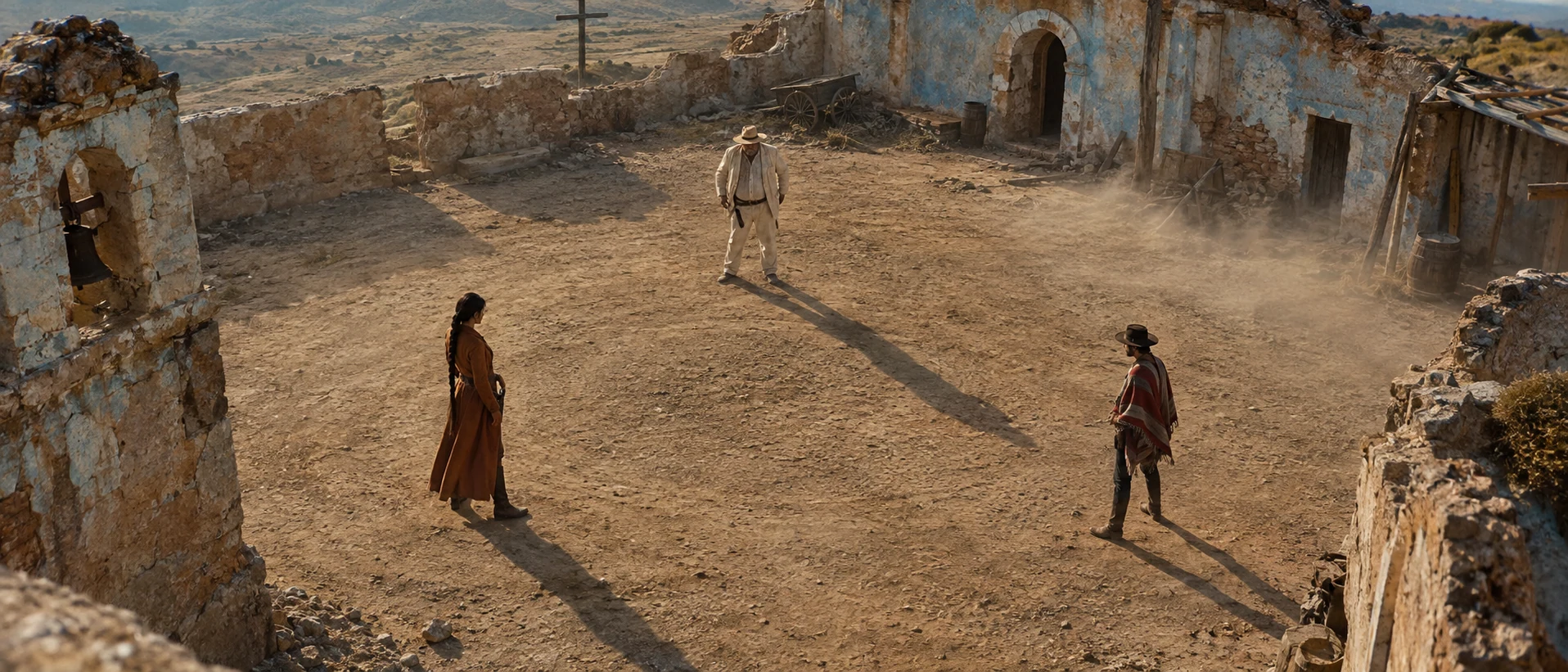
The second take flips the scale: instead of eyes, the whole arena. "Circular courtyard" and "equal distances on a triangle" give the duel its geometry, and "camera high on a crane looking down" lets the model show the layout. Three distinct costumes keep the figures readable at a tiny size.
Open FlashBoardsCamera: a very slow push-in toward the gunslinger's eyes that starts immediately and ends a little tighter on his face, with the rider still visible behind him. Action: The distant rider trots from left to right across the white salt flat, a thin trail of dust behind the horse. The gunslinger's eyes narrow and slide right to follow the rider while a bead of sweat runs down from his temple. Wind lifts the brim of his hat slightly and blows fine dust across the frame. At the end he blinks once, slowly, and his jaw tightens.The shot is alive from the first frame: the rider is already moving and the eyes already tracking, so the model does not just drift in on a still. "Very slow push-in" matches Leone's patient tension, and every action uses only what exists in recipe 1: rider, salt flat, sweat, hat brim, dust.
Open FlashBoards{
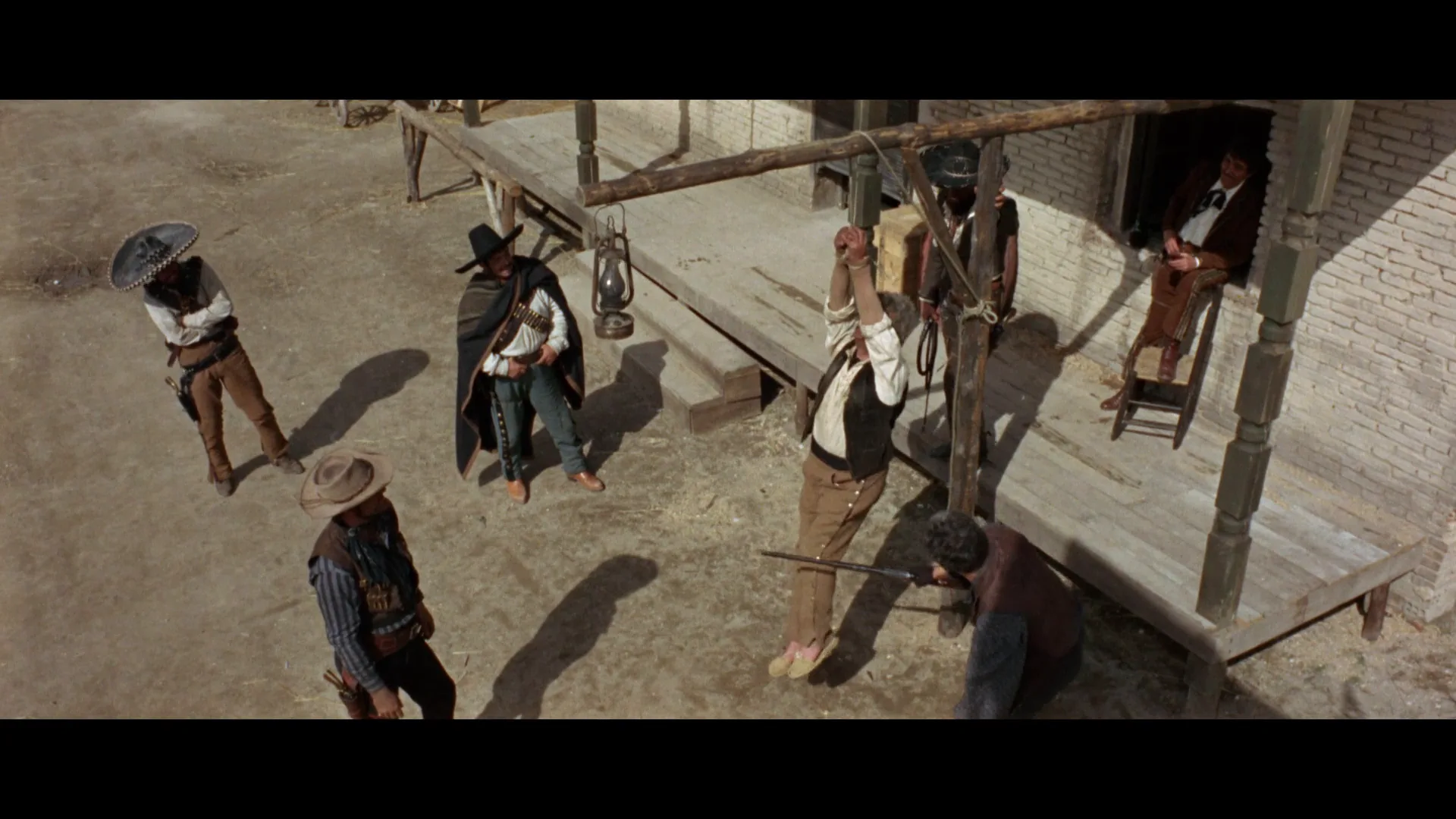
"output": "Full-screen live-action scene from A Fistful of Dollars (1964), from its very first frame: one single continuous shot with no cuts. 1960s Italian western on Techniscope 35mm, 2.35:1 scope frame, warm grainy color, hard low afternoon sun from behind the camera on the left throwing long black shadows diagonally up and to the right across a pale dusty street strewn with straw, in front of the raised wooden porch of a whitewashed brick building in a Mexican border town; bleached ochre, dust-brown and bone-white palette.",
"characters": {
"S1": {
"name": "Ram\u00f3n Rojo, played by Gian Maria Volont\u00e9",
"look": "stocky man with a black moustache and dark stubble, pale tan cowboy hat with a pinched crown, blue-and-grey striped long-sleeved shirt, dark brown leather vest with rows of cartridge loops, dark neckerchief, dark trousers, red-brown gun belt with a holstered revolver",
"voice": "calm, hard, mocking baritone"
},
"S2": {
"name": "Rubio, played by Benito Stefanelli",
"look": "lean man in his forties, bareheaded, thick dark hair going grey, stubble, blue-grey patterned shirt, dark reddish-brown vest, black trousers with a row of silver buttons down the outer seam",
"voice": "only a loud laugh, no words"
},
"S3": {
"name": "Silvanito, played by Jos\u00e9 Calvo",
"look": "heavy old man with grey curly hair and a grey moustache, white long-sleeved shirt, black vest, baggy tan trousers, rope-soled canvas sandals; his wrists are tied together with rope to a thick log beam above his head, so he hangs stretched with only his toes on the dirt",
"voice": "only pained grunts and breaths, no words"
}
},
"shots": [
{
"shot": 1,
"camera": "locked-off static camera high above the street, looking steeply down at about 45 degrees, wide shot of the whole group; the raised wooden porch runs diagonally from the top center of the frame to the lower right, wooden steps lead down from its left edge, a thick log beam runs along its front with an old oil lantern hanging from the beam's left end, a carved wooden corner post stands at the lower right; the framing never changes",
"action": [
"BEGINNING: alive from the first frame, the men spaced across the dirt like pieces on a board. S3 hangs from the beam in the center, slowly turning on the rope from facing the camera to showing his back. S2 stands just right of him, laughing at him with his mouth wide open, both hands open at his waist. S1 stands in the lower-left foreground facing right toward S2, a lever-action rifle hanging low in his screen-left hand, head bowed so the hat brim hides his face. Upper left, a gunman in a wide embroidered grey sombrero, white shirt and brown trousers stands still; left of center, a gunman in a black flat hat and a long dark cape over a white shirt and a cartridge bandolier stands still, hands at his belt; on the porch behind the beam's post, a gunman in a dark sombrero holds the loose end of the rope; upper right, a man in a brown suit, white shirt and black string tie sits tipped back on a wooden chair against the wall beside a dark doorway, watching.",
"THEN: S1 lifts the rifle in both hands to his waist and holds it level, looking down at it.",
"THEN: S1 swings the rifle and tosses it underhand with both hands to the right; it flies past S3's legs and S2 catches it with both hands. S1 drops his arms and sets both hands on his hips, facing S2.",
"THEN: S2 works the lever across his chest, then thrusts the muzzle into S3's stomach; S3 flinches and sways on the rope.",
"THEN: S2 bends down low at the lower right and aims along the barrel, the muzzle level with S3's knees, then slowly straightens, the muzzle creeping up S3's body to his ribs.",
"END: S2 stands up by the corner post and raises the rifle upright, muzzle to the sky, looking up at S3, who hangs with his back half turned to the camera; S1 keeps his hands on his hips, and the other gunmen and the seated man have not moved."
],
"dialogue": [
{
"speaker": "S1",
"on_screen": true,
"when": "from the first frame, while S2 is still laughing and before S1 lifts the rifle",
"delivery": "calm call across the street, head still bowed",
"line": "<d>[English] Rubio, here.</d>"
},
{
"speaker": "S1",
"on_screen": true,
"when": "while S2 is aiming low along the barrel, running on until the end of the shot",
"delivery": "dry, unhurried, mocking, hands on his hips",
"line": "<d>[English] Wouldn't like to ruin the rifle. I couldn't find another like it.</d>"
}
]
}
],
"sound": {
"ambience": "dry wind over the empty street, boots scuffing the dirt, the rope creaking on the beam, the metal click of the rifle lever, S2's laugh and S3's pained grunts",
"speech": "exactly these spoken phrases, each said once, in this order",
"never_spoken": "no narration and no voice-over: the descriptions, performance notes and step words of this prompt are never spoken aloud",
"music": "a film score under the scene, always below the voices: a slow, sparse twanging electric guitar over a low tolling bell and tense sustained strings",
"subtitles": "none"
}
}Remakes the high-angle street shot from A Fistful of Dollars (1964), dir. Sergio Leone, DP Massimo Dallamano: the prompt carries over the locked-off view down on the porch, Silvanito (José Calvo) strung from the beam, Ramón (Gian Maria Volonté) tossing his rifle to Rubio (Benito Stefanelli), and Ramón's two lines from that moment.
Locked-off static camera high above the street, looking steeply down is the original's own setup, and the men spaced across the dirt like pieces on a board names the Leone staging: the onlookers never move while two men carry out the cruelty. Every figure is pinned to a screen position, because left and right are what text-to-video gets wrong first. Ramón's two lines come verbatim from the film, and the score line keeps the model from leaving the scene silent.
Open FlashBoardsCommon mistakes
- The medium shot creep. Models default to a waist-up cowboy. Say "extreme close-up, eyes and hat brim fill the frame" or "extreme long shot, figures tiny"; the genre lives at the extremes.
- Soft backgrounds. Image models love shallow depth of field, which kills the foreground-face composition. Write "deep focus, sharp from nose to horizon" and name a wide-angle lens.
- Golden-hour everything. Without direction you get warm sunset glow. Ask for "hard overhead noon sun" and "bleached sky" for the Almería look; save warm light for horizon riders.
- Clean faces. Models return scrubbed, heroic faces. Add sweat, stubble, dust and sunburn explicitly.
- Lookalikes. "Man with No Name" or an actor's name steers toward a real person. Describe a fictional character by specific features and costume instead.
- Dead video. If the H3 clip only zooms slowly into a still, the prompt lacked motion in its first sentence; start with something already moving, such as a rider, dust or eyes.
Keep the reference frames, prompts and every generated take side by side — images and video in one canvas.
FAQ
6 questionsWhat is a spaghetti western?
A spaghetti western is a western made by Italian producers and directors, mostly between 1964 and the mid-1970s, often shot in southern Spain with international casts and dubbed dialogue. Sergio Leone's Dollars trilogy defined it: mercenary anti-heroes, stylized violence, Ennio Morricone's unconventional scores, and a visual style that cuts from vast desert wides to extreme close-ups of eyes.
Why is it called a spaghetti western?
The nickname came from critics who used it to mock Italian westerns as cheap foreign copies of the American genre. The films were Italian (hence the pasta), usually co-produced with Spain and West Germany. In Italy they were called western all'italiana. Over time the label lost its sting, and today "spaghetti western" is a neutral, even affectionate name for the whole cycle.
What was the first spaghetti western?
Italian and Spanish studios made westerns before 1964, so there is no single first film. The one that launched the boom is Sergio Leone's A Fistful of Dollars (1964), starring Clint Eastwood, a loose uncredited remake of Kurosawa's Yojimbo. Its international success led to hundreds of Italian westerns over the next decade, including Leone's own sequels and Sergio Corbucci's Django (1966).
What are the best spaghetti westerns to watch?
Start with Sergio Leone: A Fistful of Dollars (1964), For a Few Dollars More (1965), The Good, the Bad and the Ugly (1966), Once Upon a Time in the West (1968) and Duck, You Sucker (1971). Then widen out to Sergio Corbucci's Django (1966) and The Great Silence (1968), Sergio Sollima's The Big Gundown (1967) and Damiano Damiani's A Bullet for the General (1966).
What is Sergio Leone's cinematography style?
Leone shot in wide 2.35:1 frames and jumped between extremes: tiny riders in huge landscapes and faces so close the eyes fill the screen. He placed heads in the foreground against sharp, deep backgrounds, used low angles, zooms and hard midday sun, and stretched duels with long silent holds before cutting faster and tighter to Morricone's music.
Is Django Unchained a spaghetti western?
Not strictly. Django Unchained (2012) is an American film by Quentin Tarantino, set in the antebellum South. It is a deliberate homage to the Italian cycle: it borrows its title from Corbucci's Django (1966), uses Italian western music, features a cameo by original Django star Franco Nero, and adopts the genre's revenge plot, zooms and operatic violence.
Related terms
7- Extreme Close-UpCamera Shots
An extreme close-up isolates a tiny part of a subject — an eye, lips, a finger on a trigger, a watch face — so a single detail fills the frame and takes on enormous weight.
- Extreme Long ShotCamera Shots
An extreme long shot shows a vast space in which people are tiny or absent — landscapes, cityscapes, battlefields — so environment, scale and isolation matter more than any character.
- Film ScoreSound & Music
A film score is original music written by a composer for a specific film, timed to picture to shape emotion, pace and theme; it differs from a soundtrack of pre-existing songs.
- Anti-HeroStorytelling
An anti-hero is a protagonist who lacks conventional heroic qualities — selfish, cynical or morally compromised — yet still carries the story and the audience's attention.
- CinemaScopeFormats & Exhibition
CinemaScope was 20th Century Fox's anamorphic widescreen system, launched with The Robe (1953): a lens squeezed a wide image onto 35mm film and the projector lens unsqueezed it to about 2.35:1.
- Telephoto LensLenses, Focus & Exposure
A telephoto (long) lens has a narrow angle of view that magnifies distant subjects; used from far away it compresses space, stacking the background onto the subject — the look of long-lens crowd shots, heat-haze chases and isolated faces.
- Film GenresGenres
A film genre is a category of films that share recognizable conventions of story, setting, character and style — western, horror, musical, noir — letting audiences know what to expect and filmmakers play with it.
Further reading
Christopher Frayling, Spaghetti Westerns: Cowboys and Europeans from Karl May to Sergio Leone (1981). Christopher Frayling, Sergio Leone: Something to Do with Death (2000).